
CON-250 · Lesson 9 of 12 · 31 min
Mass haul and earthwork balancing
Knowing how much cut and fill a project contains is only half of the earthwork problem. The other half is where the material goes. Cut from one end of a road might build the embankment at the other end, two kilometres away; surplus from a building excavation might be wasted off site at a tipping fee; a shortfall might have to be imported from a borrow pit. Each choice has a cost, and haul distance drives much of it. The mass haul diagram is the classic tool for planning earthwork movement along a linear project, and the same thinking applies to balancing a building site. This lesson shows how to adjust cut and fill to a common basis, build a mass diagram, read balance points and haul distances, and decide between hauling, borrowing and wasting.
Putting cut and fill on the same basis
Cut is measured in bank volume. Fill is measured in compacted volume. To balance them, both must be expressed in the same units. The usual approach is to convert fill into the bank volume needed to make it, by dividing by (1 − shrinkage). Some engineers instead multiply cut by a shrinkage factor to get its compacted equivalent; either works as long as it is consistent. Rock, which bulks rather than shrinks, is handled with its own factor.
Other adjustments may be needed: unsuitable material in the cut that cannot be used in fill (such as topsoil, organic soil or wet clay) is subtracted from the usable cut; material needed for other purposes, such as backfill or landscaping berms, is set aside; and the volume of pavement structure, imported granular base and topsoil replacement is accounted for in the design surfaces.
Worked problem
Adjusting fill to bank volume
Between two stations the cut is 410 BCM and the fill is 210 CCM. The soil has 15 per cent shrinkage. What is the net volume in bank cubic metres?
Show solution
- Bank equivalent of the fill = 210 ÷ 0.85 = 247 BCM.
- Net = 410 − 247 = +163 BCM.
- Positive means surplus cut that can be moved forward to fill elsewhere.
Answer: +163 BCM of surplus.
The mass ordinate
The mass ordinate at any station is the running total of cut minus adjusted fill from the start of the project to that station. Starting at zero, add each interval's cut and subtract its adjusted fill. A rising mass ordinate means the project is in cut; a falling ordinate means it is in fill.
| Station | Cut (BCM) | Fill (CCM) | Adjusted fill (BCM) | Net | Mass ordinate |
|---|---|---|---|---|---|
| 0+000 | 0 | ||||
| 0+050 | 640 | 0 | 0 | +640 | 640 |
| 0+100 | 880 | 0 | 0 | +880 | 1,520 |
| 0+150 | 720 | 30 | 35 | +685 | 2,205 |
| 0+200 | 410 | 210 | 247 | +163 | 2,368 |
| 0+250 | 90 | 540 | 635 | −545 | 1,823 |
| 0+300 | 0 | 860 | 1,012 | −1,012 | 811 |
| 0+350 | 0 | 940 | 1,106 | −1,106 | −295 |
| 0+400 | 0 | 610 | 718 | −718 | −1,013 |
| 0+450 | 150 | 180 | 212 | −62 | −1,075 |
| 0+500 | 520 | 0 | 0 | +520 | −555 |
| 0+550 | 700 | 0 | 0 | +700 | +145 |
The mass diagram
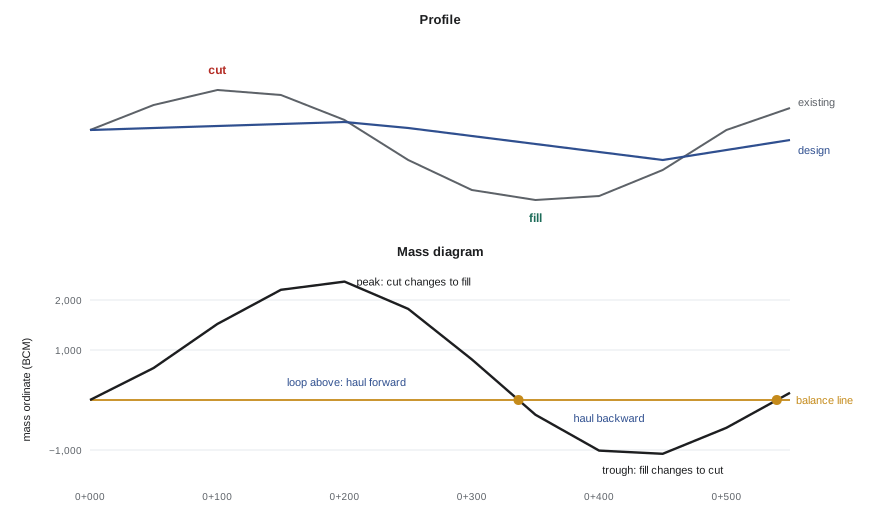
Plotting the mass ordinate against station gives the mass diagram, usually drawn directly below the profile so the two can be read together. The diagram has a few properties that make it powerful.
- Rising segments correspond to cut; falling segments to fill.
- A maximum point marks a change from cut to fill; a minimum point marks a change from fill to cut. These are the grade points on the profile where cut and fill meet.
- Any horizontal line drawn across the diagram is a balance line. Where it intersects the diagram, the stations between consecutive intersections have equal cut and fill: the material in one part of that loop exactly fills the other part.
- The vertical distance from the balance line to the peak or trough of a loop is the volume moved within that loop.
- A loop above the balance line means material moves forward (in the direction of increasing stations); a loop below means it moves backward.
- The difference between the mass ordinate at the end and the balance line is the surplus to waste (if positive) or the shortfall to borrow (if negative).
Worked problem
Reading the mass diagram
Using the table, find the balance points on the zero balance line and describe the earth movement.
Show solution
- The mass ordinate crosses zero between 0+300 (811) and 0+350 (−295): 811 ÷ (811 + 295) × 50 = 36.7 m, so at about 0+337.
- It crosses again between 0+500 (−555) and 0+550 (+145): 555 ÷ 700 × 50 = 39.6 m, so at about 0+540.
- From 0+000 to 0+337, cut at the start fills the embankment ahead: a loop above the line, peak 2,368 BCM, moving material forward.
- From 0+337 to 0+540, the fill around 0+350 to 0+450 is supplied by cut from 0+450 to 0+540, hauled backward: a loop below the line, 1,075 BCM.
- At 0+550 the ordinate is +145, so 145 BCM is surplus to be wasted or used elsewhere.
Answer: Balance points near 0+337 and 0+540; 2,368 BCM moved forward, 1,075 BCM moved backward and 145 BCM surplus.
Average haul distance
The cost of moving earth depends on how far it travels. The average haul distance in a loop is the distance between the centre of mass of the cut and the centre of mass of the fill it supplies. On the mass diagram, it equals the area of the loop (between the diagram and the balance line) divided by the volume moved (the height of the loop). In practice, software computes it, but a quick estimate is the horizontal width of the loop at half its height.
Worked problem
Estimating average haul
A loop on a mass diagram has a height of 2,400 BCM and its width at half height (1,200 BCM) is 260 m. Estimate the average haul and the total haul effort.
Show solution
- Average haul ≈ width at half height = 260 m.
- Haul effort ≈ 2,400 × 260 = 624,000 m³·m, or 624 m³·km.
- This effort, not just the volume, drives the equipment and cost.
Answer: About 260 m average haul; about 624 m³·km of haul.
Freehaul and overhaul
Many unit-price contracts pay excavation at a single rate that includes hauling up to a stated distance, the freehaul distance. Material hauled further earns an additional payment for overhaul, measured as volume times the distance beyond the freehaul. Overhaul is common on highway contracts, and less common on private site work, where hauling is usually included in the unit rates. Whether or not overhaul is paid separately, the contractor's costs rise with distance, so the concept matters to every estimate.
Canadian specifications measure overhaul in units such as cubic metre-kilometres (one cubic metre moved one kilometre beyond freehaul) or cubic metre-stations, depending on the agency.
Worked problem
Overhaul payment
A loop moves 3,000 BCM with an average haul of 650 m. Freehaul is 300 m and overhaul is paid at $4.00 per m³·km. What is the overhaul quantity and payment?
Show solution
- Overhaul distance = 650 − 300 = 350 m = 0.35 km.
- Overhaul = 3,000 × 0.35 = 1,050 m³·km.
- Payment = 1,050 × $4.00 = $4,200.
Answer: 1,050 m³·km, paid $4,200.
Borrow, waste and the economic haul limit
Balancing cut and fill is not always the cheapest solution. If cut must travel a long way to reach a fill, it may cost less to waste the cut nearby and import borrow close to the fill. The economic haul limit is the distance beyond which it is cheaper to waste and borrow than to haul.
Adding the freehaul distance gives the limit of economic haul. On the mass diagram, the engineer can move the balance line up or down, or use several balance lines, so that no loop is wider than the economic haul limit. Material outside those loops is wasted or borrowed.
Worked problem
Economic haul limit
Borrow costs $6.00 per BCM delivered to the fill, wasting surplus costs $2.00 per BCM, and overhaul costs $4.00 per m³·km. Freehaul is 300 m. What is the limit of economic haul?
Show solution
- Economic overhaul distance = (6.00 + 2.00) ÷ 4.00 = 2.0 km.
- Limit of economic haul = 0.3 + 2.0 = 2.3 km.
- Beyond about 2.3 km, waste the cut and borrow near the fill instead.
Answer: About 2.3 km.
Real decisions also consider the quality of the material (cut may be unsuitable for fill), the schedule (borrow may allow two fronts to work at once), haul road conditions, environmental approvals for borrow pits and waste sites, truck traffic through neighbourhoods, and the cost and availability of disposal sites for surplus soil, which is often regulated.
Excess soil regulation
Moving soil off a site is increasingly regulated. In Ontario, the On-Site and Excess Soil Management Regulation (O. Reg. 406/19) requires many projects to characterize excess soil, plan where it goes, track loads and use registered receiving sites, with requirements phased in over several years. Other provinces have similar rules for contaminated or excess soil. These rules can change the economics of a project significantly, favouring designs and grading plans that balance on site.
For building projects the mass diagram is rarely drawn, but the same thinking applies: estimate the cut, the fill and the unsuitable material; decide what can be reused on site and where it will be stockpiled; and price off-site disposal and imported fill realistically. A site that balances, with reuse of excavated material for landscaping and berms, can save substantial trucking cost and community disruption.
Planning the earthwork operation
The mass diagram also helps plan the sequence and the equipment. Short hauls within a loop are suited to dozers (up to about 100 metres) and to loaders and scrapers for middle distances. Long hauls suit trucks. Loops in different directions may run with different crews at the same time. Borrow and waste sites need haul roads, and the haul road grades and surfaces affect cycle times, which are covered in Lesson 11.
| Typical haul distance | Suitable equipment |
|---|---|
| Up to about 100 m | Dozers pushing material |
| About 100 to 1,500 m | Wheel tractor-scrapers, or excavators and articulated trucks |
| About 1,000 m and beyond | Articulated or rigid haul trucks, or highway trucks on public roads |
| Any, on public roads | Highway dump trucks loaded by excavators or loaders |
Finally, earthwork plans change. Weather, unexpected unsuitable material, rock and design revisions all upset the original balance. A good practice is to update the earthwork quantities and mass diagram monthly from progress surveys, so that the team knows whether the site is trending towards surplus or shortfall, and can adjust borrow, waste and equipment before it becomes expensive.
Common mistakes
MistakeBalancing bank cut against compacted fill directly.
InsteadConvert fill to bank equivalent (or cut to compacted) before computing mass ordinates.
MistakeCounting unsuitable material as usable cut.
InsteadSubtract topsoil, organics and wet or contaminated material from the cut available for fill.
MistakeReading the height of the diagram as haul distance.
InsteadVertical distance on the mass diagram is volume; horizontal distance is haul length.
MistakeAssuming that a balanced design is always cheapest.
InsteadCompare the cost of long hauls with the cost of borrow plus waste using the economic haul limit.
MistakeIgnoring excess soil rules when pricing disposal.
InsteadCheck the regulations and the receiving site requirements, and price testing and tracking.
MistakeNever updating the earthwork plan.
InsteadUpdate quantities and the mass diagram from progress surveys so shortfalls or surpluses are caught early.
Summary and key terms
- Express cut and fill on the same basis, usually bank volume, by dividing compacted fill by (1 − shrinkage).
- The mass ordinate is the running total of cut minus adjusted fill along the alignment.
- Rising mass diagram = cut; falling = fill; peaks and troughs are cut-fill transitions.
- A horizontal balance line crosses the diagram at balance points with equal cut and fill between them.
- Average haul is the loop area divided by its height; volume times distance drives cost.
- Overhaul = volume × (average haul − freehaul).
- Beyond the economic haul limit, waste and borrow are cheaper than hauling.
- Mass ordinate
- The cumulative sum of cut minus adjusted fill from the start of an alignment.
- Mass diagram
- A plot of mass ordinates against station.
- Balance line
- A horizontal line on the mass diagram along which cut and fill are balanced.
- Balance point
- A station where the mass diagram crosses a balance line.
- Average haul
- The distance between the centres of mass of a cut and the fill it supplies.
- Freehaul
- The haul distance included in the excavation unit price.
- Overhaul
- Hauling beyond the freehaul distance, measured as volume times distance.
- Borrow
- Material imported from outside the project limits to make up a shortfall.
- Waste
- Surplus or unsuitable material disposed of outside the project.
- Economic haul limit
- The haul distance beyond which waste and borrow cost less than hauling.
Practice problems
Work each problem on paper first, then reveal the answer to check.
An interval has 500 BCM of cut and 400 CCM of fill with 20 per cent shrinkage. What is the net?
Show answer
Fill = 400 ÷ 0.8 = 500 BCM; net = 0.
On a mass diagram, what does a falling segment indicate?
Show answer
Fill: the cumulative volume is decreasing as fill is placed.
What is shown by the vertical distance from a balance line to the top of a loop?
Show answer
The volume of material moved within that loop.
A loop lies below the balance line. Which way does the material move?
Show answer
Backward, toward decreasing stations.
The mass ordinate at the end of a project is −800 BCM on the zero balance line. What does this mean?
Show answer
There is a shortfall of 800 BCM that must be borrowed.
2,000 BCM are hauled an average of 900 m with 300 m freehaul. What is the overhaul?
Show answer
2,000 × 0.6 km = 1,200 m³·km.
Borrow costs $5.00/BCM, waste $1.00/BCM and overhaul $3.00 per m³·km. What is the economic overhaul distance?
Show answer
(5 + 1) ÷ 3 = 2.0 km.
Give two reasons other than cost to choose borrow over a long haul.
Show answer
Cut is unsuitable, schedule, haul road conditions, traffic impacts, environmental approvals.
Lesson quiz · 5 questions
Score 60% or more to complete this lesson.
Create a free account to save your progress, take quizzes and earn a certificate.