
CON-305 · Lesson 11 of 12 · 27 min
Professional conduct, legal duties and ethics
Supervisors hold a position of trust. Workers trust them to keep the site safe and treat them fairly; employers trust them to protect the company's interests honestly; owners trust them to build what was specified; inspectors and the public trust them to follow the law. This lesson looks at what professional conduct means for a site supervisor, the supervisor's legal duties, especially for safety, the ethical issues supervisors meet most often, and the rules on harassment and impairment. CON-355 and HSE-402 cover supervisor safety duties and due diligence in depth, HSE-108 covers harassment and violence prevention and CON-365 covers employment and labour law.
What professional conduct means
Construction supervisors are not licensed professionals in the way engineers and architects are, but the job carries professional obligations. Industry bodies have codes of conduct that describe them.
In Canada, the Canadian Construction Association's Gold Seal Certification program certifies superintendents, project managers, estimators and other construction managers based on experience, education and examination, and certified people agree to follow a code of ethics. Provincial construction associations and many owners also publish codes of conduct for contractors.
Across these codes the themes are consistent: protect the health and safety of workers and the public; be honest in all dealings and records; avoid conflicts of interest; treat people with respect and without discrimination; comply with the law; keep confidential information confidential; and work within your competence, asking for help when needed. These are not abstract ideals. Each corresponds to situations supervisors meet regularly.
Honesty in records and reporting
Supervisors produce and sign many records: daily reports, timesheets, time and material tickets, inspection checklists, test reports, incident reports, toolbox talk attendance and quantities for progress claims. Every one of them must be accurate. Pressure to shade the truth is common: to record a pour as on schedule when it slipped, to sign a time and material ticket for hours not worked as a favour to a subcontractor, to tick an inspection item that was not checked, to describe an injury as minor to protect the site's record, or to backdate a toolbox talk.
Falsified records can have serious consequences. They can hide hazards that later injure someone, mislead owners into paying for work not done, destroy the contractor's credibility in a dispute when the falsification comes to light (CON-420), and expose the supervisor and the company to discipline, civil liability and in some cases criminal charges for fraud or for obstructing a safety investigation. Under-reporting injuries can also breach workers' compensation and occupational health and safety reporting requirements. The rule is simple: record what actually happened, and if a record is wrong, correct it openly with a dated note rather than altering it.
Gifts, favours and conflicts of interest
Supervisors control things of value: work assignments, schedules, sign-offs, recommendations for future work. That makes them targets for gifts and favours. A subcontractor may offer hockey tickets, a supplier may offer a fishing trip, a vendor may offer to do work on the supervisor's house at a discount. Some small courtesies, such as coffee or a modest holiday gift, are normal and allowed by many company policies. Larger gifts, cash, personal work and anything offered while a decision is pending create a conflict of interest, or the appearance of one, and may be prohibited.
Corrupt payments are also crimes. Canada's Criminal Code prohibits secret commissions, which include giving or accepting a benefit as a reward for doing or not doing something in relation to an employer's affairs without the employer's knowledge. Quebec's Charbonneau Commission, which reported in 2015, documented collusion and corruption in the province's construction industry and led to reforms in public contracting, and public owners across Canada now require integrity declarations from bidders.
The practical test is transparency. Would you be comfortable if your manager, the owner and the other bidders knew about the gift? If not, decline it politely or report it under your company's policy. When a personal relationship creates a conflict, such as a relative owning one of the subcontractors, disclose it and let someone else make the decisions involving that firm.
Supervisors' legal duties for safety
Occupational health and safety law places specific duties on supervisors, not just on employers. The figure summarizes the main elements in each country.
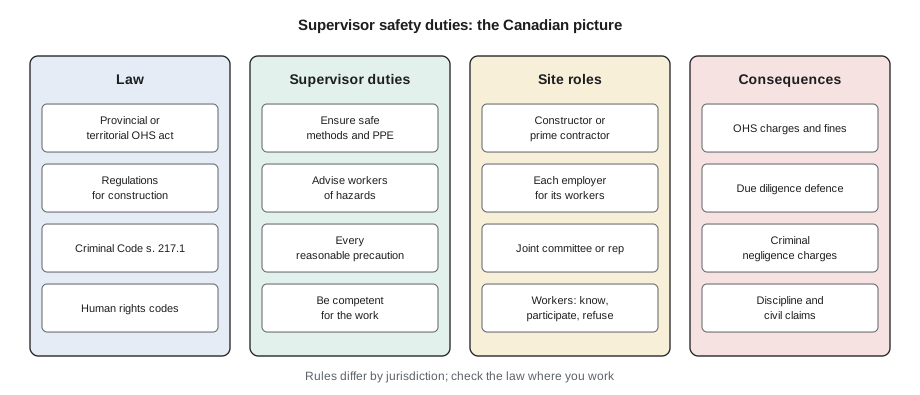
In Canada, every province and territory has an occupational health and safety act that defines a supervisor, typically someone who has charge of a workplace or authority over a worker, and sets out supervisor duties. Typical duties include ensuring that workers work in the manner and with the protective equipment and procedures the law requires, advising workers of known hazards, providing written instructions where required and taking every precaution reasonable in the circumstances to protect workers. Ontario's Occupational Health and Safety Act and British Columbia's Workers Compensation Act both list supervisor duties expressly, and several jurisdictions require supervisors to be competent: qualified by knowledge, training and experience, familiar with the law and aware of hazards. On construction projects, the constructor (Ontario) or prime contractor (British Columbia and several other provinces) has overall responsibility for coordinating health and safety on the site.
The consequences of failing these duties can be severe. Supervisors as well as employers can be prosecuted and fined under provincial and territorial OHS law. Most OHS offences are strict liability offences: the prosecution need only prove the offence occurred, and the accused can avoid conviction only by showing due diligence, that it took all reasonable care to prevent it. In 2004, following the Westray mine disaster in Nova Scotia, Parliament added section 217.1 to the Criminal Code, which places a legal duty on everyone who directs or has authority to direct how another person does work to take reasonable steps to prevent bodily harm. Breach of that duty can support charges of criminal negligence. In Ontario, the Metron Construction case, which arose from a 2009 swing stage collapse that killed four workers, resulted in a criminal negligence conviction of the company and, later, of its project manager, who was sentenced to prison.
Due diligence is a useful idea in both countries. It means being able to show, with records, that you took all reasonable steps: hazards identified, workers trained and informed, controls in place, work inspected, problems corrected and rules enforced. A supervisor's daily habits, the walk, the huddle, the correction of an unsafe act, the note in the daily report, are the raw material of due diligence.
The worked example analyses Larkspur Commons' weekly supervisor inspection records for each floor to see whether hazards found are being closed promptly, which is both good safety management and evidence of due diligence.
# Weekly supervisor inspections by area: findings and how quickly they were closed (invented records)
records = [  # area, inspections planned, done, findings, closed within 24 h, still open
    ("Podium P1-P2", 5, 5, 6, 6, 0),
    ("Level 3", 5, 5, 9, 8, 0),
    ("Level 4", 5, 4, 11, 7, 2),
    ("Level 5", 5, 3, 14, 6, 5),
    ("Roof and stair towers", 3, 3, 4, 4, 0),
]
tot_find = tot_24 = 0
for area, plan, done, finds, c24, open_ in records:
    tot_find += finds; tot_24 += c24
    flag = []
    if done < plan:
        flag.append(f"{plan-done} inspection(s) missed")
    if open_:
        flag.append(f"{open_} finding(s) open")
    print(f"{area:22s} done {done}/{plan}  findings {finds:2d}  closed <24h {c24/finds:4.0%}  {'; '.join(flag) or 'ok'}")
print(f"Site: {tot_find} findings, {tot_24/tot_find:.0%} closed within 24 h")Podium P1-P2 done 5/5 findings 6 closed <24h 100% ok Level 3 done 5/5 findings 9 closed <24h 89% ok Level 4 done 4/5 findings 11 closed <24h 64% 1 inspection(s) missed; 2 finding(s) open Level 5 done 3/5 findings 14 closed <24h 43% 2 inspection(s) missed; 5 finding(s) open Roof and stair towers done 3/3 findings 4 closed <24h 100% ok Site: 44 findings, 70% closed within 24 h
The pattern points straight at level 5, where framing is most active, and to a lesser extent level 4: on level 5, two inspections were missed, findings are highest and five remain open. That is a safety problem and a due diligence gap. Dana assigns Omar to level 5 for daily inspections for the next two weeks and asks Ridgeline's foreman to walk the floor with him each morning. Records are not a substitute for safety, but gaps in records often reveal gaps in supervision.
The right to refuse and protection from reprisal
Canadian OHS laws give workers the right to know about hazards, the right to participate in health and safety and the right to refuse work they believe is dangerous, following the procedure set out in the law. Employers and supervisors are prohibited from taking reprisals, such as discipline, dismissal or intimidation, against workers who exercise these rights or comply with the law. A supervisor who receives a work refusal must respond according to the legislated procedure, which typically involves investigating with the worker and, if not resolved, involving a worker health and safety representative or committee member and possibly an inspector.
Whatever the formal rules, supervisors set the tone. A supervisor who mocks a worker for raising a concern, assigns the 'troublemaker' the worst jobs or hints that complainers will not be called back next project is not only breaking the law but destroying the reporting culture the site depends on. Stop-work authority means little if people are afraid to use it.
Harassment, discrimination and respect
In Canada, provincial and territorial OHS laws increasingly require employers to have policies and programs to prevent workplace harassment, including sexual harassment, and to investigate complaints; Ontario's OHS Act, for example, requires a written workplace harassment policy and program, and federally regulated workplaces are covered by the Work Place Harassment and Violence Prevention Regulations, in force since 2021. Human rights codes prohibit discrimination and harassment based on protected grounds such as race, sex, religion, disability, sexual orientation and gender identity.
Construction has historically tolerated behaviour, such as hazing apprentices, sexist and racist jokes, graffiti in portable toilets and pranks, that would be unacceptable in most workplaces. That tolerance has costs: it drives people out of an industry that badly needs workers, it is unlawful in many forms, and research links harassment and bullying to poorer mental health and safety outcomes. Supervisors are the front line. They must not harass anyone, they must stop harassment they see or hear about, and they must take complaints seriously and pass them to the right person under the company's policy. 'It's just banter' is not a defence when the target does not experience it that way.
Impairment, cannabis and fitness for duty
Construction involves safety-sensitive work, and impairment by alcohol, cannabis, other drugs, some prescription medications or fatigue can kill. Supervisors are usually the first to notice signs of impairment: slurred speech, the smell of alcohol or cannabis, unsteadiness, unusual behaviour, near misses. Company fitness-for-duty policies tell supervisors what to do, typically removing the worker from safety-sensitive work, arranging safe transport home rather than letting them drive, documenting observations and informing management, without making medical diagnoses or public accusations.
In Canada, recreational cannabis has been legal since October 2018, but legality does not change the rule that workers must not be impaired at work, and several provinces' OHS regulations prohibit working while impaired in a way that endangers anyone. Drug and alcohol testing is more limited than in the United States: Canadian courts and arbitrators, including the Supreme Court in the 2013 Irving Pulp & Paper decision, have restricted random testing, particularly in unionized workplaces, although testing after incidents or with reasonable cause is more widely accepted. Human rights law treats substance dependence as a disability, so employers have a duty to accommodate workers with addictions to the point of undue hardship, often through treatment and return-to-work plans.
Fatigue is a form of impairment too, linked to long hours and shift work (lesson 8). A worker who has driven four hours to site after a night shift elsewhere may be as dangerous as one who has been drinking.
Making ethical decisions under pressure
Many ethical failures in construction are not the work of bad people. They happen when decent people face pressure, such as a schedule, a cost overrun or an angry owner, and take a small step over the line, then another. A simple framework helps a supervisor stop and think.
Worked problem
Pressure to sign off
It is Friday afternoon. The concrete supplier's truck is waiting and the pump is set up for the level 3 slab pour. Thornbury's pre-pour checklist requires the field engineer to confirm embedded sleeve locations, but Mei has not finished checking the north half. Priya calls: the owner is visiting Monday and wants to see the slab poured. She asks Dana to 'just sign it, the plumbers know what they're doing'. What should Dana do?
Show solution
- Ask the questions: signing would be dishonest, because the check was not done; it breaches company procedure; a missed sleeve means coring a post-tensioned or reinforced slab later, which is costly and can be hazardous; she would not be comfortable if it came out.
- Look for a legitimate option: can Mei and the plumbing foreman finish the north half in 45 minutes while the pump starts on the fully checked south half? Can the pour be split at a construction joint already shown on the drawings?
- Explain to Priya calmly, with facts: what remains to check, the cost and risk of a missed sleeve, and the option to pour the south half now and the north half Monday morning.
- Do not sign a record for a check that was not done. If overruled, document the instruction and escalate under company policy.
Answer: Dana protects the integrity of the record and the structure while actively looking for a way to meet the schedule goal. Most ethical dilemmas on site have a third option between 'cheat' and 'refuse', and finding it is part of the job.
Speaking up is easier when it is framed in terms of shared goals: 'I want to get this poured as much as you do; here's the risk I see and here's how we can still make it'. It is harder when the person applying pressure is senior, which is why good companies make clear that employees will be supported, not punished, for raising concerns in good faith, and provide channels such as an ethics line.
Common mistakes
MistakeSigning a checklist or ticket for work or checks that were not done, to keep things moving.
InsteadRecord only what actually happened; find a legitimate option to meet the schedule.
MistakeAccepting gifts or favours from subcontractors while decisions involving them are pending.
InsteadFollow company policy, decline or disclose, and step back from decisions where you have a conflict.
MistakeAssuming safety law applies only to the employer, not to the supervisor personally.
InsteadSupervisors carry their own legal duties; due diligence records show reasonable care.
MistakeTreating harassment as harmless banter.
InsteadStop it, take complaints seriously and follow the company's harassment policy.
MistakeAssuming legal cannabis means impairment at work is a private matter.
InsteadImpairment at work is a safety issue under any law; follow the fitness-for-duty policy.
Summary and key terms
- Professional conduct for supervisors means safety, honesty, avoiding conflicts of interest, respect, legal compliance, confidentiality and working within competence.
- All records, from daily reports to inspection checklists, must be accurate; falsification hides hazards and destroys credibility.
- Gifts and favours can create conflicts of interest, and corrupt payments are crimes in both countries.
- Canadian OHS laws place duties on supervisors directly; Criminal Code section 217.1 imposes a duty on those who direct work.
- US OSHA places duties on employers, requires competent persons for many activities and can cite controlling employers on multi-employer sites.
- Due diligence means being able to show, with records, that all reasonable steps were taken.
- Workers' rights to raise concerns and refuse dangerous work are protected from reprisal.
- Harassment and discrimination are unlawful; impairment must be managed under fitness-for-duty policies whatever the status of cannabis law.
- Under pressure, ask whether a decision is legal, compliant, safe and defensible in public, and look for a legitimate third option.
- Code of ethics
- A statement of the professional standards of conduct expected of members of an organization or profession.
- Conflict of interest
- A situation in which personal interests could influence, or appear to influence, professional decisions.
- Due diligence
- Taking all reasonable care to prevent harm, shown through documented actions.
- Strict liability offence
- An offence where the prosecution need not prove intent, but the accused may defend by showing due diligence.
- Competent person
- A person qualified by knowledge, training and experience to identify hazards and, in OSHA usage, authorized to correct them.
- Controlling employer
- An employer with general supervisory authority over a worksite under OSHA’s multi-employer policy.
- Reprisal
- Punishment or retaliation against a worker for exercising legal rights, such as raising a safety concern.
- Fitness for duty
- Being physically and mentally able to perform work safely, free of impairment.
Practice problems
Work each problem on paper first, then reveal the answer to check.
Name four themes common to construction codes of ethics.
Show answer
Safety, honesty, avoiding conflicts of interest, respect, legal compliance, confidentiality, working within competence.
What should a supervisor do if a record they made turns out to be wrong?
Show answer
Correct it openly with a dated note rather than altering it.
Give a practical test for whether a gift is acceptable.
Show answer
Would you be comfortable if your manager, the owner and other bidders knew about it, and does company policy allow it?
What does Criminal Code section 217.1 require?
Show answer
Everyone who directs or has authority to direct how another person works must take reasonable steps to prevent bodily harm.
What does due diligence mean in safety law?
Show answer
Being able to show that all reasonable care was taken to prevent harm, supported by records.
In the inspection records example, which area needed attention and why?
Show answer
Level 5: missed inspections, rising findings and five open items.
In the pre-pour example, what was the third option?
Show answer
Pour the fully checked south half now and the north half after the check, or finish the check quickly while pumping the south half.
What should a supervisor do when a worker appears impaired?
Show answer
Remove them from safety-sensitive work, arrange safe transport, document observations and follow the fitness-for-duty policy.
Lesson quiz · 5 questions
Score 60% or more to complete this lesson.
Create a free account to save your progress, take quizzes and earn a certificate.