
CON-310 · Lesson 1 of 12 · 27 min
Why cost control matters
A contractor's estimate is a prediction; its cost control system is how the prediction is turned into a result. Most general contractors and trade contractors work on thin margins. A building contractor that bids a 4 or 5 % fee on a lump sum contract can see the whole of that margin disappear with a small slip in labour productivity, a late subcontract buyout or a handful of unpriced changes. Cost control is the set of practices that catches those slips while there is still time to act: a budget the field understands, a way of recording what has been spent and committed, a way of measuring how much work has been done, and a regular forecast of where the job will finish.
This course follows a project from the moment the estimate becomes a budget to the monthly cost report that tells management and the owner where the job stands. It builds on CON-200 (estimating) and CON-210 (planning and scheduling), and uses the earned value ideas that CON-260 introduced as dashboard measures. Contract law for payment, changes and holdback is covered in CON-220; contractor accounting and revenue recognition belong to CON-320; procurement and buyout to CON-330; and risk, contingency and insurance to CON-350. Where those topics touch cost control, this course explains what the cost engineer needs and points to the course that goes deeper.
The evidence on cost overruns
Studies of large public projects have found for decades that most finish over budget. The research of Bent Flyvbjerg and colleagues on transport and infrastructure megaprojects is the best known: across thousands of projects, a large majority exceeded their budgets, and the average overrun for rail and bridge projects ran well above a quarter of the original estimate. Building projects tend to show smaller average overruns than megaprojects, but the spread is wide and a small share of projects produce very large losses. The causes are a mix of optimistic estimates, scope growth, design changes, poor site conditions, weak control and, on some projects, strategic misrepresentation when a low number is used to win approval.
Two lessons follow for the contractor. First, an overrun usually builds up gradually rather than appearing in a single event; the early months of the job give warning signs if anyone is measuring. Second, the cost of correcting a problem rises steeply with time. Research on project performance suggests that once a project is about 20 % complete, its cumulative cost performance rarely improves much, which is why early, honest measurement matters so much (Lesson 8 returns to this finding).
| Cause of overrun | Typical symptom in the cost report | Where it is controlled |
|---|---|---|
| Estimate error or optimism | Unit costs running high from the first weeks | Estimate review, buyout (Lessons 2, 6) |
| Scope growth and changes | Costs on work not in the budget; growing pending change log | Change management (Lesson 10) |
| Labour productivity loss | Productivity factor below 1.0, earned hours behind actual hours | Field reporting (Lesson 5) |
| Buyout losses | Subcontracts awarded above the budget line | Control budget and commitments (Lessons 2, 6) |
| Schedule slip | Extended general conditions and equipment rental | Schedule and earned schedule (Lesson 8) |
| Cash and financing strain | Overdraft interest, late supplier discounts lost | Cash flow management (Lesson 11) |
What cost control is, and what it is not
Cost control is not accounting, although it uses accounting data. Accounting records what has happened, by legal entity and period, to produce financial statements and pay bills. Cost control looks forward: it compares what has happened with what was planned and asks what will happen by the end of the job. The two systems share the job cost ledger, but the cost engineer adds three things the accountant does not need: a budget at the level of detail the field manages, a measure of physical progress, and a forecast.
Cost control is also not the same as cost cutting. Reducing spending on a job that is already well planned can make things worse; cutting a supervisor to save general conditions can cost far more in rework and delay. The aim is to know, early and accurately, where the job is heading, so that the project team can make good decisions.
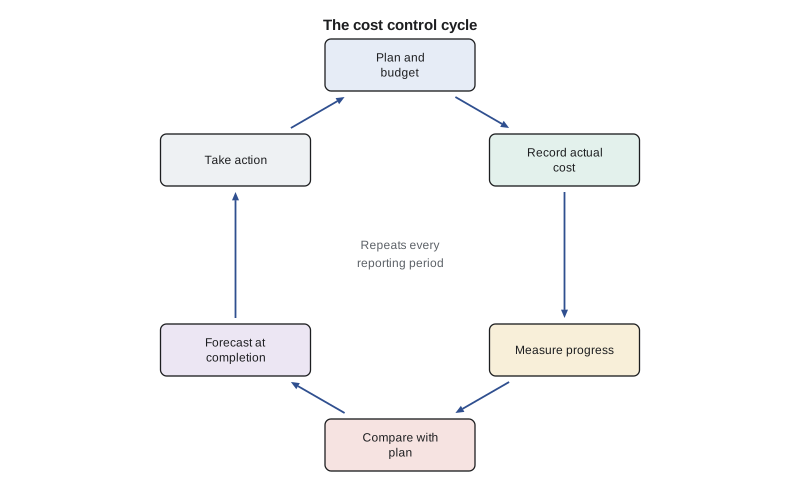
The cycle in the figure is simple, but each step needs a discipline behind it. The budget must be broken into the same cost codes the field charges time and materials to. Actual cost must be recorded accurately and promptly, including costs that have been incurred but not yet invoiced. Progress must be measured objectively, not guessed. Variances must be explained by someone who knows the work. The forecast must reflect what the team really expects, not what it hoped at bid time. And action must follow, or the cycle becomes a reporting ritual.
Who does what
| Role | Cost control responsibilities |
|---|---|
| Project manager | Owns the budget and forecast; manages subcontracts, changes and owner billing; signs the monthly cost report |
| Superintendent | Plans and directs field work; approves timecards and cost codes; reports quantities installed and field problems |
| Project controls or cost engineer | Maintains cost codes and the control budget, assembles the cost report, calculates earned value and prepares forecasts on larger projects |
| Project coordinator or project accountant | Processes invoices, commitments and accruals; reconciles the job cost ledger |
| Estimator | Hands over the estimate and its assumptions; receives feedback on actual unit costs for future bids |
| Operations manager or executive | Reviews forecasts across projects, approves contingency use and acts on early warnings |
On a small project, the project manager may do all of this alone. On a large project, a project controls group may include cost engineers, schedulers and change managers. What matters is that every responsibility has an owner and that the field and office work from the same cost codes and the same budget.
How the contract type shapes cost control
The contract between owner and contractor determines who bears the risk of cost overruns, and so how the contractor's cost control is used and who sees the results.
| Contract type | Who bears cost overruns | How cost control is used |
|---|---|---|
| Stipulated or lump sum price | The contractor, except for owner changes | Internal: protect the margin; price changes accurately |
| Unit price | Shared: the owner pays for actual quantities at bid unit rates; the contractor bears unit cost risk | Quantity tracking is essential for billing and for cost per unit |
| Cost plus a fee | Largely the owner | Open-book reporting to the owner; cost must be documented for reimbursement |
| Guaranteed maximum price (GMP) | The contractor above the maximum; savings often shared | Open-book reporting, contingency tracking and shared savings calculations |
| Target price or alliance | Shared through a pain and gain formula | Joint cost reporting and forecasting with the owner |
Standard form contracts used in Canada, such as the CCDC stipulated price, cost plus and construction management forms, set out how payment applications, changes and cost records work; CON-220 explains them. Cost-reimbursable contracts usually give the owner audit rights over the contractor's records, so a cost system that cannot trace each dollar to a code, a date and a document becomes a contractual problem, not just an internal one.
The running example: Riverbend Commons
Throughout this course we follow Riverbend Commons, an invented four-storey mixed-use building with ground-floor retail and three floors of rental apartments, about 6,200 m² gross floor area. Northline Builders, the general contractor, won it under a stipulated price contract of $16,850,000 before taxes. Northline self-performs concrete formwork and placing, rough carpentry and general labour, and subcontracts the rest. Its bid carried a fee of 4.5 % and a contingency of 1.8 % of cost. The schedule runs 16 months.
The numbers in the example are illustrative and are chosen to make the calculations clear, not to represent current market prices.
How small slips erase a margin
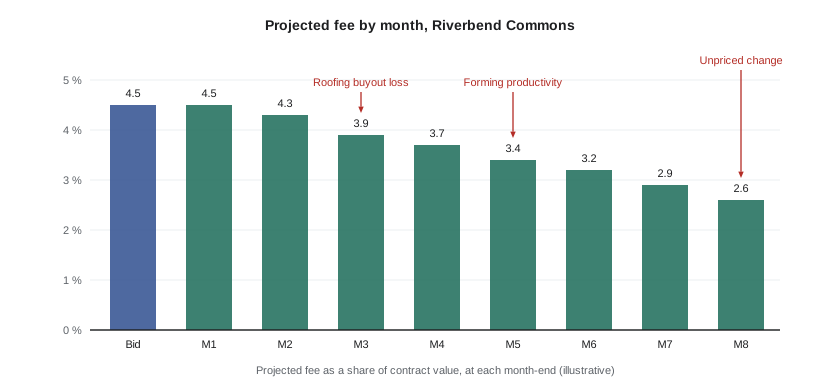
Margin fade (or profit fade) is the gradual erosion of the expected profit on a job between the bid and the final accounting. It is a familiar pattern in contractors' financial results: each month the projected margin drops a little as cost problems surface. The simple calculation below shows why even modest overruns matter so much on a lump sum job.
contract = 16_850_000
fee_rate = 0.045
cost_budget = contract / (1 + fee_rate)          # cost the fee was applied to
planned_fee = contract - cost_budget
print(f"Cost budget {cost_budget:,.0f}, planned fee {planned_fee:,.0f}")
for overrun in (0.01, 0.02, 0.03, 0.045):
    final_cost = cost_budget * (1 + overrun)
    fee_left = contract - final_cost
    print(f"Overrun {overrun:.1%}: fee left {fee_left:>10,.0f}  "
f"({fee_left / planned_fee:.0%} of planned)")Cost budget 16,124,402, planned fee 725,598 Overrun 1.0%: fee left 564,354 (78% of planned) Overrun 2.0%: fee left 403,110 (56% of planned) Overrun 3.0%: fee left 241,866 (33% of planned) Overrun 4.5%: fee left 0 (0% of planned)
A 2 % cost overrun takes away almost half of a 4.5 % fee, and an overrun equal to the fee rate leaves the job at break-even before any home office overhead is recovered. Because most of the cost on a building is subcontracted at fixed prices after buyout, the remaining risk sits in a smaller share of the work, chiefly self-performed labour, general conditions, unbought packages and changes. That is where the cost control effort should focus.
Worked problem
Where is the risk?
On Riverbend Commons, $11.2 million of the $16.1 million cost budget is subcontracted, $1.6 million is self-performed labour and material, $1.9 million is general conditions and $1.4 million covers packages not yet bought out, contingency and allowances. If subcontract prices are fixed, what share of the cost budget carries most of the cost risk?
Show solution
- Subcontracts at fixed prices: $11.2 million (risk mainly from changes and subcontractor default).
- Self-performed work, general conditions and unbought packages: 1.6 + 1.9 + 1.4 = $4.9 million.
- Share: 4.9 ÷ 16.1 = about 30 %.
Answer: About 30 % of the cost budget carries most of the cost risk; an overrun of 7 % on that portion would equal the whole fee. Cost control effort should concentrate there, along with change management.
Reporting periods and the rhythm of control
Most contractors run a monthly cost cycle that follows the accounting close, with a formal cost report and forecast at each month-end. Labour is usually watched more often, weekly or even daily, because labour productivity can change quickly and is the main controllable cost on self-performed work. Large projects may have a weekly cost meeting where the superintendent, project manager and cost engineer review quantities installed and hours spent. The rhythm matters because a monthly report that arrives three weeks after month-end is reporting on a job that has moved on.
| Frequency | Typical review | Main data |
|---|---|---|
| Daily | Foremen and superintendent check crews and quantities | Daily reports, timecards |
| Weekly | Labour productivity and short-interval plan | Hours by cost code, quantities installed, earned hours |
| Monthly | Cost report and forecast; owner billing | Job cost ledger, commitments, progress, changes |
| Quarterly | Executive portfolio review | Projected margins and cash across all jobs |
What good looks like
Good cost control systems share a few features regardless of size. The budget is set up before work starts and changes only through documented transfers or approved changes. Every cost is coded at the source, by the person who knows what it was for. Progress is measured by objective methods agreed in advance. The forecast is prepared by the project team, reviewed by someone independent, and compared with the previous month so that trends are visible. And the results feed back to estimating so the next bid is better.
The remaining lessons build those features one at a time. Lesson 2 turns the estimate into a control budget; Lesson 3 structures it with cost codes and loads it onto the schedule; Lessons 4 and 5 measure progress and record field costs; Lesson 6 assembles the cost report; Lessons 7 to 9 add earned value and forecasting; Lesson 10 deals with changes; Lesson 11 with cash; and Lesson 12 with action, reporting and a capstone monthly report.
Common mistakes
MistakeTreating cost control as an accounting function that reports what was spent.
InsteadCost control compares actual cost with budget and progress and forecasts the final cost so the team can act.
MistakeWaiting until the job is half done to look closely at cost performance.
InsteadMeasure carefully from the first weeks; early performance strongly predicts the final result.
MistakeSpreading control effort evenly across all cost codes.
InsteadConcentrate on the cost codes that carry risk: self-performed work, general conditions, unbought packages and changes.
MistakeCutting supervision or planning to save cost on a struggling job.
InsteadFind the cause of the variance first; cuts can increase rework and delay.
MistakeUsing the same reporting approach for lump sum and cost-plus work.
InsteadMatch the reporting to the contract: internal margin protection on lump sum, open-book records on cost-plus and GMP.
MistakeLetting the monthly report arrive weeks after month-end.
InsteadKeep the cycle short and watch labour weekly so that problems surface while they can still be fixed.
Summary and key terms
- Cost control turns an estimate into a result by budgeting, recording, measuring, comparing, forecasting and acting.
- Most projects that overrun do so gradually; early warning signs are visible if progress is measured honestly.
- Cost control uses accounting data but adds a field-level budget, a measure of physical progress and a forecast.
- Clear roles are needed for the project manager, superintendent, cost engineer, accountant and estimator.
- Contract type decides who bears overruns and whether cost reports are internal or open-book.
- On a thin lump sum margin, a small cost overrun can erase most of the fee, so effort should focus where the risk is.
- A monthly cost cycle with weekly labour checks is the common rhythm on building projects.
- Cost control
- The process of planning, measuring, comparing, forecasting and acting on project cost.
- Job cost ledger
- The accounting record of costs charged to a project by cost code.
- Control budget
- The budget used to manage the job, derived from the estimate and broken into cost codes.
- Variance
- The difference between planned or budgeted and actual or forecast values.
- Forecast at completion
- The expected final cost of the work.
- Margin fade
- The gradual erosion of projected profit on a job over time.
- Open-book reporting
- Sharing cost records and forecasts with the owner, as on cost-plus and GMP contracts.
- Guaranteed maximum price
- A cost-reimbursable contract with a ceiling above which the contractor bears the cost.
- Project controls
- The group or function that manages cost, schedule and change data on a project.
- Reporting period
- The interval, usually a month, at which cost is reported and forecast.
Practice problems
Work each problem on paper first, then reveal the answer to check.
Name the six steps of the cost control cycle.
Show answer
Plan and budget, record actual cost, measure progress, compare and analyse variances, forecast at completion, take action.
How does cost control differ from accounting?
Show answer
Accounting records past transactions for financial reporting; cost control compares them with budget and progress and forecasts the final cost.
A contractor bids a 5 % fee on cost. The cost budget is $10,000,000. What overrun leaves the job at break-even?
Show answer
5 %, or $500,000.
Why does most of the cost risk on a building sit in a small share of the budget?
Show answer
Most work is subcontracted at fixed prices after buyout; remaining risk is in self-performed work, general conditions, unbought packages and changes.
Which contract types usually require open-book cost reporting to the owner?
Show answer
Cost plus a fee, guaranteed maximum price and target price or alliance contracts.
Who usually approves the cost codes on timecards?
Show answer
The superintendent or foreman who directs the work.
Give three common causes of cost overruns.
Show answer
Estimate error, scope growth and changes, productivity loss, buyout losses, schedule slip, cash strain.
Why is labour usually reviewed weekly rather than monthly?
Show answer
Labour productivity can change quickly and is the main controllable cost on self-performed work.
What is margin fade?
Show answer
The gradual reduction in projected profit on a job from month to month.
What does the estimator gain from cost control?
Show answer
Actual unit costs and productivity for future bids.
Lesson quiz · 5 questions
Score 60% or more to complete this lesson.
Create a free account to save your progress, take quizzes and earn a certificate.