
CON-320 · Lesson 1 of 12 · 30 min
Why contractors fail and why finance matters
Construction is one of the few industries where a company can be busy, growing and profitable on paper and still run out of money. Contractors take on large commitments against small amounts of equity, are paid in arrears for work already done, carry money held back by owners for months after the work is finished, and price their work months before they know what it will really cost. When those pressures line up in the wrong way, a firm that looked healthy at its last year-end can be unable to meet payroll a few months later. This course is about the financial side of a contracting business: how its accounts are kept, how revenue and profit are recognized on contracts that last more than one period, how cash moves through the firm, how it borrows, how it is taxed, and how sureties and lenders judge whether it can be trusted with more work.
The earlier courses in this program looked at money from the project's point of view. CON-200 and CON-300 priced the work, CON-310 controlled cost and cash on a single job, and CON-220 covered the payment terms in the contract. CON-320 steps back to the company. The project manager needs to understand this view because the decisions made on site, such as how quickly to bill, whether to accept a change without a signed order, or whether to rent or buy a piece of equipment, end up in the company's financial statements and affect its ability to bid, borrow and bond the next job. The financial manager needs to understand the projects because nearly every number in a contractor's statements comes from estimates made by project teams.
Accounting standards, tax rules and lending practices change and depend on the firm's circumstances; a contractor should work with a professional accountant who knows construction, and with its surety broker and banker. The numbers in the examples are illustrative.
How contractors fail
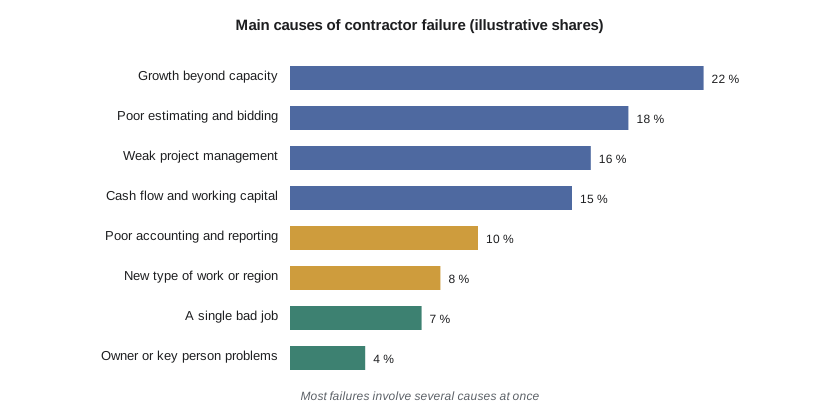
Studies of business survival consistently show that construction firms close at rates at or somewhat above the average for all industries, and that small and young firms are most at risk. Statistical agencies such as Statistics Canada and the US Bureau of Labor Statistics track business openings and closures; across industries, roughly a fifth of new businesses close within their first year or two and around half within five years, and construction is not an exception. Closures are not all failures in the sense of unpaid creditors; many owners simply retire or wind down. But the firms that do fail with debts unpaid tend to fail for a recognizable set of reasons, and surety companies, which pay when a bonded contractor defaults, have studied those reasons closely.
| Cause of failure | How it develops | Early financial sign |
|---|---|---|
| Growth beyond capacity | The firm takes on more or larger work than its people, systems and working capital can support | Revenue rising much faster than equity and working capital; overbillings used to fund operations |
| Poor estimating and bidding | Bids are too low or miss scope; the firm wins work it cannot do profitably | Gross margin falling; profit fade on the WIP schedule |
| Weak project management and cost control | Overruns are found late and changes are not recovered | Large differences between projected and final margins; growing underbillings |
| Inadequate accounting and reporting | Management does not know which jobs make or lose money until year-end | Late or unreliable financial statements; frequent year-end adjustments |
| Cash flow and working capital shortage | Slow billing and collection, heavy holdback or retainage, lending to jobs | Days in receivables rising; line of credit fully drawn; suppliers paid late |
| Entering a new type of work or region | The firm moves away from what it knows | Losses concentrated on unfamiliar projects |
| A single bad job | One large loss consumes the firm's equity | One job dominating the WIP schedule |
| Owner or key person problems | Loss of a founder, disputes among owners, poor succession, personal draws | Equity falling despite reported profits; related-party loans |
Two patterns appear again and again. The first is that growth, which looks like success, is a leading cause of failure. A firm that doubles its volume needs roughly double the working capital to carry the extra receivables, holdbacks and payroll, and it needs more supervision and better systems at the same time. If the growth is financed by billing ahead of the work and by stretching suppliers, it can continue for a while and then collapse when one job goes wrong. The second is that losses usually build up gradually. A job that will lose money rarely announces it in month one. Its projected margin fades a little each month as problems surface, and a firm that is not measuring honestly keeps reporting profit until the job is nearly done.
Why construction finance is different
A manufacturer makes a product, sells it and is paid. A contractor sells first, at a fixed price in most cases, then builds over months or years on the customer's land, using materials it does not own once they are installed, and is paid in instalments that lag the work. That sequence creates several features that set construction finance apart.
| Feature | What it means for the contractor's finances |
|---|---|
| Long contracts that span accounting periods | Revenue and profit must be estimated and recognized as the work proceeds (Lessons 4 and 5) |
| Fixed prices set before costs are known | Profit depends on estimates; small errors are magnified because margins are thin |
| Holdback withheld by owners | Five to ten per cent of every progress payment is held for months, tying up working capital (Lesson 10) |
| Payment in arrears | The contractor pays labour and suppliers before it is paid by the owner |
| High volume on little equity | A firm with a few million dollars of equity can carry tens of millions of contract work |
| Sureties and lenders as gatekeepers | Bonding capacity and credit limits, not demand, often cap how much work the firm can take |
| Project-based cost structure | Most costs are direct job costs; home office overhead must be recovered through markups |
| Heavy equipment for some trades | Large capital investment that must be costed to jobs and financed |
The ratio of contract volume to equity is worth dwelling on. A general contractor with $4.4 million of equity may complete $58 million of work a year, more than thirteen times its equity. A loss of 7.5 % on that year's volume would wipe out its equity entirely. That is why the people who lend money to contractors, and the sureties who guarantee their performance, watch margins, backlog and working capital so closely, and why a contractor's own management needs to understand its finances well enough to see trouble coming.
The running example: Kestrel Builders
Throughout this course we follow Kestrel Builders Ltd., an invented general contractor that builds commercial, institutional and multi-unit residential projects. Kestrel has about 85 employees, self-performs concrete and rough carpentry, and subcontracts most other trades. It is a Canadian-controlled private corporation owned by two founders, reports under Accounting Standards for Private Enterprises (ASPE), and has its year-end financial statements reviewed by a CPA firm. In its fiscal year 2025 it completed $58.4 million of work.
| Kestrel Builders, fiscal year 2025 (illustrative) | Amount |
|---|---|
| Contract revenue | $58,400,000 |
| Gross profit | $4,960,000 (8.5 % of revenue) |
| General and administrative overhead | $3,300,000 (5.7 % of revenue) |
| Net income after tax | $1,230,000 |
| Working capital at year-end | $2,450,000 |
| Shareholders' equity at year-end | $4,400,000 |
| Backlog of signed work not yet done | $41,000,000 |
These figures are typical in shape for a mid-sized general contractor, though every firm differs. A general contractor's gross margin is usually in the single digits because much of the value is subcontracted; a specialty trade contractor that self-performs most of its work will usually show a higher gross margin and higher overhead. Lesson 3 builds Kestrel's full financial statements; later lessons use them to look at revenue recognition, the WIP schedule, cash flow, financing, tax and bonding, and Lesson 12 assembles a complete financial health review.
A firm can be profitable and still run out of cash
Profit and cash are not the same thing. Profit is measured on an accrual basis: revenue is recognized as work is done, and costs are recognized as they are incurred, whether or not money has changed hands. Cash is what is in the bank. On a growing contractor, the two can diverge sharply. The firm must pay its own crews weekly or every two weeks and pay its suppliers within thirty days or so, but it bills the owner monthly, waits for the payment certifier and then for payment, and has a share of every payment held back. The difference has to be financed out of the firm's own working capital or its line of credit.
# A contractor that grows from $40M to $64M of annual revenue
# Assume receivables (including holdback) run at about 60 days of revenue,
# and payables at about 40 days of revenue. Net working capital tied up:
for revenue in (40e6, 48e6, 56e6, 64e6):
    receivables = revenue * 60 / 365
    payables = revenue * 40 / 365
    tied_up = receivables - payables
    print(f"Revenue {revenue/1e6:>4.0f}M: receivables {receivables/1e6:5.2f}M, "
          f"payables {payables/1e6:5.2f}M, cash tied up {tied_up/1e6:5.2f}M")
growth_need = (64e6 - 40e6) * 20 / 365
print(f"Extra working capital needed for the growth: {growth_need/1e6:.2f}M")Revenue 40M: receivables 6.58M, payables 4.38M, cash tied up 2.19M Revenue 48M: receivables 7.89M, payables 5.26M, cash tied up 2.63M Revenue 56M: receivables 9.21M, payables 6.14M, cash tied up 3.07M Revenue 64M: receivables 10.52M, payables 7.01M, cash tied up 3.51M Extra working capital needed for the growth: 1.32M
In this illustration, growing from $40 million to $64 million of revenue ties up about $1.3 million of additional cash, even if every job is profitable. If the firm earns a 2 % net margin, the growth year's profit of about $1.3 million is entirely absorbed by the extra working capital. A firm growing faster than that, or one with a slow-paying owner on a large job, will need to borrow, and Lesson 8 shows how to measure and manage that gap.
Worked problem
Growth and equity
A contractor has equity of $3.0 million and completes $36 million of work a year at a net margin of 2.5 % after tax. It retains all its profits. It wants to keep its revenue at no more than 12 times its equity. How much revenue can it support next year?
Show solution
- Profit this year = 0.025 × 36,000,000 = $900,000.
- Equity next year = 3,000,000 + 900,000 = $3,900,000.
- Supportable revenue = 12 × 3,900,000 = $46.8 million.
Answer: The firm can grow to about $46.8 million, a growth rate of 30 %, only if it keeps every dollar of profit in the business. Paying dividends or bonuses, or taking a loss, would reduce the growth it can safely support.
Who uses a contractor's financial information
A contractor's financial statements have more readers than most private companies'. Each reader asks a different question.
| User | Main question | What they look at most |
|---|---|---|
| Owners and management | Is the firm making money, and on which jobs? | Job margins, WIP schedule, overhead, cash forecast |
| Surety | Can the firm complete the work it is bonded for, and if it fails, what is left? | Working capital, equity, WIP schedule, profit fade, backlog, character of the owners |
| Bank or lender | Can the firm repay its loans? | Cash flow, receivables, covenant ratios, collateral |
| Project owners | Is this contractor financially able to do our job? | Prequalification statements, references, bonding letters |
| Tax authorities | Has the firm reported income and taxes correctly? | Tax returns, revenue recognition method, holdback or retainage treatment |
| Subcontractors and suppliers | Will we be paid? | Credit reports, payment history, lien and bond rights |
| Employees and unions | Are wages and benefit contributions secure? | Payroll remittances, trust fund contributions |
Because so many outsiders rely on the statements, the quality of the information matters as much as the numbers. A contractor whose statements arrive late, change a lot at year-end, or are prepared on a basis the surety does not accept will find its bonding and credit limited even if it is profitable. Lesson 11 returns to the level of assurance sureties expect and the schedules they ask for.
The accounting cycle in a contracting firm
Every contractor, however small, runs through the same cycle: record transactions, assign them to jobs and accounts, close the books at month-end, estimate the status of each job, adjust revenue for the work done, and produce statements and reports. What distinguishes a well-run contractor is how quickly and accurately that cycle runs. A firm that closes its books within ten days of month-end and has a reliable WIP schedule each month can see a job going bad in time to act. A firm that only knows its position when the accountant prepares the year-end statements is managing by looking in the rear-view mirror.
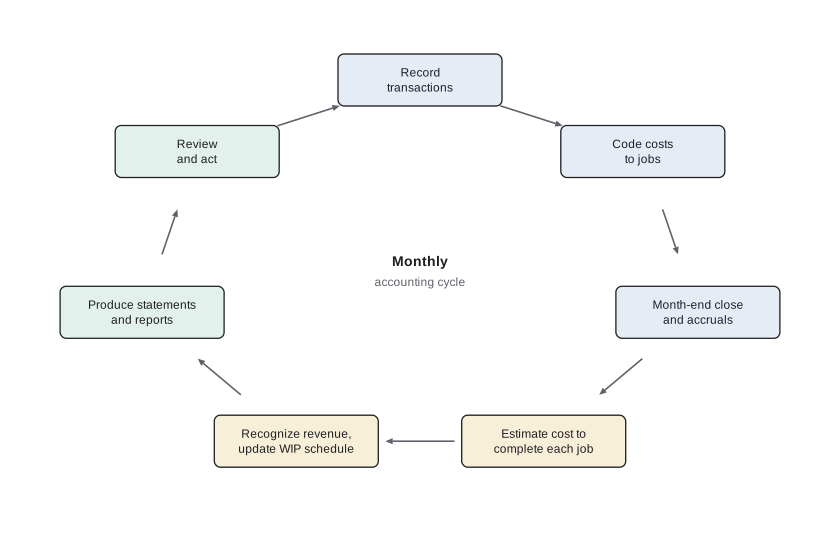
The step in the middle of that cycle, estimating the cost to complete each job, is where the project team and the accountants meet. Contract revenue under the percentage-of-completion approach depends on the estimated total cost of each job, so an optimistic cost-to-complete estimate overstates both revenue and profit. Lessons 4 and 5 show how that works and how the WIP schedule exposes it.
What this course covers
| Lesson | Topic |
|---|---|
| 2 | Accounting basics for contractors: the accounting equation, accrual accounting, the chart of accounts and job cost ledger |
| 3 | Contractor financial statements: balance sheet, income statement and cash flow statement |
| 4 | Revenue recognition on construction contracts under the accounting standards |
| 5 | The WIP schedule, over and underbillings, and profit fade |
| 6 | Job costing and overhead accounting, break-even volume |
| 7 | Equipment accounting and internal equipment rates |
| 8 | Cash flow, working capital and the cash conversion cycle |
| 9 | Financing: lines of credit, term loans and leasing |
| 10 | Taxes and holdbacks in Canada |
| 11 | Bonding capacity, surety and financial reporting to sureties and lenders |
| 12 | Financial analysis, planning and a capstone financial health review |
Basic bookkeeping is assumed only lightly; Lesson 2 reviews what a project person needs. Students who want a full grounding in financial accounting should take ACCT-101 alongside or before this course.
Common mistakes
MistakeAssuming that a profitable year means the firm has plenty of cash.
InsteadProfit is measured on an accrual basis; growth, holdback and slow collections can absorb all of it, so watch working capital and cash flow as well as profit.
MistakeTreating rapid growth as a sign of financial strength.
InsteadGrowth needs working capital, people and systems; check that equity and working capital are growing in step with volume.
MistakeLeaving the financial statements entirely to the accountant.
InsteadRevenue and profit depend on project teams' estimates of cost to complete, so project managers shape the statements.
MistakeWaiting for year-end statements to learn which jobs made money.
InsteadClose the books monthly and update a WIP schedule so that fading margins are visible while there is time to act.
MistakeThinking only the bank reads the statements.
InsteadSureties, owners, tax authorities and subcontractors all rely on them; quality and timeliness affect bonding and credit.
MistakeIgnoring how thin a contractor's equity is compared with its volume.
InsteadCompare volume with equity: at thirteen times equity, a loss of a few per cent of revenue can wipe out the firm.
Summary and key terms
- Contractors carry large commitments on small equity, are paid in arrears and have money held back, so they can be profitable and still run short of cash.
- Common causes of failure include growth beyond capacity, poor estimating, weak project control, poor accounting, cash shortages, unfamiliar work and a single bad job.
- Losses usually build up gradually; honest monthly estimates of cost to complete reveal them early.
- Growth ties up working capital; profits retained in the business limit how fast a firm can safely grow.
- Owners, sureties, lenders, project owners, tax authorities and suppliers all rely on a contractor's financial information.
- A fast, accurate monthly accounting cycle with a reliable WIP schedule is a mark of a well-run contractor.
- This course connects project decisions to the company's financial statements, financing, taxes and bonding.
- Working capital
- Current assets minus current liabilities; the short-term financial cushion that funds operations.
- Equity
- The owners' stake in the firm: total assets minus total liabilities.
- Backlog
- The value of signed contract work not yet performed.
- Accrual basis
- Accounting that records revenue when earned and costs when incurred, regardless of when cash moves.
- Profit fade
- A decline in a job's projected profit over time as costs are re-estimated.
- Surety
- A company that guarantees a contractor's performance and payment obligations through bonds.
- Gross margin
- Gross profit (revenue minus contract costs) as a percentage of revenue.
- Net margin
- Net income as a percentage of revenue.
- Month-end close
- The process of completing and checking the accounting records for a month.
- Volume-to-equity ratio
- Annual revenue divided by equity; a measure of how much work a firm carries on its capital.
Practice problems
Work each problem on paper first, then reveal the answer to check.
Name four common causes of contractor failure.
Show answer
Any four of: growth beyond capacity, poor estimating, weak project management, inadequate accounting, cash shortage, new type of work, a single bad job, owner problems.
Why can a profitable contractor run out of cash?
Show answer
Revenue is recognized as earned but cash arrives later; receivables, holdback and growth tie up cash while labour and suppliers must be paid sooner.
A contractor has $5 million of equity and $70 million of annual revenue. What is its volume-to-equity ratio?
Show answer
14 times.
Using the same firm, what loss as a percentage of revenue would wipe out its equity?
Show answer
5 ÷ 70 = about 7.1 %.
A firm with equity of $2.0 million earns $500,000 after tax and pays $200,000 in dividends. What is its equity next year?
Show answer
$2.3 million.
What does a surety most want to know from a contractor's statements?
Show answer
Whether it has the capital, capacity and character to complete bonded work, and what would be left if it failed.
Why is a general contractor's gross margin usually lower than a specialty contractor's?
Show answer
Much of a general contractor's value is subcontracted at fixed prices; specialty contractors self-perform more and carry more overhead.
What is the link between estimates of cost to complete and reported revenue?
Show answer
Under percentage of completion, revenue depends on cost incurred divided by estimated total cost; optimistic estimates overstate revenue and profit.
Give two financial signs of growth beyond capacity.
Show answer
Revenue growing much faster than equity and working capital; reliance on overbillings and stretched payables to fund operations.
What should a contractor do to see fading job margins early?
Show answer
Close the books monthly and update a WIP schedule with honest cost-to-complete estimates.
Lesson quiz · 5 questions
Score 60% or more to complete this lesson.
Create a free account to save your progress, take quizzes and earn a certificate.