
CON-330 · Lesson 1 of 12 · 28 min
Procurement in construction: roles, buyout and why it fails
A general contractor that wins a project has, at that moment, sold something it does not yet own. Most of the building will be put in place by subcontractors and built from materials and equipment that other companies make, ship and install. Between contract award and the first shovel in the ground, the contractor must turn the estimate into dozens of signed subcontracts and purchase orders, at prices that fit the budget, with scopes that fit together, on schedules that let the work happen in the right order. That process is called buyout, and the wider discipline of planning, sourcing, contracting for and delivering everything the project needs is construction procurement. This course is about doing it well.
Procurement sits between the other parts of the construction program. Estimating and bidding (CON-200 and CON-300) produce the prices and scope sheets that procurement starts from. Contract law, standard forms, payment and liens (CON-220) set the legal rules. Scheduling (CON-210) says when each package is needed. Cost control (CON-310) tracks what the buyout commits. Finance (CON-320) cares about the cash that subcontracts and supplier terms consume. Delivery methods are covered in CON-340, and risk, insurance and surety in CON-350. This course connects them from the buyer's side of the desk.
What gets bought, and by whom
On a typical building project a general contractor self-performs only a small share of the work, often concrete, rough carpentry, general labour and site services, and buys the rest. Industry estimates commonly put subcontracted work at 70 to 90 % of contract value on commercial buildings, though the share varies with the contractor's trades and the project type. What is bought falls into four broad groups.
| Category | Examples | Typical contract |
|---|---|---|
| Subcontracted trades (supply and install) | Mechanical, electrical, drywall, roofing, glazing, elevators, fire protection | Subcontract |
| Materials supplied for self-performed work | Ready-mix concrete, reinforcing steel, lumber, formwork rentals, hardware | Purchase order or supply agreement |
| Equipment and services | Cranes, hoists, temporary power, fencing, waste removal, survey, testing | Rental agreement, service agreement or purchase order |
| Owner-specified or long-lead equipment | Switchgear, generators, elevators, rooftop units, specialty glazing | Purchase order, sometimes pre-purchased by the owner and assigned |
The people involved vary with the size of the firm. In a small company the project manager may do everything from issuing the invitation to bid to signing the subcontract. Larger contractors separate the work among several roles.
| Role | Main procurement responsibilities |
|---|---|
| Estimator or preconstruction manager | Prepares the bid, scope sheets and trade budgets; hands over subcontractor quotes and qualifications |
| Project manager | Owns the buyout plan, leads scope reviews, negotiates and recommends awards, administers subcontracts |
| Procurement or buyout manager (larger firms) | Runs the commercial process, standard terms, vendor database and purchasing policy |
| Project coordinator or engineer | Tracks submittals, deliveries and documents; maintains logs |
| Superintendent | Advises on sequence, site logistics and subcontractor capability; manages trades in the field |
| Contracts administrator or legal | Maintains standard subcontract forms, reviews exceptions and insurance and bonding requirements |
| Owner and consultants | Approve substitutions, review submittals, sometimes nominate or pre-purchase |
The procurement cycle
Every package, whether a $40,000 painting subcontract or a $5 million mechanical subcontract, moves through the same broad steps. The steps take different amounts of time and effort, but skipping one usually costs more later than it saves now.
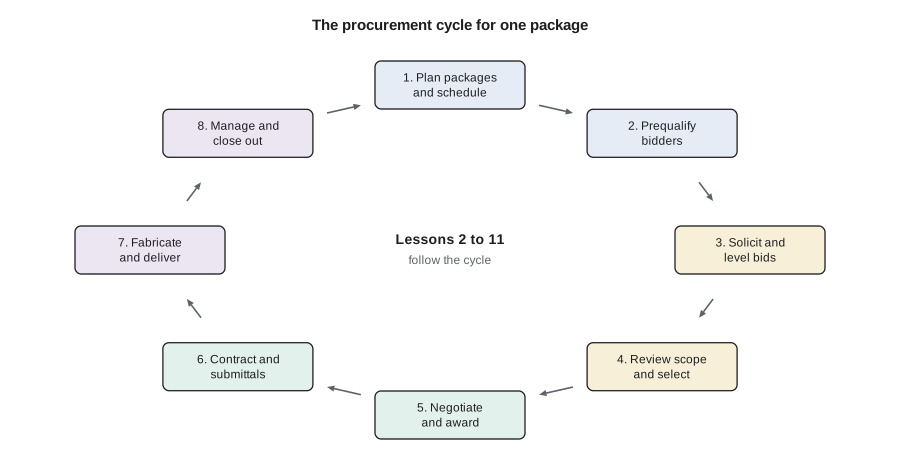
| Step | Key output | Lesson |
|---|---|---|
| Plan the packages and the procurement schedule | Package list, need-by dates, buyout schedule | 2 |
| Prequalify bidders | Approved bidders list | 3 |
| Solicit, receive and level bids | Levelled bid comparison (see CON-300) | 4 |
| Review scope and select | Scope review minutes, award recommendation | 4 |
| Contract | Signed subcontract or purchase order | 5, 6 |
| Submittals and fabrication | Approved shop drawings, release to fabricate | 7 |
| Delivery and site logistics | Delivery schedule, laydown plan, receiving records | 9 |
| Manage performance and close out | Progress, back-charges, warranties, final release | 11 |
Buyout: turning the estimate into commitments
Buyout is the period, usually the first weeks or months after award, in which the contractor converts the estimate's trade budgets into signed commitments. The tool that tracks it is the buyout log: one line per package, showing the budget carried in the estimate, the amount actually committed, the difference, and the status. Any saving (committed below budget) or loss (committed above budget) flows straight to the project's forecast margin, so the buyout log is one of the first cost reports the project team and senior management look at.
Throughout this course we follow one invented project. Halyard Construction has won a stipulated-price contract to build Larch Street Residences, a six-storey mixed-use building: a concrete podium with ground-floor retail and parking, five storeys of wood-frame apartments above (72 units), two elevators and a flat roof with mechanical equipment. The contract price is $36.4 million. Halyard self-performs concrete formwork and placing and buys almost everything else.
# Larch Street Residences - buyout log at week 6 after award (illustrative)
packages = [  # (package, estimate budget, committed or None if not yet awarded)
    ("Excavation and shoring",        1_450_000, 1_392_000),
    ("Reinforcing steel",               820_000,   865_500),
    ("Ready-mix concrete (PO)",          910_000,   884_000),
    ("Wood framing",                   3_900_000, 3_745_000),
    ("Mechanical",                     5_600_000, 5_812_000),
    ("Electrical",                     3_700_000, 3_598_000),
    ("Elevators",                        640_000,   702_000),
    ("Windows and storefront",         2_350_000, None),
    ("Exterior cladding",              1_780_000, None),
    ("Roofing",                          610_000, None),
    ("Fire protection",                  690_000,   655_000),
    ("Drywall and ceilings",           2_250_000, None),
]
bought = [(p, b, c) for p, b, c in packages if c is not None]
open_ = [(p, b) for p, b, c in packages if c is None]
for p, b, c in bought:
    print(f"{p:26} budget {b:>10,}  committed {c:>10,}  {b - c:>+9,}")
net = sum(b - c for _, b, c in bought)
print(f"Net buyout result on awarded packages: {net:+,}")
print(f"Awarded: {len(bought)} packages, {sum(b for _, b, _ in bought):,} of budget")
print(f"Still to buy: {len(open_)} packages, {sum(b for _, b in open_):,} of budget")Excavation and shoring budget 1,450,000 committed 1,392,000 +58,000 Reinforcing steel budget 820,000 committed 865,500 -45,500 Ready-mix concrete (PO) budget 910,000 committed 884,000 +26,000 Wood framing budget 3,900,000 committed 3,745,000 +155,000 Mechanical budget 5,600,000 committed 5,812,000 -212,000 Electrical budget 3,700,000 committed 3,598,000 +102,000 Elevators budget 640,000 committed 702,000 -62,000 Fire protection budget 690,000 committed 655,000 +35,000 Net buyout result on awarded packages: +56,500 Awarded: 8 packages, 17,710,000 of budget Still to buy: 4 packages, 6,990,000 of budget
Six weeks in, Halyard has awarded eight packages. Savings on excavation, framing, electrical and some materials are partly offset by losses on mechanical, reinforcing steel and elevators, for a small net saving. Four packages worth about $7 million are still open. The important point is not the net figure on any one day but the trend and the exposure: the open packages include the window and storefront package, which is both long-lead and, on this project, the one with the widest spread of bids. A buyout log that shows only the net saving can hide the fact that the riskiest decisions are still ahead.
Worked problem
Reading a buyout result
A project carries a trade budget of $2,250,000 for drywall and ceilings. The lowest compliant bid after scope review is $2,182,000, but it excludes acoustic sealant at demising walls that the next bidder includes; the project manager estimates that scope at $41,000. What is the true buyout result if Halyard awards to the low bidder and buys the sealant separately?
Show solution
- Committed subcontract: $2,182,000.
- Add the excluded scope that must still be bought: $41,000.
- Total cost of the package: $2,223,000.
- Buyout result: 2,250,000 − 2,223,000 = $27,000 saving.
Answer: The apparent saving of $68,000 is really $27,000. Recording only the subcontract value would overstate the margin by $41,000 and leave the sealant unbought, a classic scope gap.
Why procurement fails
When projects go wrong, procurement decisions are often near the root. Post-project reviews and claims files show the same patterns again and again.
| Failure | What it looks like on site | Usual root cause |
|---|---|---|
| Scope gaps | Work nobody included: firestopping, blocking, final connections, temporary heat | Packages split without a responsibility matrix; scope review rushed |
| Scope overlaps | Two trades both priced the same item | Unclear division of work; contractor pays twice or argues |
| Late long-lead items | Building closed in, waiting for switchgear or elevators | Package awarded late; submittal cycle underestimated |
| Subcontractor failure | Trade walks off, cannot staff the job, or goes insolvent | Weak prequalification; award to a low bid the trade could not afford |
| Price escalation | Supplier withdraws or reprices a quote | Quote held too long; no escalation terms |
| Back-to-back mismatch | Owner contract terms not passed to subcontractors | Subcontract form not aligned with prime contract |
| Paperwork disputes | Arguments over what was agreed, insurance gaps, unsigned changes | Work started on a letter of intent with no signed subcontract |
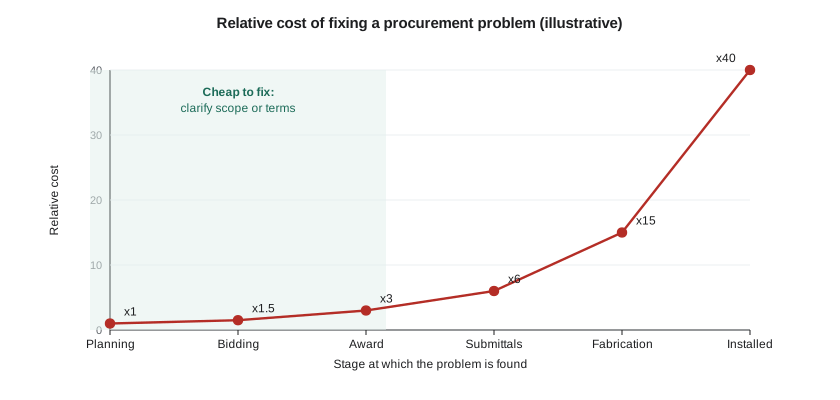
These failures share a theme: they are cheap to prevent before award and expensive to fix after. A scope gap found during scope review is a line on a meeting agenda; the same gap found when the drywall is closed is a change order the owner will not pay for, a delay and an argument. Most of this course is about catching problems while they are still cheap.
Value, not just price
The lowest price is not the best buy if the trade cannot deliver. Good procurement looks at total value: price, but also scope completeness, schedule, quality, safety record, financial strength and the cost of managing the relationship. A subcontractor who is $30,000 cheaper but needs a full-time project engineer to chase its submittals, misses milestones and leaves deficiencies at handover may cost far more. Lesson 4 shows how to weigh these factors without losing the discipline of competitive pricing.
Worked problem
Cheap price, expensive outcome
Two electrical bidders are $3,598,000 and $3,640,000. Halyard believes, from past projects, that the lower bidder has a 30 % chance of a two-week delay to energization, which would cost about $95,000 in extended general conditions and temporary power. The other bidder has a 5 % chance of the same delay. Which bid has the lower expected cost?
Show solution
- Low bidder: 3,598,000 + 0.30 × 95,000 = $3,626,500.
- Second bidder: 3,640,000 + 0.05 × 95,000 = $3,644,750.
- Difference: $18,250 in favour of the low bidder.
Answer: Even after allowing for delay risk, the low bidder is cheaper in expectation, so Halyard awards to it but plans tighter monitoring of the energization milestone. Had the risk been higher or the price gap smaller, the answer would change. The point is to put numbers on the risk rather than ignore it or let it override price by instinct.
Ethics and fairness in buying
Procurement involves money, competition and discretion, so it attracts temptation. Construction associations and public owners set out expectations that also make good business sense: treat bidders consistently, keep bid prices confidential, do not shop one bidder's price to another to drive it down after the close, avoid conflicts of interest, and decline gifts that could look like inducements. Bid shopping and bid peddling in particular damage trust and, over time, the quality of bids a contractor receives.
In Canada, bid depositories in several provinces and the Canadian Construction Association's tendering practices are designed partly to discourage bid shopping. Public owners also impose integrity rules: the federal Ineligibility and Suspension Policy can bar suppliers convicted of certain offences from federal contracts, and provincial procurement directives set conflict-of-interest and gift rules for public buyers.
Fair dealing is not only an ethical point. Subcontractors remember which contractors share their prices, change scopes after the fact or delay payment, and they price the next bid accordingly. A reputation as a fair buyer is part of a contractor's competitive advantage.
Common mistakes
MistakeTreating buyout as paperwork that starts after mobilization.
InsteadStart buyout immediately after award, with the riskiest and longest-lead packages first.
MistakeRecording a buyout saving without checking excluded scope.
InsteadAdd the cost of exclusions and scope gaps before calculating the result.
MistakeAwarding to the lowest number by default.
InsteadCompare complete, levelled scopes and weigh schedule, quality, safety and financial risk.
MistakeLetting trades start on a handshake or letter of intent.
InsteadGet the subcontract, insurance and bonds in place before work starts.
MistakeIgnoring how packages fit together.
InsteadUse a responsibility matrix so every item belongs to exactly one package.
MistakeShopping one bidder's price to another.
InsteadTreat bidders consistently and keep prices confidential; negotiate on scope and terms, not leaked numbers.
Summary and key terms
- Procurement plans, sources, contracts for and delivers everything a project needs; buyout converts the estimate into signed commitments.
- General contractors commonly subcontract most of a building's value, so procurement largely determines cost, schedule and quality.
- Each package moves through a cycle: plan, prequalify, solicit and level, review scope, award, contract, submittals and fabrication, delivery, management and closeout.
- The buyout log compares trade budgets with commitments and shows savings, losses and open exposure.
- Scope gaps, late long-lead items, subcontractor failure, escalation and mismatched terms are the commonest procurement failures.
- Problems are cheap to fix before award and expensive after fabrication or installation.
- Good buyers judge total value and deal fairly with bidders.
- Procurement
- Planning, sourcing, contracting for and delivering the labour, materials, equipment and services a project needs.
- Buyout
- The process of awarding subcontracts and purchase orders after the prime contract is won.
- Buyout log
- A report comparing each package's budget with its committed value and status.
- Package
- A defined scope of work or supply bought under one subcontract or purchase order.
- Self-perform
- Work the general contractor does with its own forces.
- Scope gap
- Work required by the contract that no package includes.
- Scope overlap
- Work included in more than one package.
- Long-lead item
- Equipment or material whose procurement and fabrication time threatens the schedule unless ordered early.
- Bid shopping
- Disclosing one bidder's price to others to drive prices down after bids close.
- Total value
- Price combined with scope, schedule, quality, safety, financial strength and management cost.
Practice problems
Work each problem on paper first, then reveal the answer to check.
Define buyout in one sentence.
Show answer
Awarding the subcontracts and purchase orders that turn the estimate into committed costs after the contract is won.
Name four categories of things a general contractor buys.
Show answer
Subcontracted trades, materials for self-performed work, equipment and services, and long-lead or owner-specified equipment.
A package budget is $610,000 and the award is $588,000 with a $14,000 exclusion to buy separately. What is the buyout result?
Show answer
610,000 − (588,000 + 14,000) = $8,000 saving.
Why can a positive net buyout figure be misleading early in buyout?
Show answer
The riskiest or most volatile packages may still be open, so exposure remains.
Give two causes of scope gaps.
Show answer
Splitting packages without a responsibility matrix; rushed scope review; reliance on unclear specifications.
Why are problems cheaper to fix before award?
Show answer
Before award they can be fixed by clarifying scope or terms; after fabrication or installation they require rework, delay and disputes.
List three factors besides price in total value.
Show answer
Scope completeness, schedule capability, quality, safety record, financial strength, management effort.
A bid is $40,000 lower but carries a 25 % chance of a $200,000 delay versus 5 % for the other. Which has the lower expected cost?
Show answer
Relative to the higher price, the low bid saves 40,000 but adds 0.25 × 200,000 = 50,000 of expected delay, a net +10,000; the other bid adds 0.05 × 200,000 = 10,000. They tie.
What is bid shopping and why is it harmful?
Show answer
Revealing competitors' prices after bids close to force reductions; it erodes trust and future bid quality.
Which course covers subcontractor quotes and bid levelling in detail?
Show answer
CON-300.
Lesson quiz · 5 questions
Score 60% or more to complete this lesson.
Create a free account to save your progress, take quizzes and earn a certificate.