
CON-330 · Lesson 3 of 12 · 26 min
Subcontractor prequalification
Prequalification is the contractor's decision about who is allowed to bid. It happens before prices are seen, which is its strength: a contractor that screens on safety, finances, capacity and experience first, and only then compares prices among firms it would be content to hire, is protected from the temptation to award to a low number from a firm that cannot perform. Subcontractor default is one of the most damaging events on a project, because the contractor usually has to finish the work at its own cost, under time pressure, while the owner's schedule keeps running. Prequalification is the cheapest insurance against it.
This lesson sets out what to assess, where the information comes from, how to score it, and how to keep the approved list current. Insurance, surety bonds and subcontractor default insurance are introduced only briefly here; CON-350 covers them in depth.
What to assess
Prequalification looks at five broad areas. The weight given to each depends on the package: for a small painting subcontract, safety and basic finances may be enough; for a $5 million mechanical subcontract on the critical path, every area matters.
| Area | Key questions | Typical evidence |
|---|---|---|
| Safety | Does the firm manage hazards and train its workers? What is its injury record? | COR or equivalent certificate, injury frequency and severity, WSIB or WCB clearance and rate history, safety program, orders from inspectors |
| Financial strength | Can the firm carry its payroll and suppliers until it is paid? Will it survive the project? | Financial statements, working capital, bank and surety letters, credit report, liens and claims history |
| Capacity | Does it have the people and equipment for this job on top of its current work? | Backlog, annual volume, key staff and their commitments, largest past contract |
| Experience and quality | Has it done this type and size of work well? | Project list, references, deficiency and warranty history, certifications |
| Compliance | Is it licensed, insured and able to meet project requirements? | Trade certification or licensing (for example, Quebec RBQ licence, Ontario electrical contractor licence), insurance certificates, litigation record |
Safety: reading the numbers
Safety record is often the first screen, because a trade with a poor record puts everyone on site at risk and exposes the general contractor, as constructor or controlling employer, to orders, penalties and liability. The common measures are injury rates normalized by hours worked.
The constant 200,000 represents 100 full-time workers working 40 hours a week for 50 weeks, so the rate is the number of cases per 100 full-time workers per year. The same formula gives a total recordable rate if all recordable injuries are counted, or a lost-time rate if only cases with days away from work are counted.
In Canada, provincial workers' compensation boards publish injury statistics by rate group, and many contractors ask bidders for their lost-time injury frequency and severity, their board account standing and a clearance certificate. A clearance letter from the board (for example, a WSIB clearance certificate in Ontario) confirms that the subcontractor's premiums are paid; without one, the contractor may become liable for the subcontractor's unpaid premiums. The Certificate of Recognition (COR), issued through provincial construction safety associations after an external audit of the firm's safety management system, is widely required by owners and contractors.
# Safety screen for four electrical bidders (3-year totals, illustrative)
bidders = {
    #            recordables  lost-time  hours worked
    "Bidder A": (6,           1,         412_000),
    "Bidder B": (14,          5,         388_000),
    "Bidder C": (3,           0,         165_000),
    "Bidder D": (9,           2,         520_000),
}
industry_trir = 2.4   # illustrative benchmark for the trade
for name, (rec, lt, hrs) in bidders.items():
    trir = rec * 200_000 / hrs
    ltr = lt * 200_000 / hrs
    flag = "review" if trir > 1.25 * industry_trir else "pass"
print(f"{name}: recordable rate {trir:4.2f} lost-time rate {ltr:4.2f} {flag}")Bidder A: recordable rate 2.91 lost-time rate 0.49 pass Bidder B: recordable rate 7.22 lost-time rate 2.58 review Bidder C: recordable rate 3.64 lost-time rate 0.00 review Bidder D: recordable rate 3.46 lost-time rate 0.77 review
Bidder B's recordable rate is more than twice the illustrative benchmark, so it is flagged for review. A flag is not an automatic rejection: a single bad year, a change in management, or a small number of hours can distort rates, and Bidder C's rate rests on fewer hours than the others. The reviewer looks behind the numbers at the safety program, recent audits and how the firm responded to incidents. But a pattern of poor results with no credible improvement plan should keep a firm off the list for high-risk work.
Financial strength
A subcontractor is paid in arrears, typically 30 to 60 days after the month its work is done, and often has part of each payment held back. It must carry its payroll, materials and equipment in the meantime, so financial strength matters even more for subcontractors than for general contractors. The ratios are the same ones sureties and lenders use (CON-320); here the question is narrower: can this firm carry this subcontract without running out of cash?
| Measure | How to calculate | Rule of thumb (illustrative) |
|---|---|---|
| Working capital | Current assets − current liabilities | Comfortably more than one or two months of the subcontract's monthly billing |
| Current ratio | Current assets ÷ current liabilities | Above about 1.3 for most trades |
| Debt to equity | Total liabilities ÷ equity | Below about 3 |
| Subcontract as share of annual volume | Subcontract value ÷ annual revenue | Above about 25 % to 30 % means the firm is betting heavily on this job |
| Bonding capacity | Letter from the surety stating single and aggregate limits | Single limit above the subcontract value if bonds are required |
# Can each mechanical bidder carry the Larch Street mechanical subcontract?
sub_value = 5_600_000
months = 14
monthly_billing = sub_value / months
bidders = {
    #           current assets, current liabilities, equity, total liabilities, annual revenue
    "Mech 1": (6_800_000, 4_100_000, 3_900_000, 5_300_000, 24_000_000),
    "Mech 2": (2_900_000, 2_450_000, 1_100_000, 3_600_000, 11_500_000),
    "Mech 3": (9_400_000, 6_200_000, 5_800_000, 8_900_000, 38_000_000),
}
for n, (ca, cl, eq, tl, rev) in bidders.items():
    wc = ca - cl
    print(f"{n}: WC {wc/1e6:4.2f}M = {wc/monthly_billing:3.1f} months of billing | "
f"current ratio {ca/cl:4.2f} | D/E {tl/eq:3.1f} | job = {sub_value/rev:4.0%} of revenue")Mech 1: WC 2.70M = 6.8 months of billing | current ratio 1.66 | D/E 1.4 | job = 23% of revenue Mech 2: WC 0.45M = 1.1 months of billing | current ratio 1.18 | D/E 3.3 | job = 49% of revenue Mech 3: WC 3.20M = 8.0 months of billing | current ratio 1.52 | D/E 1.5 | job = 15% of revenue
Mech 2 stands out. Its working capital covers barely a month of billing on this job, its current ratio is about 1.2, its debt is more than three times its equity, and the subcontract would be almost half of its annual revenue. Even if Mech 2 submits the lowest price, the risk that it runs short of cash partway through, slows down or fails is high. Halyard could still use it with protections, such as a performance bond, joint cheques to its major suppliers, or a smaller scope, but those protections should be decided before bids, not after Mech 2 has submitted an attractive number.
Worked problem
Capacity check
An electrical bidder has annual revenue of $16 million and current backlog of $13.5 million to be completed in the next 12 months. Its largest completed project was $2.8 million. The Larch Street electrical subcontract is $3.7 million over 14 months. Should Halyard be concerned?
Show solution
- Backlog already uses about 13.5 ÷ 16 = 84 % of a year's volume.
- Larch Street adds about 3.7 × 12 ÷ 14 = $3.2 million in the next 12 months, taking the total to $16.7 million, slightly above last year's volume.
- The job is 3.7 ÷ 2.8 = 1.3 times the largest the firm has completed.
Answer: The firm would be at or beyond its demonstrated capacity on a job larger than any it has done. Halyard should ask who the project manager and foreman would be, what else they are running, and how the firm will staff peak manpower. That conversation belongs in prequalification.
Collecting the information
Contractors collect prequalification information using a standard form, which makes firms comparable and saves subcontractors from filling in a different questionnaire for every contractor.
In Canada, CCDC 11 (Contractor's Qualification Statement) is the common standard form, and many contractors adapt it for subcontractors. Industry safety associations and third-party prequalification services collect safety and insurance documents for many owners at once.
Whatever the form, the contractor should verify what matters: call references (and ask specific questions, such as whether they would hire the firm again and how it handled changes), check that insurance certificates name the right insured and limits, confirm licences or certifications with the issuing authority, and treat unaudited financial statements with appropriate caution. Large subcontracts may justify reviewed or audited statements and a meeting with the firm's principals.
| Information | How to verify |
|---|---|
| References | Call two or three recent clients; ask about schedule, quality, changes and payment of their own suppliers |
| Insurance | Certificate from the broker or insurer, with limits, additional insured status and policy dates checked against the subcontract requirements |
| Licences and certifications | Online registries of the licensing authority or safety association |
| Financial statements | Prefer statements prepared by an accountant; compare year over year; ask about large changes |
| Bonding capacity | Letter direct from the surety or broker, recently dated |
| Litigation and liens | Ask directly; search court and lien registries for large packages |
Scoring and the approved list
A simple, transparent scoring method helps make consistent decisions and explain them later. The usual approach has two parts: knock-out criteria that a firm must meet regardless of anything else (for example, a valid trade licence, required insurance, and no serious unresolved safety orders), and weighted scores for the remaining areas.
# Weighted prequalification scoring with knock-out criteria (scores out of 10)
weights = {"safety": 0.30, "financial": 0.25, "capacity": 0.20, "experience": 0.25}
bidders = {
    "Mech 1": {"knockout_ok": True,  "safety": 8, "financial": 8, "capacity": 7, "experience": 8},
    "Mech 2": {"knockout_ok": True,  "safety": 7, "financial": 3, "capacity": 4, "experience": 6},
    "Mech 3": {"knockout_ok": True,  "safety": 9, "financial": 9, "capacity": 8, "experience": 7},
    "Mech 4": {"knockout_ok": False, "safety": 9, "financial": 8, "capacity": 9, "experience": 9},
}
threshold = 6.5
for n, b in bidders.items():
    if not b["knockout_ok"]:
        print(f"{n}: excluded (knock-out criterion not met)")
        continue
    score = sum(weights[k] * b[k] for k in weights)
print(f"{n}: weighted score {score:4.2f} -> {'approved' if score >= threshold else 'not approved'}")Mech 1: weighted score 7.80 -> approved Mech 2: weighted score 5.15 -> not approved Mech 3: weighted score 8.30 -> approved Mech 4: excluded (knock-out criterion not met)
Mech 4 scores well but is excluded because it failed a knock-out criterion (on this project, its insurance limits were below the owner's requirement and it declined to increase them). Mech 2 falls below the threshold, mainly on finances and capacity. Mech 1 and Mech 3 are approved to bid. Weights and threshold are the contractor's choice and should be set before scoring begins, so that the result is not tuned to favour a preferred firm.
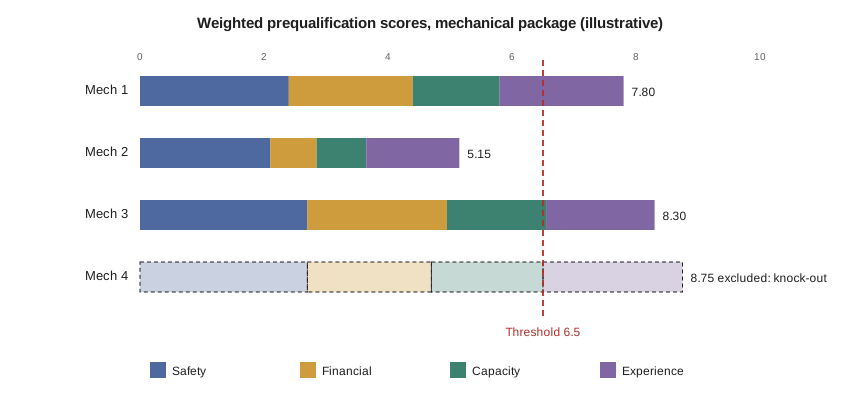
Approved lists should be kept current. A firm approved two years ago may have lost key staff, taken on too much work or had a serious incident. Many contractors refresh full prequalification annually and ask for updated safety and insurance information for every new bid. After each project, the contractor's evaluation of the subcontractor's performance (Lesson 11) feeds back into the list.
Protecting against subcontractor default
Even good prequalification cannot eliminate default. For packages where failure would be serious, contractors add protection. The options are introduced here and covered in CON-350.
| Protection | How it works | Notes |
|---|---|---|
| Subcontractor performance and payment bonds | A surety guarantees the subcontractor's performance and payment of its suppliers | Cost typically passed through in the subcontract price; surety does its own prequalification |
| Subcontractor default insurance | The general contractor buys a policy covering its costs if enrolled subcontractors default | Available to larger contractors; carries a deductible; contractor must run a strong prequalification program |
| Letters of credit or holdback above the statutory amount | Cash or bank security held against default | Ties up the subcontractor's cash; can raise its price |
| Parent company guarantee | A parent company guarantees a subsidiary's obligations | Only as good as the parent |
| Joint cheques and direct payment to suppliers | Payments made jointly to the subcontractor and its supplier | Reduces lien and supplier risk; needs agreement |
Common mistakes
MistakePrequalifying after seeing prices.
InsteadPrequalify before bids so price cannot sway the assessment.
MistakeRejecting a firm on a single bad safety number.
InsteadLook behind the rate: hours worked, trend, program and response to incidents.
MistakeAccepting insurance certificates without reading them.
InsteadCheck insured name, limits, additional insured status and policy dates against the requirements.
MistakeIgnoring the size of the job relative to the bidder.
InsteadCompare the subcontract with annual revenue, backlog and the largest past job.
MistakeAdjusting weights after scoring to favour a preferred firm.
InsteadSet criteria, weights and thresholds before scoring and apply them consistently.
MistakeKeeping firms on the list indefinitely.
InsteadRefresh prequalification regularly and feed project performance back into it.
Summary and key terms
- Prequalification decides who may bid, before prices are seen, to reduce the risk of subcontractor default.
- It assesses safety, financial strength, capacity, experience and compliance, weighted by the package's risk.
- Incident rates normalize injury counts per 200,000 hours, about 100 full-time workers for a year.
- Canadian contractors commonly check COR certification, board clearance and injury frequency and severity.
- Financial screens test whether the firm can carry the subcontract: working capital in months of billing, current ratio, leverage and job size against revenue.
- Knock-out criteria plus weighted scores, set in advance, give consistent and defensible decisions.
- Bonds, default insurance and other security add protection where failure would be serious.
- Prequalification
- Assessing firms before bidding to decide who may bid.
- Incident rate
- Cases per 200,000 hours worked.
- Total recordable incident rate
- The incident rate for all recordable injuries and illnesses.
- Lost-time injury
- An injury that causes the worker to miss time beyond the day of injury.
- Certificate of Recognition (COR)
- In Canada, an audited safety management certification issued through provincial safety associations.
- Experience Modification Rate (EMR)
- In the US, a ratio of a firm's workers' compensation claims to those expected for its class of work; 1.00 is average.
- Knock-out criterion
- A requirement a firm must meet regardless of its other scores.
- Approved bidders list
- Firms prequalified to bid on a package or class of work.
- Subcontractor default
- A subcontractor's failure to perform or complete its subcontract.
- Subcontractor default insurance
- Insurance bought by a general contractor to cover its costs when an enrolled subcontractor defaults.
Practice problems
Work each problem on paper first, then reveal the answer to check.
A firm had 5 recordable injuries in 250,000 hours. What is its recordable rate?
Show answer
5 × 200,000 ÷ 250,000 = 4.0.
What does the 200,000 in the incident-rate formula represent?
Show answer
100 full-time workers × 40 hours × 50 weeks.
Why ask for a board clearance certificate?
Show answer
It confirms premiums are paid, protecting the contractor from liability for the subcontractor's unpaid premiums.
A $2.4 million, 12-month subcontract; the bidder has $310,000 of working capital. How many months of billing does that cover?
Show answer
Monthly billing = $200,000; 310,000 ÷ 200,000 = 1.55 months.
Why is a subcontract that is 45 % of a bidder's annual revenue a concern?
Show answer
The firm depends heavily on one job; any loss or delay could threaten its survival.
Name three things to ask a reference.
Show answer
Would you hire them again? How did they handle schedule, quality and changes? Did they pay their suppliers on time?
Give two examples of knock-out criteria.
Show answer
Valid licence or certification; required insurance; no unresolved serious safety orders; minimum bonding capacity.
Weights are safety 0.3, financial 0.3, capacity 0.2, experience 0.2; scores 8, 6, 7, 9. What is the weighted score?
Show answer
2.4 + 1.8 + 1.4 + 1.8 = 7.4.
Why set weights before scoring?
Show answer
To keep decisions consistent and prevent tuning the method to favour a preferred firm.
Name three protections against subcontractor default.
Show answer
Performance and payment bonds, subcontractor default insurance, letters of credit, parent guarantees, joint cheques.
Lesson quiz · 5 questions
Score 60% or more to complete this lesson.
Create a free account to save your progress, take quizzes and earn a certificate.