
CON-365 · Lesson 1 of 12 · 19 min
Construction labour relations in Canada
A building is put up by people, and on most construction sites those people work for many different employers, belong to different trades, and may or may not be represented by a union. The rules that govern how those workers are hired, paid, organized, disciplined and treated are as much a part of construction management as the schedule or the budget. A superintendent who does not know them will make mistakes that cost money, delay work and damage relationships with crews. This course covers those rules and the practical workforce management built on top of them, following one general contractor through one project.
Calder Ridge and the Elmwood tower
Calder Ridge Constructors is a mid-sized general contractor based in Hamilton, Ontario. It self-performs concrete, carpentry and general labour and subcontracts the other trades. Its field workforce of carpenters and labourers is unionized: Calder Ridge is bound by the province-wide industrial, commercial and institutional (ICI) agreements for those two trades. A sister company, Calder Homes, builds townhouses with a non-union crew. Through this course we follow Calder Ridge as it builds the Elmwood Health Centre tower, a seven-storey, $310 million patient tower for a regional hospital, with about 220 of its own field workers at peak and more than 600 workers on site when the subcontractors are counted.
The people who appear in the lessons are Nadia Okafor, Calder Ridge's vice-president of operations; Grace Thibodeau, who manages human resources and labour relations; Luis Ferreira, the general superintendent on Elmwood; Ben Morrison, the project manager; Marco Silva, a labour foreman; Tom Kowalski, a carpenter who is also the union steward on site; and Aisha Rahman, a second-year apprentice carpenter. Their problems are invented, but each one is typical of what happens on real projects.
Why construction is different
Labour relations law was mostly designed with factories and offices in mind: one employer, one fixed workplace, a stable group of employees who can vote on whether to join a union and then bargain with their employer for years. Construction breaks almost every one of those assumptions, and both Canadian and American law contain special rules for it.
| Feature of construction | Why it matters for labour relations |
|---|---|
| Projects are temporary | A workforce assembled for a project disperses when it ends, so a union may represent workers who will soon work for someone else |
| Employment is short and intermittent | Workers move between employers many times a year; benefits and pensions must follow them |
| Many employers share one site | Disputes with one employer can affect the others, and work must be divided between trades |
| Work is organized by craft | Carpenters, electricians and plumbers each have their own skills, training, unions and claims to particular work |
| Employers need to know labour costs before they bid | Contractors want wage rates fixed in advance, which is hard if the workforce has not yet been hired |
| Demand rises and falls with the economy and the season | Employers want flexibility; workers want security and portable skills |
These features explain much of what follows: hiring halls that supply workers project by project, multi-employer pension and health plans that follow workers from job to job, collective agreements covering a whole trade in a region, rules for dividing work between crafts, and special rules about how a union can come to represent workers who are not yet hired.
Who makes the rules in Canada
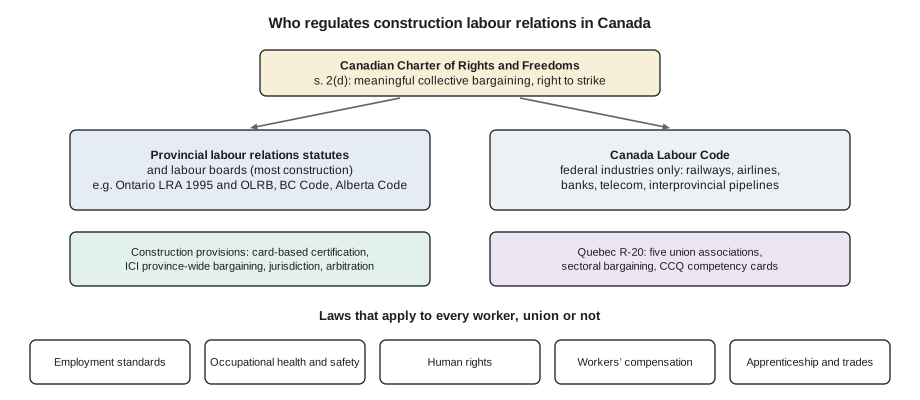
In Canada, labour relations are mainly a provincial responsibility. Since the 1925 Privy Council decision in Toronto Electric Commissioners v. Snider, each province has had its own labour relations statute and labour board, and the federal Canada Labour Code applies only to federally regulated industries such as railways, airlines, banking, telecommunications and interprovincial pipelines. Construction work almost always falls under provincial law, even on a federally owned site, because building is treated as a provincial activity unless it is an integral part of a federal undertaking.
Each province has adapted its law to construction. In Ontario, the Labour Relations Act, 1995 contains a separate part for the construction industry, administered by the Ontario Labour Relations Board (OLRB), with its own rules on certification, province-wide bargaining in the ICI sector, jurisdictional disputes and expedited arbitration. British Columbia's Labour Relations Code, Alberta's Labour Relations Code and the other provincial statutes each have construction provisions of their own. Quebec is the most distinctive: under its construction labour relations act, usually called R-20, almost all construction workers must belong to one of five recognized union associations, bargaining takes place sector by sector across the province, and the Commission de la construction du Québec (CCQ) issues competency cards and manages hiring, training and benefits.
The Canadian Charter of Rights and Freedoms adds a constitutional layer. In a series of decisions, most notably Health Services and Support (2007) and Saskatchewan Federation of Labour (2015), the Supreme Court of Canada held that freedom of association in section 2(d) protects a meaningful process of collective bargaining and, in its essential form, the right to strike. Governments can still regulate bargaining, but laws that substantially interfere with it must be justified.
The other laws that apply to every worker
Labour relations law governs unions, bargaining and the relationship between the parties. A second set of laws applies to every worker whether or not a union is present. Supervisors deal with all of them daily.
| Subject | Ontario example |
|---|---|
| Minimum standards: wages, hours, overtime, vacation, termination | Employment Standards Act, 2000 |
| Health and safety | Occupational Health and Safety Act and the Construction Projects regulation |
| Discrimination and harassment | Human Rights Code; OHSA harassment provisions |
| Injury compensation | Workplace Safety and Insurance Act (WSIB) |
| Wages on public work | Fair wage policies of some public owners |
| Apprenticeship and trade certification | Building Opportunities in the Skilled Trades Act, 2021 (Skilled Trades Ontario) |
A collective agreement can give workers more than these statutes require but not less. If the Employment Standards Act gives a worker a right and the collective agreement is silent, the statute still applies, and in Ontario an employment standards complaint by a unionized worker is usually decided through the grievance procedure rather than by an employment standards officer.
Union and non-union work side by side
Canadian construction has a higher level of union coverage than American construction, but the share varies widely: it is high in the ICI sector in Ontario, Quebec (where it is close to universal) and parts of Atlantic Canada, and much lower in residential construction and in Alberta. There are also several kinds of union. The traditional building trades unions are craft unions, each representing one trade. The Christian Labour Association of Canada (CLAC) and some independent unions represent all trades of an employer together. And many contractors are open shops, operating without a union. Lesson 2 compares these models.
On Elmwood, the owner did not require union labour. Calder Ridge's own crews are unionized, the electrical and mechanical subcontractors are union shops, and the drywall, painting and landscaping subcontractors are not. Running that mixed site well means knowing what each employer's agreements require and keeping disputes from spreading between them.
A first look at the Elmwood workforce
Grace Thibodeau starts every project by mapping who will be on site, which agreements cover them and who represents them. The table below is a simplified version of her map for Elmwood's busiest month.
# Elmwood tower: workers on site in the peak month, by employer and representation (illustrative)
site = [
    # (employer, trade, workers, represented by)
    ("Calder Ridge", "carpenters", 120, "carpenters' union (ICI provincial agreement)"),
    ("Calder Ridge", "labourers", 100, "labourers' union (ICI provincial agreement)"),
    ("Brightline Electric", "electricians", 95, "electrical workers' union"),
    ("Keystone Mechanical", "plumbers and pipefitters", 110, "plumbers' and pipefitters' union"),
    ("Apex Sheet Metal", "sheet metal workers", 45, "sheet metal workers' union"),
    ("Norfield Drywall", "drywall and framing", 80, "none (open shop)"),
    ("Colourline Painting", "painters", 30, "none (open shop)"),
    ("Steelcraft Erectors", "ironworkers", 25, "ironworkers' union"),
]
total = sum(w for _, _, w, _ in site)
union = sum(w for _, _, w, rep in site if not rep.startswith("none"))
employers = {e for e, _, _, _ in site}
print(f"workers on site: {total}, employers: {len(employers)}")
print(f"represented by a union: {union} ({union / total:.0%}); open shop: {total - union} ({(total - union) / total:.0%})")
for e, trade, w, rep in sorted(site, key=lambda r: -r[2]):
print(f" {e:20s} {trade:26s} {w:4d} {rep}")workers on site: 605, employers: 7 represented by a union: 495 (82%); open shop: 110 (18%) Calder Ridge carpenters 120 carpenters' union (ICI provincial agreement) Keystone Mechanical plumbers and pipefitters 110 plumbers' and pipefitters' union Calder Ridge labourers 100 labourers' union (ICI provincial agreement) Brightline Electric electricians 95 electrical workers' union Norfield Drywall drywall and framing 80 none (open shop) Apex Sheet Metal sheet metal workers 45 sheet metal workers' union Colourline Painting painters 30 none (open shop) Steelcraft Erectors ironworkers 25 ironworkers' union
Seven of the eight employers on Grace's list have their own agreements, rates, stewards and procedures, and two do not. Calder Ridge directly employs just over a third of the workforce, but as the general contractor it coordinates everyone. A dispute between the drywall contractor and the carpenters about who frames the bulkheads, or a picket line set up against the painting subcontractor, can stop work for every trade on site.
Three relationships on every site
It helps to think of labour relations on a project as three overlapping relationships. The first is between each employer and its own workers, governed by employment law and, where there is a union, by the collective agreement. The second is between employers and unions, which bargain the agreements, administer them through stewards and business representatives, and settle disputes through grievances and arbitration. The third is between the employers on the site, linked by subcontracts that pass down obligations such as schedules, safety rules and sometimes labour requirements set by the owner. A good superintendent keeps all three in view. When Luis Ferreira plans a weekend pour, he thinks about his own crew's overtime rules, the steward's likely questions, and whether the pump operator's union and the rebar subcontractor's crew are covered for the same hours.
What a supervisor needs to know
Superintendents and foremen are not labour lawyers, and Calder Ridge does not expect them to be. It does expect them to know enough to spot an issue early, avoid making it worse and call Grace. Her short list for new supervisors covers the areas where field decisions most often create labour relations problems.
- Which agreement covers each crew, and what it says about hours, overtime, breaks, travel, show-up pay and the number of apprentices per journeyperson.
- Who the stewards are, what rights they have, and why problems should be raised with them early rather than allowed to fester.
- Which trade claims which work, and why changing an assignment without checking can trigger a jurisdictional dispute.
- What supervisors must never do during a union organizing campaign, such as threatening, interrogating, promising benefits or spying.
- How to document performance and conduct problems so that discipline can be defended if it is grieved.
- How to respond to harassment, discrimination or a safety complaint, which are legal duties as well as good management.
Lessons 2 to 6 build the labour relations foundation: union models, how representation and bargaining work, collective agreements, jurisdiction, and project agreements. Lessons 7 to 11 turn to workforce management: hiring, apprenticeship, workforce planning and productivity, respect and harassment prevention, and discipline and grievances. Lesson 12 brings everything together in a workforce and labour relations plan for Calder Ridge's next project.
Common mistakes
MistakeAssuming the Canada Labour Code governs a construction project because the owner is federal.
InsteadConstruction labour relations are almost always provincial; check the provincial statute and board.
MistakeTreating labour relations as the head office's problem.
InsteadField decisions about assignments, overtime, discipline and complaints create most labour relations issues; supervisors need to spot them early.
MistakeBelieving a collective agreement replaces employment standards, safety or human rights laws.
InsteadThose statutes set a floor that applies to every worker; an agreement can add to them but not take them away.
MistakeThinking only about your own company's crews.
InsteadOn a shared site, another employer's dispute or another union's claim can stop everyone's work.
Summary and key terms
- Construction's temporary projects, mobile workforce, shared sites and craft structure led to special labour relations rules.
- Canadian labour relations are mainly provincial; each province has construction provisions, and Quebec's R-20 system is unique.
- The Charter protects a meaningful process of collective bargaining and, in essence, the right to strike.
- Employment standards, safety, human rights, workers' compensation and apprenticeship laws apply to every worker, union or not.
- Most sites mix union and non-union employers, each with its own rules.
- Supervisors should know the agreements, the stewards, trade jurisdiction, campaign rules, documentation and complaint duties.
- Labour relations
- The legal and practical relationship between employers, workers and unions, especially organizing, bargaining and dispute resolution.
- Collective agreement
- A written contract between an employer or employers' association and a union that sets wages and working conditions for the workers it covers.
- Labour board
- A provincial tribunal that certifies unions and decides complaints under the labour relations statute, such as the OLRB.
- Open shop
- A contractor that operates without a union agreement.
- Steward
- A worker elected or appointed to represent the union on a site or crew.
- ICI sector
- The industrial, commercial and institutional sector of construction, as distinct from residential, roads and heavy civil work.
- Charter section 2(d)
- The freedom of association guarantee, which protects a meaningful process of collective bargaining.
Practice problems
Work each problem on paper first, then reveal the answer to check.
Why does most construction labour relations law in Canada come from the provinces?
Show answer
Since Toronto Electric Commissioners v. Snider (1925), labour relations have been treated as provincial; only federally regulated industries fall under the Canada Labour Code.
Name two features of construction that led to special labour relations rules.
Show answer
Any two: temporary projects, short and intermittent employment, many employers on one site, craft organization, the need to fix labour costs before bidding, cyclical demand.
What share of Elmwood's peak workforce was represented by a union, according to Grace's map?
Show answer
About 83 percent (505 of 605 workers).
If a collective agreement is silent on a right in the Employment Standards Act, does the worker still have it?
Show answer
Yes; statutes set a floor that applies regardless of the agreement.
What makes Quebec's construction system distinctive?
Show answer
Under R-20, nearly all construction workers must belong to one of five union associations, bargaining is sectoral across the province, and the CCQ manages competency cards, hiring and benefits.
Lesson quiz · 5 questions
Score 60% or more to complete this lesson.
Create a free account to save your progress, take quizzes and earn a certificate.