
CON-365 · Lesson 10 of 12 · 18 min
Respect, inclusion and harassment prevention
Construction has a reputation for a rough culture: hazing of new workers, crude jokes, graffiti in portable toilets, and an expectation that newcomers will put up with it to be accepted. That culture costs the industry dearly. It drives away the women, Indigenous workers, newcomers and young people the industry needs to replace its retiring workforce; it makes workers less willing to speak up about hazards; and it exposes employers to legal liability. Changing it is not about being soft. It is about running a site where everyone can do their job safely and well. This lesson covers the legal duties, the practical steps that work, and how supervisors should respond when something goes wrong.
Why this is a workforce issue
Women make up only about one in twenty workers in the skilled construction trades in Canada, a share that has barely moved in decades, and many leave within the first years of their apprenticeships. Surveys of tradeswomen, Indigenous workers and racialized workers consistently report harassment, exclusion, being given only menial work, and inadequate facilities as reasons for leaving. With the industry needing hundreds of thousands of new workers in the coming decade, a contractor that cannot keep a diverse workforce is limiting its own supply of labour.
There is also a safety link. Workers who feel they do not belong are less likely to ask questions, report near misses or stop unsafe work. Hazing that targets new workers puts them at risk at exactly the time when they are most likely to be injured. A site where people treat each other with respect is a site where the safety systems in CON-355 work.
The legal duties in Ontario
Two bodies of law apply. Ontario's Human Rights Code prohibits discrimination and harassment in employment on the protected grounds listed in lesson 7, and makes employers responsible for preventing and responding to it. The Occupational Health and Safety Act adds specific duties on workplace harassment, including sexual harassment, and workplace violence. Every employer must have a written policy on workplace harassment and on workplace violence, reviewed at least annually, and a program that sets out how workers report incidents, including to someone other than the employer or supervisor if that person is the alleged harasser, how complaints will be investigated, and how information will be kept confidential except as needed to investigate or as required by law. The employer must ensure an investigation appropriate in the circumstances is conducted, and must inform both the complainant and the alleged harasser of the results and of any corrective action. Recent amendments extended the definitions to harassment carried out by electronic and virtual means, such as group chats and social media.
Ontario's construction regulation adds requirements that address some of the practical barriers women face on sites. Since July 1, 2023, larger projects must provide at least one women-only washroom where reasonable, and toilets must be clean, private, lit and have a lock. Since January 1, 2025, constructors on projects with 20 or more regularly employed workers expected to last three months or more must provide menstrual products. From July 1, 2025 washrooms must be kept clean and sanitary, and from January 1, 2026 cleaning records must be kept and posted. The regulation also requires personal protective equipment to fit the worker properly, which matters for workers who do not fit standard sizes.
Prevention: what actually works
Policies are necessary but not enough. Every construction company has a harassment policy; the companies that have changed their culture did it through leadership, clear expectations, training that is practical rather than defensive, attention to facilities, and consistent consequences. Calder Ridge's program on Elmwood had six parts.
- Leadership: Nadia and Luis opened the project by telling every foreman, in person, that respect was a site rule with the same weight as fall protection, and explaining why.
- Clear expectations at orientation: what respectful behaviour looks like, what is not acceptable (including hazing, slurs, sexual comments, graffiti and exclusion), how to report, and what happens next.
- Bystander training: short sessions teaching workers practical ways to step in when they see disrespect, from a simple 'not cool' to telling a supervisor.
- Facilities: clean, lit, lockable washrooms including women-only facilities, properly fitting PPE in a range of sizes, and graffiti removed the same day.
- Fair work assignment: foremen were expected to give every worker, including apprentices and newcomers, a fair share of skilled work, and this was checked in apprentice reviews.
- Consequences: violations were dealt with promptly and consistently, through the discipline process in lesson 11, whatever the person's seniority or skill.
The fourth point surprised some foremen. Graffiti in toilets was so normal on sites that some saw removing it as fussy. Luis's view was that graffiti targeting women, racialized workers or gay workers told every member of those groups that the site was not theirs, and that leaving it up for a week told them the company agreed.
Responding when something happens
Supervisors are often the first to hear of harassment, sometimes informally: a comment at lunch, a worker who seems withdrawn, a steward who mentions a problem. A supervisor who knows about harassment is generally treated as the employer knowing about it, so doing nothing is not an option. Calder Ridge's response steps are designed so that supervisors know exactly what to do.
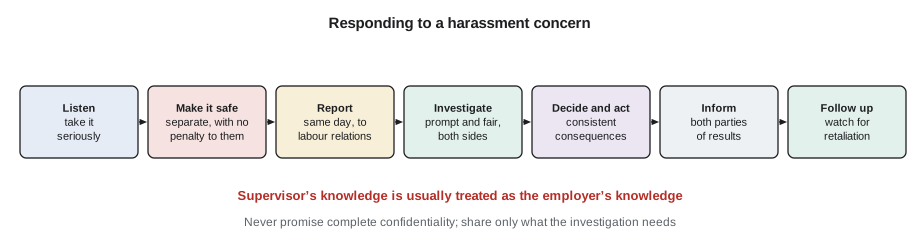
| Step | What the supervisor does | What to avoid |
|---|---|---|
| Listen | Take the concern seriously, listen without judging, note what was said | Dismissing it as a joke or asking why they did not toughen up |
| Make it safe | If needed, separate the people involved right away without penalizing the person who complained | Moving the complainant to a worse crew or shift |
| Report | Tell Grace the same day, even if the worker asks you not to | Promising complete confidentiality or handling it alone |
| Support the investigation | Provide facts and witness names; keep it confidential | Discussing it with the crew or tipping off the person accused |
| Prevent retaliation | Watch for exclusion, bad assignments or comments after a complaint | Assuming it is over once the investigation ends |
| Follow up | Check in with the worker in the weeks afterwards | Never mentioning it again |
Investigations are conducted by Grace or, for serious or sensitive cases, by an outside investigator. They follow basic fairness: the complainant and the person accused are both interviewed and told the allegations they need to respond to, witnesses are interviewed, evidence such as messages and photos is gathered, and findings are made on the balance of probabilities. In a unionized workplace, the person accused is entitled to union representation in the interview, and the steward's role is to see that the process is fair, not to block it.
A case from Elmwood
In month 11, Aisha Rahman told her mentor that two labourers on another crew had been making comments about her body whenever she passed the hoist, and that one had sent a crude image to a site group chat with her name on it. She did not want to make a formal complaint because she worried about being seen as a problem. Her mentor told her he understood, explained that he had to tell Grace, and did so that afternoon.
Grace spoke with Aisha the next morning, explained the process and the protections against retaliation, and asked what she needed to feel safe at work in the meantime. She interviewed the two labourers with their steward present, collected the group chat messages from two witnesses, and interviewed the hoist operator. Within a week she had found that the comments and the image were harassment under the policy. One labourer received a final written warning and was moved to a different area of the site; the other, who had sent the image and had a prior warning, was dismissed, and the union decided not to grieve after reviewing the evidence. Both outcomes were explained to Aisha. Luis held a toolbox talk on respect and the group chat rules for every crew, without naming anyone. Aisha's mentor checked in with her weekly for the next two months; there was no further incident, and she stayed on the project.
The case went well because each person did their part: the mentor reported despite the request to keep quiet, the investigation was quick and fair, the consequences fit the conduct and the history, and the follow-up continued after the decision.
Working with the union
Unions have a double role in harassment cases. They represent the member who has been harassed and, often, the member accused of harassment, and they owe a duty of fair representation to both. In practice, construction unions have increasingly taken an active part in prevention: many now train stewards and members on respectful workplaces, run programs for women and Indigenous members, and have endorsed industry campaigns against hazing and harassment. Calder Ridge invited the carpenters' and labourers' business representatives to its respect session for foremen on Elmwood, and Tom Kowalski, the carpenters' steward, spoke about why he had come to see harassment as a union issue: it weakens the crew, and it drives out members the union needs.
When discipline for harassment is grieved, arbitrators generally uphold serious penalties where the investigation was fair and the conduct was proven, and they look closely at whether the employer applied its policy consistently. A company that tolerated similar conduct by others in the past will find its discipline harder to defend, which is one more reason for consistency.
Measuring the culture
Harassment is under-reported, so the number of complaints says little on its own: a rise can mean things are getting worse or that people trust the process more. Calder Ridge runs a short anonymous survey every quarter on each large project and looks at the results by crew alongside complaints and turnover.
# Quarterly respect survey (share agreeing, anonymous) by crew, with early turnover (illustrative)
crews = {
    # crew: (I am treated with respect, I would report harassment without fear, I get a fair share of skilled work, early turnover rate)
    "Forming crew A":    (0.91, 0.84, 0.88, 0.08),
    "Forming crew B":    (0.86, 0.79, 0.81, 0.12),
    "Concrete crew":     (0.72, 0.58, 0.69, 0.27),
    "Deck crew":         (0.88, 0.80, 0.77, 0.10),
    "Finishing crew":    (0.93, 0.88, 0.90, 0.05),
}
print(f"{'crew':16s} respect report fair-work turnover")
for c, (r, rep, fair, t) in crews.items():
    low = min(r, rep, fair)
    flag = "  <- talk with foreman, observe crew" if low < 0.75 or t > 0.2 else ""
print(f"{c:16s} {r:6.0%} {rep:6.0%} {fair:8.0%} {t:8.0%}{flag}")crew respect report fair-work turnover Forming crew A 91% 84% 88% 8% Forming crew B 86% 79% 81% 12% Concrete crew 72% 58% 69% 27% <- talk with foreman, observe crew Deck crew 88% 80% 77% 10% Finishing crew 93% 88% 90% 5%
The concrete crew stood out on every measure, including early turnover. Grace and Luis did not treat the survey as proof of wrongdoing, but they spent time with the crew, observed the work, talked privately with several workers and coached the foreman, who had been leaving new workers to fend for themselves. The next quarter's results improved, and early turnover on the crew fell.
Common mistakes
MistakeTreating hazing of new workers as harmless tradition.
InsteadMake respect a site rule; hazing harms new workers at their most vulnerable time and drives them away.
MistakePromising a worker you will keep a harassment report to yourself.
InsteadExplain that you must report it, and report the same day; confidentiality is limited to what the investigation needs.
MistakeMoving the person who complained to a worse crew to end the conflict.
InsteadSeparate people without penalizing the complainant, and watch for retaliation.
MistakeLeaving offensive graffiti until the next cleaning.
InsteadRemove it the same day; leaving it signals the company accepts it.
MistakeJudging the culture by the number of complaints.
InsteadUse anonymous surveys, turnover and observation alongside complaints.
Summary and key terms
- Disrespect and harassment drive away the workers construction needs and weaken safety.
- Ontario's Human Rights Code and OHSA require harassment policies, programs, investigations and reporting of results to both parties.
- Ontario's construction regulation now requires women-only washrooms, menstrual products, clean facilities and properly fitting PPE.
- Prevention combines leadership, clear expectations, bystander training, facilities, fair assignment and consistent consequences.
- Supervisors who learn of harassment must listen, make it safe, report the same day, support the investigation and prevent retaliation.
- Investigations must be prompt and fair, with representation where the agreement provides it.
- Anonymous surveys by crew, with turnover, reveal problems complaints miss.
- Workplace harassment
- A course of vexatious comment or conduct against a worker that is known or ought to be known to be unwelcome, including sexual harassment.
- Workplace sexual harassment
- Unwelcome comment or conduct because of sex, sexual orientation, gender identity or expression, or an unwelcome solicitation by a person in a position of power.
- Hazing
- Humiliating or dangerous treatment of new workers presented as initiation.
- Bystander intervention
- Action by a witness to stop or report disrespectful behaviour.
- Retaliation
- Adverse treatment of a person for raising a complaint or taking part in an investigation.
- Balance of probabilities
- The standard of proof in workplace investigations: more likely than not.
- Harassment program
- The written procedures for reporting, investigating and responding to harassment required by Ontario's OHSA.
Practice problems
Work each problem on paper first, then reveal the answer to check.
Why is respect on site a safety issue as well as a workforce issue?
Show answer
Workers who feel excluded are less likely to ask questions, report near misses or stop unsafe work, and hazing targets workers when they are most at risk.
Aisha asked her mentor not to report the harassment. What should he have done, and what did he do?
Show answer
Explain that he must report it and report it the same day; he did.
Why was one labourer dismissed and the other given a final warning?
Show answer
The one dismissed had sent the image and had a prior warning; the outcomes reflected the conduct and the history.
Which crew stood out in the survey, and what did Grace and Luis do?
Show answer
The concrete crew; they observed, talked privately with workers and coached the foreman rather than treating the survey as proof.
Why can a rise in complaints be a good sign?
Show answer
It can mean people trust the process more, not that harassment has increased.
Lesson quiz · 5 questions
Score 60% or more to complete this lesson.
Create a free account to save your progress, take quizzes and earn a certificate.