
CON-410 · Lesson 6 of 12 · 26 min
The Last Planner System III: weekly work plans, PPC and learning
The weekly work plan is where the Last Planner System becomes a set of promises. Each week, the last planners, usually trade forepersons, choose tasks from the workable backlog and commit to completing them in the following week. At the end of the week, the team records which commitments were kept and, for each one that was missed, the reason. The fraction of commitments kept, percent plan complete (PPC), is the system's best-known metric. But PPC on its own is just a number; the value comes from the learning loop that asks why commitments fail and changes the system so they fail less often. This lesson covers how to make good commitments, how to run the weekly planning meeting and daily huddles, how to calculate and interpret PPC and how to turn reasons for misses into improvement.
What makes a good commitment
A commitment in the weekly work plan is a promise by a named person to complete a defined piece of work by a stated day. Ballard proposed five quality criteria for assignments. They are worth checking for every line in the plan, because vague or unsound assignments make PPC meaningless.
| Criterion | Question | Example of a weak assignment | Stronger version |
|---|---|---|---|
| Definition | Is the task specific enough that everyone can tell when it is done? | "Electrical floor 5" | "Rough-in, suites 501 to 503, ready for inspection Thursday" |
| Soundness | Are all constraints removed? | Board zone 4B with inspection not yet passed | Board zone 4A, inspection passed Monday |
| Sequence | Is it the right work in the right order, matching the phase plan? | Ceiling grid before above-ceiling rough-in is complete | Above-ceiling rough-in first, then grid |
| Size | Is it sized to the crew's capacity for the week? | Six zones for a crew that averages two | Two zones, with one more ready in backlog |
| Learning | If it is missed, will the reason be recorded and acted on? | Missed tasks silently rolled into next week | Misses recorded with a reason and discussed |
Commitments should be made in the language of promises: 'I will finish rough-in in 501 to 503 by Thursday' rather than 'we should be able to get to some of floor 5'. A last planner who cannot make that promise, because the crew is short or a constraint is uncertain, should say so. A smaller set of reliable promises is better for everyone downstream than a long list of hopeful ones.
The weekly work planning meeting
The weekly work planning meeting usually takes 45 to 90 minutes, near the end of the week, with all the trade forepersons who will work on site the following week. It reviews the past week, then builds the next week's plan from the workable backlog. Many teams combine it with the look-ahead meeting from lesson 5, taking the look-ahead items second.
| Agenda item | What happens |
|---|---|
| Review last week | Each foreperson marks each commitment complete or not; reasons for misses are recorded |
| PPC and reasons | The team sees this week's PPC, the trend and the reasons; one or two are chosen for deeper analysis |
| Next week's plan | Each foreperson selects sound tasks from the workable backlog and commits, by day |
| Hand-off check | Trades confirm the hand-offs between them: who releases which area to whom, and when |
| Constraint check | Any doubts about soundness are raised; doubtful tasks are deferred |
| Look-ahead and constraints | If combined, roll the look-ahead and review the constraint log |
The meeting should be held in a room with the plan visible to everyone, on a wall or large screen, and it should be run by the people doing the work rather than by an office scheduler. Commitments are made by forepersons in front of their peers, which makes them more considered and more reliable than commitments made privately to a superintendent.
Daily huddles
Between weekly meetings, a short daily huddle, often 10 to 15 minutes at the start of the day, keeps the plan on track. Forepersons say what their crews will do today, confirm hand-offs and raise any problem that threatens a commitment, so that it can be solved before it causes a miss. The huddle is not a status report to management; it is a coordination meeting among peers. Problems that need more time are taken offline with the people involved. Many sites combine the daily huddle with the daily safety talk, which helps make safety part of planning rather than a separate topic.
Percent plan complete
PPC is the number of commitments completed as promised divided by the total number of commitments made for the week. A task counts as complete only if it was entirely finished; partial completion counts as a miss. This binary rule can seem harsh, but it is deliberate: PPC measures the reliability of promises, not the amount of work done, and a downstream trade that receives 90 % of an area cannot start on it.
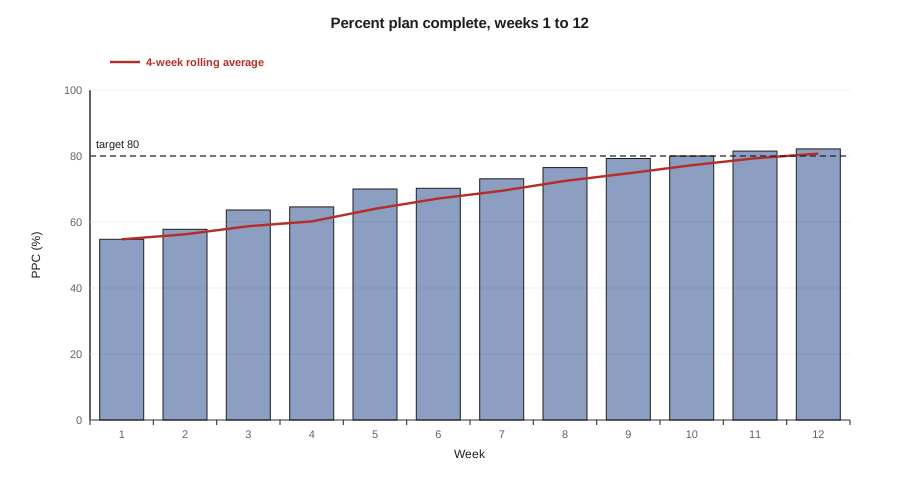
Research by Ballard and others found that projects starting the Last Planner System typically have PPC around 50 %, and that PPC rises to 70 % or 80 % as teams learn to make sound commitments and remove the causes of failure. Higher PPC is associated with better productivity, because crews spend more time on work that is ready. Very high PPC, consistently above 90 %, can be a warning sign: the team may be committing only to easy work, padding its plan, or counting partial work as complete.
# PPC trend and rolling average on Willowmere Residences, weeks 1 to 12 (illustrative)
committed = [42, 45, 44, 48, 50, 47, 52, 51, 53, 55, 54, 56]
completed = [23, 26, 28, 31, 35, 33, 38, 39, 42, 44, 44, 46]
ppc = [c / n for c, n in zip(completed, committed)]
for w, p in enumerate(ppc, 1):
    roll = sum(ppc[max(0, w - 4):w]) / min(w, 4)
    bar = "#" * round(p * 40)
    print(f"week {w:>2}: PPC {p:5.1%}  4-week avg {roll:5.1%}  {bar}")
print(f"Overall: {sum(completed)} of {sum(committed)} commitments kept = {sum(completed) / sum(committed):.1%}")week 1: PPC 54.8% 4-week avg 54.8% ###################### week 2: PPC 57.8% 4-week avg 56.3% ####################### week 3: PPC 63.6% 4-week avg 58.7% ######################### week 4: PPC 64.6% 4-week avg 60.2% ########################## week 5: PPC 70.0% 4-week avg 64.0% ############################ week 6: PPC 70.2% 4-week avg 67.1% ############################ week 7: PPC 73.1% 4-week avg 69.5% ############################# week 8: PPC 76.5% 4-week avg 72.4% ############################### week 9: PPC 79.2% 4-week avg 74.8% ################################ week 10: PPC 80.0% 4-week avg 77.2% ################################ week 11: PPC 81.5% 4-week avg 79.3% ################################# week 12: PPC 82.1% 4-week avg 80.7% ################################# Overall: 429 of 597 commitments kept = 71.9%
Reasons for non-completion
Every missed commitment is given a reason, chosen from a standard list so that reasons can be counted and compared over time. A typical list follows the seven preconditions from lesson 5, plus categories for planning errors (the task was overcommitted or poorly defined), changes in priority and weather. The reasons are recorded by the last planner who made the commitment, in the meeting, honestly and without blame.
| Reason category | Example |
|---|---|
| Prerequisite work | Previous trade had not finished the area |
| Materials | Fixtures delivered with wrong finish |
| Information | RFI response not received; drawing revision pending |
| Labour | Crew smaller than planned; key worker absent |
| Equipment | Hoist down for repair; lift not available |
| Space | Area occupied by another trade |
| External | Inspection failed or not available; permit delay |
| Weather | Rain or cold prevented work |
| Overcommitment | More work committed than the crew could do |
| Priority change | Crew moved to other work by management |
| Rework | Time spent correcting earlier work |
# Pareto of reasons for missed commitments, weeks 1 to 12 (illustrative)
from collections import Counter
misses = (["prerequisite work"] * 41 + ["overcommitment"] * 22 + ["information"] * 17 +
          ["materials"] * 15 + ["crew size"] * 13 + ["external (inspection)"] * 11 +
          ["equipment"] * 6 + ["space"] * 5 + ["weather"] * 4 + ["priority change"] * 3)
c = Counter(misses)
total = sum(c.values())
cum = 0
for reason, n in c.most_common():
    cum += n
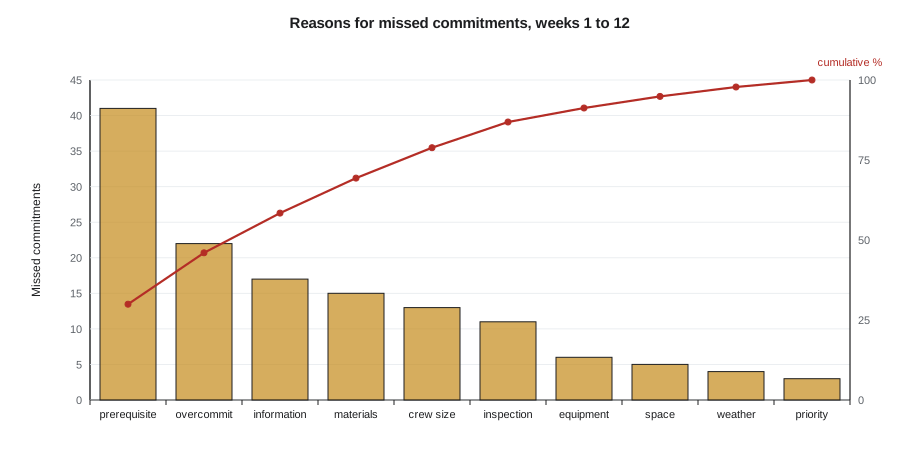
print(f"{reason:<24}{n:>4} {n / total:6.1%} cumulative {cum / total:6.1%}")prerequisite work 41 29.9% cumulative 29.9% overcommitment 22 16.1% cumulative 46.0% information 17 12.4% cumulative 58.4% materials 15 10.9% cumulative 69.3% crew size 13 9.5% cumulative 78.8% external (inspection) 11 8.0% cumulative 86.9% equipment 6 4.4% cumulative 91.2% space 5 3.6% cumulative 94.9% weather 4 2.9% cumulative 97.8% priority change 3 2.2% cumulative 100.0%
The Pareto ranking shows where to focus. On Willowmere, prerequisite work and overcommitment together account for close to half of all misses. Prerequisite work misses mean that hand-offs between trades are unreliable; the team should look at how areas are released and accepted, perhaps with a simple hand-off checklist signed by both trades. Overcommitment means forepersons are promising more than their crews can deliver; the response is to size commitments to demonstrated capacity, using each trade's recent completion record.
From reasons to root causes
A reason category is a symptom, not a root cause. 'Prerequisite work' tells the team that the previous trade had not finished, but not why. The learning step asks why repeatedly, often using the five whys technique covered in lesson 11. For one miss on Willowmere: the board crew could not start zone 4B (why?) because insulation was not complete (why?) because the insulator had been moved to another floor (why?) because the in-wall inspection on 4B was late (why?) because the inspection request was made the day before rather than three days ahead as the municipality requires (why?) because nobody owned inspection booking. The countermeasure is not to blame the insulator but to add inspection booking to the constraint log with a named owner and a lead time.
| Level | Statement |
|---|---|
| Miss | Board on zone 4B not done |
| Reason category | Prerequisite work |
| Why 1 | Insulation not complete |
| Why 2 | Insulator moved to another floor |
| Why 3 | In-wall inspection on 4B late |
| Why 4 | Inspection requested one day ahead; municipality needs three |
| Root cause | No owner or lead time for booking inspections |
| Countermeasure | Inspection booking added to constraint log with owner and 3-day lead time |
Using PPC well
PPC is a measure of planning reliability, not of productivity or progress, and it should not be used to rank trades or punish them. A trade that keeps 95 % of very small commitments may be contributing less than a trade that keeps 75 % of challenging but well-planned ones. When PPC is used for blame, people quickly learn to game it by committing only to trivial work or by redefining tasks after the fact. When it is used for learning, it becomes a shared measure of how well the team plans together. Some teams also track PPC by trade, so that each trade can see its own reliability, and milestone variance, which measures whether phase milestones are being met.
| Metric | What it measures | Level |
|---|---|---|
| Percent plan complete | Reliability of weekly commitments | Weekly work plan |
| Tasks Made Ready and Tasks Anticipated | Effectiveness of the look-ahead process | Look-ahead |
| Milestone variance | Whether phase milestones are met | Phase plan |
| Constraint age and overdue count | Speed of constraint removal | Look-ahead |
| Workable backlog in weeks | Readiness buffer for each trade | Look-ahead |
Digital tools
Many teams now run the Last Planner System on digital platforms that support pull planning boards, look-ahead plans, constraint logs, commitments and PPC charts, and that connect to the master schedule and to field management software (CON-260). Digital tools make it easier to share plans across a large site and to analyse reasons over time. They do not replace the conversations. The commitment made by a foreperson in front of peers, and the honest discussion of why it was missed, are the heart of the system; a tool that lets people update tasks silently from their phones can undermine that if it replaces the meeting rather than supporting it.
Worked problem
PPC and reasons for one week
In week 9 on Willowmere, trades made 53 commitments. Electrical kept 9 of 10, mechanical 7 of 9, plumbing 6 of 8, drywall 8 of 11, framing 6 of 7 and finishes 6 of 8. What is the project PPC for the week, and which trade had the lowest PPC?
Show solution
- Completed: 9 + 7 + 6 + 8 + 6 + 6 = 42.
- PPC = 42 ÷ 53 = 79.2 %.
- By trade: electrical 90 %, mechanical 78 %, plumbing 75 %, drywall 73 %, framing 86 %, finishes 75 %.
Answer: Project PPC was 79 %. Drywall had the lowest PPC at 73 %, and the team should look at its reasons, which may lie upstream in prerequisite work rather than in the drywall crew itself.
Common mistakes
MistakeCounting a task that is 90 % done as complete.
InsteadCount only tasks finished as promised; partial completion is a miss.
MistakeMaking vague commitments such as 'work on floor 5'.
InsteadDefine each commitment specifically, with location, scope and day.
MistakeRecording reasons for misses but never analysing them.
InsteadRank reasons, trace the main ones to root causes and act on countermeasures.
MistakeRanking or penalizing trades by their PPC.
InsteadUse PPC to improve planning; blame leads to gaming.
MistakeCelebrating PPC consistently above 95 %.
InsteadCheck whether commitments are too easy or tasks are being redefined.
Summary and key terms
- Weekly work plans are commitments by last planners, made from the workable backlog.
- Good assignments meet five criteria: definition, soundness, sequence, size and learning.
- The weekly planning meeting reviews last week, records reasons and builds next week's plan in front of peers; daily huddles keep it on track.
- Percent plan complete is commitments kept divided by commitments made, counting only full completion.
- PPC often starts near 50 % and rises to 70 to 80 % as teams learn; very high PPC can signal sandbagging.
- Reasons for misses are recorded from a standard list, ranked in a Pareto chart and traced to root causes.
- PPC measures reliability, not productivity, and should never be used to punish trades.
- Weekly work plan
- The set of commitments last planners make for the coming week.
- Commitment
- A promise by a named person to complete a defined task by a stated time.
- Percent plan complete
- Commitments completed as promised divided by commitments made.
- Reason for non-completion
- The recorded cause of a missed commitment, chosen from a standard list.
- Pareto chart
- A chart ranking categories by frequency with a cumulative percentage line.
- Daily huddle
- A short daily coordination meeting among forepersons.
- Assignment quality criteria
- Definition, soundness, sequence, size and learning.
- Sandbagging
- Committing to less than can be done so that commitments are easy to keep.
- Milestone variance
- The difference between planned and actual milestone dates.
- Root cause
- The underlying system failure that, if corrected, prevents a problem recurring.
Practice problems
Work each problem on paper first, then reveal the answer to check.
A week has 60 commitments and 45 are kept. What is PPC?
Show answer
75 %.
A task is 95 % complete at the end of the week. How does it count in PPC?
Show answer
As not complete.
Name Ballard's five quality criteria for assignments.
Show answer
Definition, soundness, sequence, size, learning.
Rewrite 'mechanical floor 6' as a better commitment.
Show answer
For example, 'Duct rough-in suites 601 to 604 complete by Wednesday'.
Why might PPC consistently above 95 % be a concern?
Show answer
Commitments may be too easy, padded or redefined after the fact.
In a Pareto of reasons, prerequisite work is the top category. What should the team examine?
Show answer
How areas are handed off between trades, and why prior work is late.
What is the purpose of the daily huddle?
Show answer
Peer coordination of the day's work and early raising of problems.
Why should commitments be made in front of peers?
Show answer
It makes them more considered and creates shared accountability.
What does milestone variance measure?
Show answer
Whether phase milestones are being met as planned.
Why is PPC not a measure of productivity?
Show answer
It measures whether promises are kept, not how much work is done per hour.
Lesson quiz · 5 questions
Score 60% or more to complete this lesson.
Create a free account to save your progress, take quizzes and earn a certificate.