
CON-430 · Lesson 4 of 12 · 27 min
Low-carbon materials: concrete, steel and mass timber
Lesson 3 showed that the structure dominates the upfront carbon of a typical mid-rise building, and that concrete and reinforcing steel together made up about 85 % of Cedar Row's product-stage emissions. This lesson looks at the materials that offer the biggest savings: concrete, steel and mass timber, with shorter notes on aluminium, insulation and finishes. CON-111 introduced these materials and their basic properties, including engineered wood and mass timber; here the focus is on how their carbon footprint arises, what a builder can do to reduce it, and the construction issues that come with each low-carbon option.
Why concrete is carbon intensive
Concrete itself is not especially carbon intensive per kilogram; it is used in such enormous quantities that it adds up. Most of its footprint comes from Portland cement, which typically makes up 10 to 15 % of a mix by mass but accounts for most of its embodied carbon. Cement is made by heating limestone and clay in a kiln to about 1,450 °C to form clinker. About 60 % of the resulting emissions come from the chemistry itself, as calcium carbonate breaks down into lime and carbon dioxide, and about 40 % from burning fuel to heat the kiln. Cement production is commonly estimated at about 7 to 8 % of global carbon dioxide emissions. Because the process emissions come from chemistry, burning cleaner fuel can only solve part of the problem; the main levers are using less clinker and, in the longer term, carbon capture at cement plants.
The practical rule for builders is that reducing clinker content is the biggest lever on concrete carbon. There are four main ways to do it: use a blended cement such as Portland-limestone cement (CSA type GUL), replace part of the cement with supplementary cementing materials (SCMs), optimize the mix so that less total binder is needed, and specify the strength at a later age so that slower-gaining SCM mixes can be used.
Low-carbon concrete strategies
Portland-limestone cement replaces part of the clinker with finely ground limestone, typically up to 15 %. The Cement Association of Canada describes GUL as having up to about 10 % lower carbon footprint than general use (GU) cement while giving similar performance, and it has become the default cement in much of Canada. Supplementary cementing materials include fly ash from coal power plants, ground granulated blast-furnace slag from iron production, silica fume, and newer materials such as calcined clays and ground glass pozzolan. Fly ash supply is shrinking as coal plants close, which makes slag and calcined clays increasingly important.
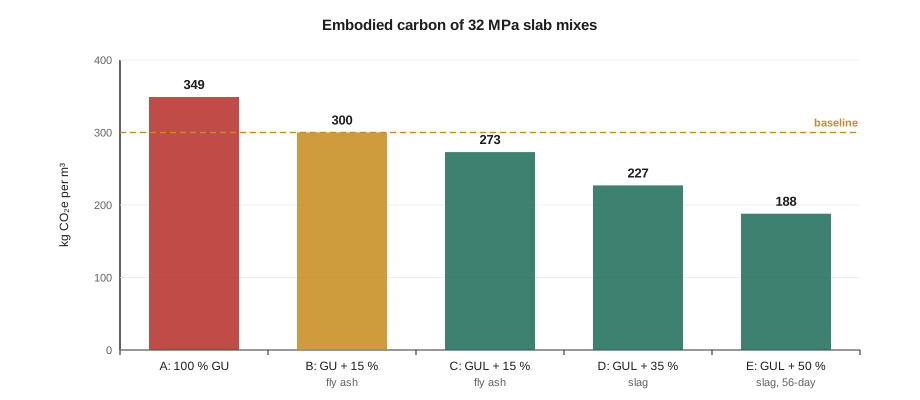
# Embodied carbon (A1-A3) of five 32 MPa slab mixes, per cubic metre (illustrative factors)
f = {'GU': 0.92, 'GUL': 0.83, 'fly ash': 0.02, 'slag': 0.12}   # kg CO2e per kg of binder
other = 0.005 * 1900 + 8        # aggregates (about 1,900 kg) plus batching, kg CO2e per m3
mixes = {
    'A: 100 % GU, 360 kg binder':            {'GU': 360},
    'B: GU + 15 % fly ash (baseline)':       {'GU': 306, 'fly ash': 54},
    'C: GUL + 15 % fly ash':                 {'GUL': 306, 'fly ash': 54},
    'D: GUL + 35 % slag':                    {'GUL': 234, 'slag': 126},
    'E: GUL + 50 % slag, 56-day strength':   {'GUL': 180, 'slag': 180},
}
for name, m in mixes.items():
    co2 = sum(kg * f[k] for k, kg in m.items()) + other
print(f"{name:38s} {co2:5.0f} kg CO2e/m3")A: 100 % GU, 360 kg binder 349 kg CO2e/m3 B: GU + 15 % fly ash (baseline) 300 kg CO2e/m3 C: GUL + 15 % fly ash 273 kg CO2e/m3 D: GUL + 35 % slag 227 kg CO2e/m3 E: GUL + 50 % slag, 56-day strength 188 kg CO2e/m3
Moving from a conventional mix with a little fly ash to Portland-limestone cement with 50 % slag cuts the slab concrete's carbon by more than a third, without changing the structural design. Even the simple switch to a limestone cement saves about 9 % per cubic metre. These factors are illustrative; real mixes vary by plant, and the supplier's product-specific EPD is the right source for a project.
Other strategies include specifying performance rather than prescription, so that suppliers can choose the lowest-carbon mix that meets strength, durability and workability requirements; setting a maximum global warming potential per cubic metre for each mix class, often set as a percentage below a benchmark such as the National Ready Mixed Concrete Association's regional benchmarks in the United States or the Canadian Ready-Mixed Concrete Association's industry-average EPD; using carbon dioxide mineralization, in which captured CO2 is injected into fresh concrete where it becomes a mineral and allows a small cement reduction; and right-sizing elements so that slabs, transfer beams and foundations are not thicker or stronger than needed.
These mixes bring construction issues that builders must plan for. High-SCM mixes gain strength more slowly, especially in cold weather, which affects formwork stripping, reshoring and post-tensioning schedules; they may need longer curing and more careful cold-weather protection; finishing may differ; and some specifications or engineers are cautious about using them in exposed or freeze-thaw conditions. A good approach is to agree on mix classes early with the structural engineer and supplier, set strength ages by element (for example, 56-day strength for foundations and walls that are not loaded early), and run trial batches.
Steel: recycled content and production route
Steel's carbon footprint depends mainly on how it is made. Blast furnace and basic oxygen furnace (BF-BOF) production makes new steel from iron ore and coke and emits roughly 2 tonnes of CO2e per tonne of steel. Electric arc furnace (EAF) production melts mainly scrap steel using electricity and typically emits a third to a half as much, with the exact figure depending on the scrap share and the grid. Most North American reinforcing bar and many hot-rolled structural sections are made in electric arc furnaces with high recycled content, while plate, sheet and some hollow sections are more often made by the BF-BOF route or imported.
| Product | Typical route in North America | Illustrative A1–A3 (kg CO2e per kg) | Builder's levers |
|---|---|---|---|
| Reinforcing steel | EAF, high scrap content | 0.6 to 1.0 | Ask for product-specific EPDs; optimize bar layout and laps |
| Hot-rolled sections | Mostly EAF | 0.9 to 1.3 | Specify EPD and maximum GWP; avoid over-designed members |
| Hollow structural sections | Mixed EAF and BF-BOF | 1.5 to 2.5 | Check route and origin; consider alternatives |
| Plate and sheet, steel deck | Often BF-BOF | 1.8 to 2.8 | Check EPDs; minimize gauge where design allows |
| Imported steel | Varies widely | Up to 3 or more | Require EPDs and traceability |
Because scrap supply is limited, buying more recycled steel for one project does not necessarily reduce global emissions; it may only shift scrap from another buyer. For that reason, many carbon policies focus on the product's actual GWP rather than recycled content alone. Newer production routes, such as direct reduced iron made with natural gas or hydrogen, could reduce primary steel emissions in the future. Meanwhile, builders can reduce steel carbon by avoiding waste, optimizing rebar detailing and coordinating so that bars are not left over or replaced.
Mass timber
Mass timber uses large engineered wood panels and members, such as cross-laminated timber (CLT), glued-laminated timber (glulam), nail-laminated timber (NLT) and dowel-laminated timber (DLT), to form floors, walls, roofs and frames. Its fossil emissions per cubic metre are typically much lower than those of concrete, and it stores biogenic carbon, although, as Lesson 3 explained, that storage must be reported separately and is not permanent. The 2020 National Building Code of Canada introduced encapsulated mass timber construction for buildings up to 12 storeys, with mass timber protected by gypsum board or other encapsulation, and the 2025 edition and several provinces have expanded the options; check the edition your province has adopted.
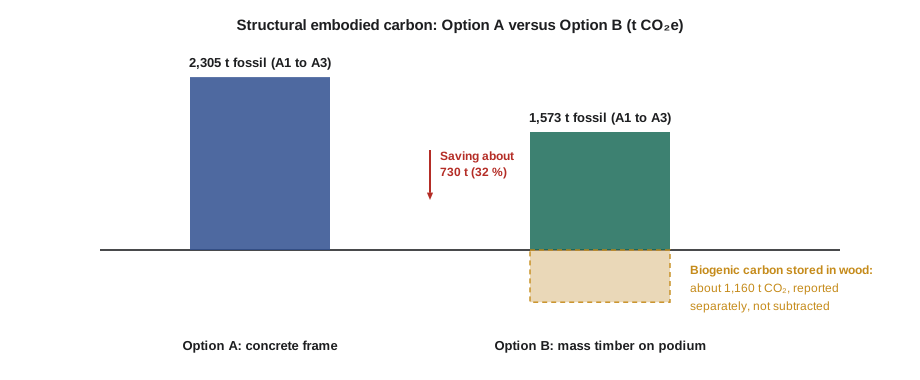
For Cedar Row, Option B uses a mass timber superstructure (CLT floors on glulam columns and beams) over a two-storey concrete podium, with concrete stair and elevator cores, a concrete topping on the floors for acoustics, and gypsum encapsulation for fire. The structural engineer has produced preliminary quantities, which the code below compares with Option A on a fossil-only basis.
# Structure only, A1-A3 fossil emissions: Cedar Row Option A (concrete) vs Option B (mass timber)
A = [('Foundations', 1400, 330), ('Suspended slabs', 3200, 300), ('Columns and walls', 900, 380),
     ('Rebar', 550000, 0.85), ('Misc. steel', 60000, 1.22)]
B = [('Foundations', 1150, 330), ('Podium slabs', 800, 300), ('Podium columns and walls', 300, 380),
     ('Concrete cores', 450, 380), ('Rebar', 270000, 0.85), ('CLT floor and roof panels', 1286, 130),
     ('Glulam columns and beams', 260, 150), ('Concrete topping', 315, 250),
     ('Steel connections', 45000, 1.8), ('Misc. steel', 30000, 1.22), ('Fire encapsulation gypsum', 14700, 2.5)]
def total(items):
    return sum(q * fct for _, q, fct in items) / 1000
ta, tb = total(A), total(B)
wood_m3 = 1286 + 260
stored = wood_m3 * 0.75          # about 0.75 t CO2 stored per m3 of softwood product
print(f"Option A structure: {ta:,.0f} t CO2e")
print(f"Option B structure: {tb:,.0f} t CO2e  (saving {ta - tb:,.0f} t, {1 - tb / ta:.0%})")
print(f"Biogenic carbon stored in Option B wood, reported separately: {stored:,.0f} t CO2")Option A structure: 2,305 t CO2e Option B structure: 1,573 t CO2e (saving 731 t, 32%) Biogenic carbon stored in Option B wood, reported separately: 1,160 t CO2
Option B saves about 730 tonnes, or roughly a third of the structural embodied carbon, even after including the concrete podium, cores, topping, steel connections and fire encapsulation. The lighter building also needs smaller foundations. The wood stores about 1,160 tonnes of biogenic CO2, but that figure is reported separately and does not reduce the upfront total. Published comparisons of mass timber and concrete buildings typically find savings in a similar range, although results depend heavily on the scope, the concrete mix assumed for the baseline and how biogenic carbon is treated.
Mass timber changes construction in ways a builder must manage. Panels are prefabricated, so erection is fast and quiet with small crews, but procurement lead times are long and design must be frozen early; CON-410 covers the prefabrication logistics. Wood must be protected from moisture during construction with temporary roofing, membranes and sequencing, and moisture content should be monitored before encapsulation. Fire safety during construction needs particular attention, since unprotected timber is combustible until encapsulation and sprinklers are complete. Insurance, acoustic separation, vibration and connections to the concrete cores all need early coordination. Finally, the carbon benefit depends on responsible forestry, so specifications usually require certified wood from sustainably managed forests.
Other materials
Once the structure is optimized, other materials become relatively more important.
| Material | Why it matters | Lower-carbon options |
|---|---|---|
| Aluminium | Primary aluminium is very carbon intensive, especially when smelted with coal power | Recycled content, hydro-smelted metal, fewer aluminium elements, thermally broken alternatives |
| Insulation | Some foam blowing agents have very high GWPs; quantities are large in high-performance envelopes | Mineral wool, cellulose, wood fibre, HFO-blown foams, low-GWP spray foam |
| Glazing | Glass and frames add up; triple glazing adds carbon but saves energy | Right-size window area; balance with operational savings |
| Gypsum board | Large areas, especially with fire encapsulation | Recycled content, efficient layouts to reduce offcuts |
| Finishes and carpets | Replaced often over the study period | Durable finishes, exposed structure, low-replacement products |
| Mechanical and electrical | Equipment, ductwork, refrigerants and cable can be significant | Simpler systems, low-GWP refrigerants, right-sized equipment |
Insulation shows how operational and embodied carbon interact. Adding insulation always reduces heat loss, but each additional increment saves less energy while adding the same embodied carbon. For mineral wool or cellulose, the embodied carbon is usually repaid by operational savings within a few years; for foams blown with high-GWP agents, the payback can be decades or never. Specifying low-GWP products for the same thermal performance avoids the trade-off entirely.
Procurement and specification
Low-carbon materials only end up in the building if specifications, procurement and submittal review protect them. Common tools include maximum GWP limits per product category written into the specifications; requirements for product-specific EPDs with submittals; a carbon budget for the structure that the contractor must report against; and review of substitutions for carbon as well as cost and performance. Public owners in Canada and some US states now set such limits through green procurement policies, which Lesson 12 discusses. For a builder, the key is to involve suppliers early, check that the specified products are available locally in the needed quantities, and price the alternatives honestly.
Worked problem
Specifying low-carbon concrete on Cedar Row
The structural engineer agrees to Mix D (GUL with 35 % slag) for Cedar Row's 3,200 cubic metres of suspended slabs, and to a GUL mix with 50 % slag and 56-day strength for the 1,400 cubic metres of foundations and walls (factor 230 kg CO2e per cubic metre instead of 330). The columns and shear walls stay at 380. Estimate the saving in A1–A3 carbon.
Show solution
- Slabs: 3,200 × (300 − 227) = 233,600 kg ≈ 234 t saved.
- Foundations and walls: 1,400 × (330 − 230) = 140,000 kg = 140 t saved.
- Total saving: about 374 t CO2e.
- Option A A1–A3 falls from 2,624 t to about 2,250 t, a reduction of about 14 %.
- Schedule check: the slower strength gain of Mix D in winter may delay stripping; plan reshoring and heating accordingly.
Answer: Mix changes alone save about 374 t CO2e, about 14 % of Option A's product-stage carbon, with no change to the structural design. Combined with mass timber (Option B) or rebar optimization, savings grow further.
Common mistakes
MistakeAssuming recycled content alone guarantees low-carbon steel.
InsteadCompare the product's EPD global warming potential, not just its recycled content.
MistakeSpecifying 28-day strength for every concrete element.
InsteadUse 56-day strength where early loading is not needed, so higher-SCM mixes can be used.
MistakeIgnoring cold-weather strength gain of high-SCM mixes.
InsteadPlan curing, heating, stripping and reshoring around the actual strength gain.
MistakeCounting stored biogenic carbon as a reduction in mass timber's upfront total.
InsteadReport storage separately and compare fossil emissions.
MistakeAccepting a foam insulation substitute with a high-GWP blowing agent.
InsteadCheck blowing agent and EPD; choose low-GWP products of equal thermal performance.
Summary and key terms
- Portland cement clinker causes most of concrete's carbon; about 60 % of cement emissions come from chemistry, not fuel.
- Reducing clinker through limestone cement, SCMs, mix optimization and later-age strength is the main lever on concrete carbon.
- Portland-limestone cement typically saves about 10 % compared with ordinary cement; high-slag mixes can save more than a third.
- Low-carbon mixes need planning for strength gain, curing, cold weather and finishing.
- Steel's footprint depends on production route; EAF steel from scrap typically emits much less than BF-BOF steel.
- Mass timber can cut structural embodied carbon by about a third in a mid-rise building, but biogenic storage is reported separately.
- Mass timber requires early design freeze, moisture protection, construction fire safety and responsible forestry.
- Specifications, EPD requirements, GWP limits and substitution reviews protect low-carbon choices through procurement.
- Clinker
- The intermediate product of cement manufacture, made by heating limestone and clay in a kiln.
- Portland-limestone cement
- Blended cement in which part of the clinker is replaced by finely ground limestone.
- Supplementary cementing materials
- Materials such as fly ash, slag and silica fume that partly replace Portland cement.
- Electric arc furnace
- A steelmaking process that melts mainly scrap steel using electricity.
- Basic oxygen furnace
- A steelmaking process that converts iron from a blast furnace into steel.
- Cross-laminated timber
- A panel made of layers of lumber glued at right angles to each other.
- Glued-laminated timber
- Structural members made of lumber laminations glued together, used for beams and columns.
- Encapsulated mass timber
- Mass timber construction protected by gypsum board or other materials to delay ignition.
- GWP limit
- A maximum global warming potential per unit of product written into a specification or policy.
Practice problems
Work each problem on paper first, then reveal the answer to check.
Why can cleaner kiln fuel only partly decarbonize cement?
Show answer
About 60 % of emissions come from the chemical breakdown of limestone.
Name four ways to reduce clinker in concrete.
Show answer
Limestone cement, SCMs, mix optimization and later-age strength.
What carbon saving does Portland-limestone cement typically offer?
Show answer
About 10 % compared with ordinary Portland cement.
Why is fly ash becoming harder to obtain?
Show answer
Coal-fired power plants are closing.
What construction issue comes with high-slag mixes in winter?
Show answer
Slower strength gain, affecting stripping, reshoring and curing.
Why does buying recycled steel not always reduce global emissions?
Show answer
Scrap supply is limited, so it may just shift scrap from another buyer.
How much does Option B save in structural fossil emissions compared with Option A?
Show answer
About 730 t, roughly a third.
Why is biogenic storage not subtracted from Option B's upfront total?
Show answer
It is reported separately because it is released at end of life unless the wood is reused or durably stored.
Name two construction risks of mass timber.
Show answer
For example, moisture exposure and fire risk before encapsulation.
How can specifications protect low-carbon materials?
Show answer
GWP limits, EPD requirements and carbon review of substitutions.
Lesson quiz · 5 questions
Score 60% or more to complete this lesson.
Create a free account to save your progress, take quizzes and earn a certificate.