
CRE-101 · Lesson 1 of 12 · 27 min
From bloggers to influencers
Millions of people now earn some or all of their income by making things for an audience online: videos, photos, podcasts, newsletters, livestreams, tutorials, reviews and jokes. Together, the people who make this work, the platforms that distribute it, the brands that pay for access to its audiences and the companies that provide tools and services make up what is called the creator economy. This course introduces it honestly: how it came to exist, how the platforms differ, how creators actually earn money, how uneven those earnings are, and how to plan a realistic first year. It does not promise that you will become famous or rich. Most people who try earn little or nothing, and the course explains why. What it does offer is a clear picture of the work, so that you can decide how to approach it and build skills that remain valuable whatever happens to any single account. The section at the end of this lesson shows how the twelve lessons fit together.
This first lesson traces where the creator economy came from, defines the main terms, and explains the forces that shaped it: cheap tools, free distribution, recommendation algorithms and the shift of advertising money toward individuals.
What is a creator?
A creator, in this sense, is a person (or a small team built around a person) who regularly publishes content to an audience they build themselves, and who may earn from that audience. Several overlapping words are used:
- Content creator: the broadest term, covering anyone who publishes regularly, from a cooking channel to a history podcast.
- Influencer: a creator whose value to brands lies in their ability to influence what their audience buys, thinks or does. The word emphasizes the commercial relationship and is sometimes used dismissively.
- Streamer: a creator who broadcasts live, often for hours, on platforms such as Twitch, YouTube or Kick.
- YouTuber, TikToker, podcaster, newsletter writer: creators described by their main platform or format.
- Personality or talent: terms borrowed from broadcasting, often used by agencies and networks.
What unites them is that the audience follows a person, not a publication or a brand. That relationship (people return because they like, trust or are entertained by a specific individual) is the core asset of every creator business, and it is why the same view count can be worth very different amounts depending on who made the video and who watched it.
| Traditional media | Creator media |
|---|---|
| Gatekeepers (editors, producers, networks) decide what is published | Anyone can publish; platforms and audiences decide what spreads |
| Large teams and expensive equipment | One person with a phone can produce, edit and publish |
| Audience belongs to the outlet | Audience follows the individual |
| Revenue from advertising sold by the outlet, subscriptions and licensing | Revenue from platform ad shares, brand deals, fans and products |
| Fixed schedules and formats | Formats and schedules set by the creator and the platform's feed |
| Salaried staff | Mostly self-employed; income irregular |
Before social media: zines, radio and public access
Self-published media is not new. Pamphleteers printed political tracts in the eighteenth century; fans produced photocopied magazines (zines) about music and science fiction through the twentieth; amateur radio operators and later community television channels gave ordinary people a broadcast voice. What limited these earlier creators was distribution: printing and mailing cost money, broadcast spectrum was scarce and licensed, and reaching people beyond a local area was hard. The internet removed most of these limits by making copies and distribution almost free.
The blog era (late 1990s to 2000s)
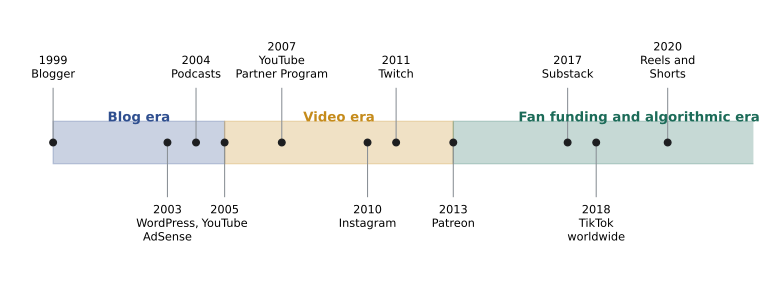
Personal websites and online diaries appeared in the 1990s, and easy publishing tools (Blogger in 1999, WordPress in 2003) made the blog the first mass format for self-publishing. Bloggers wrote about politics, technology, parenting, fashion, food and personal life. A few became influential enough to break news, shape opinions or launch careers; some earned money through display advertising (pay-per-click networks such as Google AdSense, launched in 2003), affiliate links (commissions on sales of products they recommended, through programs such as Amazon Associates), and sponsored posts.
Several patterns from the blog era still define the creator economy:
- Niches: the most successful blogs served a specific audience well (a particular hobby, profession or community) rather than trying to appeal to everyone.
- Trust and voice: readers followed bloggers for their personality and judgment.
- The first disclosure problems: as companies began paying bloggers and sending free products, regulators started to require that paid endorsements be disclosed. In the US, the Federal Trade Commission updated its endorsement guides to cover bloggers in 2009.
Podcasts emerged in the same period (the term dates from 2004), allowing audio shows to be subscribed to and downloaded, and they remain an important creator format.
The video era (2005 to 2015)
YouTube launched in 2005 and was bought by Google in 2006. Cheap digital cameras, faster broadband and free hosting made video creation accessible. In 2007 YouTube started its Partner Program, sharing advertising revenue with creators whose videos attracted enough views, which for the first time gave ordinary people a direct, scalable way to earn from content. Genres that are now familiar took shape: vlogs (video blogs), tutorials, product reviews and unboxings, comedy sketches, gaming commentary and "let's play" videos, beauty and fashion hauls.
Instagram (2010) made photographs, and later short videos and stories, the main currency of lifestyle influence, and the term "influencer" became common as brands began paying Instagram users with large followings to feature products. Twitch (2011) built a business around live-streamed gaming, where viewers pay creators directly through subscriptions and tips. Multi-channel networks appeared, promising creators help with growth and brand deals in exchange for a share of revenue, often on terms that later proved unfavourable for the creators. Companies that sold tools and services to creators began to form an ecosystem around them.
The algorithmic, short-form era (2016 to today)
The most important change of the last decade has been the shift from social graphs to recommendation algorithms. On early social networks, you mostly saw content from accounts you had chosen to follow. TikTok (launched internationally in 2017 and merged with Musical.ly in 2018) built its main feed, the For You page, around recommendations: it shows each video to small groups of viewers, measures how they respond, and shows it to more people if they watch to the end, rewatch, share or comment. A creator with no followers can reach millions of viewers if a video performs well.
Other platforms copied the model: Instagram Reels (2020), YouTube Shorts (2020 to 2021) and recommendation-heavy feeds on Facebook, X, LinkedIn and Snapchat. This made it easier than ever to get views, but it also made reach less predictable and less tied to follower counts. A creator can go viral one week and see little response the next, and the platform, not the creator, controls who sees each post. CRE-201 covers how these algorithms work.
Other changes in this era include:
- Direct fan funding: Patreon (2013), channel memberships, Super Chats, Twitch subscriptions and paid newsletters (Substack, 2017) let fans pay creators directly, reducing dependence on advertising.
- Creator products: merchandise, courses, digital downloads, consumer brands (some built by creators have become large companies) and paid communities.
- Professionalization: talent managers, agencies, editors, analytics tools and dedicated platform teams for creators.
- Generative AI tools for scripting, editing, translation and graphics, and new concerns about synthetic media (CRE-410).
- Regulation: disclosure rules, child influencer protections, privacy laws and national-security reviews of platforms.
How big is the creator economy?
Estimates vary widely because the boundaries are fuzzy: does the creator economy include a dentist who posts educational videos, the platforms' entire advertising revenue, or software companies that sell editing tools? One widely cited estimate, from Goldman Sachs Research in 2023, put its total size at about US$250 billion, growing to about US$480 billion by 2027, and estimated about 50 million creators worldwide, of whom only about 4% were professionals earning more than US$100,000 a year. Brand deals were the largest source of creator income in the surveys it used, at roughly 70%.
Industry surveys from creator tool companies report similar patterns: a large majority of people who call themselves creators earn less than a living wage from it, a small minority earn a full-time income, and a tiny fraction earn very large sums. Lesson 7 examines this distribution in detail. When reading statistics about creators, check who produced them and why: companies that sell services to creators have an interest in describing a large, growing and profitable market.
Worked problem
Reading a statistic critically
An article says "creators earn an average of $50,000 a year." A survey of 1,000 creators found 900 earning $2,000, 90 earning $100,000 and 10 earning $3.02 million. What are the mean and the median?
Show solution
- Total: \(900 \times 2000 + 90 \times 100000 + 10 \times 3020000 = 1.8 + 9 + 30.2 = 41\) million.
- Mean: \(41{,}000{,}000 / 1000 = 41{,}000\).
- Median: the 500th and 501st creators both earn $2,000, so the median is $2,000.
Answer: The mean is $41,000 but the median is only $2,000. A handful of very high earners pull the average far above what a typical creator earns, so averages are misleading for skewed incomes; the median, and the share earning above a meaningful threshold, tell you more.
Why it grew: four forces
Several forces combined to create the creator economy:
- Cheap tools: a smartphone now records 4K video, edits it and publishes it. Microphones, lights and editing software that once cost thousands are available for tens or hundreds of dollars.
- Free distribution: platforms host and distribute content for free, in exchange for a share of the advertising revenue it attracts and the data they collect.
- Algorithmic discovery: recommendation feeds can put a new creator in front of millions without a publisher's approval.
- Advertising and attention shifts: younger audiences spend more time with creators than with television, so advertisers moved budgets toward creators, who often deliver audiences that trust their recommendations.
The same forces also create the main challenges of creator work: because the tools and distribution are available to everyone, competition is enormous; because platforms control distribution, they can change the rules at any time; and because attention is the product, creators face pressure to post constantly.
Platforms as landlords
A useful way to understand the creator's position is to think of platforms as landlords. The creator builds a business on land the platform owns. The platform sets the rules (what content is allowed, how it is recommended, how revenue is shared), can change them without negotiation, and can evict a tenant by demonetizing or removing an account. Several episodes illustrate this:
- Algorithm changes: when Facebook prioritized friends and family over publishers in 2018, many media companies and creators lost most of their reach.
- Advertiser boycotts: in 2017, advertisers pulled spending after ads appeared next to extremist videos, and YouTube tightened monetization rules, cutting many creators' income (the "adpocalypse").
- Platform shutdowns: Vine, a six-second video app with many popular creators, was shut down in 2017, and creators who had not built audiences elsewhere lost them.
- Government action: Canada's Online News Act led Meta to block news content on Facebook and Instagram in Canada from August 2023, affecting news creators. In November 2024 the federal government ordered TikTok's Canadian business to wind up after a national security review; in January 2026 the government agreed to set aside the order and reconsider it, and the app itself remained available to Canadian users throughout.
The lesson most experienced creators draw is to own as much of the relationship with their audience as possible, for example through an email list or website, and to spread their presence across more than one platform. Lesson 5 returns to this idea.
Who becomes a creator?
Creators come from every background. Some started as hobbyists sharing something they loved; some are professionals (doctors, lawyers, teachers, tradespeople) who use content to build reputation and clients; some are performers, athletes or artists using platforms to reach fans directly; some treat it as a startup business from the start. Surveys show that many creators are young, but many successful creators in education, finance, crafts and professional niches are older and draw on deep expertise.
Expertise and creator skills are increasingly valued by ordinary employers too. Companies hire people to make content for their brands, run social accounts, manage creator partnerships and produce video, so the skills in this program (writing, filming, editing, analytics, community management, business) transfer to many jobs even if you never become a full-time independent creator.
How this course is organized
The twelve lessons build an honest, practical picture of the creator economy:
- Lesson 1 (this lesson): what the creator economy is, how it developed and how big it is.
- Lesson 2: audiences, attention and community.
- Lesson 3: platforms, audience measurement and choosing where to publish.
- Lesson 4: how recommendation systems shape reach.
- Lesson 5: how creators earn money.
- Lesson 6: content craft: ideas, formats and production.
- Lesson 7: the realities: uneven earnings, costs, risks and wellbeing.
- Lesson 8: working with brands.
- Lesson 9: planning a realistic first year.
- Lesson 10: analytics and experiments.
- Lesson 11: responsibility, ethics and trust.
- Lesson 12: the changing creator economy and a launch project.
Common mistakes
MistakeBelieving averages about creator income describe a typical creator.
InsteadLook at medians and distributions; incomes are extremely skewed.
MistakeTreating a platform account as something you own.
InsteadPlatforms can change rules or remove accounts; build owned channels too.
MistakeAssuming the creator economy began with TikTok.
InsteadIt grew from blogs, podcasts, YouTube and Instagram over two decades.
MistakeAccepting market-size statistics without checking the source.
InsteadAsk who produced them, how they define the market and what they sell.
MistakeThinking creator skills are only useful for full-time creators.
InsteadContent, editing, analytics and community skills are valued by many employers.
Summary and key terms
- Creators publish regularly to audiences that follow them personally, and may earn from them.
- The creator economy grew from blogs and podcasts, then video (YouTube, Instagram, Twitch), then algorithmic short-form video.
- Recommendation feeds let new creators reach large audiences but make reach unpredictable.
- Estimates put the creator economy at hundreds of billions of dollars, but only a small share of creators earn a professional income.
- Averages mislead for skewed incomes; medians are more informative.
- Platforms act like landlords: they control rules, reach and monetization and can change them at any time.
- Creator skills transfer to many jobs beyond independent content creation.
- Creator economy
- The creators, platforms, brands and service companies built around content made by individuals for their audiences.
- Content creator
- A person who regularly publishes content to an audience they build.
- Influencer
- A creator whose value to brands is their influence over an audience's choices.
- Partner program
- A platform scheme that shares advertising revenue with eligible creators.
- Affiliate link
- A tracked link that pays the creator a commission on resulting sales.
- Recommendation algorithm
- Software that decides what content to show each user based on predicted interest.
- Social graph
- The network of follow and friend relationships between accounts.
- Niche
- A specific topic and audience a creator serves.
- Median
- The middle value when data are ordered; half are above and half below.
- Fan funding
- Direct payments from audience members, such as memberships, tips and subscriptions.
Practice problems
Work each problem on paper first, then reveal the answer to check.
What distinguishes creator media from traditional media?
Show answer
The audience follows an individual; anyone can publish; platforms and audiences, not gatekeepers, decide what spreads.
Name two ways bloggers earned money in the 2000s.
Show answer
Display advertising (such as AdSense), affiliate links and sponsored posts.
What did the YouTube Partner Program change in 2007?
Show answer
It shared ad revenue with ordinary creators, giving them a scalable way to earn.
How does a recommendation feed differ from a follower feed?
Show answer
It shows content predicted to interest you, not only content from accounts you follow.
Five creators earn $1,000, $1,500, $2,000, $3,000 and $250,000. Mean and median?
Show answer
Mean $51,500; median $2,000.
According to the 2023 Goldman Sachs estimate, what share of creators were professionals earning over $100,000?
Show answer
About 4%.
Give two examples of platform decisions that cut creators' income or reach.
Show answer
Facebook's 2018 feed change, YouTube's 2017 advertiser-driven demonetization, Vine's shutdown.
Why do platforms resemble landlords?
Show answer
Creators build on infrastructure the platform owns and controls, under rules it can change.
List the four forces that drove the creator economy's growth.
Show answer
Cheap tools, free distribution, algorithmic discovery, shift of advertising and attention.
Why might a market-size estimate from a creator tool company be optimistic?
Show answer
It benefits from describing a large, growing market to attract customers and investors.
Lesson quiz · 5 questions
Score 60% or more to complete this lesson.
Create a free account to save your progress, take quizzes and earn a certificate.