
CRE-101 · Lesson 3 of 12 · 27 min
Platforms and their audiences
Every platform is a different place with its own audience, formats, culture, discovery system and ways to earn. A video that does well on TikTok may fail on YouTube; a thoughtful LinkedIn post would be ignored on Snapchat; a podcast built over years can earn more from a small loyal audience than a viral clip from millions of passing viewers. Choosing where to focus is one of the most important early decisions a creator makes. This lesson surveys the major platforms, explains the dimensions on which they differ, introduces the main audience numbers, and gives a method for choosing a primary platform and supporting ones.
Who uses which platforms
The 2025 State of Social Media in Canada survey by the Social Media Lab at Toronto Metropolitan University (1,500 adults, February to March 2025) found that 82% of Canadian adults had a Facebook account, 73% YouTube, 63% Instagram, 49% LinkedIn, 37% X, 35% TikTok and 27% Reddit. Pinterest was used by about half of women but only a quarter of men. Use differs strongly by age: younger Canadians are much more likely to use Instagram, TikTok and Snapchat, and older Canadians Facebook.
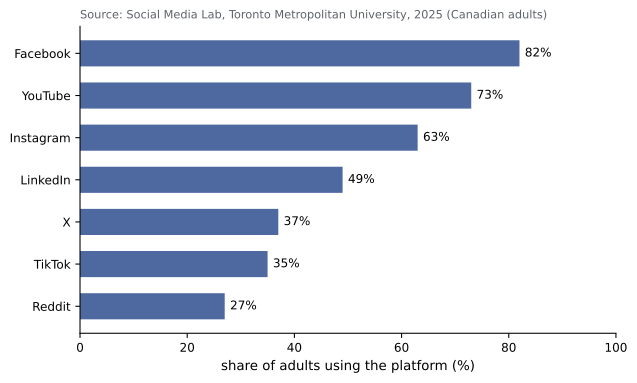
Reach numbers tell only part of the story. What matters to a creator is whether the platform's users include the specific audience they want to serve, whether that audience pays attention to creators there, and whether the platform offers ways to earn from them. A business-to-business consultant may do better on LinkedIn, used by a minority of adults, than on TikTok, used by many more.
Six dimensions that distinguish platforms
Platforms can be compared on a few dimensions:
- Format: short vertical video, long horizontal video, still images, text, audio, live streams. Each demands different skills and production effort.
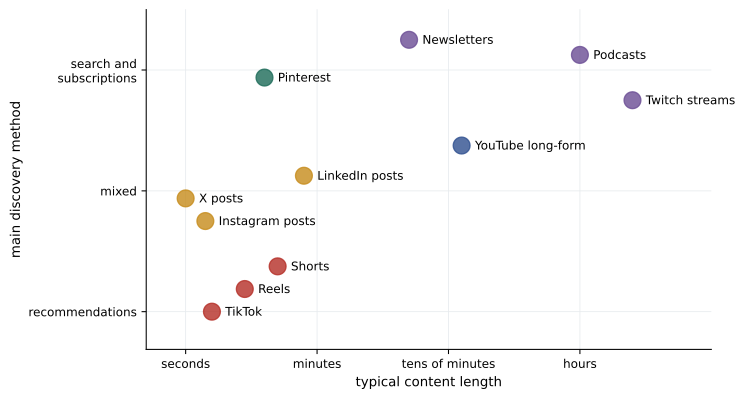
- Discovery: how new viewers find you. Some platforms rely mainly on recommendations (TikTok, YouTube Shorts, Reels), some on search (YouTube long-form, Pinterest, podcasts through directories, blogs through Google), and some on the social graph and sharing (Facebook groups, newsletters, X).
- Shelf life: how long content keeps attracting views. A tweet or story may last hours; a TikTok usually a few days; a YouTube tutorial or Pinterest pin can attract search traffic for years.
- Relationship depth: how strongly the audience connects with the creator. Long-form video, podcasts, live streams and newsletters build deeper relationships because people spend more time with the creator's voice.
- Monetization: which ways of earning the platform supports directly (ad revenue share, subscriptions, tips, shopping) and how much it pays.
- Audience: age, interests, location and purpose (entertainment, learning, professional networking, shopping inspiration).
The major platforms
YouTube
YouTube is the largest video platform and the second most used search engine after Google, which owns it. It supports long-form video (from a few minutes to hours), Shorts (vertical videos up to three minutes), live streams and podcasts. Its discovery combines search, recommendations on the home page and next to videos, and subscriptions. Long-form videos can earn views for years, especially tutorials, reviews and explainers that answer what people search for.
YouTube has the most developed revenue sharing. Through the YouTube Partner Program, eligible creators earn a share of advertising revenue: 55% of the net ad revenue on long-form videos, and 45% of their allocated share of Shorts ad revenue. Eligibility for ad revenue sharing currently requires 1,000 subscribers plus either 4,000 public watch hours in the last 12 months or 10 million public Shorts views in the last 90 days; a lower tier (500 subscribers with 3,000 watch hours or 3 million Shorts views) unlocks fan funding such as channel memberships and Super Chat. In August 2026 YouTube announced that from 1 February 2027 new applicants for ad revenue sharing will need 8,000 watch hours or 20 million Shorts views, while creators already in the program keep their status. Thresholds change, so always check the platform's current help pages.
TikTok
TikTok is built around a recommendation feed of short vertical videos, with live streaming, longer videos, photo posts and shopping. Its algorithm can give a new account large reach quickly, which makes it popular for testing ideas and growing fast, but views often come from people who do not follow the creator, and attention is fleeting. TikTok's Creator Rewards Program pays for qualified views of videos longer than one minute, for adult creators in eligible countries who meet follower and view thresholds (commonly cited as 10,000 followers and 100,000 views in the last 30 days); payments per thousand views are low compared with YouTube long-form. Live gifts, subscriptions, TikTok Shop affiliate commissions and brand deals are other sources.
TikTok's position in Canada has been uncertain: the federal government ordered its Canadian business to wind up in 2024 and agreed in January 2026 to reconsider the order, while the app stayed available to users. Creators should watch for further developments.
Instagram and Facebook
Instagram (owned by Meta) combines a feed of photos and videos, Reels (short vertical video), Stories (posts that disappear after 24 hours) and direct messages. It is strong for lifestyle, fashion, beauty, food, travel and fitness, and for visual businesses. Brand deals are the main source of income for Instagram creators; Meta also offers subscriptions, gifts and bonus programs that change often. Facebook remains the most widely used social network among adults overall, especially older adults, with strong groups and communities, and offers revenue sharing on some video and content formats.
Other platforms
- X (formerly Twitter): short text posts, news and commentary; strong for journalism, politics, technology and finance; pays eligible premium subscribers a share of ad revenue.
- LinkedIn: professional networking; text posts, documents, articles, video and newsletters; strong for business-to-business creators, consultants and job seekers; little direct monetization, but valuable for clients and career.
- Pinterest: visual search and inspiration (recipes, home decor, crafts, fashion, weddings); long shelf life; drives traffic to websites and affiliate links.
- Snapchat: messaging, stories and a short video feed, used heavily by teenagers and young adults; offers a revenue share program for eligible creators.
- Twitch and Kick: live streaming, mainly gaming, music and "just chatting"; viewers pay through subscriptions, tips (Bits on Twitch) and gifts.
- Podcasts: audio and video shows distributed through Apple Podcasts, Spotify and YouTube; deep relationships and valuable sponsorships for engaged niche audiences.
- Newsletters and blogs: Substack, Beehiiv, Ghost and personal websites; owned email lists; paid subscriptions and sponsorships.
- Reddit and Discord: communities organized around interests; useful for research, feedback and community building, though self-promotion is often restricted.
| Platform | Main formats | Main discovery | Main ways to earn |
|---|---|---|---|
| YouTube | Long video, Shorts, live, podcasts | Search, recommendations, subscriptions | Ad share, memberships, brand deals |
| TikTok | Short vertical video, live | Recommendations | Creator Rewards, gifts, shop affiliate, brand deals |
| Reels, photos, Stories | Recommendations, followers | Brand deals, subscriptions | |
| Text, documents, video | Network, recommendations | Clients, career, sponsorships | |
| Pins, video pins | Search | Traffic to affiliate links and websites | |
| Twitch | Live streams | Browse, following | Subscriptions, tips, ads |
| Podcasts | Audio and video episodes | Directories, word of mouth | Sponsorships, listener support |
| Newsletters | Referrals, social posts | Paid subscriptions, sponsorships |
Measuring audience: followers are not enough
Follower counts are the most visible number but often the least useful. A creator with 200,000 followers whose posts reach 3,000 people and get 50 comments may be worth less to a brand than one with 15,000 followers whose posts reach 10,000 people and get 400 comments. More useful measures include:
- Reach and views: how many people saw the content.
- Engagement rate: interactions (likes, comments, shares, saves) divided by reach or followers.
- Retention or watch time: how much of a video people watched; a key signal for algorithms.
- Audience composition: age, location and interests, which determine what advertisers will pay.
- Conversion: how many people take an action, such as clicking a link, joining a mailing list or buying.
Worked problem
Comparing two creators
Creator A has 200,000 followers; a typical post reaches 12,000 people and gets 360 interactions. Creator B has 25,000 followers; a typical post reaches 9,000 people and gets 540 interactions. Compare their engagement rates by reach and by followers.
Show solution
- A by reach: \(360/12000 = 3.0\%\); by followers: \(360/200000 = 0.18\%\).
- B by reach: \(540/9000 = 6.0\%\); by followers: \(540/25000 = 2.16\%\).
Answer: B engages its audience twice as strongly by reach and twelve times as strongly by followers. A's large follower count includes many people who no longer see or respond to its posts. Brands increasingly ask for reach, engagement and audience data rather than follower counts, partly because followers can be bought or inflated (CRE-202).
Where an audience lives also matters. Advertisers pay more to reach viewers in countries with high consumer spending, so the same number of views can earn several times more from an audience in Canada or the US than from one in a country with lower advertising prices. Topics matter too: finance, technology, business and software attract higher ad rates than general entertainment.
Choosing a primary platform
Most successful creators focus on one primary platform where they build their main audience, and use others to support it, often by adapting the same content. A practical method for choosing:
1. Define your audience: who do you want to serve, and what do they need (to learn, laugh, decide, belong)?
2. Find where that audience already pays attention to creators: search for creators in your topic on each platform and note their size, engagement and how they earn.
3. Match the format to your strengths and resources: are you better on camera, in writing, in conversation, or behind the camera? How much time can you spend per piece?
4. Consider shelf life and discovery: search-driven platforms reward evergreen, useful content; recommendation-driven platforms reward frequent, entertaining content.
5. Check monetization paths: will this platform let you earn in the ways that suit your topic?
6. Plan a secondary channel you own, such as an email list or website.
Worked problem
Choosing a platform
Priya is a licensed electrician who wants to teach homeowners and apprentices about electrical safety and DIY limits. She is comfortable on camera, has about 6 hours a week, and wants content that keeps working over time. Which platform should be primary?
Show solution
- Audience need: practical answers to specific questions ("why does my breaker keep tripping?"), which people search for.
- Shelf life: tutorials answer searches for years.
- Format: on camera, with demonstrations; 6 hours a week allows one solid video weekly.
- Monetization: YouTube ad share in a home-improvement niche, affiliate links to tools, sponsorships from tool brands, and later courses for apprentices.
Answer: YouTube long-form as the primary platform, with Shorts or Reels cut from each video to attract new viewers, and an email list for apprentices. Each piece of content works on several platforms with modest extra effort.
Repurposing across platforms
Repurposing means adapting one piece of content for several platforms, for example a long video that becomes three short clips, a carousel of images, a newsletter and a thread. Done well, it multiplies reach without multiplying effort. Done badly (posting the same video with another platform's watermark, or a horizontal video squeezed into a vertical frame), it performs poorly because each platform's audience and algorithm expect native content. Adapt the hook, length, aspect ratio, captions and call to action for each platform.
Lesson 4 explains how the recommendation systems behind these platforms decide what each viewer sees.
Common mistakes
MistakeChoosing a platform because it is popular overall.
InsteadChoose where your specific audience pays attention to creators like you.
MistakeJudging creators by follower count.
InsteadLook at reach, engagement, retention, audience and conversion.
MistakeTrying to be equally active on every platform at once.
InsteadFocus on one primary platform and repurpose to a few others.
MistakePosting identical content everywhere with watermarks.
InsteadAdapt hooks, format and length to each platform.
MistakeAssuming monetization rules are fixed.
InsteadCheck current program thresholds; they change often.
Summary and key terms
- In Canada (2025), Facebook, YouTube and Instagram reach the most adults; use varies strongly by age.
- Platforms differ in format, discovery, shelf life, relationship depth, monetization and audience.
- YouTube shares 55% of long-form ad revenue; eligibility thresholds rise for new applicants in February 2027.
- TikTok offers fast reach through recommendations but lower pay per view.
- Engagement, reach, retention, audience and conversion matter more than followers.
- Choose a primary platform by audience, format, shelf life and monetization, and build an owned channel.
- Repurpose content by adapting it natively to each platform.
- Format
- The type of content: short video, long video, image, text, audio or live.
- Shelf life
- How long a piece of content keeps attracting views.
- Evergreen content
- Content that remains useful and searchable for a long time.
- Reach
- The number of unique people who saw a piece of content.
- Engagement rate
- Interactions divided by reach (or followers), as a percentage.
- Retention
- How much of a video viewers watch.
- Conversion
- The share of viewers who take a desired action.
- Primary platform
- The platform where a creator builds their main audience.
- Repurposing
- Adapting one piece of content for several platforms.
- Creator Rewards Program
- TikTok's program paying for qualified views of longer videos.
Practice problems
Work each problem on paper first, then reveal the answer to check.
Which three platforms reached the most Canadian adults in 2025?
Show answer
Facebook (82%), YouTube (73%), Instagram (63%).
Name the six dimensions for comparing platforms.
Show answer
Format, discovery, shelf life, relationship depth, monetization, audience.
Why do tutorials on YouTube have a long shelf life?
Show answer
People search for answers, so useful videos keep being found for years.
What share of long-form ad revenue does YouTube pay creators?
Show answer
55%.
A post reaches 8,000 people and gets 320 interactions. Engagement rate by reach?
Show answer
4%.
A creator has 50,000 followers and averages 250 interactions. Engagement by followers?
Show answer
0.5%.
Why might the same views earn different amounts in different countries?
Show answer
Advertisers pay different prices depending on the audience's location and spending.
What changes for new YouTube Partner Program applicants on 1 February 2027?
Show answer
Ad revenue sharing requires 8,000 watch hours or 20 million Shorts views.
A B2B accountant wants clients. Suggest a primary platform and why.
Show answer
LinkedIn, where business decision makers network professionally (or YouTube for search-driven tax questions).
What makes repurposing effective?
Show answer
Adapting hooks, length, aspect ratio, captions and calls to action to each platform.
Lesson quiz · 5 questions
Score 60% or more to complete this lesson.
Create a free account to save your progress, take quizzes and earn a certificate.