
CRE-110 · Lesson 12 of 12 · 25 min
Your brand plan: putting it all together
Over the past eleven lessons you have examined yourself, researched an audience, validated a niche, defined a position, planned content pillars and series, described a voice, designed a visual identity, set boundaries, chosen a name, and planned how to measure and evolve your brand. Each of those decisions is useful on its own, but their real value comes from fitting together: a voice that matches the position, visuals that express the voice, pillars that serve the audience's jobs, boundaries that make the brand sustainable. This final lesson shows how to assemble the brand plan into a clear, usable document, how to condense it into a one-page brand canvas, how to turn it into a ninety-day launch or relaunch plan, how to stress-test it before committing, and how to keep it alive as a working tool rather than a file you write once and forget.
The structure of the brand plan
A complete brand plan for an individual creator is typically eight to fifteen pages, organized in the order of this course:
- 1. Self-inventory: skills, interests, energy, values, story and constraints (Lesson 2).
- 2. Audience profile: primary persona, jobs to be done, top problems with quotes, consumption habits and size estimate (Lesson 3).
- 3. Niche validation: finalist comparison, scoring matrix, competitor audit, test results and decision (Lesson 4).
- 4. Positioning: positioning statement, positioning map, tagline and elevator pitch (Lesson 5).
- 5. Content strategy: pillars, purposes mix, formats, series, capacity plan and calendar approach (Lesson 6).
- 6. Voice and tone: voice chart and tone map with examples (Lesson 7).
- 7. Visual identity: palette, typography, thumbnail templates, on-camera style and accessibility rules (Lesson 8).
- 8. Boundaries and integrity: sharing zones, privacy protections, others' privacy, disclosure and correction policies (Lesson 9).
- 9. Name and protection: name, handles, domain, bios, media kit outline, business registration and trademark status (Lesson 10).
- 10. Measurement and evolution: brand dashboard, survey plan, review schedule and evolution triggers (Lesson 11).
Write in plain, direct language. The plan is a working tool for you and anyone who helps you, not a document to impress anyone.
The one-page brand canvas
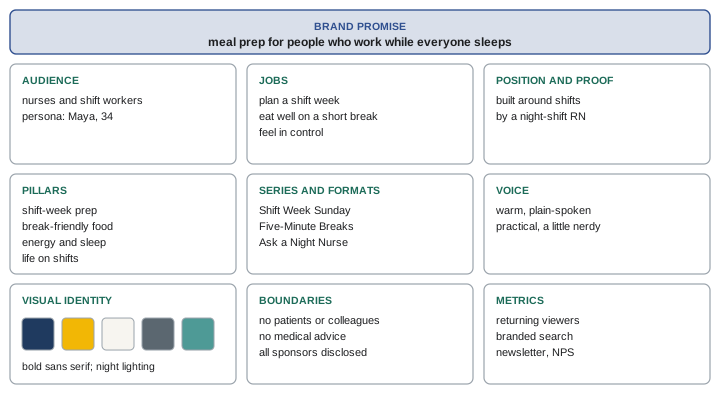
A brand canvas condenses the plan onto a single page that you can keep beside your desk or in your editing software. It forces clarity: if you cannot fit your brand on one page, it is probably not yet clear enough for an audience to grasp in a few seconds.
Worked problem
Completing the canvas for Night Shift Kitchen
Summarize Jordan's brand decisions from the course in canvas form.
Show solution
- Brand promise: meal prep for people who work while everyone sleeps.
- Audience: nurses and other shift workers on rotating and night shifts (primary persona: Maya, 34, night-shift nurse).
- Jobs: plan a shift week (functional), eat well on a short break (functional), feel less alone and more in control (emotional).
- Position and proof: the meal prep channel built around shift schedules, from a night-shift RN who preps this way every week.
- Pillars: shift-week prep, break-friendly food, energy and sleep, life on shifts. Series: "Shift Week Sunday", "Five-Minute Breaks", "Ask a Night Nurse".
- Voice: warm, plain-spoken, practical, a little nerdy. Visuals: navy, warm yellow, soft white; bold sans serif; real kitchen at night lighting.
- Boundaries: no hospital names, patients or colleagues; no individual medical advice; children private; all sponsorships disclosed; no energy-drink sponsors.
- Metrics: returning viewers, branded search, newsletter growth, NPS twice a year; quarterly review.
Answer: The canvas fits on one page and each part supports the others: the voice suits tired, busy viewers; the night-time visuals reinforce the niche; the boundaries protect patients, colleagues and Jordan's professional standing.
Checking coherence
Before finalizing, test the plan for internal consistency with a few questions:
- Does every pillar serve a job from the audience research?
- Does the voice suit the audience's situation and the position?
- Do the visuals express the voice, and would they stand out among competitors?
- Do the formats fit the capacity plan and the constraints from the self-inventory?
- Do sponsor criteria and boundaries align with the core values?
- Do the metrics measure the promise you are trying to keep?
Inconsistencies are normal in a first draft. Resolve them by returning to the evidence: the audience research and the test results usually tell you which choice is right.
The ninety-day plan
A brand plan becomes real through action. A ninety-day plan breaks the first stage of launch (or relaunch) into weekly tasks and milestones:
| Period | Focus | Example milestones |
|---|---|---|
| Weeks 1 to 2 | Foundations | Handles and domain secured; bios and banners updated; templates created; first five pieces scripted |
| Weeks 3 to 6 | Launch the core series | Three to five episodes of the first series published; newsletter sign-up live; first community post |
| Weeks 7 to 10 | Establish rhythm | Weekly schedule kept; short-form adaptations added; first audience questions answered in content |
| Weeks 11 to 12 | Review | Brand dashboard reviewed; short audience survey run; adjustments listed for the next ninety days |
| Week 13 | Rest and plan | Planned light week; next ninety-day plan written |
Build the plan backwards from your capacity (Lesson 6), not forwards from ambition. Include rest. Many creators burn out in the first three months by trying to do everything at once; a plan that you complete is worth more than an impressive plan that collapses.
Stress-testing the plan
Before committing, imagine how the plan could fail and what you would do. A simple risk register lists risks, their likelihood and impact, and a response:
- Low early reach: respond by improving packaging, collaborating with adjacent creators, and focusing on searchable utility content.
- Losing interest in a pillar: respond by reducing its share and expanding a pillar you enjoy more, within the brand promise.
- Professional or employer concerns: respond by reviewing content against regulator and workplace guidance in advance and keeping a clear line between general information and advice.
- Harassment or privacy breach: respond with the safety plan from Lesson 9.
- Platform change: respond by growing owned channels from the start.
- Life events (illness, new job, family): respond with a backlog of evergreen content and a plan for scheduled breaks.
Thinking these through in advance reduces panic when they happen, and often reveals small changes to make now, such as starting a newsletter in week three rather than "later".
Getting feedback
Share the brand canvas and ninety-day plan with two or three people: someone in your target audience, a fellow creator, and a mentor or instructor. Ask specific questions: "From this page, who do you think this is for?", "Would you follow this, and why or why not?", "What seems unclear or inconsistent?" and "What do you think will be hardest for me?" Note the feedback, decide what to change, and record your reasons in the plan.
Keeping the plan alive
A brand plan is only useful if you use it. Practical habits include: keeping the canvas visible while planning content; checking new ideas against the pillars and position; using the voice and visual guides when reviewing drafts and thumbnails; updating the dashboard monthly; reviewing the whole plan every quarter with fresh data; and rewriting sections when your niche evolves. Date each version so you can see how your brand has changed over time; that history is valuable when you reflect on what worked.
Capstone assignment
Your capstone for this course is a complete brand plan and one-page canvas for your own creator brand (or for a fictional creator if you prefer to keep your plans private). It should include all ten sections, a positioning statement, a voice chart, a visual identity sample with a contrast check, a sharing-zones diagram, a name availability check, a brand dashboard design and a ninety-day plan with a risk register. Close with a short reflection: what surprised you, what you are most and least confident about, and what evidence you will look for in the first ninety days to know whether your niche and brand are working.
Looking ahead
The rest of the program builds on this foundation. Courses on platforms and algorithms, storytelling and on-camera presence, production, analytics, brand partnerships, law and ethics, and creator wellbeing all assume you know who you serve and what you stand for. Return to your brand plan as you take them: each will add tools for keeping your promise more effectively.
Presenting your brand plan
Part of the capstone is presenting your plan, whether to classmates, a mentor or a small group of people from your target audience. A short presentation of five to seven minutes is enough. Start with the brand promise and the audience, explain the evidence behind your niche choice, show the positioning map and a sample of your visual identity, play or read an example in your brand voice, and finish with your ninety-day plan and the main risks. Invite questions and note them carefully: questions reveal parts of the plan that are unclear or unconvincing.
Presenting has a second benefit: it rehearses the way you will describe your brand to sponsors, collaborators and journalists. If you can explain your brand clearly in a few minutes, you can also explain it in an email, a media kit or a conversation at an event.
After the course
Treat this course as the start of an ongoing practice. In the first few months after launching, keep a weekly journal of what you published, how it performed, what the audience said and how you felt about making it. After ninety days, compare the journal with your brand plan. Where did reality match your expectations, and where did it surprise you? Update the plan with what you learned, set new milestones, and continue. Over time, this cycle of planning, publishing, measuring and reflecting builds both a stronger brand and a deeper understanding of yourself as a creator.
Many creators find it useful to connect with peers at a similar stage. A small group that meets online every few weeks to share progress, review each other's content and discuss challenges provides accountability, encouragement and honest feedback that analytics cannot provide.
A note on patience
Building a personal brand takes time. Most creators who succeed describe years, not months, of consistent work before significant growth. The brand plan does not shortcut that work, but it makes each month count: every piece you publish strengthens a clear promise, every measurement teaches you something, and every review brings you closer to a niche and brand that fit you and your audience. Measure progress against your own previous quarters, not against creators who started years earlier, and celebrate milestones along the way, such as the first comment from someone who says your content helped them.
When you submit your capstone, include the date and plan to revisit it in ninety days. The most valuable part of the exercise is not the document itself but the habit it builds: making brand decisions deliberately, grounding them in evidence, writing them down, and reviewing them as you learn. That habit will serve you through every stage of your work as a creator, whatever platforms and formats the future brings.
Remember that the plan should feel like yours. Templates and frameworks in this course are starting points; adapt section headings, add sections for things that matter to your brand, and remove anything that does not help. The best brand plan is the one you actually open and use every week.
Common mistakes
MistakeWriting the plan once and filing it away.
InsteadUse it weekly and review it quarterly.
MistakeMaking a canvas too dense to read.
InsteadKeep it to one clear page.
MistakePlanning ninety days from ambition rather than capacity.
InsteadPlan from real hours, with rest.
MistakeIgnoring how the plan might fail.
InsteadKeep a risk register with responses.
MistakeOnly asking friends whether they like it.
InsteadAsk audience members and creators specific questions.
Summary and key terms
- The brand plan assembles ten sections from the course into a coherent working tool.
- A one-page canvas condenses the brand so it can be grasped quickly.
- Check coherence between audience, pillars, voice, visuals, boundaries and metrics.
- A ninety-day plan turns the brand into weekly actions within real capacity.
- A risk register prepares responses to low reach, burnout, platform change and life events.
- Specific feedback from audience members, creators and mentors improves the plan.
- Keep the plan alive with regular use, monthly metrics and quarterly reviews.
- Brand plan
- A document recording all niche and brand decisions.
- Brand canvas
- A one-page summary of the brand.
- Coherence
- Consistency among the parts of the brand.
- Ninety-day plan
- A short-term plan of weekly tasks and milestones.
- Milestone
- A measurable checkpoint in a plan.
- Risk register
- A list of risks with likelihood, impact and responses.
- Evergreen content
- Content that remains useful for a long time.
- Backlog
- Finished content held in reserve.
- Quarterly review
- A full review of the plan every three months.
- Reflection
- Considered thought on what was learned and what to test.
Practice problems
Work each problem on paper first, then reveal the answer to check.
List the ten sections of the brand plan.
Show answer
Self-inventory, audience, validation, positioning, content, voice, visuals, boundaries, name and protection, measurement.
Why condense the plan into a one-page canvas?
Show answer
It forces clarity and keeps the brand visible while working.
Give three coherence checks.
Show answer
Pillars serve jobs; voice suits audience; visuals express voice; formats fit capacity.
What are the five phases of the sample ninety-day plan?
Show answer
Foundations, launch core series, establish rhythm, review, rest and plan.
Why plan from capacity rather than ambition?
Show answer
Plans beyond capacity collapse and cause burnout.
What does a risk register contain?
Show answer
Risks, likelihood, impact and responses.
Suggest a response to low early reach.
Show answer
Improve packaging, collaborate, focus on searchable utility content.
Name two questions to ask reviewers.
Show answer
Who is this for? Would you follow it and why?
How often should the full plan be reviewed?
Show answer
Every quarter.
Why date each version of the plan?
Show answer
To see how the brand has changed and reflect on what worked.
Lesson quiz · 5 questions
Score 60% or more to complete this lesson.
Create a free account to save your progress, take quizzes and earn a certificate.