
CRE-110 · Lesson 2 of 12 · 25 min
Starting with yourself: the self-inventory
Most advice about choosing a niche starts with the market: find a profitable topic and make content about it. That advice misses something important about creator work. Unlike a company that can hire new staff when its strategy changes, a creator is the product, the staff and the strategy. You will be making content in your niche several times a week, for years, often without much reward at first. If the topic bores you, conflicts with your values or depends on skills you do not have and cannot build, you are unlikely to keep going long enough to succeed. So the search starts with an honest inventory of yourself: your skills and knowledge, your interests and energy, your values, your story and your constraints. This lesson walks through each part, introduces tools for capturing them, and shows how to turn the inventory into a list of candidate niches to research in Lessons 3 and 4.
Skills and knowledge
List what you know and can do. Include formal education and work experience, but do not stop there: hobbies, side projects, things friends ask you for help with, problems you have solved in your own life, and languages or cultures you know. Creators often undervalue knowledge that feels ordinary to them. A bookkeeper who finds spreadsheets easy may not realize how many small-business owners are confused by them; a person who moved countries three times has hard-won knowledge about visas, banking and loneliness that newcomers would value.
For each item, rate your level honestly: beginner, intermediate, advanced or expert. Each level can support a niche, but in different ways:
- Expert creators teach, explain and analyze with authority. They need to show credentials or a track record, and they face higher expectations of accuracy.
- Intermediate creators can be excellent teachers because they still remember what it was like to struggle, and they can explain without jargon.
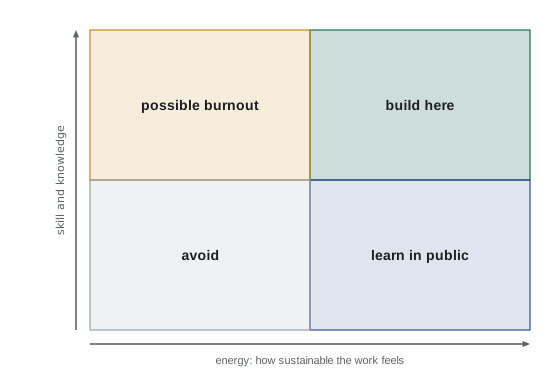
- Beginners can document their learning journey ("learning to draw in 365 days"), which audiences enjoy because it is relatable and honest. The brand promise is progress and authenticity, not authority.
What matters is matching the claim to the level. Presenting yourself as an expert when you are a beginner damages trust and, in areas like health or finance, can harm people.
Interests and energy
Interest is what you enjoy thinking about; energy is what you can sustain doing. They are related but not identical. You may love watching films but find writing reviews draining, or enjoy cooking for friends but dislike filming yourself in the kitchen. An energy audit helps separate them: for two weeks, notice which activities leave you energized and which leave you drained, including the activities of content creation itself (researching, writing, filming, editing, talking to camera, replying to comments).
Signs of a durable interest include: you already spend free time on it without being paid, you can list dozens of questions or ideas about it without effort, you follow other people who talk about it, and your interest has lasted several years rather than a few weeks. A fresh enthusiasm may be real, but it is safer to test it with a few pieces of content before building a brand on it.
Values
Values are the principles that guide your choices: honesty, curiosity, inclusion, frugality, sustainability, faith, family, craftsmanship, humour, independence. They matter for a niche because they shape what you will and will not do: which sponsors you accept, how you treat critics, what you are willing to share about your life, and what message your content sends. A creator who values frugality but builds a brand on luxury hauls will feel conflicted; a creator who values honesty will struggle in a niche where exaggerated claims are the norm.
To identify your values, list moments you felt proud of yourself and moments you felt uncomfortable or angry, and ask which principle was honoured or violated in each. Narrow the list to three to five core values. These become the backbone of the brand: audiences increasingly choose creators whose values they share, and values give you a basis for decisions when sponsors, controversies and opportunities arrive.
Your story and perspective
Your story is the set of experiences that shaped you: where you grew up, what you studied, jobs you held, obstacles you faced, communities you belong to. Perspective is how that story makes you see your topic differently from others. Many creators find their distinctive angle here. An engineer who explains cooking as chemistry, a former retail manager who reviews customer service, a wheelchair user who reviews travel destinations for accessibility, and a grandparent who learns to game with grandchildren all bring a perspective that makes familiar topics fresh.
You do not need a dramatic story. You need a specific one. A useful prompt is: "What do I notice about this topic that most people who talk about it miss?" The answer often points to an underserved audience or angle.
Constraints
Constraints are the practical limits on what you can do. They are not failures; they are design inputs, and many distinctive brands grew from them.
- Time: how many hours a week can you reliably commit? A creator with five hours a week needs a niche and format that can be produced in five hours, such as short videos or a weekly newsletter, rather than a heavily researched documentary series.
- Money: equipment, software, travel and materials cost money. Some niches (cars, travel, tech reviews) need significant spending; others need almost none.
- Location and access: what is nearby that others cannot easily reach? A farm, a rare skill community, a particular city or wilderness.
- Privacy and safety: are there people (children, employers, family) or details you must protect? Some niches require showing your face, home or location; others do not.
- Health and accessibility: what pace and format suit your body and mind?
- Employment and legal limits: employment contracts, professional codes, immigration status or industry rules may restrict what you can publish or earn. Check before you build.
In Canada, regulated professionals such as nurses, financial advisers, lawyers and accountants should check their provincial regulator's guidance on social media and advertising before giving professional advice online, and employees should check workplace social media policies.
The self-inventory worksheet
| Area | Prompt | Example entries |
|---|---|---|
| Skills | What can I do or explain better than most people I know? | Spreadsheets, sewing, Spanish, nursing, car repair |
| Knowledge | What have I learned through work, study or life? | Immigration paperwork, night shift health, small-business tax |
| Interests | What do I explore in my free time without being paid? | Board games, birdwatching, history podcasts |
| Energy | Which tasks leave me energized and which drain me? | Energized by explaining; drained by editing long videos |
| Values | What principles guide my choices? | Honesty, frugality, inclusion |
| Story | What experiences shaped my perspective? | Moved countries twice; first in family at university |
| Constraints | What limits my time, money, privacy or access? | 6 hours a week, small budget, no face on camera |
Fill in the worksheet with as many entries as you can, then ask two or three people who know you well to add to it. Others often see strengths you take for granted. Keep the worksheet; it is the first section of your brand plan.
From inventory to candidate niches
With the inventory complete, look for combinations: a skill plus an interest, a story plus a topic, a value plus an audience. Write at least ten candidate niche statements in the what, for whom and why format from Lesson 1. Do not judge them yet. Quantity at this stage helps, because the best idea is often the seventh or eighth, after the obvious ones are written down.
Then apply a quick first filter, scoring each candidate from 1 to 5 on four personal criteria:
- Interest: will I still want to make this in two years?
- Credibility: do I have the knowledge, experience or perspective to make it well, or a clear plan to learn in public?
- Fit with constraints: can I produce it with my time, budget and privacy limits?
- Values alignment: does it fit what I stand for?
Worked problem
Scoring candidate niches
Priya has three candidates: (A) budget vegan cooking for students, (B) honest reviews of luxury skincare, and (C) Python tutorials for biology students. Her scores (interest, credibility, constraints, values) are A: 4, 3, 5, 5; B: 3, 2, 2, 2; C: 5, 4, 4, 4. Which should she research further?
Show solution
- Totals: A = 4 + 3 + 5 + 5 = 17; B = 3 + 2 + 2 + 2 = 9; C = 5 + 4 + 4 + 4 = 17.
- B scores low on credibility, constraints (luxury products are expensive) and values (Priya values frugality); drop it.
- A and C tie. A is easy to produce; C uses Priya's rarer combination of programming and biology knowledge.
- Both go forward to audience research (Lesson 3) and validation (Lesson 4), where demand and competition will be compared.
Answer: Research A and C further; drop B. Personal fit narrows the field, and market research will decide between the finalists.
Common traps
Two traps are common at this stage. The first is choosing a niche purely for money: high-paying topics such as finance, software and luxury goods attract many creators, and those without genuine interest or credibility tend to produce generic content and give up. The second is choosing a niche purely for passion without checking whether anyone else cares: a creator may love a topic that has almost no audience or that the audience prefers to consume in a different form. The self-inventory protects against the first trap; audience research and validation, in the next two lessons, protect against the second.
Talking to people who know you
Self-assessment has blind spots. We tend to undervalue what comes easily to us and overvalue what we find hard. A short conversation with friends, colleagues or family members can correct this. Ask them three questions: what do people come to me for help with, what do I talk about with the most enthusiasm, and what do they think I would be good at explaining or showing to others? Write down their answers without arguing. Patterns across several people are particularly revealing: if three different friends mention your patience in explaining technology to grandparents, that skill might point to a niche serving older adults learning to use their devices.
Keep a running inventory over a few weeks rather than completing it in one sitting. Ideas tend to arrive while doing ordinary things, and capturing them in a notes app as they appear produces a richer list than a single brainstorming session.
Finally, revisit the inventory whenever your circumstances change. A new job, a move, a new skill or a shift in values can open niches that were not available before, or close ones that no longer fit. Treat the self-inventory as a living document, not a one-time exercise.
A final caution: the inventory is about honesty, not modesty or boasting. Record what is true, including weaknesses. Knowing that you dislike editing, or that you cannot film during weekdays, is as useful as knowing your strengths, because it shapes the formats and schedule that will work for you. Many creators later say that their constraints, accepted honestly at the start, became part of what made their brand distinctive and sustainable.
Common mistakes
MistakeStarting from "what pays most" without checking personal fit.
InsteadStart with skills, interests, values and constraints.
MistakeDismissing ordinary knowledge as not interesting.
InsteadAsk others what they come to you for.
MistakeClaiming expertise you do not have.
InsteadMatch the claim to your level; learn in public if needed.
MistakeIgnoring time and privacy constraints.
InsteadTreat constraints as design inputs for niche and format.
MistakeJudging the first idea and stopping there.
InsteadWrite ten or more candidates before filtering.
Summary and key terms
- A creator is the product, so niche choice starts with an honest self-inventory.
- List skills and knowledge with honest levels; beginners can learn in public.
- Separate interest from energy with an energy audit.
- Three to five core values guide sponsorship, content and conduct decisions.
- Your story and perspective often provide the distinctive angle.
- Constraints of time, money, privacy, health and employment shape niche and format.
- Generate ten or more candidates, then score them on interest, credibility, constraints and values.
- Self-inventory
- A structured record of skills, interests, values, story and constraints.
- Energy audit
- Tracking which activities energize or drain you.
- Learning in public
- Documenting your progress as a beginner.
- Core values
- The few principles that guide your decisions.
- Perspective
- The distinctive way your experience makes you see a topic.
- Constraint
- A practical limit on time, money, access or privacy.
- Candidate niche
- A possible niche to be researched and tested.
- Credibility
- The audience's reason to believe you know the topic.
- Values alignment
- Consistency between a niche and your principles.
- First filter
- A personal-fit screen applied before market research.
Practice problems
Work each problem on paper first, then reveal the answer to check.
Why does niche choice start with yourself?
Show answer
The creator must sustain the work for years; poor personal fit leads to quitting.
How can a beginner build a credible niche?
Show answer
By learning in public and promising progress and honesty rather than authority.
What is the difference between interest and energy?
Show answer
Interest is enjoying a topic; energy is being able to sustain the tasks of making content about it.
Give two signs of a durable interest.
Show answer
You already spend free time on it, and it has lasted several years.
Why do values matter for a brand?
Show answer
They guide decisions on sponsors, content and conduct and attract like-minded audiences.
What prompt helps uncover your perspective?
Show answer
What do I notice about this topic that most people miss?
Give an example of a constraint becoming a feature.
Show answer
A creator who will not show their face builds a hands-only or voice-only format.
Why should regulated professionals check rules before posting advice?
Show answer
Their regulators may restrict advertising and advice online.
How many candidate niches should you write before filtering?
Show answer
At least ten.
Score a candidate 3, 4, 2, 5. What is its total and weakest point?
Show answer
14; its fit with constraints.
Lesson quiz · 5 questions
Score 60% or more to complete this lesson.
Create a free account to save your progress, take quizzes and earn a certificate.