
CRE-250 · Lesson 7 of 12 · 28 min
Engaging a live audience and chat
The difference between a stream and a broadcast is the audience. In a live stream, chat is a co-star: viewers ask questions, crack jokes, give advice, react, argue, support and sometimes cause trouble. A streamer who talks to chat, remembers regulars, invites participation and builds a welcoming culture turns passing viewers into a community. This lesson covers why interaction matters, talking when chat is quiet, reading and responding to chat, welcoming newcomers and regulars, participation tools such as polls, predictions and channel points, viewer games and challenges, handling questions and requests, building chat culture, accessibility in live content, and measuring engagement. CRE-220 covered on-camera presence and improvisation; this lesson focuses on the live audience.
Why interaction matters
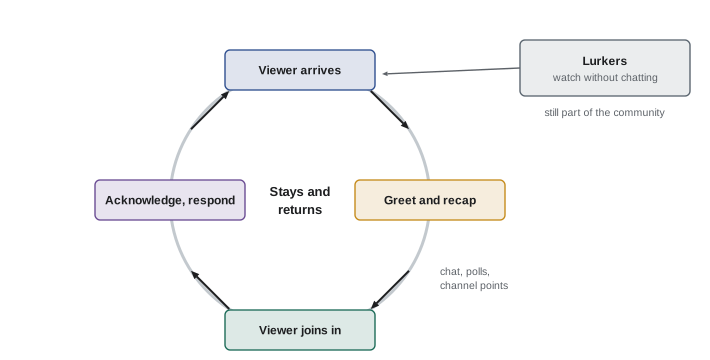
Interaction serves both viewers and streamers. Viewers stay longer and return more often when they feel seen and part of something; chat activity also signals to platform discovery systems that a stream is engaging. For streamers, chat provides ideas, feedback, company and energy during long sessions. Interaction must be genuine: viewers quickly notice scripted or transactional engagement, such as responding only to paying viewers. A good guideline is that every viewer who chats should feel acknowledged at least occasionally, while the stream remains watchable for those who never chat, many of whom are lurkers who enjoy watching silently.
Talking when chat is quiet
Most streams start small, often with zero to a handful of viewers, many of whom never type. Talking to an empty or silent chat is one of the hardest skills in streaming and one of the most important, because viewers who arrive at a silent stream with a silent streamer leave. Techniques include narrating what you are doing and thinking, as if explaining to a friend; asking open questions that are easy to answer; sharing stories and opinions related to the activity; reacting genuinely to what happens; reading out interesting comments from earlier or from social media; and treating every arrival as a chance to greet and engage. Recording and watching your own streams shows how much dead air there is and how often you talk.
| Situation | Try saying | Why it works |
|---|---|---|
| No one is chatting | I always mess up this part; if you've played it, how did you get past it? | Easy, specific question invites a reply |
| A new name appears | Hey, welcome in! We're trying to finish this map before the timer runs out. | Greets and recaps the promise |
| Lurkers present | Lurkers welcome; no need to chat, just enjoy. | Makes silent viewers feel comfortable |
| Long task | Here's why I'm doing it this way instead of the faster method. | Narration adds value |
Reading and responding to chat
As chat grows, reading every message becomes impossible. Effective habits include reading chat aloud before answering, so VOD viewers and those who missed the message understand; prioritizing questions and comments that add to the stream; acknowledging names; avoiding long silences while reading; and not responding to bait, spam or harassment (Lesson 9). For fast chats, streamers rely on moderators to highlight questions, use pinned or highlighted messages, or set segments for questions. Remember that latency means chat is reacting to something that happened a few seconds earlier.
Welcoming newcomers and regulars
Newcomers decide within minutes whether to stay. A warm greeting, a quick recap of what is happening and an invitation to join in help. Explaining in-jokes and rituals briefly keeps the community open. Regulars, the core of a channel, appreciate being remembered: their names, their interests, the game they recommended last week. Some streamers keep notes about regulars, and many communities give regulars recognition through roles, badges or VIP status. Balance attention so that the stream does not become a private conversation among regulars that excludes newcomers.
Participation tools
Platforms and extensions offer tools that let viewers influence the stream:
- Polls: choose the next game, character, topic or challenge.
- Predictions: viewers bet channel points on outcomes, such as whether the streamer will win, adding stakes without real money.
- Channel points and rewards: viewers earn points by watching and redeem them for on-stream actions, such as choosing a song from an approved list, triggering a sound effect, making the streamer do a silly voice or highlighting a message.
- Hype trains, goals and community challenges: collective goals that celebrate support.
- Extensions and interactive overlays: mini-games, leaderboards, trivia and game integrations that let chat affect gameplay.
Choose tools that fit the stream's tone and do not overwhelm the content. Redemptions that interrupt constantly can frustrate the streamer and other viewers; limit frequency with cooldowns.
Viewer games and challenges
Playing with viewers builds community strongly. Viewer game nights invite chat into multiplayer games; community servers host ongoing worlds; quizzes and trivia turn chat into contestants; challenge runs let viewers set handicaps; and creative streams can invite viewer suggestions or votes. These events need clear rules, fair selection of participants (for example random draws rather than always choosing the same regulars), moderation of voice chat and in-game behaviour, and safety precautions, particularly where minors may participate (Lesson 12). Be careful about sharing personal information such as gamer tags and server addresses publicly, which can enable harassment.
Questions, requests and boundaries
Viewers ask personal questions, request games or songs, offer unsolicited advice ("backseating") and sometimes make demands. Clear, friendly boundaries help: pinned rules or a frequently asked questions panel, chat commands that answer common questions such as setup and schedule, and simple phrases such as "I prefer not to share that, but thanks for asking" or "I'd like to figure this out myself, so no hints unless I ask". Requests can be managed through queues, channel point redemptions or dedicated request streams. It is acceptable to say no; streamers who never set boundaries often burn out or find their channel shaped by the loudest viewers.
Worked problem
Handling backseat gaming
During a first playthrough of a puzzle game, several viewers keep posting solutions, frustrating the streamer and spoiling the experience for others. What can be done?
Show solution
- State the preference clearly and kindly: "Blind run today, please no hints unless I ask."
- Add the rule to the title and a pinned message, and set a chat command such as !blind.
- Ask moderators to delete hints and give short timeouts to repeat offenders, with a friendly explanation.
- Offer a release valve, such as a "hint" channel point redemption the streamer can accept or decline.
Answer: Clear rules in the title and pins, moderator enforcement, and an optional controlled way for chat to offer hints.
Building chat culture
Every chat develops its own culture of jokes, emotes, phrases and behaviour. Streamers shape it through what they reward, what they ignore and what they forbid. Practices that build healthy cultures include modelling kindness and humour, welcoming people regardless of background, enforcing rules consistently, celebrating positive contributions, discouraging pile-ons and drama, and protecting vulnerable viewers. Custom emotes, inside references and community names give identity. Toxic cultures develop when streamers reward cruelty, attack others or ignore harassment, and they drive away viewers, sponsors and moderators.
Accessibility in live content
Live content can be made more accessible: automatic live captions offered by some platforms or added through caption tools; reading chat aloud; describing important visual moments; avoiding rapidly flashing effects and allowing viewers to disable intense alerts where possible; clear audio with music kept low; readable overlays with high contrast; and providing written schedules and summaries. Deaf and hard-of-hearing viewers, blind and low-vision viewers, people with photosensitive epilepsy and neurodivergent viewers may all experience streams differently, and asking the community about access needs often produces simple improvements.
Measuring engagement
Platform analytics show live engagement through metrics such as average and peak concurrent viewers, chatters, chat messages per minute, follows during the stream, returning viewers, average watch time and the point at which viewers leave (CRE-202). Combine these with qualitative feedback from chat, community spaces and moderators. Rather than chasing raw chat volume, aim for signs of a healthy community: newcomers who return, regulars who welcome others, conversations that add to the stream and positive feedback about how people feel in chat.
Conversation techniques for streamers
Talking to chat is a skill that can be practised. Useful techniques include asking open questions that start with what, how or which rather than questions answered with yes or no; following up on answers to show you read them; sharing a small personal opinion to invite agreement or disagreement; using names when replying; and connecting a comment to what is happening on screen. Avoid interrogating chat with constant questions, which can feel like pressure, and avoid long monologues that leave no space for viewers to join in.
| Closed question | Open alternative |
|---|---|
| Do you like this game? | What game got you into this genre? |
| Is this build good? | Which build would you try here, and why? |
| Did you watch the finale? | What did you think of the finale ending? |
| Am I doing this right? | How would you approach this part? |
Engagement rates
Engagement can be compared across streams using the share of viewers who chat. A small chat with a high engagement rate often feels livelier than a large chat where few people talk.
Worked problem
Comparing engagement rates
Stream A has 40 average viewers and 18 unique chatters. Stream B has 200 average viewers and 36 unique chatters. Which has the higher engagement rate?
Show solution
- Stream A: 18 / 40 x 100 % = 45 %.
- Stream B: 36 / 200 x 100 % = 18 %.
- Stream A has a much higher share of chatters, though Stream B has more chatters in total.
- Unique chatters over a whole stream can include viewers who left, so compare streams of similar length.
Answer: Stream A, at about 45 % against 18 %, although B has more chatters in absolute terms.
Handling difficult moments in chat
Not every chat moment is easy. Viewers may share bad news, express distress, disagree strongly with each other or criticize the streamer. Respond to sincere criticism calmly and briefly, and continue the stream; take long discussions to a community space or a later time. If a viewer shares that they are in crisis, respond with care, avoid drawing more attention to them in a large chat, let moderators share crisis resources privately or pin them, and follow the platform reporting tools where there is risk of harm. Streamers are not counsellors and do not need to solve viewers' problems on stream, but a kind and safe response matters.
Remembering community members
Simple tools help streamers remember people. Many keep notes in a document or use chat tools that show a viewer's history, such as how long they have followed and past messages. Recognizing milestones such as follow anniversaries, a regular's first sub or a viewer's achievement in their own life builds belonging. Respect privacy: remember what people share publicly in chat, but do not bring up personal details they might not want repeated in front of others.
Engagement outside the stream
Engagement continues between streams in community spaces such as Discord servers, social media, community posts and newsletters. These spaces let viewers talk with each other, see schedules, share fan art and clips, and stay connected during breaks. They need their own rules and moderation, and they work best when the streamer appears regularly but does not need to be present all the time.
Calls to action without pressure
Calls to action, such as asking viewers to follow, join the community server or turn on notifications, help a channel grow, but constant requests feel transactional. Place them at natural moments: after a highlight, when welcoming a raid, before a break and at the end of the stream. Explain the benefit to the viewer, for example "follow if you want to see the next part of this run on Thursday", rather than simply asking for numbers. Thank people for following without making those who do not feel unwelcome, and remember that a viewer who enjoys the stream and returns is valuable whether or not they ever press a button. A useful rule is that every call to action should be easy to ignore, and the stream should be just as enjoyable for someone who ignores it.
Engagement also depends on energy. Viewers mirror the streamer, so a host who sounds bored produces a quiet chat, while a host who sounds curious and pleased to be there invites conversation. That does not mean forced enthusiasm; it means being present, paying attention and showing genuine reactions.
Common mistakes
MistakeStaying silent when chat is quiet.
InsteadNarrate, ask easy questions and greet arrivals.
MistakeAnswering messages without reading them aloud.
InsteadRead before responding for context.
MistakeAcknowledging only paying viewers.
InsteadEngage genuinely with everyone, including lurkers.
MistakeUncapped channel point interruptions.
InsteadUse cooldowns and limits.
MistakeNever setting boundaries.
InsteadState rules kindly and let moderators enforce them.
Summary and key terms
- Chat is a co-star; genuine interaction builds community.
- Talking to quiet chats is essential: narrate, ask and greet.
- Read chat aloud before responding; rely on moderators as chat grows.
- Welcome newcomers and remember regulars without excluding others.
- Polls, predictions and channel points invite participation.
- Viewer games and requests need fair rules and boundaries.
- Healthy culture, accessibility and thoughtful metrics sustain engagement.
- Chat
- Live text conversation alongside a stream.
- Lurker
- Viewer who watches without chatting.
- Dead air
- Silence with nothing happening on stream.
- Poll
- Vote among options in chat.
- Prediction
- Wager of channel points on an outcome.
- Redemption
- Using channel points for an on-stream action.
- Backseating
- Unsolicited advice on how to play or act.
- Chat command
- Short text that triggers an automatic reply.
- Emote
- Custom image used in chat.
- Concurrent viewers
- Viewers watching at the same moment.
Practice problems
Work each problem on paper first, then reveal the answer to check.
Why does chat activity matter to platforms?
Show answer
It signals engagement to discovery systems.
Name three techniques for a quiet chat.
Show answer
Narrate, ask easy questions, share stories, greet arrivals.
Why read messages aloud?
Show answer
So VOD viewers and others understand the reply.
How should newcomers be welcomed?
Show answer
Greet, recap and invite them to join in.
What are predictions?
Show answer
Viewers wager channel points on outcomes.
Why use cooldowns on redemptions?
Show answer
To prevent constant interruptions.
How can viewer game participants be chosen fairly?
Show answer
Random draws rather than favourites.
What is backseating?
Show answer
Unsolicited advice on how to play.
Name two accessibility practices for streams.
Show answer
Captions, reading chat aloud, no flashing, high-contrast overlays.
Name a healthy community signal.
Show answer
Newcomers return and regulars welcome others.
Lesson quiz · 5 questions
Score 60% or more to complete this lesson.
Create a free account to save your progress, take quizzes and earn a certificate.