
CRE-320 · Lesson 11 of 12 · 27 min
Ethics of influence: AI, virtual influencers, deepfakes and edits
Generative artificial intelligence has made it cheap and easy to create realistic images, voices and videos, to edit appearance and results invisibly and to build entire personas that do not exist. These tools can help creators work faster and more creatively. They also make deception easier than ever: a product can be shown doing what it cannot do, a person can appear to endorse something they never saw, and an audience can form a relationship with a character it believes is human. This lesson looks at the ethics and law of influence in this new environment: edited and filtered images, AI-generated content, virtual influencers, deepfakes and the rights people have over their names, faces and voices. It ends with a practical framework for ethical decisions.
Ethics as a professional practice
Lesson 1 introduced a four-question ethics check: honesty, fairness, respect and accountability. Professional ethics goes further than asking those questions occasionally. It means building habits and policies that make the right choice the default, especially under commercial pressure. Creators face real tension: brands want results, audiences reward polish, and competitors may cut corners. Ethical creators handle this by deciding their standards in advance, writing them down and applying them consistently, rather than deciding case by case when money is on the table.
- Decide in advance which categories and claims you will not promote.
- Write a short public or private standards statement covering disclosure, editing and AI.
- Build standards into contracts so brands know them before work begins.
- Review your choices periodically, especially after mistakes or audience feedback.
Edited images and filters
Editing is part of photography and video, and much of it is harmless: adjusting brightness, cropping, removing a stray hair. The ethical and legal question is whether an edit changes the audience's understanding of what the product does or what a person looks like in a way that matters to their decision.
- Acceptable in most cases: lighting and colour correction, cropping, stabilization and background clean-up that do not affect the product's performance.
- Risky: smoothing skin, whitening teeth, slimming bodies or lengthening lashes in content promoting skincare, cosmetics, toothpaste, fitness or mascara, because the edit can exaggerate the product's effect.
- Misleading: before-and-after images where the "after" has been edited, or demonstrations sped up or altered to show results the product does not achieve.
In 2021 the UK's Advertising Standards Authority ruled that influencers should not apply filters to images promoting beauty products if the filter is likely to exaggerate the product's effect, and some countries, such as France and Norway, require labels on commercially retouched images of bodies. Canada and the United States do not have equivalent labelling laws, but their general rules on misleading advertising lead to the same practical conclusion: do not use edits that exaggerate a product's effect, and a disclosure cannot fix an image that misleads.
Worked problem
Deciding whether an edit is acceptable
A creator films a sponsored video for a foundation. They plan four edits: (a) brighten the whole video because the room was dim; (b) remove a background object; (c) apply a skin-smoothing filter to the "after" shot; (d) speed up the application process to fit 30 seconds. Which edits are acceptable?
Show solution
- (a) Global brightness correction does not change the product's apparent effect; acceptable.
- (b) Removing a background object does not affect the product; acceptable.
- (c) Skin smoothing on the "after" shot exaggerates what the foundation does; not acceptable, even with a disclosure.
- (d) Speeding up is acceptable if the video does not claim the application takes 30 seconds; add "sped up" on screen if timing could be implied.
Answer: Edits (a) and (b) are fine, (d) is fine with care, and (c) should not be used because it misrepresents the product's effect.
AI-generated content in sponsored posts
AI tools can generate product images, backgrounds, voiceovers, scripts and entire videos. Using AI is not unlawful in itself. The legal and ethical issues arise in three situations.
- When AI shows a product doing something it cannot do, or achieving results it does not achieve, the content is misleading, whether or not it is labelled as AI.
- When AI creates a person, voice or experience the audience believes is real, such as a "customer" testimonial that no customer gave, the content is deceptive.
- When AI uses someone's likeness or voice without permission, it may infringe their rights, discussed below.
Ad Standards' 2025 Influencer Marketing Disclosure Guidelines address AI directly. They say AI-generated and virtual influencers must disclose material connections like any other influencer, that it should be disclosed when a spokesperson is virtual, that an AI influencer should not give testimonials about experiences it cannot have, such as how food tastes, and that AI-generated or significantly AI-altered images showing product benefits should be disclosed, with tags such as #VirtualInfluencer, #AIinfluencer, #AIcreated or #MadeWithAI. They add that a disclaimer cannot fix a misleading impression created by filters or AI. Under the Competition Act, AI-generated content is judged by the same general impression test as any other representation.
Virtual influencers
Virtual influencers are computer-generated characters with names, personalities and followings, operated by companies or creators. Some are clearly fictional, like cartoon mascots; others are designed to look and behave like real people. Brands use them because they are controllable, never age and never cause scandals of their own.
The ethical concerns are about honesty. If audiences believe a virtual influencer is a real person, they may trust its recommendations as they would a human's lived experience. A virtual influencer cannot taste a snack, feel a mattress or see results from a skincare product, so testimonials about such experiences are inherently misleading. And because virtual influencers are often owned by brands or agencies, the material connection may be total: the "influencer" is the advertiser.
- Disclose that the influencer is virtual, prominently and regularly, not only in the bio.
- Disclose who owns or operates the character, especially if it is the brand itself.
- Do not let a virtual influencer claim personal experiences it cannot have.
- Apply all ordinary disclosure rules to every sponsored post.
Deepfakes and fake endorsements
A deepfake is synthetic media in which a person's face, body or voice is generated or manipulated to show them saying or doing something they did not. Deepfake endorsements, in which celebrities or creators appear to promote products they never endorsed, are now common in scam advertising: in 2023, for example, an actor warned fans about an AI-generated video using his likeness to promote a dental plan, and a well-known creator warned about a deepfake ad offering phones for $2. Creators can be victims of deepfakes, and creators who use them, even as jokes, can cause harm and legal liability.
- Never use AI to make a real person appear to endorse a product without their written permission.
- If you find a deepfake of yourself promoting a product, report it to the platform, warn your audience, keep evidence and consider legal advice.
- Be careful with parody: satire of public figures can be lawful, but using a real person's likeness in commercial content is risky.
Rights over name, image and voice in Canada
Canada protects people's control over commercial use of their identity in several ways. Ontario courts recognize a common-law tort of appropriation of personality, which allows a person to sue when their name, likeness or voice is used for commercial gain without permission, as in Athans v. Canadian Adventure Camps (1977). British Columbia, Manitoba, Saskatchewan and Newfoundland and Labrador have privacy statutes that make unauthorized use of a person's name or likeness for advertising actionable. In Quebec, the Civil Code protects every person's right to their image and name, and the Charter of Human Rights and Freedoms protects privacy and dignity. The Criminal Code prohibits publishing intimate images without consent, and misleading use of a person's apparent endorsement can also breach the Competition Act. At the time of writing, Canada had no federal law specifically addressing deepfakes in advertising.
| Use | Risk level | Safeguard |
|---|---|---|
| AI-assisted scripting or captions | Low | Review for accuracy and honesty |
| AI background or setting | Low to medium | Do not imply a real location if it matters |
| AI voiceover in your own voice | Medium | Disclose if the audience would assume you recorded it |
| AI-enhanced product results | High | Do not use; show real results |
| Virtual influencer endorsement | High | Disclose virtual status and owner; no experiential claims |
| Real person's likeness without consent | Very high | Do not use |
Authenticity and parasocial relationships
Influence works partly through parasocial relationships: one-sided bonds in which viewers feel they know a creator. These relationships can be positive, offering community and connection. They also create responsibility. A creator who seems like a friend carries more persuasive power than an ordinary advertiser, and audiences, especially young or lonely ones, may follow recommendations with less scrutiny. Ethical creators use this trust carefully: promoting only products they believe in, being honest about failures and dislikes, and not manufacturing intimacy, such as fake personal stories or "scarcity" pressure, to drive sales.
An ethical decision framework
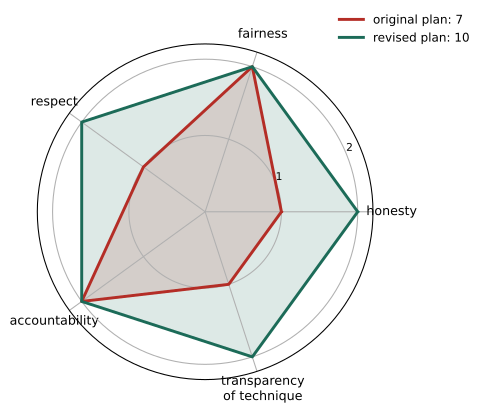
When facing a hard choice, a structured approach helps. Score a proposed post or deal on each of the four questions from 0 to 2, where 0 means a clear problem and 2 means no concern, and add a fifth question on transparency of technique: would the audience feel misled about how the content was made?
A score of 9 or 10 suggests a sound choice; 7 or 8 suggests changes; anything with a 0 should be rejected or redesigned. Like the disclosure rubric in lesson 3, this is a thinking tool rather than a rule.
Worked problem
Scoring an AI campaign
A brand offers a creator a campaign in which an AI-generated version of the creator, using a cloned voice, will appear in 40 personalized ads saying "I use this protein powder every day." The creator does use it, has approved the voice cloning in the contract, and the ads will carry the platform's AI label but no other mention of AI. Score the campaign and suggest changes.
Show solution
- Honesty: the creator uses the product, but audiences may believe the creator personally recorded each message; 1.
- Fairness: no particular vulnerability is exploited; 2.
- Respect: viewers lack information about how the content was made; 1.
- Accountability: the creator consented and can defend the arrangement if disclosed; 2.
- Transparency of technique: only a small platform label signals AI; 1.
Answer: Score 7. Changes: add a clear statement such as "AI-generated with my voice and permission," keep claims to the creator's real use, and set contract limits on where and how long the AI likeness is used.
Responsibilities when things go wrong
Ethical practice includes how you respond to mistakes. If a sponsored post turns out to be misleading, or you used an edit you now regret, act quickly: correct or remove the content, tell your audience plainly what was wrong, tell the brand and, if a regulator or platform contacts you, cooperate. Audiences forgive honest mistakes handled openly far more readily than cover-ups discovered later.
Common mistakes
MistakeUsing skin-smoothing filters in beauty product content.
InsteadShow real results; do not exaggerate product effects.
MistakeLetting a virtual influencer describe experiences it cannot have.
InsteadDisclose virtual status and avoid experiential claims.
MistakeUsing a real person's likeness or voice in an ad without consent.
InsteadGet written permission or do not use it.
MistakeTreating an AI label as a cure for misleading content.
InsteadMake the content truthful first, then label it.
MistakeDeciding ethical standards only when a deal arrives.
InsteadSet and write down standards in advance.
Summary and key terms
- Ethical practice means setting standards in advance and applying them consistently.
- Edits that exaggerate a product's effect are misleading, even with disclosure.
- AI content is judged by the same honesty rules as any other content.
- Virtual influencers must disclose their virtual status and cannot claim experiences.
- Deepfake endorsements are harmful and can infringe rights over name, image and voice.
- Parasocial trust creates responsibility to recommend honestly.
- Handle mistakes quickly and openly.
- Filter
- A digital effect that alters appearance in images or video.
- Generative AI
- Technology that creates text, images, audio or video.
- Virtual influencer
- A computer-generated persona used as an influencer.
- Deepfake
- Synthetic media showing a person doing or saying something they did not.
- Appropriation of personality
- A tort protecting against commercial use of a person's identity.
- Right to one's image
- Quebec's Civil Code protection of a person's image and name.
- #MadeWithAI
- A tag recognized for AI-generated content.
- Parasocial relationship
- A one-sided bond a viewer forms with a creator.
- Voice cloning
- Using AI to imitate a person's voice.
- Ethics score
- A five-part score for testing a decision.
Practice problems
Work each problem on paper first, then reveal the answer to check.
Name two acceptable edits.
Show answer
Lighting correction, cropping, background clean-up.
Why is a skin-smoothing filter a problem in foundation ads?
Show answer
It exaggerates the product's effect.
What do Ad Standards' guidelines say about AI influencers' testimonials?
Show answer
They should not describe experiences they cannot have.
Name two AI disclosure tags Ad Standards recognizes.
Show answer
#VirtualInfluencer, #AIinfluencer, #AIcreated, #MadeWithAI.
Which Ontario case recognized appropriation of personality?
Show answer
Athans v. Canadian Adventure Camps (1977).
Which provinces have privacy statutes covering use of likeness?
Show answer
British Columbia, Manitoba, Saskatchewan, Newfoundland and Labrador.
What protects image rights in Quebec?
Show answer
The Civil Code and the Quebec Charter.
What should you do if a deepfake of you appears in an ad?
Show answer
Report it, warn your audience, keep evidence and consider legal advice.
Ethics scores 2, 2, 1, 2, 1. Total and verdict?
Show answer
8; make changes.
Can an AI label fix a misleading image?
Show answer
No.
Lesson quiz · 5 questions
Score 60% or more to complete this lesson.
Create a free account to save your progress, take quizzes and earn a certificate.