
CRE-320 · Lesson 2 of 12 · 27 min
Canadian advertising law: the Competition Act and Ad Standards
In Canada, the rules that matter most to creators come from one federal statute and one self-regulatory code. The Competition Act sets the legal standard for truth in advertising across the country and gives the Competition Bureau powerful tools to enforce it. The Canadian Code of Advertising Standards, administered by Ad Standards, sets industry standards and handles public complaints. This lesson explains both in detail: the prohibitions, the tests, the two enforcement tracks, recent amendments and the penalties, with worked examples of how penalties are calculated.
The Competition Act and the Competition Bureau
The Competition Act is a federal law that applies across Canada to almost every industry. Its purpose is to maintain and encourage competition, and truthful marketing is part of that. The Competition Bureau is the independent law enforcement agency that investigates possible breaches. The Commissioner of Competition leads the Bureau and decides whether to take cases to the Competition Tribunal, the Federal Court or, for criminal matters, the Public Prosecution Service of Canada.
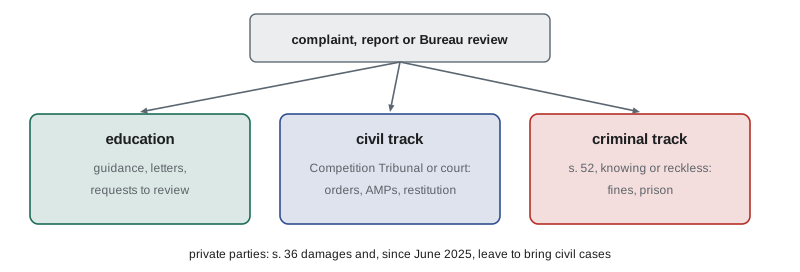
The Act deals with deceptive marketing on two tracks. A civil track covers most misleading advertising and leads to orders and administrative monetary penalties. A criminal track, under section 52, is reserved for the most serious cases, where a person knowingly or recklessly makes a false or misleading representation. The Bureau chooses the track based on the evidence of intent and the seriousness of the conduct; most cases proceed civilly.
The general prohibition
Section 74.01(1)(a) of the Act, on the civil side, and section 52(1), on the criminal side, both prohibit making a representation to the public, for the purpose of promoting a product or a business interest, that is false or misleading in a material respect. Each part of that test matters for creators.
- A representation can be words, images, video, sound, a demonstration or even an omission that changes the meaning of what is said.
- To the public means it is available to people generally, which includes any public social media post, story or stream.
- For the purpose of promoting means the message is meant to sell a product or advance a business interest. A paid post plainly qualifies, and so can unpaid promotion of a creator's own products.
- False or misleading in a material respect means the misleading element is capable of influencing a consumer to buy. Trivial inaccuracies are not enough.
The Act also says that the general impression conveyed by a representation, as well as its literal meaning, must be considered. That is why a technically true post can still break the law.
Specific prohibited practices
Beyond the general prohibition, section 74.01 lists specific practices that are deceptive in themselves.
- Performance claims not based on an adequate and proper test, which must be done before the claim is made. Lesson 6 covers substantiation.
- Environmental claims: since June 2024, claims that a product benefits the environment or mitigates climate change must also be based on an adequate and proper test, and claims about a business or its activities must be based on adequate and proper substantiation. Lesson 6 explains the 2026 amendments that narrowed these rules.
- Misleading warranties and guarantees, and misleading ordinary selling price claims, where a "regular price" is inflated to make a sale look better.
- Drip pricing: since 2022, advertising a price that cannot be attained because fixed, obligatory fees are added later is deemed false or misleading, unless the extra charges are only government-imposed, such as sales tax.
Separate sections cover misleading testimonials and test results. Section 74.02 prohibits representing a test or a testimonial as having been made or given when it was not, or distorting it. That is directly relevant to influencer endorsements and reviews, which lesson 5 covers.
| Provision | What it covers | Track |
|---|---|---|
| s. 74.01(1)(a) | False or misleading representations | Civil |
| s. 74.01(1)(b) | Performance claims without an adequate and proper test | Civil |
| s. 74.01(1.1) | Drip pricing | Civil |
| s. 74.02 | Unauthorized or distorted tests and testimonials | Civil |
| s. 52 | Knowingly or recklessly false or misleading representations | Criminal |
How the Bureau applies the law to influencers
The Competition Bureau has published guidance on influencer marketing. It says that influencers who promote products must disclose any material connection with the brand, and that the disclosure must be clear and prominent. It warns that both the business and the influencer may be held responsible for misleading representations, and that endorsements must reflect the influencer's genuine experience. The Bureau also treats fake reviews and misleading testimonials as deceptive marketing.
The Bureau's general approach is educational first. It publishes guidance, sends letters to industries it is concerned about and asks businesses to review their practices. Where conduct is serious or continues, it investigates. Investigations can lead to a consent agreement, where the business agrees to stop, pay a penalty and fix the problem, or to an application to the Competition Tribunal or a court.
Penalties on the civil track
If the Tribunal or a court finds deceptive marketing on the civil track, it can order the person to stop, to publish a corrective notice, to pay an administrative monetary penalty and, since 2022, to pay restitution to affected consumers. The penalty maximums were raised substantially by amendments in 2022.
- Individuals: up to $750,000 for a first order, and up to $1,000,000 for each later order, or three times the value of the benefit derived from the conduct, if that can be reasonably determined, whichever is greater.
- Corporations: up to $10,000,000 for a first order, and up to $15,000,000 for each later order, or three times the value of the benefit derived, or, if that cannot be reasonably determined, 3 % of the corporation's annual worldwide gross revenues, whichever is greater.
Worked problem
Calculating a maximum administrative monetary penalty
A supplement company earned $2.4 million in sales from an influencer campaign found to be deceptive. It is the company's first order. A creator in the campaign earned $18,000 in fees and affiliate commissions from the misleading posts. What are the maximum penalties for each, assuming benefit can be reasonably determined as the sales and the fees?
Show solution
- Company: statutory cap for a first order is $10,000,000; three times benefit is 3 × $2,400,000 = $7,200,000.
- The maximum is the greater: $10,000,000.
- Creator: statutory cap for a first order is $750,000; three times benefit is 3 × $18,000 = $54,000.
- The maximum is the greater: $750,000.
Answer: Up to $10 million for the company and up to $750,000 for the creator. Actual penalties are set by the Tribunal using factors in the Act and are usually far below the maximum, but the exposure is real.
Criminal penalties and private actions
On the criminal track, a person convicted under section 52 can face a fine at the court's discretion and up to 14 years in prison on indictment, or a fine of up to $200,000 and up to one year in prison on summary conviction. These cases are rare and involve deliberate fraud, but they show the seriousness Parliament attaches to deceptive marketing.
Private parties also have rights. Under section 36, anyone who has suffered loss because of conduct that breaches a criminal provision such as section 52 can sue for damages, and class actions based on section 52 are common. Since June 2025, private parties can also ask the Competition Tribunal for leave to bring their own applications about civil deceptive marketing, which means competitors and consumer groups can now pursue cases the Bureau does not take.
Provincial consumer protection laws add another layer. Ontario, British Columbia, Alberta, Quebec and other provinces prohibit unfair or deceptive practices in dealings with consumers, give consumers rights to cancel or recover money and allow provincial regulators to act. Quebec's Consumer Protection Act is particularly detailed on advertising and is discussed in lesson 8 for its rules on advertising to children. For a creator, the practical effect is that the absence of a Competition Bureau case is not the absence of risk.
Ad Standards and the Canadian Code of Advertising Standards
Ad Standards is a national, not-for-profit self-regulatory body. It administers the Canadian Code of Advertising Standards, the main set of standards for acceptable advertising in Canada, and accepts complaints from the public and from businesses about ads in any medium, including social media. The Code is voluntary, but most major advertisers, agencies and media organizations support it, and its decisions are published.
Several Code clauses matter especially to creators.
- Clause 1, accuracy and clarity: ads must not contain inaccurate or deceptive claims, omit relevant information in a deceptive way or bury qualifying information in fine print.
- Clause 2, disguised advertising techniques: advertising must not be presented in a format or style that conceals its commercial intent. Undisclosed influencer posts fall under this clause.
- Clause 7, testimonials: testimonials must reflect the genuine, reasonably current opinion of the person giving them and be based on adequate information about or experience with the product. Interpretation Guideline #5 applies this clause and Clause 2 to material connections.
- Clauses 12 and 13 cover advertising to children and to minors, and Clause 14 covers unacceptable depictions and portrayals.
When Ad Standards receives a complaint, it reviews whether the ad may breach the Code. If so, the advertiser is asked to respond, and an independent council of industry and public representatives decides. If the complaint is upheld, the advertiser is asked to amend or withdraw the ad, and the decision is published in the Ad Complaints Reports. Ad Standards also provides clearance services for certain regulated categories, such as consumer advertising for some health products and alcohol, and children's broadcast advertising.
Putting the pieces together
For a creator, the practical lesson is that one sponsored post can be examined in several places: by a regulator applying the law, by a self-regulatory body deciding a complaint, by a court in a private lawsuit and by the platform. Each applies similar ideas: the overall impression, materiality, disclosure of material connections and substantiation of claims. A post that would satisfy all of them at once is the goal, and the rest of this course shows how to build one.
Worked problem
Mapping a complaint to the right forum
Four situations arise. (a) A competitor believes a rival's influencers are making unsupported performance claims about a running shoe. (b) A viewer thinks a creator's video is an undisclosed ad. (c) Many consumers lost money after following a creator's deliberately false claims about a product. (d) A brand keeps hiding fees in prices advertised by its creators despite warnings. Where is each most likely to be pursued?
Show solution
- (a) A competitor can complain to Ad Standards under its trade dispute procedure, ask the Bureau to act or, since June 2025, seek leave to bring its own case before the Competition Tribunal.
- (b) A viewer can file a consumer complaint with Ad Standards or report the post to the Competition Bureau.
- (c) Consumers can sue for damages under section 36 based on section 52, often in a class action, and the Bureau may refer serious cases for prosecution.
- (d) Persistent drip pricing is a priority for the Bureau, which can seek orders and administrative monetary penalties.
Answer: Each situation has more than one possible forum. Creators should expect that serious or repeated problems can reach regulators and courts, while most everyday complaints go through self-regulation or the platform.
Common mistakes
MistakeThinking only false statements are illegal.
InsteadMisleading impressions and omissions can also break the law.
MistakeAssuming penalties are too small to matter.
InsteadMaximum penalties run to millions, and per-violation amounts add up.
MistakeTreating self-regulatory codes as irrelevant because they are voluntary.
InsteadCodes shape industry practice and decisions are public.
MistakeBelieving only the government can bring a case.
InsteadCompetitors and consumers have their own routes to court or tribunal.
MistakeForgetting that guidance can change quickly.
InsteadCheck the regulator's current guidance before a campaign.
Summary and key terms
- The Competition Act prohibits false or misleading representations in a material respect.
- The general impression, not just literal meaning, is considered.
- Most cases are civil; section 52 criminal cases need knowing or reckless conduct.
- Civil AMPs reach $750,000 for individuals and $10 million or more for corporations on a first order.
- Drip pricing and unsupported performance claims are specific prohibitions.
- Private parties can now seek leave to bring civil deceptive marketing cases.
- Ad Standards' Code clauses 1, 2 and 7 matter most for creators.
- Competition Act
- The federal law that prohibits deceptive marketing practices in Canada.
- Competition Bureau
- The federal agency that enforces the Competition Act.
- Competition Tribunal
- The specialized body that hears civil competition and marketing cases.
- Administrative monetary penalty
- A civil penalty ordered for deceptive marketing.
- Section 52
- The criminal prohibition on knowingly or recklessly misleading representations.
- Drip pricing
- Advertising a price that excludes unavoidable fixed fees.
- Adequate and proper test
- The testing required before making a performance claim.
- Ad Standards
- Canada's national advertising self-regulatory body.
- Disguised advertising
- Advertising presented in a way that hides its commercial intent.
- Restitution
- An order to repay consumers harmed by deceptive marketing.
Practice problems
Work each problem on paper first, then reveal the answer to check.
What four elements make up the general prohibition in s. 74.01(1)(a)?
Show answer
A representation, to the public, to promote, false or misleading in a material respect.
What distinguishes the criminal track?
Show answer
The person knowingly or recklessly made the representation.
What is the maximum first-order AMP for an individual?
Show answer
$750,000, or three times the benefit if greater.
When does the 3 % of worldwide revenue alternative apply?
Show answer
For corporations when benefit cannot be reasonably determined.
What is drip pricing?
Show answer
Advertising an unattainable price because fixed obligatory fees are added.
Which section covers distorted testimonials?
Show answer
Section 74.02.
What changed for private parties in June 2025?
Show answer
They can seek leave to bring civil deceptive marketing cases.
Which Ad Standards clause covers disguised advertising?
Show answer
Clause 2.
Three times a benefit of $400,000 for a corporation's first order versus the cap?
Show answer
$1.2 million is below the $10 million cap, so the cap applies.
What happens when an Ad Standards complaint is upheld?
Show answer
The ad must be amended or withdrawn and the decision is published.
Lesson quiz · 5 questions
Score 60% or more to complete this lesson.
Create a free account to save your progress, take quizzes and earn a certificate.