
CRE-320 · Lesson 2 of 12 · 27 min
US advertising law: the FTC Act and self-regulation
In the United States, the rules that matter most to creators come from one federal statute, a set of FTC guides and rules, the consumer protection laws of every state and an industry self-regulatory system.
Section 5 of the FTC Act sets the national standard, the FTC enforces it with guides, rules and lawsuits, state attorneys general enforce their own laws and BBB National Programs runs voluntary advertising review. This lesson explains each in detail: the prohibitions, the tests, enforcement and penalties, with worked examples of how penalties are calculated.
The FTC Act and the Federal Trade Commission
The Federal Trade Commission Act created the FTC in 1914. Section 5 of the Act declares unlawful "unfair or deceptive acts or practices in or affecting commerce." The FTC is an independent federal agency led by commissioners appointed by the President. Its Bureau of Consumer Protection investigates deceptive advertising, and the Commission decides whether to bring administrative cases or sue in federal court.
The FTC has broad jurisdiction over most businesses, but not all. Banks, common carriers, insurance (largely regulated by states) and some other sectors fall wholly or partly outside it, and other agencies regulate specific products, such as the Food and Drug Administration for prescription drugs and the Securities and Exchange Commission for securities. Lesson 7 covers those overlaps.
Deception and unfairness
The FTC's 1983 Policy Statement on Deception defines a deceptive practice with three elements, and each matters for creators.
- There must be a representation, omission or practice. It can be words, images, a demonstration or the failure to disclose information needed to prevent a misleading impression.
- It must be likely to mislead consumers acting reasonably in the circumstances. The FTC looks at the net impression of the whole message, through the eyes of the group targeted.
- It must be material, meaning likely to affect consumers' decisions. Express claims and claims about health, safety, cost or central characteristics are presumed material.
Unfairness is a separate theory: a practice is unfair if it causes or is likely to cause substantial injury that consumers cannot reasonably avoid and that is not outweighed by benefits to consumers or competition. Unfairness is used less often in advertising cases but appears in privacy and data cases.
Guides and rules
The FTC explains how Section 5 applies through guides and rules, and the difference between them matters a great deal for penalties.
- Guides, such as the Guides Concerning the Use of Endorsements and Testimonials in Advertising (revised in June 2023) and the Green Guides, are the FTC's interpretation of what is deceptive. They are not binding law in themselves, but conduct inconsistent with them can lead to enforcement under Section 5.
- Trade regulation rules, such as the Trade Regulation Rule on the Use of Consumer Reviews and Testimonials (in force since October 2024) and the Made in USA Labeling Rule, have the force of law. Violating a rule can lead directly to civil penalties.
| Source | What it covers | Binding? |
|---|---|---|
| FTC Act s. 5 | Unfair or deceptive acts or practices | Yes, statute |
| Endorsement Guides (16 CFR Part 255) | Endorsements, testimonials and disclosure | Guidance on s. 5 |
| Consumer Reviews and Testimonials Rule (16 CFR Part 465) | Fake reviews, insider reviews, fake influence | Yes, rule |
| Green Guides (16 CFR Part 260) | Environmental claims | Guidance on s. 5 |
| Made in USA Labeling Rule (16 CFR Part 323) | Unqualified Made in USA labels | Yes, rule |
How the FTC applies the law to influencers
The Endorsement Guides say that endorsements must reflect the honest opinions and experience of the endorser, that an endorser who claims to use a product must actually have used it, and that any material connection between the endorser and the advertiser that the audience would not expect must be disclosed clearly and conspicuously.
The 2023 revision defined clear and conspicuous as difficult to miss and easily understandable by ordinary consumers, addressed virtual influencers, stated that tags, likes and pins can be endorsements and noted that platform disclosure tools may not be sufficient on their own. The FTC also publishes plain-language guidance for influencers, "Disclosures 101 for Social Media Influencers."
Penalties and remedies
The FTC's remedies depend on the path a case takes. In 2021, in AMG Capital Management v. FTC, the Supreme Court held that Section 13(b) of the FTC Act does not allow the FTC to obtain monetary relief such as refunds directly in court for Section 5 violations.
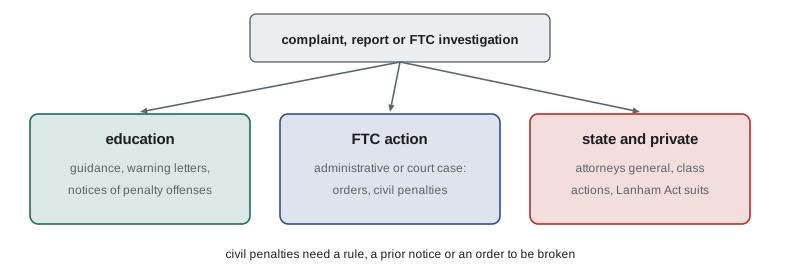
Since then, money in FTC cases comes mainly from violations of rules, violations of earlier orders, and conduct that the FTC has formally told the industry is unlawful.
- Rule violations: civil penalties per violation, for example under the Consumer Reviews and Testimonials Rule.
- Notices of Penalty Offenses: if a company has received a notice stating that a practice has been found unlawful in earlier FTC decisions, and then engages in that practice knowingly, it can face civil penalties. In 2021 the FTC sent such notices on endorsements and testimonials to more than 700 companies.
- Order violations: a company or individual under an FTC order faces civil penalties for each violation.
The maximum civil penalty is adjusted for inflation each year. The 2025 figure was $53,088 per violation. Because the late-2025 government shutdown delayed the inflation data needed for the calculation, the FTC kept its 2025 amounts in place for 2026. Each post, each day or each consumer affected can count as a separate violation, so totals can become very large.
Worked problem
Calculating maximum civil penalty exposure
A company that received a Notice of Penalty Offenses on endorsements later runs a campaign in which 40 influencer posts fail to disclose payment. Treating each post as one violation, what is the maximum civil penalty exposure at the 2025 amount, which still applies in 2026?
Show solution
- Number of violations: 40.
- Maximum per violation: $53,088.
- Multiply: 40 × $53,088 = $2,123,520.
- If each day a post stays up counted separately, the figure would be higher still.
Answer: About $2.1 million at the maximum. Courts consider factors such as good faith, ability to pay and the effect on the business, so actual penalties are often lower, but per-violation penalties add up quickly.
State laws and private actions
Every state has a consumer protection statute, often modeled on the FTC Act and called a UDAP law (unfair and deceptive acts and practices). State attorneys general enforce them and can obtain civil penalties, refunds and injunctions, often in multistate actions. Many state laws also give consumers a private right to sue, sometimes for multiple damages and attorney's fees, and class actions over false advertising are common, particularly under California's laws. Competitors can sue each other for false advertising under Section 43(a) of the federal Lanham Act. The FTC Act itself does not give consumers a private right of action.
State enforcement matters to creators for two reasons. First, state attorneys general often move faster than federal agencies on local problems, such as misleading promotions for clinics, supplements or events, and they can act even when the FTC does not. Second, state laws sometimes go further than federal law. California's Unfair Competition Law and False Advertising Law, for example, allow broad suits by private plaintiffs who lost money, and several states have their own rules on automatic renewals, health claims and promotions directed at minors. A creator who sells products to people in many states is exposed to the laws of each of them.
State attorneys general have also taken part in influencer-related settlements alongside the FTC, including the 2022 settlement over radio personalities who endorsed a phone they had not used. For a creator, the practical effect is simple: the absence of an FTC case is not the absence of risk. A consumer class action, a competitor's lawsuit or a state investigation can each begin from a single screenshot of a misleading post.
BBB National Programs: NAD, NARB and CARU
BBB National Programs runs the main US advertising self-regulatory system. The National Advertising Division (NAD) reviews national advertising for truthfulness and substantiation, mostly in challenges brought by competitors, and also monitors on its own. Appeals go to the National Advertising Review Board (NARB). The Children's Advertising Review Unit (CARU) applies guidelines for advertising directed at children under 13. Participation is voluntary, but companies that refuse to participate or to comply are referred to the FTC or another regulator, and decisions are published.
Several features of the NAD process matter especially to creators and brands.
- NAD applies the same core principles as the FTC: claims must be truthful, not misleading and supported by a reasonable basis before they are made.
- NAD has reviewed influencer posts and decided that material connections must be disclosed clearly, consistent with the Endorsement Guides.
- Advertisers often agree to modify or discontinue claims after an NAD decision, and NAD publishes summaries that serve as practical precedent for the industry.
- CARU's guidelines cover influencer and online advertising to children, including clear disclosure that children can understand. Lesson 8 covers them.
An NAD case typically begins with a challenge. The advertiser responds with its substantiation, NAD reviews the evidence and issues a decision recommending whether claims should be modified or discontinued, and either party can appeal to the NARB. A faster track handles simpler disputes. Because NAD decisions are public and widely followed, they shape industry practice well beyond the parties involved.
Putting the pieces together
For a creator, the practical lesson is that one sponsored post can be examined in several places: by a regulator applying the law, by a self-regulatory body deciding a complaint, by a court in a private lawsuit and by the platform. Each applies similar ideas: the overall impression, materiality, disclosure of material connections and substantiation of claims. A post that would satisfy all of them at once is the goal, and the rest of this course shows how to build one.
Worked problem
Mapping a complaint to the right forum
Four situations arise. (a) A competitor believes a rival's influencers are making unsupported performance claims about a running shoe. (b) A viewer thinks a creator's video is an undisclosed ad. (c) Many consumers lost money after following a creator's deliberately false claims about a product. (d) A brand keeps hiding fees in prices advertised by its creators despite warnings. Where is each most likely to be pursued?
Show solution
- (a) A competitor can bring a challenge at NAD or sue under Section 43(a) of the Lanham Act.
- (b) A viewer can report the post to the FTC through its online complaint portal, and to the platform.
- (c) Consumers can sue under state consumer protection laws, often in a class action, and the FTC or state attorneys general may act.
- (d) Persistent hidden fees can lead to FTC or state action, and a rule or prior notice can bring civil penalties.
Answer: Each situation has more than one possible forum. Creators should expect that serious or repeated problems can reach regulators and courts, while most everyday complaints go through self-regulation or the platform.
Common mistakes
MistakeThinking only false statements are illegal.
InsteadMisleading impressions and omissions can also break the law.
MistakeAssuming penalties are too small to matter.
InsteadMaximum penalties run to millions, and per-violation amounts add up.
MistakeTreating self-regulatory codes as irrelevant because they are voluntary.
InsteadCodes shape industry practice and decisions are public.
MistakeBelieving only the government can bring a case.
InsteadCompetitors and consumers have their own routes to court or tribunal.
MistakeForgetting that guidance can change quickly.
InsteadCheck the regulator's current guidance before a campaign.
Summary and key terms
- Section 5 of the FTC Act prohibits unfair or deceptive acts or practices.
- Deception requires a likely-to-mislead representation that is material.
- Guides interpret the law; rules are binding and carry civil penalties.
- Since AMG Capital (2021), FTC money remedies rely on rules, notices and orders.
- The maximum civil penalty is $53,088 per violation in 2025 and 2026.
- State UDAP laws, private lawsuits and the Lanham Act add enforcement routes.
- NAD, NARB and CARU provide voluntary self-regulation with published decisions.
- FTC Act Section 5
- The federal prohibition on unfair or deceptive acts or practices.
- Federal Trade Commission
- The federal agency that enforces truth-in-advertising law.
- Policy Statement on Deception
- The FTC's 1983 statement defining deceptive practices.
- Civil penalty
- A monetary penalty for violating a rule or order.
- Notice of Penalty Offenses
- An FTC notice that a practice has been found unlawful.
- Endorsement Guides
- FTC guidance on endorsements, testimonials and disclosure.
- Trade regulation rule
- An FTC rule with the force of law.
- UDAP law
- A state law prohibiting unfair and deceptive acts and practices.
- Lanham Act
- The federal law allowing competitors to sue for false advertising.
- National Advertising Division
- The BBB National Programs unit that reviews advertising claims.
Practice problems
Work each problem on paper first, then reveal the answer to check.
What three elements make up deception?
Show answer
A representation, likely to mislead reasonable consumers, that is material.
What is the difference between a guide and a rule?
Show answer
Guides interpret the law; rules are binding and carry penalties.
What did AMG Capital decide?
Show answer
Section 13(b) does not authorize monetary relief.
What is the maximum civil penalty per violation in 2026?
Show answer
$53,088, the 2025 amount kept for 2026.
What is a Notice of Penalty Offenses?
Show answer
A notice that a practice is unlawful, enabling penalties for knowing violations.
Which body hears NAD appeals?
Show answer
The National Advertising Review Board.
Can consumers sue under the FTC Act?
Show answer
No, but state laws often allow private suits.
Which law lets competitors sue for false advertising?
Show answer
Section 43(a) of the Lanham Act.
Exposure for 25 violations at the maximum?
Show answer
25 × $53,088 = $1,327,200.
What does the 2023 revision say about platform disclosure tools?
Show answer
They may not be sufficient on their own.
Lesson quiz · 5 questions
Score 60% or more to complete this lesson.
Create a free account to save your progress, take quizzes and earn a certificate.