
CRE-320 · Lesson 10 of 12 · 27 min
Platform rules and branded-content tools
Platforms are the third layer of rules a creator works under, and for day-to-day enforcement they are often the most important. A regulator might look at one post in a million; a platform's systems look at every post. This lesson explains how platform branded-content policies work, the disclosure tools each major platform offers, the categories platforms restrict or ban in sponsored content, their rules on promotions and on artificial intelligence, and what happens when a creator breaks them. Platform policies change frequently, often several times a year, so treat the specifics here as a snapshot as of October 2026 and check each platform's current help pages before a campaign.
Why platform rules matter
Platform rules are contracts. When you open an account, you agree to the platform's terms of service, community guidelines and, if you post branded content, its branded-content or advertising policies. Breaking them is not illegal in itself, but the platform can enforce them directly and immediately, without a hearing.
- Removing posts or limiting their distribution.
- Applying labels or warnings to content.
- Removing access to branded-content tools, partnership programs or creator marketplaces.
- Demonetizing videos or channels, or suspending revenue sharing.
- Issuing strikes that lead to suspension or permanent bans.
For a creator whose income depends on one or two platforms, these consequences can be more serious than a regulatory warning letter. Platforms also share information with regulators and cooperate with their investigations, and regulators cite platform tools in their guidance.
What branded-content policies usually require
Although each platform words its policy differently, most branded-content policies share a set of core requirements.
- Use the platform's paid-partnership or branded-content tool for content created in exchange for something of value.
- Tag or identify the brand partner, where the tool supports it, so the label names the brand.
- Comply with the law, including advertising, consumer protection and disclosure law, in the places where the content is seen.
- Do not promote prohibited goods or services, and follow extra restrictions for regulated categories.
- Follow the platform's general community guidelines and advertising standards.
- Do not use the platform's own logos or imply that the platform endorses the promotion.
The main tools
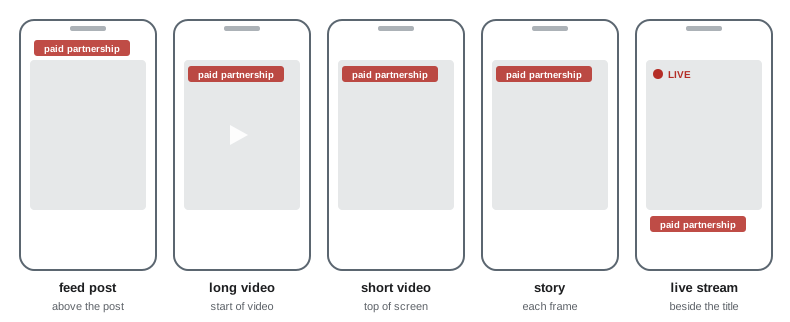
The table below summarizes the main branded-content tools on large platforms at the time of writing. Tool names and placement change often.
| Platform | Tool | What viewers see |
|---|---|---|
| YouTube | Paid promotion setting in video details | An "Includes paid promotion" label at the start of the video |
| Instagram and Facebook | Branded content tool, tagging the brand partner | A "Paid partnership with [Brand]" label above the post |
| TikTok | Content disclosure setting: Your brand or Branded content | A "Promotional content" or "Paid partnership" label |
| Snapchat | Paid partnership tag | A "Paid partnership" label on the Snap |
| Paid partnership tool | A "Paid partnership" label on the Pin |
On Instagram and Facebook, tagging the brand partner through the branded-content tool also gives the brand access to post-performance data and lets it, with permission, run the post as a partnership ad. On TikTok, choosing "Your brand" signals promotion of the creator's own business, while "Branded content" signals a deal with a third party; both apply labels and require compliance with TikTok's branded-content policy. YouTube's setting adds a short label at the start of the video and also tells YouTube not to place conflicting ads in some cases.
Why platform labels are not enough on their own
As lesson 3 explained, regulators in both countries say platform labels help but may not be sufficient alone. The reasons are practical:
- Labels can be small, appear for only a few seconds or sit where viewers do not look.
- On some devices or views, such as embedded videos or reposts, the label may not appear.
- The label's wording, such as "promotional content," may not tell viewers clearly that the creator was paid.
- Labels may not appear in content that is cross-posted, downloaded or shared off the platform.
The practical rule is therefore to turn on every relevant platform tool and add your own disclosure in the content and caption.
Prohibited and restricted categories
Platforms ban some products from branded content entirely and restrict others to adult audiences or particular countries. The lists vary, but commonly include:
- Prohibited in most branded-content policies: weapons and ammunition, illegal drugs and drug paraphernalia, tobacco and vaping products, unsafe supplements, adult services, counterfeit goods, and services that facilitate cheating or deception, such as fake reviews or essay mills.
- Restricted or allowed only with conditions: alcohol, gambling and betting, financial products and crypto assets, dating services, weight-loss products, cosmetic procedures and prescription medicines. Conditions may include age-gating, country restrictions, licenses, pre-approval or a ban on targeting teens.
Platform rules can be stricter than the law. A product that is legal to sell, such as a vaping device or a legal cannabis accessory, can still be banned from branded content. And platform rules can differ by country, reflecting local law: for example, gambling promotion may be allowed only where the operator is licensed and only to adult audiences.
Worked problem
Checking a deal against platform rules
A creator is offered four deals for one month: (a) a sports betting app licensed in the creator's province or state; (b) a nicotine pouch brand; (c) a meal-kit service; (d) a crypto exchange. The creator posts on a platform whose branded-content policy prohibits tobacco and nicotine products and restricts gambling and financial products. What should the creator check?
Show solution
- (a) Gambling is restricted: confirm the operator's license covers the audience's location, that the content is age-gated to adults and that the platform's specific gambling requirements, such as pre-approval, are met.
- (b) Nicotine pouches fall under tobacco and nicotine products, which are prohibited; decline for this platform.
- (c) Meal kits are not restricted; use the branded-content tool and disclose.
- (d) Financial products and crypto are restricted: check whether the platform allows crypto promotion in the audience's country, whether the exchange is registered and whether securities rules apply (lesson 7).
Answer: Decline (b), proceed with (c) normally, and proceed with (a) and (d) only after confirming licenses, audience age and the platform's specific conditions.
Promotions and contests on platforms
Most platforms allow creators to run contests and giveaways, but they set rules on top of the law (lesson 9). Common requirements include:
- The promotion's official rules, terms and eligibility are the creator's or sponsor's responsibility.
- A statement that the platform does not sponsor, endorse or administer the promotion, and a release of the platform by each entrant.
- No requirement to tag people inaccurately, such as tagging friends who are not in the photo, or to share on personal timelines, depending on the platform.
- No inauthentic engagement, such as requiring entrants to like or comment with bots.
Breaking these rules can lead to removal of the promotion and loss of access to promotional features.
Platform rules on artificial intelligence
Platforms have added rules on synthetic and altered media since 2024, partly in response to deepfakes and election concerns.
- YouTube requires creators to disclose realistic content that is altered or synthetic, such as making a real person appear to say or do something they did not, altering footage of real events or generating realistic scenes. A label appears on the video, and more prominently for sensitive topics.
- Meta applies an "AI info" label to images, video and audio it detects as AI-generated or that creators disclose as such, and requires disclosure of realistic AI-generated video or audio.
- TikTok requires creators to label realistic AI-generated content and automatically labels some content that carries Content Credentials metadata showing it was AI-generated.
These rules overlap with advertising law: an AI-generated product demonstration that exaggerates results is misleading whether or not the platform label is applied. Lesson 11 returns to AI in depth.
Monetization and advertiser-friendly rules
Platforms that share advertising revenue with creators also set content standards for monetization. A video can be lawful and within community guidelines but still receive limited or no ads if it covers topics advertisers avoid, such as violence or controversial issues. Sponsored content that breaks branded-content rules can also lead to demonetization of the video or channel. Creators who rely on revenue sharing should read the monetization guidelines alongside the branded-content policy.
Cross-posting and platform differences
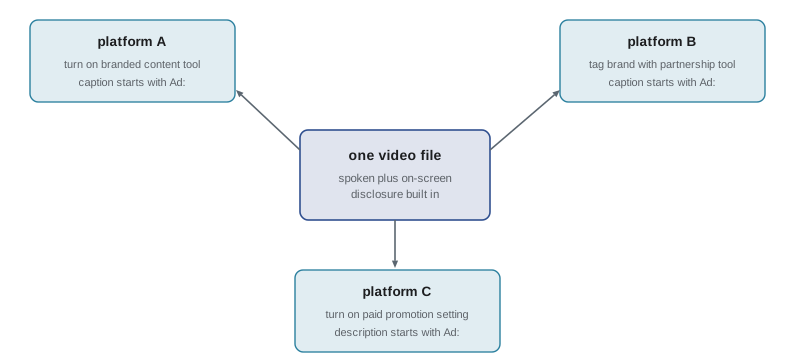
Many creators post the same content on several platforms. Disclosure and tools do not carry over automatically: a paid-partnership label applied on one platform does not appear when the video is uploaded to another. Each upload needs its own label and its own caption disclosure, and the content itself should include a spoken and on-screen disclosure so that it travels with the video. Category rules also differ: a deal that is allowed on one platform may be prohibited on another.
Worked problem
Planning disclosures for a cross-posted campaign
A creator's contract requires one 45-second video posted on TikTok, Instagram Reels and YouTube Shorts, plus three story frames on Instagram. Plan the disclosures.
Show solution
- In the video itself: a spoken disclosure in the first seconds ("This video is sponsored by [Brand]") and an on-screen "Ad" label, so the disclosure travels across platforms.
- TikTok: turn on the Content disclosure setting with "Branded content," and start the caption with "Ad:".
- Instagram Reels: use the branded-content tool tagging the brand, and start the caption with "Ad:".
- YouTube Shorts: turn on the paid promotion setting, and start the description with "Ad:".
- Instagram stories: use the branded-content tool on each frame and add an "Ad" sticker or text to each frame.
Answer: Build the disclosure into the video itself, then apply each platform's tool and a caption disclosure on every upload and every story frame.
When platforms and law conflict
Occasionally, platform rules and legal requirements seem to conflict, for example when a platform's label uses wording a regulator considers unclear, or when a platform allows a category that local law restricts. In those cases, follow both by meeting the stricter requirement: use the platform tool and add your own clear disclosure; and do not run content that local law prohibits, even if the platform allows it. If the platform prohibits content the law allows, the platform's rule still governs what you can post there.
Keeping up with changes
Because platform policies change often, build a simple habit into each campaign:
- Check the current branded-content policy and prohibited categories for each platform used.
- Check the current tool names and where the label appears, using a test post or the help pages.
- Note the date you checked in your campaign records.
- Ask the brand whether it has platform pre-approval for restricted categories.
Brands sometimes ask creators to give them access to their accounts or to grant permissions for partnership ads. Grant only the specific permissions needed, for a defined period, using the platform's built-in partnership features rather than sharing passwords, and remove access when the campaign ends.
Common mistakes
MistakeRelying only on the platform's paid-partnership label.
InsteadUse the tool and add your own disclosure.
MistakeAssuming a label applied on one platform carries over when cross-posting.
InsteadApply each platform's tool and caption disclosure on every upload.
MistakeAccepting deals for products the platform bans from branded content.
InsteadCheck prohibited and restricted categories first.
MistakeRunning giveaways without the platform's required statements.
InsteadInclude non-endorsement and release statements.
MistakePosting realistic AI-generated content without a label.
InsteadFollow each platform's AI disclosure rules.
Summary and key terms
- Platform rules are contracts enforced directly and quickly.
- Branded-content policies require using tools, tagging partners and following the law.
- Platform labels help but should be combined with your own disclosure.
- Platforms ban some categories and restrict others to adults or licensed operators.
- Platforms add their own rules for promotions and contests.
- Platforms require labels for realistic AI-generated or altered content.
- Each cross-posted upload needs its own tool and disclosure.
- Branded-content policy
- A platform's rules for content made in exchange for value.
- Paid-partnership label
- A platform label identifying sponsored content.
- Partnership ad
- A paid ad that uses a creator's post or identity.
- Content disclosure setting
- TikTok's tool for labeling promotional content.
- Paid promotion setting
- YouTube's tool for labeling sponsored videos.
- Prohibited category
- Products a platform bans from branded content.
- Restricted category
- Products allowed only with conditions such as age-gating.
- Demonetization
- Loss of advertising revenue on content or a channel.
- Strike
- A platform penalty that can lead to suspension.
- Content Credentials
- Metadata showing how media was created or edited.
Practice problems
Work each problem on paper first, then reveal the answer to check.
Name three platform enforcement actions.
Show answer
Removal, demonetization, loss of tools, strikes, bans.
What does Instagram's branded content tool display?
Show answer
A Paid partnership with [Brand] label.
What does TikTok's Your brand option signal?
Show answer
Promotion of the creator's own business.
Why might a platform label be insufficient?
Show answer
It can be small, brief, missing on some views or unclear.
Name two categories most platforms prohibit in branded content.
Show answer
Weapons, tobacco and vaping, illegal drugs, adult services.
Name two restricted categories.
Show answer
Alcohol, gambling, financial products, weight loss.
What must platform giveaways usually include?
Show answer
A statement that the platform does not sponsor or endorse the promotion.
What does YouTube require for realistic synthetic content?
Show answer
Disclosure, which adds a label.
Does a label carry over when cross-posting?
Show answer
No, each upload needs its own.
When law and platform rules differ, which do you follow?
Show answer
Both, meeting the stricter requirement.
Lesson quiz · 5 questions
Score 60% or more to complete this lesson.
Create a free account to save your progress, take quizzes and earn a certificate.