
CRE-320 · Lesson 7 of 12 · 26 min
Regulated products: health, alcohol, cannabis, gambling and finance
Some products carry rules that go far beyond general advertising law. Health products can harm people if promoted with false hope; alcohol, cannabis and gambling carry risks of addiction and harm to young people; and investment promotions can cost audiences their savings. For these categories, product-specific laws decide not only how a product may be advertised but sometimes whether it may be promoted by creators at all. This lesson surveys the main regulated categories in your country, explains the extra rules for each and shows how creators can decide whether to accept a deal and how to keep content within the lines. This is awareness-level information; regulated categories are exactly where specialist legal advice is most valuable.
Why regulated categories need extra care
Three features make these categories different. First, the harm from a misleading message can be serious: a person who delays medical treatment, develops a gambling problem or loses their savings suffers more than one who buys an overpriced gadget. Second, many of these products are legal only for adults, so content that reaches minors creates its own problem. Third, separate regulators with their own powers oversee each category, in addition to the general advertising regulator, so one post can draw attention from several agencies at once.
Health products: drugs, supplements and devices
In the United States, health product advertising is split between two agencies. The Food and Drug Administration (FDA) regulates labeling of foods, drugs, devices and cosmetics, and advertising of prescription drugs and restricted devices. The FTC regulates advertising of over-the-counter drugs, dietary supplements, foods, cosmetics and most devices. Several rules matter directly to creators.
- Health claims must be supported by competent and reliable scientific evidence. The FTC's Health Products Compliance Guidance, issued in December 2022, says this generally means high-quality randomized, controlled human clinical trials for claims about health benefits.
- Prescription drug promotion must present fair balance between benefits and risks and include required risk information. In 2015 the FDA sent a warning letter to a drug company after a celebrity posted about a morning-sickness drug on social media without any risk information, and the post had to be corrected.
- Dietary supplements may make structure or function claims, such as "supports immune health," but not disease claims such as "prevents colds" or "treats arthritis." Labels with structure or function claims carry the disclaimer that the FDA has not evaluated the statement and that the product is not intended to diagnose, treat, cure or prevent any disease.
- In April 2023 the FTC sent Notices of Penalty Offenses about substantiation of health claims to roughly 670 marketers of health products, which means those companies face civil penalties for unsupported claims.
- Cosmetics cannot make drug claims. A moisturizer can say it hydrates skin; it cannot say it treats eczema unless it is an approved or properly marketed drug.
In November 2023 the FTC sent warning letters to a dozen registered dietitians and other health influencers, and to two trade associations, about Instagram and TikTok posts promoting the safety of aspartame or sugar consumption without clearly disclosing that the trade groups had paid for them. The letters stressed that health professionals carry extra credibility and that their paid posts must be clearly disclosed.
Worked problem
Checking a supplement claim
A creator is offered a deal for a melatonin supplement. The brief asks the creator to say: "It cured my insomnia," "Helps me fall asleep when my schedule changes," and "Doctors recommend it for kids." The brand's evidence consists of two small studies in adults with jet lag. What can the creator say?
Show solution
- "Cured my insomnia" is a disease claim that supplements may not make and the evidence does not support; do not use it.
- "Helps me fall asleep when my schedule changes" is a first-person structure or function statement that fits the evidence on schedule changes; acceptable if true and properly disclosed.
- "Doctors recommend it for kids" is an expert endorsement and a claim about children with no supporting evidence; do not use it.
- Add a clear disclosure, and avoid implying results the evidence does not show.
Answer: Only the second statement is supportable; the first and third should be dropped.
Food and nutrition
Food claims sit between general advertising law and health rules. Nutrient content claims ("high in fiber," "low fat") and health claims ("reduces the risk of heart disease") have defined conditions. Creators promoting food and drinks should use the brand's approved claims and avoid adding their own health benefits, such as calling a snack "a cure for bloating." Diet, weight loss and detox products are a frequent enforcement target in both countries because claims are often exaggerated and audiences vulnerable.
Alcohol
Alcohol advertising in the United States is regulated by the Alcohol and Tobacco Tax and Trade Bureau (TTB), by state laws and by industry self-regulatory codes from the Distilled Spirits Council, the Beer Institute and the Wine Institute. Industry codes require that influencers be of legal drinking age (21) and that content be placed where a substantial majority of the expected audience, generally at least about 71.6 % to 73.8 % depending on the code, is of legal drinking age. Content must not appeal mainly to minors, encourage excessive drinking or link alcohol to driving or dangerous activities. Creators should check audience age data before accepting alcohol deals and use platform age-gating tools.
Cannabis and tobacco
Cannabis remains illegal under federal law, although many states permit medical or adult use. State laws restrict marketing, often banning content that appeals to minors and requiring that a large majority of the audience be adults; platforms generally prohibit paid cannabis promotion. Tobacco and nicotine products are regulated by the FDA, which, jointly with the FTC, sent warning letters in 2019 to e-liquid companies over influencer posts that lacked the required nicotine warnings. Most platforms prohibit branded content for tobacco and vaping products.
Gambling and betting
Sports betting and online gambling are regulated by the states that permit them, and rules vary. Many states prohibit advertising to people under 21, require responsible-gambling messages, restrict "risk-free" bet claims and limit use of college athletes. The American Gaming Association's Responsible Marketing Code, updated in 2023, commits members not to partner with college athletes and to place advertising only where at least 73.6 % of the audience is reasonably expected to be 21 or older. Creators should avoid promoting offshore or unlicensed operators and should check each state's rules before accepting betting deals.
Financial products and finfluencers
Creators who discuss money, often called finfluencers, can provide valuable financial education. But promoting specific investments, trading platforms or crypto assets for pay can bring them within securities law, which is much stricter than general advertising law.
In the United States, Section 17(b) of the Securities Act of 1933 requires anyone who promotes a security in exchange for compensation to disclose the nature, source and amount of that compensation. In 2022 a celebrity paid $1.26 million to settle SEC charges for promoting a crypto asset on social media without disclosing a $250,000 payment, and the SEC brought similar cases against other celebrities in 2023. Investment advisers that use testimonials and endorsements, including from paid influencers, must follow the SEC's Marketing Rule, which requires disclosures and oversight, and broker-dealers must supervise influencer communications under FINRA Rule 2210. Pump-and-dump schemes and misleading statements are prohibited regardless of disclosure.
| Category | Key question before accepting | Common red flags |
|---|---|---|
| Health products | Are the claims authorized or supported by strong evidence? | Cure claims, before-and-after miracles |
| Alcohol | Is my audience of legal age, and am I? | Young audience, party or driving themes |
| Cannabis and tobacco | Is creator promotion allowed at all? | Lifestyle content, testimonials |
| Gambling | Is the operator licensed where my audience lives? | Offshore sites, risk-free claims |
| Investments and crypto | Does this make me an adviser or promoter under securities law? | Guaranteed returns, undisclosed payments |
Audience composition
For age-restricted products, the audience matters as much as the message. Platform analytics show the age distribution of a creator's followers, though they are estimates and may be incomplete. A creator can calculate the share of the audience that is of legal age and compare it with the threshold required by law, industry codes or platform rules.
Worked problem
Checking audience composition for an age-restricted deal
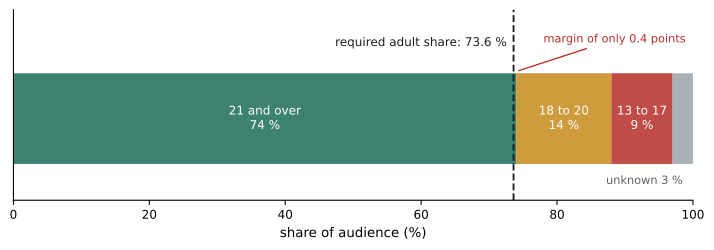
A creator's analytics show followers aged 13 to 17: 9 %; 18 to 20: 14 %; 21 and over: 74 %; unknown: 3 %. A betting brand's code requires at least 73.6 % of the audience to be 21 or older, and the creator lives where the legal age is 21. Should the creator accept?
Show solution
- Known share aged 21 and over: 74 %.
- Treat the unknown 3 % cautiously, assuming it may be under 21: 74 % remains the conservative estimate.
- 74 % is only just above 73.6 %, and 9 % of followers are minors.
- A small change in audience could push the share below the threshold, and content may still reach minors through shares.
Answer: The audience narrowly meets the threshold, but with 9 % minors, the creator should use age-gating, avoid content appealing to young people and consider declining if the margin cannot be maintained.
Deciding whether to accept a regulated deal
Before accepting any deal in a regulated category, a creator should ask:
- Is this product legal to sell and to advertise where my audience lives, and is creator promotion permitted?
- Does the brand hold the required license, product number or registration?
- What claims am I being asked to make, and are they authorized or substantiated?
- Is my audience of the right age, and does my content appeal to minors?
- Does the platform allow branded content for this category?
- Would promoting this product be consistent with what my audience expects from me?
If the answer to any of the first five questions is no or unclear, decline or get specialist advice.
Health professionals as endorsers
Doctors, nurses, pharmacists, dietitians, dentists and other regulated health professionals carry extra credibility, and their professional bodies often add rules on top of advertising law. Many professional regulators restrict or prohibit members from endorsing commercial products, from using testimonials and from making claims that are not supported by evidence. A creator who is a health professional should check their regulator's advertising and conflict-of-interest standards before accepting any deal, should never imply that their profession or regulator endorses a product, and should disclose payments especially clearly because audiences give their views more weight. Creators who are not health professionals should never present themselves as experts, use titles such as "nutritionist" loosely where the title is regulated, or wear clinical clothing in ways that imply professional status they do not have.
When a deal falls in a regulated category, it is reasonable to ask the brand for written confirmation of the product's legal status, its license or product number, the approved claims and any restrictions on audience or placement, and to keep that confirmation in your records with the contract.
Common mistakes
MistakePromoting a supplement with disease cure claims.
InsteadStay within authorized or substantiated structure or function claims.
MistakeAccepting alcohol or betting deals without checking audience age.
InsteadCheck analytics and use age-gating.
MistakeRelying on a "not financial advice" disclaimer.
InsteadDisclaimers do not avoid securities obligations; disclose compensation.
MistakePromoting cannabis or vaping products as you would any other brand.
InsteadCheck whether creator promotion is allowed at all.
MistakePromoting offshore gambling sites to your audience.
InsteadPromote only operators licensed where your audience lives.
Summary and key terms
- Regulated categories carry product-specific rules beyond general advertising law.
- Health claims must be authorized or strongly substantiated; no disease cures.
- Alcohol promotion requires legal-age creators and audiences and avoids risky themes.
- Cannabis and tobacco promotion by creators is heavily restricted.
- Gambling promotion must be licensed, adult-focused and responsible.
- Paid investment promotion can trigger securities law and disclosure duties.
- Check audience composition and platform rules before accepting regulated deals.
- FDA
- The Food and Drug Administration.
- Structure or function claim
- A supplement claim about normal body function.
- Disease claim
- A claim to diagnose, treat, cure or prevent disease.
- Fair balance
- Presenting drug benefits and risks evenly.
- Competent and reliable scientific evidence
- The standard for health claims.
- Section 17(b)
- The Securities Act provision requiring disclosure of paid promotion.
- Marketing Rule
- The SEC rule on investment adviser advertising.
- Finfluencer
- A creator who discusses or promotes financial products.
- Age-gating
- Restricting content to users of legal age.
- Audience composition
- The age and other make-up of an audience.
Practice problems
Work each problem on paper first, then reveal the answer to check.
Which agency regulates supplement advertising?
Show answer
The FTC.
What evidence does the FTC generally expect for health benefit claims?
Show answer
Randomized, controlled human clinical trials.
Can a supplement claim to prevent colds?
Show answer
No, that is a disease claim.
What did the November 2023 FTC letters concern?
Show answer
Undisclosed paid posts about aspartame and sugar.
What does Section 17(b) require?
Show answer
Disclosure of the nature, source and amount of compensation.
How much did the 2022 crypto promotion settlement cost?
Show answer
$1.26 million.
What audience share do industry alcohol codes require?
Show answer
Roughly 71.6 % to 73.8 % of legal drinking age.
What does the AGA code say about college athletes?
Show answer
Members should not partner with them.
Audience 72 % aged 21+ against 73.6 %?
Show answer
Below the threshold; decline or adjust.
Name two alcohol advertising red flags.
Show answer
Appeal to minors, driving or excessive drinking themes.
Lesson quiz · 5 questions
Score 60% or more to complete this lesson.
Create a free account to save your progress, take quizzes and earn a certificate.