
CRE-320 · Lesson 4 of 12 · 27 min
Disclosure in practice: affiliates, gifts and hard cases
The basic rule is easy to state: disclose material connections clearly. Applying it is harder, because creator businesses produce situations that the rules' authors did not always foresee. This lesson works through the hard cases one by one: affiliate links and codes, gifts and seeding, events and trips, ambassadors and long-term deals, employees and family, contests, reposts and old content, live and audio formats, multi-brand content, and connections that are not with a brand at all. For each, we look at what the rules say and then at the practical decision a creator has to make.
Affiliate links and discount codes
Affiliate links and codes earn the creator a commission or fee when the audience buys. That is a material connection, because the creator benefits financially from the recommendation, and it must be disclosed in every post, video or page that contains an affiliate link or code.
The hard part is placement. Many creators put affiliate links in a description, a link-in-bio page or a pinned comment. The disclosure must appear where the audience encounters the recommendation and the link, not only on a separate page.
- In a video, say that you earn from links before or as you mention them, for example "links below are affiliate links; I earn a commission if you buy."
- In a caption, put a short disclosure near the start and next to the link or code.
- On a link-in-bio or storefront page, put a clear statement at the top of the page, above the links, as well as on the posts that send people there.
- In a blog or newsletter, disclose before the first affiliate link, not in a footer.
The FTC's guidance says affiliate links require disclosure in the post or video, and that a statement such as "I get commissions for purchases made through links in this post" is clear. It notes that a disclosure on a separate page, or one that viewers have to click to see, is unlikely to be adequate.
Worked problem
Deciding where affiliate disclosures go
A creator publishes a 12-minute video reviewing four blenders. Two are linked through affiliate links in the description, one was sent free by the brand and one was bought. Where and how should the creator disclose?
Show solution
- Identify connections: two affiliate products, one gifted product, one bought product with no connection.
- In the video: near the start, say "Two of these links are affiliate links and I earn a commission; [Brand C] sent me their blender free; I bought the fourth myself." Show the same on screen.
- At each product's segment, repeat briefly, for example an on-screen label reading "affiliate link" or "sent free by [Brand C]".
- In the description: put a one-line disclosure above the links, not at the bottom.
Answer: Disclose in the video near the start and at each relevant product, and above the links in the description; make clear which products carry which connection.
Gifts, seeding and unsolicited products
Brands often send free products to many creators, hoping some will post. This practice is called seeding. If a creator posts about a product received this way, the free product is a material connection and must be disclosed, even if there was no obligation to post and even if the opinion is genuine. The disclosure can be simple: #Gifted or "Thanks to [Brand] for sending this."
What about products the creator never asked for, received long ago or has since paid for again? The test is whether the connection could affect how the audience weighs the post. A free sample received last week clearly could. A free product received years ago that the creator has since repurchased many times is weaker, but disclosing it costs little. When in doubt, disclose.
Events, trips and experiences
Travel, accommodation, meals, event tickets and experiences are material connections. A creator posting from a press trip or a brand-paid hotel must disclose it, even if the trip was not conditional on posting. Ad Standards' guidelines recognize #InvitedGuest for event invitations where no travel or accommodation was provided, and state that where travel, hotel stays or gifts were provided, the disclosure should name what was provided. The FTC's guidance similarly says that if a brand paid for a trip, the creator should disclose that.
Ambassadors and long-term relationships
A brand ambassador has an ongoing relationship with a brand, often with regular payments, free products and exclusivity. The connection continues between campaigns. That creates two practical questions.
- Do posts outside the contract need disclosure? If the creator mentions the brand's products in a post that was not specifically paid for, the ongoing relationship is still a material connection. Both countries' guidance indicates that disclosure is required.
- Is a one-time announcement enough? No. Audiences see individual posts. Each post that endorses the brand needs its own disclosure, such as "#[Brand]Ambassador" or "I am a paid ambassador for [Brand]."
The relationship can also affect posts about competitors. An ambassador who criticizes a competing product has a material connection relevant to that criticism, and a disclosure may be needed for the audience to weigh it fairly.
Employees, owners, family and friends
Material connections are not only commercial deals. A creator who works for a company, owns part of it, or is related to its owner has a connection the audience would want to know about. Employee advocacy programs, where companies encourage staff to post about products, require employees to disclose their employment when they endorse the employer's products. Similarly, a creator promoting a business run by their partner or sibling should say so.
The Endorsement Guides give examples of employees and family members whose connections must be disclosed, and the Consumer Reviews and Testimonials Rule prohibits certain undisclosed reviews by company officers, managers, employees and their relatives. The FTC expects companies with employee advocacy programs to train employees and monitor their posts.
Contests, giveaways and incentives
Contests and giveaways create material connections in two directions. A creator running a giveaway with products from a brand has a connection with that brand. And when a brand or creator asks participants to post, tag or review as a condition of entry, the participants' posts are incentivized and should be identified, for example with #contest or #giveaway alongside the brand. Contests also carry their own legal requirements, such as rules, odds disclosure and, in Canada, skill-testing questions; lesson 9 covers them.
Reposts, shares, tags and likes
Sharing a brand's content, tagging a brand or liking its posts can all function as endorsements. If a creator with a material connection reposts a brand's ad to their own audience, the repost is an endorsement and the connection should be disclosed. The FTC's 2023 Guides note that tags, likes, pins and similar actions can be endorsements. Ad Standards' guidelines say that tagging a brand is not itself a disclosure: tagging tells the audience which brand, not that there is a relationship.
Old content and edited posts
Disclosure obligations do not expire. A sponsored video from three years ago that is still public and still earns views remains an advertisement. If it lacked a clear disclosure, the safest course is to edit the caption or description to add one, add an on-screen note if the platform allows, or remove it. When a relationship ends, past sponsored posts still need their disclosure; the connection existed when they were made.
Editing also creates risks. Changing a caption after posting can remove a disclosure without anyone noticing, and some platforms truncate captions differently after edits. Check posts on mobile after any edit.
Live, audio and long-form formats
Formats without a written caption need spoken disclosures. In a live stream, say at the start that the stream is sponsored, repeat it at intervals (for example, every 15 to 20 minutes or at each product segment) and keep a persistent on-screen label if the software allows. In a podcast, the host should disclose before each sponsored read and before any organic-sounding endorsement of a sponsor. Host-read ads that sound like personal stories need especially clear disclosure, because they are designed to feel like recommendations.
Multi-brand and comparison content
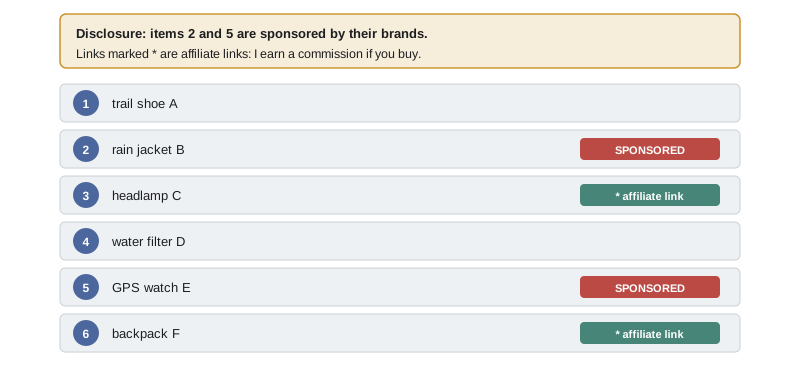
Content that features several products, such as "top 10" lists, hauls, comparisons and gift guides, needs disclosure that tells the audience which items carry a connection. A single "#ad" at the top of a list where only two of ten products are sponsored is unclear, and it may unfairly suggest all products were paid. A short line such as "Items 3 and 7 are sponsored by their brands; links marked * are affiliate links" is clearer.
Connections that are not with a brand
Some material connections involve causes, political campaigns, governments or investment interests rather than brands. A creator paid by an advocacy group to promote a policy position, by a government to promote a program or by a company to promote its shares has a connection the audience needs to know about. Political and issue advertising may also be governed by election laws, and paid promotion of securities by securities law, which lesson 7 covers. The principle is the same: disclose who is paying and what you receive.
| Situation | Disclose? | How |
|---|---|---|
| Affiliate link in a description | Yes | In the video and above the links |
| Unsolicited gift you chose to post | Yes | #Gifted or Thanks to [Brand] for the free product |
| Brand-paid trip | Yes | Say who paid and what was provided |
| Ambassador's unpaid post about the brand | Yes | #[Brand]Ambassador on each post |
| Employee praising employer's product | Yes | State the employment |
| Product bought with no brand contact | No | No disclosure needed |
| Old sponsored post still public | Yes | Add disclosure or remove the post |
A decision process for hard cases
When a situation is unclear, work through four questions:
- Is this an endorsement or recommendation the audience will see as mine?
- Do I, or someone close to me, receive or expect any benefit connected to it, now or later?
- Would a new viewer, seeing only this post, understand that connection without being told?
- If my audience learned about the connection later, would they feel misled?
If the answer to the second question is yes and the third is no, disclose. The fourth question is a useful tie-breaker: if the honest answer is yes, disclosure is required ethically even if a legal argument against it exists.
Worked problem
Working through a mixed-connection livestream
During a two-hour live stream, a gaming creator plays a game they received free from the publisher, wears headphones from a brand they are a paid ambassador for, mentions a snack brand that paid for a 60-second read at the 45-minute mark and shares a discount code for a chair through an affiliate program. How should the creator disclose?
Show solution
- At the start: "The publisher sent me this game for free, I am a paid ambassador for [headphone brand], and I earn a commission on the chair code." Show the same on a persistent label.
- At the 45-minute mark: "This segment is sponsored by [snack brand]" before the read.
- Every 15 to 20 minutes, and whenever the chair code appears in chat, repeat the relevant disclosure for viewers who joined late.
- In the stream title or description: a short summary of all connections.
Answer: Disclose all four connections at the start and persistently on screen, announce the paid read before it begins, and repeat disclosures at intervals and alongside the code.
Common mistakes
MistakePutting affiliate disclosures only at the bottom of a description.
InsteadDisclose in the content and above the links.
MistakeSkipping disclosure for gifts with no obligation to post.
InsteadGifts are material connections whenever you post about them.
MistakeDisclosing once when becoming an ambassador.
InsteadDisclose on every post that endorses the brand.
MistakeUsing one #ad for a list where only some items are sponsored.
InsteadMark which items carry which connection.
MistakeLeaving old undisclosed sponsored posts public.
InsteadAdd disclosure or remove them.
Summary and key terms
- Affiliate links and codes need disclosure in every post and above the links.
- Gifts, trips and event invitations are material connections even without payment.
- Ambassadors must disclose on every endorsing post, including unpaid ones.
- Employment, ownership and family ties count as material connections.
- Reposts, tags and likes can be endorsements; tagging is not disclosure.
- Live and audio formats need spoken, repeated disclosures.
- Multi-product content should show which items carry which connection.
- Affiliate link
- A tracked link that earns commission on purchases.
- Seeding
- Sending free products to creators in the hope they post.
- Brand ambassador
- A creator with an ongoing paid relationship with a brand.
- Employee advocacy
- A program encouraging staff to post about their employer.
- #InvitedGuest
- A tag for event invitations without travel or accommodation.
- #Gifted
- A tag for free products with no required post.
- Host-read ad
- A sponsor message read by a podcast or stream host.
- Link-in-bio page
- A profile landing page that collects links.
- Incentivized post
- Content created in return for a reward or contest entry.
- Persistent label
- An on-screen disclosure that stays visible during a stream.
Practice problems
Work each problem on paper first, then reveal the answer to check.
Where should an affiliate disclosure appear on a link-in-bio page?
Show answer
At the top, above the links.
Must an unsolicited gift be disclosed if posted about?
Show answer
Yes.
What should a press-trip disclosure include?
Show answer
Who paid and what was provided.
Does an ambassador's unpaid post about the brand need disclosure?
Show answer
Yes.
Is tagging a brand a disclosure?
Show answer
No.
How often should a live stream repeat disclosures?
Show answer
At intervals, such as every 15 to 20 minutes, and at product segments.
What should a top 10 list with two sponsored items say?
Show answer
Which items are sponsored and which links are affiliate.
Must an employee disclose when praising the employer's product?
Show answer
Yes.
What should happen to an old undisclosed sponsored post?
Show answer
Add a disclosure or remove it.
What is the tie-breaker question for hard cases?
Show answer
Would the audience feel misled if they learned of the connection later?
Lesson quiz · 5 questions
Score 60% or more to complete this lesson.
Create a free account to save your progress, take quizzes and earn a certificate.