
CRE-320 · Lesson 5 of 12 · 30 min
Reviews, testimonials and fake engagement
Reviews, testimonials, star ratings and follower counts are signals that audiences use to decide whom and what to trust. Because they are valuable, they are also manipulated: brands buy fake reviews, offer rewards only for positive ones, suppress negative ratings and post testimonials from people who never used the product, while some creators buy followers, likes and views to look more influential than they are. This lesson explains the rules on honest endorsements and testimonials, the specific prohibitions on fake reviews and fake engagement in each country, and how creators can protect themselves when brands ask for reviews or when they evaluate other creators.
Honest endorsement: the starting point
In both countries the foundation is the same. An endorsement or testimonial must reflect the honest opinion and genuine experience of the person giving it. That principle has several practical consequences.
- If you say you use a product, you must actually use it, and for a claim about ongoing use, you must still be using it when the endorsement runs.
- You cannot describe results you did not get, or present a brand's script as your own experience unless it matches what happened.
- You cannot claim expertise you do not have. A creator presented as a dentist, dietitian or financial expert must have that expertise and must have actually evaluated the product with it.
- A testimonial that describes extraordinary results implies they are typical unless the ad clearly says otherwise, and a disclaimer such as "results not typical" may not be enough to correct that impression.
- A brand cannot use an old endorsement once it no longer reflects the endorser's views, or once the product has changed in a way that matters.
Testimonials, scripts and brand edits
Brands often supply talking points or scripts. That is normal and lawful, provided the final content reflects the creator's genuine experience and opinion. Problems arise when the script includes claims the creator cannot honestly make, such as "it cleared my acne in a week" when it did not, or when the brand edits the creator's words in a way that changes their meaning. A creator should push back on any script line that is not true for them and should not allow a brand to post edited versions of their content that misrepresent what they said.
Worked problem
Reviewing a brand's script
A skincare brand sends a creator a script for a 30-second video: (1) "I've used this serum every night for a month." (2) "My fine lines have disappeared." (3) "Dermatologists recommend it." (4) "Use my code for 15 % off." The creator has used it nightly for three weeks, has seen slightly smoother skin and has no information about dermatologists. Which lines can the creator say?
Show solution
- Line 1: not accurate; change it to "three weeks."
- Line 2: not accurate and an exaggerated performance claim; replace with an honest description such as "my skin feels smoother."
- Line 3: the creator cannot verify it, and it is the brand's claim requiring substantiation; leave it out, or attribute it only if the brand provides evidence and approval.
- Line 4: acceptable with a clear disclosure that the creator earns from the code or is paid.
Answer: Only line 4 can be used as written. Lines 1 and 2 must be changed to match the creator's real experience, and line 3 should be dropped unless the brand substantiates it.
The US Consumer Reviews and Testimonials Rule
In the United States, the FTC's Trade Regulation Rule on the Use of Consumer Reviews and Testimonials, 16 CFR Part 465, took effect on October 21, 2024. Unlike the Endorsement Guides, it is a binding rule, so violations can bring civil penalties, which were up to $53,088 per violation in 2025 and remain at that level in 2026. In December 2025 the FTC sent its first warning letters under the rule to about a dozen companies, signaling a move from education to enforcement.
The rule prohibits six categories of conduct, summarized below, and the Endorsement Guides continue to apply alongside it. In addition, the Consumer Review Fairness Act of 2016 makes contract clauses that bar or penalize customers for posting honest reviews void and unlawful.
In the United States, section 465.4 prohibits offering compensation or incentives conditioned, expressly or by implication, on writing a review with a particular sentiment. Disclosing a sentiment-conditioned incentive does not cure the violation. Unconditioned incentives remain lawful but should be disclosed under the Endorsement Guides.
Worked problem
Spotting a sentiment-conditioned incentive
Three brands contact a creator's audience. Brand A: "Leave a review of any kind and get entered to win a $100 gift card." Brand B: "Post a 5-star review and get 20 % off your next order." Brand C: "Tell us how you liked it; happy customers get a free sample." Which offers are problems?
Show solution
- Brand A: the incentive does not depend on sentiment; lawful if the reviews are identified as incentivized.
- Brand B: the incentive is expressly conditioned on a 5-star rating; a prohibited practice.
- Brand C: the phrase "happy customers get a free sample" implies the reward depends on positive feedback; likely prohibited by implication.
Answer: Brand A is acceptable with disclosure; Brands B and C condition rewards on positive sentiment and should not be used or promoted.
Review suppression and gating
Review gating means asking customers whether they are satisfied and then inviting only satisfied ones to post public reviews, or filtering out negative reviews before display. Suppressing negative reviews, whether by threats, by contract terms or by quietly hiding them, makes the remaining reviews misleading.
In the United States, the FTC's 2022 case against the online retailer Fashion Nova, which used a system that held back reviews below four stars from its website, led to a $4.2 million payment. Section 465.7 of the rule now prohibits review suppression through unjustified legal threats, intimidation or false accusations, and misrepresenting that displayed reviews represent all or most reviews when negative ones were suppressed.
Fake followers, views and engagement
Some creators buy followers, likes, comments or views, or join "engagement pods" where members agree to like and comment on each other's posts. Bought metrics mislead brands that pay based on audience size and engagement, and they mislead audiences that see popularity as social proof. They also usually break platform rules, which prohibit inauthentic engagement and can lead to removed accounts.
In the United States, section 465.8 prohibits selling, and buying for commercial purposes, fake indicators of social media influence, such as followers, views or likes generated by bots or accounts that do not reflect real individuals or real activity, when the buyer knew or should have known they were fake. The FTC's 2019 settlement with Devumi, a company that sold fake followers and views, showed the FTC's view that selling fake influence is deceptive.
Detecting inflated metrics
Brands and creators evaluating other creators use simple checks to spot inflated metrics. None is conclusive on its own, but together they flag accounts for closer review.
- Engagement that is far below the norm for accounts of that size, suggesting many inactive followers.
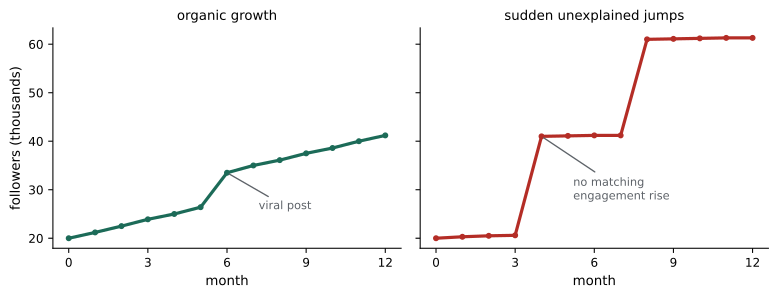
- Sudden spikes in followers without a viral post or press coverage to explain them.
- Comments that are generic, repetitive or unrelated to the post.
- Audience locations that do not match the creator's language or content.
- Views far higher than likes or comments, or likes arriving in unnatural bursts.
Worked problem
Flagging a suspicious account
A brand compares two lifestyle creators. Creator X has 400,000 followers and averages 1,600 engagements per post. Creator Y has 95,000 followers and averages 3,800 engagements per post. Similar accounts typically see engagement rates of 1.5 % to 4 %. Which account deserves a closer look?
Show solution
- Creator X: 1,600 ÷ 400,000 = 0.4 %.
- Creator Y: 3,800 ÷ 95,000 = 4.0 %.
- X is far below the typical range, which can mean inactive or bought followers, though it can also reflect an older audience.
- Next steps: ask X for platform analytics screenshots showing reach, audience location and follower growth over time.
Answer: Creator X's 0.4 % engagement rate is well below the norm and warrants a closer look; Creator Y is within the normal range.
What creators should do
- Never buy followers, likes, views or comments, and leave engagement pods that create artificial engagement.
- Present metrics honestly in media kits, using platform analytics and stating dates, and correct mistakes quickly.
- Refuse requests to post fake reviews, reviews of products you have not used, or reviews on behalf of others.
- Disclose incentives when you review products on retail sites as well as on social media.
- Do not promote review-gating or sentiment-conditioned offers to your audience.
- If you employ others, train staff and family who post about your products to disclose the connection.
Worked problem
Estimating exposure for fake reviews
A small business posts 30 fake five-star reviews written by friends who never used the product, and a creator it pays tells followers to "trust the reviews." Treating each fake review as one violation of section 465.2, what is the maximum civil penalty exposure at the 2026 amount?
Show solution
- Violations: 30 fake reviews.
- Maximum per violation: $53,088.
- Total: 30 × $53,088 = $1,592,640.
- The creator's own statement could also be examined under Section 5 and the Endorsement Guides.
Answer: About $1.6 million at the maximum. Courts consider ability to pay and other factors, but per-violation penalties make even small fake-review schemes very risky.
Reviews on retailer and marketplace sites
Creators are sometimes asked to post reviews on retailer or marketplace sites as part of a deal, or receive free products through programs that invite reviews. The same honesty and disclosure principles apply there as on social media, with some practical differences.
- Retail reviews are read by shoppers comparing products, often without any knowledge of who the reviewer is, so an undisclosed connection is especially misleading.
- Many retailers have their own rules: some prohibit reviews in exchange for free products except through their own programs, and some label incentivized reviews automatically.
- A review should describe your real experience with the product, including drawbacks, and should be posted only after you have used it long enough to form a view.
- Do not post several reviews under different names, ask friends to post reviews for products they have not used or copy a brand's suggested review text.
A simple first line such as "I received this product free from the brand in exchange for an honest review" meets the disclosure standard on most sites. If a brand asks for a review only if your experience is positive, or offers a bonus for a high rating, decline: that is the sentiment-conditioned incentive this lesson warned about.
Testimonials the brand reuses
Brands often ask to reuse a creator's content or quotes in their own ads, websites and packaging. Once a testimonial moves into the brand's own advertising, it must still reflect the creator's current, genuine opinion. Creators should limit reuse in their contracts by time and place, ask to be told when quotes are used and ask the brand to stop using a testimonial if their view changes or the product is reformulated.
Common mistakes
MistakeReading a brand's script word for word even when parts are untrue.
InsteadChange lines to match your genuine experience.
MistakeAccepting rewards only for positive reviews.
InsteadIncentives must not depend on sentiment and must be disclosed.
MistakeHiding negative reviews while showing positive ones.
InsteadShow reviews fairly and do not imply selected reviews are all reviews.
MistakeBuying followers to win better brand deals.
InsteadGrow honestly and present real analytics.
MistakeAssuming "results not typical" fixes an extraordinary testimonial.
InsteadPresent typical results honestly.
Summary and key terms
- Endorsements must reflect honest opinions and genuine experience.
- Creators should change script lines that are not true for them.
- Fake reviews, undisclosed insider reviews and distorted testimonials are prohibited.
- Incentives for reviews must not depend on sentiment and should be disclosed.
- Review gating and suppression create misleading impressions.
- Buying fake followers, views or engagement misleads brands and audiences.
- Simple metric checks can flag inflated accounts for closer review.
- Testimonial
- A statement of a person's experience with a product.
- 16 CFR Part 465
- The FTC rule on consumer reviews and testimonials.
- Sentiment-conditioned incentive
- A reward that depends on a positive or negative review.
- Incentivized review
- A review given in return for a reward.
- Review suppression
- Hiding or discouraging negative reviews.
- Consumer Review Fairness Act
- A 2016 law voiding contract terms that bar honest reviews.
- Fake indicator of influence
- Bot-generated or false followers, views or likes.
- Engagement pod
- A group that agrees to engage with each other's posts.
- Social proof
- Using others' behavior as a guide to what is good.
- Engagement rate
- Engagements divided by followers or reach.
Practice problems
Work each problem on paper first, then reveal the answer to check.
What must an endorsement reflect?
Show answer
The endorser's honest opinion and genuine experience.
When did the reviews rule take effect?
Show answer
October 21, 2024.
Does disclosing a sentiment-conditioned incentive cure it?
Show answer
No.
What did the Fashion Nova case involve?
Show answer
Suppressing reviews below four stars; $4.2 million.
What does section 465.8 prohibit?
Show answer
Buying or selling fake indicators of social media influence.
What does the Consumer Review Fairness Act do?
Show answer
Voids contract terms that bar honest reviews.
Engagement rate for 2,000 engagements on 250,000 followers?
Show answer
0.8 %.
Exposure for 12 fake reviews at the maximum?
Show answer
12 × $53,088 = $637,056.
When did the FTC send its first warning letters under the rule?
Show answer
December 2025.
Name two signs of bought followers.
Show answer
Low engagement, sudden spikes, generic comments, mismatched locations.
Lesson quiz · 5 questions
Score 60% or more to complete this lesson.
Create a free account to save your progress, take quizzes and earn a certificate.