
CRE-430 · Lesson 10 of 12 · 27 min
Defamation, anti-SLAPP and legal tools in Canada
Crises often raise legal questions. A critic posts false claims about a creator; a creator wants to respond to an allegation but worries about being sued; a former collaborator sends a threatening letter; an old article keeps appearing in search results; a creator considers suing a commentary channel. Law can protect reputations, but it is slow, expensive and unpredictable, and legal action can draw far more attention to a story than the original claim. This lesson gives an overview of defamation, anti-SLAPP protections, privacy and search de-indexing, cease-and-desist letters, insurance and when to involve a lawyer.
What defamation is
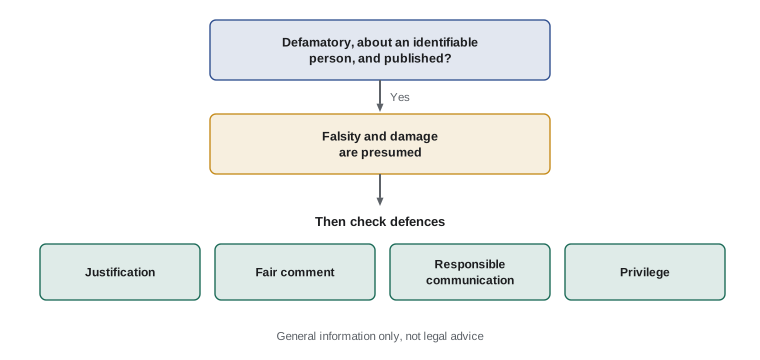
In the common-law provinces and territories, defamation is a statement that tends to lower a person's reputation in the eyes of reasonable members of society. In Grant v. Torstar Corp. (2009), the Supreme Court of Canada summarized what a plaintiff must prove: that the words were defamatory, that they referred to the plaintiff, and that they were published, meaning communicated to at least one person other than the plaintiff. Once those elements are shown, falsity and damage are presumed, and the burden shifts to the defendant to establish a defence. Libel traditionally refers to written or permanent statements and slander to spoken ones, and online posts and videos are generally treated as libel. In Quebec, defamation is handled under the civil law, mainly the Civil Code of Québec's general liability rules and the Quebec Charter of Human Rights and Freedoms' protection of dignity, honour and reputation, and the analysis focuses on fault, injury and causation.
Because falsity is presumed in the common-law provinces, Canadian defamation law is generally considered more favourable to plaintiffs than US law. Creators who make claims about other people, including other creators, brands and public figures, should be confident they can prove what they say or that a defence applies.
Key defences
Canadian law recognizes several defences.
| Defence | What it covers |
|---|---|
| Justification (truth) | The statement is substantially true; the defendant must prove it |
| Fair comment | Honest opinion on a matter of public interest, based on true facts (WIC Radio Ltd. v. Simpson, 2008) |
| Responsible communication | Diligent reporting on a matter of public interest, even if some facts prove wrong (Grant v. Torstar, 2009) |
| Qualified privilege | Statements made in good faith where there is a duty and interest, such as reporting to an employer or regulator |
| Absolute privilege | Statements in court proceedings and legislatures |
Online communication raises extra questions. In Crookes v. Newton (2011), the Supreme Court of Canada held that merely posting a hyperlink to defamatory content is not, by itself, publication of that content, though repeating or endorsing it can be. Repeating someone else's defamatory claim, for example in a reaction video, can make the creator liable as a republisher.
Anti-SLAPP laws
A SLAPP, or strategic lawsuit against public participation, is a lawsuit used mainly to silence criticism by making it expensive to speak, rather than to win on the merits. Creators can be on either side: a creator criticizing a company may be sued to silence them, or a creator may be tempted to sue critics. Anti-SLAPP laws give defendants a fast way to ask a court to dismiss such cases early.
Ontario added anti-SLAPP provisions to the Courts of Justice Act in 2015, in section 137.1. A defendant can bring a motion to dismiss if the case arises from expression on a matter of public interest. The plaintiff must then show that the claim has substantial merit, that the defendant has no valid defence, and that the harm to the plaintiff is serious enough that the public interest in allowing the case to continue outweighs the public interest in protecting the expression. The Supreme Court of Canada interpreted these provisions in 1704604 Ontario Ltd. v. Pointes Protection Association (2020). Successful defendants are generally entitled to their full legal costs. British Columbia's Protection of Public Participation Act (2019) uses a similar test, and Quebec's Code of Civil Procedure includes provisions against abusive proceedings. Other provinces have no specific anti-SLAPP law.
For creators, anti-SLAPP laws cut both ways. They protect honest criticism and commentary on matters of public interest, but a creator who sues a critic over speech on a public-interest topic may face an early dismissal motion and be ordered to pay the critic's legal costs.
Privacy and de-indexing
Some reputational harms involve true information that a person would prefer to keep private, or old information that keeps resurfacing. Privacy law and search de-indexing can sometimes help, but protection is limited, especially for people in public life.
In Ontario, courts recognized the tort of intrusion upon seclusion in Jones v. Tsige (2012), and several provinces, including British Columbia, Saskatchewan, Manitoba and Newfoundland and Labrador, have statutory privacy torts. Quebec's Law 25 added a right, in force since September 2023, allowing a person to ask a business to stop disseminating their personal information or to de-index a hyperlink attached to their name, where the dissemination breaks the law or a court order, or where it causes serious injury to their reputation or privacy that clearly outweighs the public interest in the information, subject to conditions. Outside Quebec, there is no general statutory right to be forgotten, though federal privacy regulators and courts have considered how private-sector privacy law applies to search engines. Creators seeking removal of search results should get specialized advice.
Cease-and-desist letters
A cease-and-desist letter demands that someone stop doing something, such as publishing a defamatory claim, using a trademark or infringing copyright. A well-founded letter can resolve problems quickly. But letters can backfire: recipients often publish them, critics may portray them as attempts to silence criticism, and attention to the original claim can multiply, a pattern often called the Streisand effect after a 2003 case in which an attempt to suppress a photograph greatly increased its circulation. Before sending a letter, consider whether the claim is clearly false and seriously damaging, whether a calm public correction would work better, and how the letter would look if published. If you receive a letter, do not ignore it, but do not panic: get advice on whether the claims are valid before responding.
Media liability insurance
Media liability insurance, sometimes called errors and omissions insurance for content creators, can cover legal defence costs and damages for claims such as defamation, invasion of privacy and copyright infringement arising from content. Policies vary widely in what they cover, their limits, deductibles and exclusions, and some exclude intentional acts or certain topics.
Worked problem
Comparing insurance cost with expected loss
A commentary creator estimates a 4 % chance each year of facing a defamation or privacy claim. If a claim occurs, average defence costs and settlement are estimated at $75,000. A media liability policy costs $2,200 a year with a $5,000 deductible and covers up to $1 million. Compare the expected annual loss without insurance to the cost with insurance.
Show solution
- Expected loss without insurance: 0.04 × $75,000 = $3,000 a year.
- With insurance, the creator pays the premium plus the deductible when a claim occurs: $2,200 + 0.04 × $5,000 = $2,200 + $200 = $2,400 a year.
- Expected saving: $3,000 − $2,400 = $600 a year.
- The insurance also protects against rare, very large claims, which the average hides.
Answer: Insurance has a lower expected cost ($2,400 versus $3,000) and, more importantly, removes the risk of a single catastrophic claim. The numbers are illustrative; real premiums and risks vary by niche, audience and content.
Time limits
Limitation periods restrict how long someone has to sue. In Ontario, the Libel and Slander Act requires a plaintiff to give written notice within six weeks of learning of a defamatory statement in a newspaper or broadcast, and courts have differed on how this applies to online content; the general limitation period for most claims is two years under the Limitations Act, 2002. Other provinces have their own rules. Because these deadlines are short and unclear for online content, anyone considering a claim should get advice quickly.
When to call a lawyer
- You receive a lawsuit, demand letter or cease-and-desist letter.
- Someone is publishing serious false claims about you that are causing real harm, such as lost contracts.
- You plan to make specific allegations of wrongdoing about another person or company.
- A crisis involves possible criminal conduct, contracts, employment or regulatory issues.
- A sponsor is threatening to claw back fees or sue for breach of contract.
- You are considering suing anyone.
Lawyers who specialize in media, defamation or entertainment law understand both the legal and reputational sides. Ask about fees in advance; some offer initial consultations. Professional associations and law society referral services can help find one.
Responding to false claims without legal action
Most false claims about creators are best handled without lawyers. A calm public correction with evidence, a request to the person who posted the claim to correct or remove it, and a report to the platform if the content breaks its rules are often enough. Legal action makes sense only when a claim is clearly false, seriously damaging, and not fixable by other means, and even then it should be weighed against cost, time, stress and the attention a lawsuit will bring.
- Gather evidence: screenshots with dates, links and archived copies of the content.
- Assess harm: lost contracts, partner inquiries, threats or other concrete effects.
- Try direct correction: a polite request to the poster with evidence.
- Use platform tools: reporting for harassment, impersonation or private information.
- Get advice: if the claim is serious and persists, consult a lawyer before sending any demand.
Making claims about others safely
Creators who discuss other people, brands or creators, including in commentary or investigative content, can reduce legal risk by checking facts carefully, keeping evidence, separating facts from opinions, giving the subject a chance to respond before publishing serious allegations, correcting errors quickly, and avoiding language that implies facts they cannot prove. Phrases such as allegedly do not protect a creator who repeats a claim they cannot support.
Worked problem
Weighing a lawsuit
A creator considers suing a critic over false claims. A lawyer estimates a 50 % chance of winning, legal costs of $60,000 whether they win or lose, and damages of $40,000 if they win. There is also a 30 % chance the critic brings a successful anti-SLAPP motion, which would end the case early and require the creator to pay about $25,000 of the critic's costs in addition to $15,000 of their own. Ignoring the anti-SLAPP risk, what is the expected financial result of going to trial?
Show solution
- Expected damages: 0.5 × $40,000 = $20,000.
- Legal costs: $60,000.
- Expected result: $20,000 − $60,000 = −$40,000.
Answer: Even before considering the anti-SLAPP risk, the expected result is a loss of about $40,000, plus time, stress and renewed attention to the claims. The numbers are illustrative, but they show why most creators resolve false claims through corrections rather than lawsuits.
Legal rules vary by province, state and country, and cross-border content can raise questions about which court and which law apply. Creators with international audiences or critics should mention this to their lawyer early.
Common mistakes
MistakeRepeating someone else's allegations in a reaction video.
InsteadTreat repetition as publication; only say what you can prove or properly attribute.
MistakeSuing critics over public-interest commentary.
InsteadConsider anti-SLAPP exposure and the attention a lawsuit brings; get advice first.
MistakeSending an aggressive cease-and-desist letter on impulse.
InsteadWeigh the Streisand effect; consider a calm correction and legal advice.
MistakeIgnoring legal letters or deadlines.
InsteadGet advice promptly, because limitation periods and notice rules can be short.
MistakeAssuming you have a right to have true information removed.
InsteadCheck the limited privacy and de-indexing rules that apply where you live.
Summary and key terms
- In common-law Canada, a plaintiff proves the words were defamatory, referred to them and were published; falsity and damage are then presumed.
- Defences include justification, fair comment, responsible communication and privilege.
- Ontario, British Columbia and Quebec have anti-SLAPP protections that allow early dismissal of suits targeting public-interest expression.
- Quebec's Law 25 created a limited de-indexation right; elsewhere in Canada there is no general right to be forgotten.
- Cease-and-desist letters can resolve issues but can also amplify them through the Streisand effect.
- Media liability insurance can cover defence costs and damages for content claims.
- Time limits are short, so get legal advice quickly when a legal issue arises.
- Defamation
- A false or damaging statement that harms a person's reputation.
- Libel
- Defamation in written, recorded or other permanent form, including most online content.
- Slander
- Spoken defamation in a non-permanent form.
- Actual malice
- Knowing a statement is false or showing reckless disregard for whether it is false.
- Fair comment
- A defence protecting honest opinion on matters of public interest based on true facts.
- SLAPP
- A strategic lawsuit against public participation, used mainly to silence criticism.
- Anti-SLAPP law
- A law allowing early dismissal of lawsuits targeting expression on public-interest matters.
- De-indexing
- Removing a link from search results for a person's name.
- Streisand effect
- When an attempt to suppress information increases attention to it.
- Limitation period
- The legal deadline for starting a lawsuit.
Practice problems
Work each problem on paper first, then reveal the answer to check.
What three things must a Canadian plaintiff prove in a defamation case?
Show answer
The words were defamatory, referred to them and were published.
Which case created the responsible communication defence?
Show answer
Grant v. Torstar Corp. (2009).
What is a SLAPP?
Show answer
A lawsuit used mainly to silence criticism by making speech costly.
Which Ontario provision contains anti-SLAPP rules?
Show answer
Section 137.1 of the Courts of Justice Act.
Does posting a hyperlink to defamatory content count as publication in Canada?
Show answer
Not by itself, under Crookes v. Newton (2011), though endorsing or repeating it can.
Claim probability 5 %, cost $60,000. Expected annual loss?
Show answer
$3,000.
What is the Streisand effect?
Show answer
Attention to information increasing because of an attempt to suppress it.
Name two situations when a creator should call a lawyer.
Show answer
Receiving a lawsuit or demand letter, and planning to make specific allegations about someone.
What right did Quebec's Law 25 add in 2023?
Show answer
A limited right to stop dissemination or de-index links to personal information.
Why get advice quickly about a possible defamation claim?
Show answer
Limitation periods and notice requirements can be short.
Lesson quiz · 5 questions
Score 60% or more to complete this lesson.
Create a free account to save your progress, take quizzes and earn a certificate.