
CRE-430 · Lesson 12 of 12 · 30 min
Capstone: a crisis plan and simulation
This capstone brings the course together. You will follow a fictional creator business through prevention, monitoring, a simulated crisis, the response and recovery, applying the tools from each lesson. The creator and every event in the scenario are invented. Use the worked examples as a model, then build the same plan for your own channel or a creator you invent.
The creator: Sam Okafor
Sam Okafor runs a home renovation channel with 420,000 subscribers on YouTube, 260,000 followers on short-video platforms and an email list of 38,000. Sam publishes one long video a week and several short videos. A small team supports the business: a part-time manager, Lina; a video editor, Theo; and two volunteer moderators who run the channel's Discord server. Sam's annual income is about $210,000.
| Income stream | Annual amount |
|---|---|
| Sponsorships (three main tool and hardware brands) | $105,000 |
| Affiliate links for tools and materials | $38,000 |
| Channel memberships | $22,000 |
| Printable project plans (digital products) | $27,000 |
| Platform ad revenue | $18,000 |
| Total | $210,000 |
Sam's channel is known for practical, safety-conscious advice. That reputation for competence and integrity is the foundation of the sponsorship and affiliate income.
Step 1: the risk register
Sam and Lina list the main risks and score them using the five-point scales from lesson 2.
| Risk | Likelihood | Impact | Score | Main control |
|---|---|---|---|---|
| A video shows unsafe practice that viewers copy | 3 | 5 | 15 | Safety review checklist for every project video |
| A sponsor's tool is recalled for a safety defect | 2 | 4 | 8 | Vetting checklist, recall monitoring, reverse morals clause |
| Old videos contain outdated or unsafe advice | 4 | 3 | 12 | Archive audit with added safety notes |
| Moderator conduct in Discord | 2 | 3 | 6 | Written moderation policy and training |
| Channel hacked through a fake sponsor email | 3 | 4 | 12 | Passkeys, role-based access, attachment rules |
The top risk is unsafe practice in a video, which combines a possible likelihood with severe impact because viewers could be hurt. Old videos and account security tie for second. Sam schedules an archive audit, introduces a safety review checklist for every project video, and moves the team to passkeys.
Step 2: monitoring and triggers
Lina sets up mention tracking and calculates baselines for the past 60 days: negative mentions average 30 per day with a standard deviation of 9. They agree on escalation triggers: Level 1 at a z-score above 2 or any credible safety concern; Level 2 at a z-score above 3, spread to other platforms, or a sponsor question; Level 3 for media coverage, legal threats, platform action or any report of injury.
Step 3: the simulated crisis
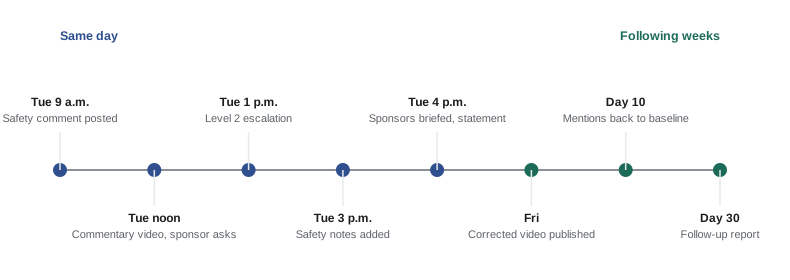
On a Tuesday morning, a commenter posts that a technique in one of Sam's videos from three years ago, showing how to cut into a wall to add an outlet, skipped turning off the circuit at the panel on camera and could lead to electric shock. By noon, a trades-focused commentary channel has made a short video criticizing it, and a sponsor's marketing manager sends Lina a message asking what is going on.
Worked problem
Applying the escalation triggers
At 1 p.m., negative mentions for the day already total 96, and there are still 11 hours left. Using the baseline of 30 per day and standard deviation of 9, what is the z-score so far, and which level applies once the sponsor question is considered?
Show solution
- z-score so far: (96 − 30) ÷ 9 = 66 ÷ 9 ≈ 7.3.
- That exceeds the Level 2 threshold of 3, even before the day is over.
- The safety concern alone meets Level 1; the sponsor question and spread to another channel meet Level 2.
- No injury has been reported and there is no media coverage yet, so Level 3 is not triggered.
Answer: The issue is at Level 2. Under the plan, the team convenes within 2 hours, briefs partners within 6 hours and decides on a holding statement within 12 hours.
Theo reviews the original video and confirms the criticism is partly right: Sam did switch off the breaker, but that step was cut in editing to keep the video short, and the video never told viewers to do it. Theo also finds two other older videos with similar editing gaps. The fact-finding answers the key question in the decision tree: the core claim is substantially true as far as viewers could see, and there is a real safety risk.
Step 4: the response
Following the plan, Sam pauses the scheduled sponsored video, Lina briefs the three sponsors before any public post, and the team drafts a statement. Sam decides to speak personally, because the issue concerns the channel's own content. The decision tree puts safety first: the most urgent action is to stop more viewers from copying the incomplete instructions.
- Within three hours, Sam adds a pinned comment and an on-screen safety note to the three affected videos, then makes the original video private until a corrected version is ready.
- Sam posts a written statement on all platforms, using the same text.
- Lina sends the statement to sponsors and the commentary channel, offering a short written response for its follow-up.
- Moderators receive guidance to leave honest criticism visible and remove only abuse.
Sam's statement reads: In my 2023 outlet video, the step where I switched off the breaker and tested the circuit was cut in editing. Without it, the video shows unsafe practice. That is my responsibility; I approve every edit. I've added safety warnings to that video and two others with similar gaps, and made the original private. This week I'll publish a corrected version reviewed by a licensed electrician, and I'm reviewing every electrical video in my archive. I'll report back here by the end of the month.
Worked problem
Scoring the statement with the apology rubric
Using the rubric from lesson 7, ownership 30 %, specific description 20 %, action and repair 25 %, recognition of impact 15 % and follow-up 10 %, the team scores the statement: ownership 2, description 2, action 2, impact 1 and follow-up 2. What is the weighted score?
Show solution
- Ownership: 0.30 × 2 = 0.60.
- Description: 0.20 × 2 = 0.40.
- Action: 0.25 × 2 = 0.50.
- Impact: 0.15 × 1 = 0.15.
- Follow-up: 0.10 × 2 = 0.20.
- Total: 1.85 out of 2, or 92.5 %.
Answer: The statement scores 1.85 out of 2. The weakest element is impact: Sam could add a sentence recognizing the risk to viewers who followed the video and inviting anyone who had problems to get in touch.
Step 5: partners and money
Two sponsors say they will continue; the third, whose tool appears in the outlet video, pauses its campaign for a month while it reviews. Lina estimates revenue at risk.
Worked problem
Revenue at risk for Sam
The sponsors' annual values are $50,000 (continuing, 5 % exit risk), $30,000 (continuing, 10 % exit risk) and $25,000 (paused, estimated 40 % exit risk). Affiliate income of $38,000 is expected to dip 10 % for the year. What is the expected loss?
Show solution
- Sponsor 1: 0.05 × $50,000 = $2,500.
- Sponsor 2: 0.10 × $30,000 = $3,000.
- Sponsor 3: 0.40 × $25,000 = $10,000.
- Affiliates: 0.10 × $38,000 = $3,800.
- Total expected loss: $2,500 + $3,000 + $10,000 + $3,800 = $19,300.
Answer: About $19,300, or roughly 9 % of annual income, is at risk. That is serious but manageable, largely because the response was fast and specific and because no viewer injury was reported.
Step 6: recovery and review
Sam publishes the corrected video with the electrician on Friday. By the end of the month, Sam posts an update: 41 electrical videos reviewed, seven updated with clearer safety steps, and a new rule that every electrical, structural or gas-related video is reviewed by a licensed professional before publishing. The paused sponsor returns after six weeks. Negative mentions return to baseline within ten days.
The team then runs an after-action review. What went well: fast fact-finding, briefing sponsors before posting, a specific statement, and visible follow-through. What went badly: the editing gap itself, and the absence of any safety review for older videos. Changes: the safety checklist now covers editing decisions, the archive audit is prioritized, and the risk register score for unsafe practice is updated with new controls.
Your capstone deliverable
Build a crisis plan for your own channel or an invented creator. Include the following.
- A short reputation profile: niche, audience, income streams and what the audience trusts you for.
- A risk register with at least eight risks, scored for likelihood and impact, with controls and owners.
- Monitoring sources, baselines and written escalation triggers for four levels.
- A response team with roles, backups and contact methods.
- A first-hour checklist and three holding statement templates.
- A partner briefing template and a list of key partners.
- A simulated scenario walked through from trigger to after-action review, including at least one calculation from the course.
- A note on legal issues to check with a lawyer, specific to your country and niche.
Keep the plan to a few pages so it will actually be used. Review it with anyone who would be part of the response team, and schedule its first update for six months from now.
Running the simulation as a team exercise
The capstone scenario can double as a tabletop exercise. Gather the people who would be part of your response team, give them the scenario one stage at a time, and ask them to make decisions using the plan. Add complications partway through, such as a journalist's request, a sponsor threatening to cancel, or a discovery that the problem is bigger than first thought. Time each stage against your response targets. Afterwards, discuss what was unclear and update the plan.
| Stage | Information given | Decisions required |
|---|---|---|
| 1 | A critical comment with a clip, 200 mentions | Is this noise or a signal? Who is told? |
| 2 | Mentions triple; a sponsor asks a question | Escalation level, team roles, holding statement |
| 3 | Fact-finding confirms part of the claim | Statement content, safety actions, partner briefings |
| 4 | A commentary channel requests comment by 6 p.m. | Who responds, in what format, with what facts |
| 5 | One sponsor pauses; attention starts to fall | Revenue at risk, cash flow, follow-up commitments |
| 6 | Two weeks later | Follow-up report, recovery measures, after-action review |
Worked problem
Checking response times in the exercise
In the exercise, the team convenes 35 minutes after the Level 2 trigger, briefs sponsors after 4 hours 20 minutes and posts a holding statement after 7 hours. The Level 2 targets are 2 hours, 6 hours and 12 hours. Which targets are met?
Show solution
- Team: 35 minutes is within 2 hours.
- Sponsors: 4 hours 20 minutes is within 6 hours.
- Holding statement: 7 hours is within 12 hours.
Answer: All three targets are met. The team should still check that sponsors heard before the public statement, which they did, and whether the statement could have gone out sooner to reduce speculation.
Finish your capstone with a one-page summary: your top three risks and controls, your escalation triggers, your team, and the date of your next review. Keep it where you will find it quickly when you need it.
Common mistakes
MistakeBuilding a plan that is too long to use.
InsteadKeep the core plan to a few pages with checklists and templates.
MistakeTreating the capstone scenario as unrealistic.
InsteadBase scenarios on the top risks in your own register.
MistakeForgetting partners in the simulation.
InsteadInclude sponsor briefings and revenue-at-risk estimates.
MistakeEnding the simulation at the public statement.
InsteadContinue through follow-through, recovery measurement and an after-action review.
MistakeNever revisiting the plan.
InsteadSchedule regular updates and review it after any incident.
Summary and key terms
- A capstone crisis plan starts with a reputation profile and a scored risk register with controls and owners.
- Baselines and written escalation triggers turn monitoring into timely action.
- Fact-finding determines whether a claim is true and what the decision tree requires.
- Safety comes first, followed by a specific, owned statement coordinated with partners.
- Revenue-at-risk estimates help prioritize partner relationships and cash flow.
- Visible follow-through and measured recovery rebuild trust.
- An after-action review updates the risk register and plan so the business is stronger next time.
- Capstone
- A final project that applies the skills from a whole course.
- Reputation profile
- A summary of what an audience trusts a creator for and where income depends on that trust.
- Scenario
- A realistic, invented sequence of events used to test a plan.
- Simulation
- Walking through a scenario as if it were happening, making decisions at each step.
- Fact-finding
- Establishing what actually happened before responding.
- Safety note
- A visible warning added to content to prevent harm.
- Follow-up report
- A public update describing how commitments were carried out.
- Expected loss
- The sum of each possible loss multiplied by its probability.
- Plan owner
- The person responsible for keeping the crisis plan current.
- Review cycle
- The schedule for updating the risk register and crisis plan.
Practice problems
Work each problem on paper first, then reveal the answer to check.
What is Sam's largest income stream?
Show answer
Sponsorships, at $105,000.
Why is unsafe practice Sam's top risk?
Show answer
It combines a possible likelihood with severe impact because viewers could be hurt.
Baseline 30, standard deviation 9, mentions 75. z-score?
Show answer
5.
Why did the issue reach Level 2 but not Level 3?
Show answer
There was spread and a sponsor question but no injury, media coverage or legal threat.
What was Sam's first action under the decision tree?
Show answer
Adding safety notes and making the video private to prevent harm.
Why did Sam speak personally?
Show answer
The issue concerned the channel's own content.
A $25,000 sponsor with a 40 % exit risk. Expected loss?
Show answer
$10,000.
Which rubric element was weakest in Sam's statement?
Show answer
Recognition of impact.
Name two changes from Sam's after-action review.
Show answer
Professional review for electrical videos and a safety checklist covering editing decisions.
How many risks should your capstone register include?
Show answer
At least eight.
Lesson quiz · 5 questions
Score 60% or more to complete this lesson.
Create a free account to save your progress, take quizzes and earn a certificate.