
CRE-440 · Lesson 1 of 12 · 30 min
Strategy for creators: vision, positioning and the flywheel
Most creators make hundreds of small decisions every week: what to film next, which platform to post on first, whether to accept a sponsorship, how long a video should be, whether to try a new format. Without a strategy, those decisions are made one at a time, usually based on whatever performed well last week or whatever another creator seems to be doing. The result is often a channel that drifts, a creator who works harder each year for similar results, and a business that is vulnerable to the next algorithm change. Strategy is the set of choices that makes all those small decisions easier and more consistent.
This course is about making those choices with evidence. It combines strategy, which decides where you want to go and why, with experimentation, which tests how to get there. The first lesson sets out what strategy means for a creator. Lesson 2 turns strategy into goals and metrics. Lessons 3 to 7 cover analytics data, experiment design and the statistics needed to read noisy results honestly. Lessons 8 to 11 cover audience research, portfolio choices across platforms, competitive analysis and planning. Lesson 12 brings everything together in a one-year strategy with an experiment backlog. The course assumes you already know the basics of platform analytics from CRE-202 and the attribution methods from CRE-340; it builds on them rather than repeating them.
What strategy is, and what it is not
A strategy is a coherent set of choices about where to compete and how to win, made in the face of limited time, money and attention. The key word is choices. A strategy says yes to some things and, just as importantly, no to others. A creator who wants to be on every platform, in every format, for every audience, does not have a strategy; they have a wish list.
It helps to separate strategy from three things it is often confused with.
- A goal is not a strategy. "Reach 100,000 subscribers" is a target. Strategy explains how and why you expect to reach it, and what you will give up to get there.
- A content calendar is not a strategy. A calendar schedules work. Strategy decides which work deserves to be on the calendar in the first place.
- Copying a successful creator is not a strategy. What worked for someone else depended on their timing, audience, skills and luck. Their tactics may be worth studying, but their choices may not suit you.
A useful test is whether your strategy would help you turn down a reasonable opportunity. If a sponsor offers good money for content that does not fit your audience, or a trending format pulls you away from what your community values, your strategy should make the answer clearer.
Vision and purpose
Strategy starts with a vision: a short description of what you want your creative work to achieve in three to five years. A good creator vision has three parts.
- Who you serve: the audience whose problems, interests or entertainment you care most about.
- What change you create for them: they learn a skill, feel less alone, save money, laugh, discover new music, make better decisions.
- What success looks like for you: income level, lifestyle, creative freedom, team size, or impact.
For example: "In three years, I want to be the most trusted source of practical home repair advice for first-time Canadian homeowners, earning a full-time income from a mix of sponsorships, a paid course and YouTube revenue, while filming no more than four days a week." This vision tells you who to make content for, what kind of trust you are building, which revenue streams to develop, and a constraint on your workload. Each part will shape later decisions.
Positioning: why you instead of someone else
Positioning is the place you occupy in your audience's mind compared with the alternatives. Viewers have endless options; your positioning answers the question, "Why watch this creator rather than any of the others?" Strong positioning usually combines three elements.
- A clear audience: not everyone, but a defined group with shared needs.
- A distinctive angle: a point of view, format, personality, expertise or production style that is noticeably different.
- A promise you can keep consistently: the experience viewers can expect every time they click.
A simple positioning statement follows a pattern: For [audience] who want [need], [creator] is the [category] that [key benefit], unlike [alternatives] which [limitation]. For example: For busy parents who want healthy weeknight dinners, this channel is the cooking show that delivers complete meals in 20 minutes with grocery lists, unlike recipe channels that focus on restaurant-style cooking.
| Positioning element | Weak version | Stronger version |
|---|---|---|
| Audience | People who like tech | Students choosing their first laptop on a budget |
| Angle | Honest reviews | Long-term reviews after six months of daily use |
| Promise | Great videos | Every video ends with a clear buy, wait or skip verdict |
| Alternative | Other tech channels | Launch-day reviews that cannot test durability |
Moats: advantages that are hard to copy
In business strategy, a moat is an advantage that protects a company from competitors. Creators face constant imitation: a successful format can be copied within weeks. Moats are the things that are hard to copy even when the format is visible to everyone.
- Trust and track record: years of honest recommendations, admitted mistakes and consistent quality build a reputation that a newcomer cannot buy.
- Community: a group of viewers who know each other, contribute ideas and feel ownership. Communities are slow to build and slow to move.
- Expertise and access: professional knowledge, credentials, industry relationships or access to places and people others cannot reach.
- Owned audience: email lists, memberships and direct relationships that do not depend on a platform algorithm.
- Archive and search presence: a large library of evergreen content that keeps attracting new viewers through search.
- Personality and voice: a recognizable style that viewers return for, even when others cover the same topics.
Note that most moats take time. Fast tactics, such as trending sounds or clickbait titles, can be copied immediately. A strategy that invests in at least one or two real moats is more resilient than one that relies only on speed.
The creator flywheel
A flywheel is a heavy wheel that is hard to start but keeps spinning once it has momentum. The idea, popularized in business writing, describes a set of activities that reinforce each other so each turn of the wheel makes the next one easier. Most successful creator businesses have a flywheel, whether or not they describe it that way.
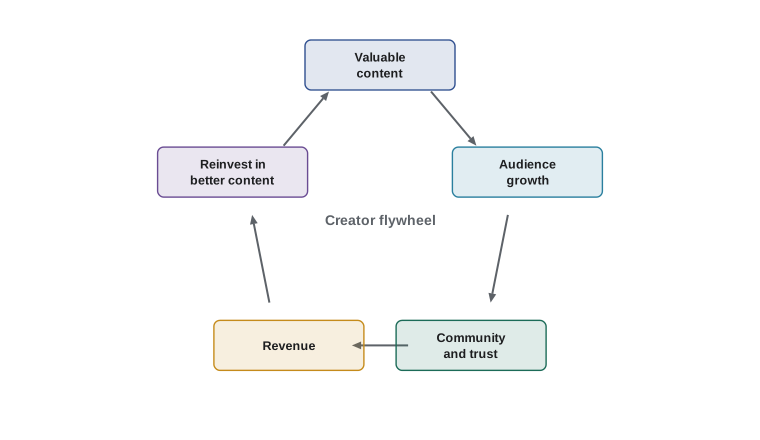
A typical creator flywheel works like this: valuable content attracts viewers; some viewers become a returning audience; a returning audience builds community and trust; trust supports revenue through sponsorships, products and memberships; revenue funds better equipment, editors and research; and better resources produce more valuable content, starting the loop again. Strategy is largely about finding the weakest link in your flywheel and strengthening it. A creator with great content but no way to convert viewers into returning fans has a leak at the audience-to-community step. A creator with a loyal community but no revenue model has a leak at the trust-to-revenue step.
Worked problem
Finding the weakest link in a flywheel
A creator publishes weekly videos averaging 40,000 views. Returning viewers make up 18 % of views, similar channels in the niche report about 35 %, and the creator earns $2,000 a month. Sponsors in the niche typically pay about $25 per 1,000 views on integrated mentions. Which link in the flywheel is weakest?
Show solution
- Content is attracting viewers: 40,000 views a week is solid for the niche.
- Audience to community: returning viewers at 18 % against a niche benchmark of 35 % suggests viewers are not coming back.
- Revenue: four sponsored videos a month at 40,000 views and $25 per 1,000 would be 4 × 40 × $25 = $4,000, double current income, so revenue is also below potential.
- Revenue depends on trust and returning viewers, because sponsors value audiences that watch regularly. Fixing retention is likely to lift revenue too.
Answer: The audience-to-community link is weakest. The creator should prioritize series, playlists, community posts and calls to subscribe before pushing harder on sponsorships.
Strategic choices every creator faces
A creator strategy can be summarized as answers to a handful of choices. You do not need to answer all of them perfectly, but you should answer them deliberately.
| Choice | Typical options | Questions to ask |
|---|---|---|
| Audience | Broad entertainment or a narrow niche | Who needs this most? Can I reach them? |
| Format | Long form, short form, livestream, podcast, newsletter | What fits my skills and the audience's habits? |
| Platform | One home platform plus satellites, or many equal channels | Where does my audience already spend time? |
| Cadence | Fewer high-effort pieces or more frequent lighter pieces | What can I sustain for two years? |
| Revenue | Ads, sponsors, affiliates, products, memberships, services | Which streams fit the trust I am building? |
| Team | Solo, freelancers, or employees | What should I stop doing myself? |
These choices interact. A narrow expert niche usually suits long-form search content, a product or course, and a modest upload schedule. A broad entertainment channel usually suits short-form discovery, frequent uploads, brand sponsorships and a team. Inconsistent choices, such as an expert niche with a high-volume trend-chasing schedule, create tension that shows up as burnout or confused positioning.
Strategy as hypotheses
No creator knows in advance which choices will work. A practical way to think about strategy is as a set of hypotheses: informed guesses about what will create value for your audience and your business, which you will test and refine. "Detailed long-term reviews will build more trust and sponsor demand than launch-day reviews" is a strategic hypothesis. "Weekly Shorts will bring new viewers who later watch long videos" is another. Treating strategy this way keeps you committed enough to give each idea a fair chance, and humble enough to change course when the evidence says you should.
Worked problem
Expected value of a strategic bet
A creator is considering a monthly documentary-style series. Each episode takes three times as long as a normal video. The creator estimates a 30 % chance the series becomes a signature format worth an extra $3,000 a month in sponsorship and memberships, a 50 % chance it performs like normal videos (no extra income), and a 20 % chance it underperforms and costs $500 a month in lost output. What is the expected monthly value?
Show solution
- Success: 0.30 × $3,000 = $900.
- Neutral: 0.50 × $0 = $0.
- Underperform: 0.20 × (−$500) = −$100.
- Expected value: $900 + $0 − $100 = $800 a month.
Answer: About $800 a month. The bet has positive expected value, but the creator should set a review point, for example after four episodes, to check whether the success scenario is emerging.
Expected value calculations rely on rough probabilities, so treat them as a way to structure thinking rather than as precise forecasts. Their main benefit is forcing you to state what success, failure and the middle outcome would actually look like before you start.
Worked problem
Choosing between two positioning options
A fitness creator scores two positioning options from 1 to 5 on four criteria, weighted by importance: audience demand (40 %), fit with skills (30 %), competition (20 %, where 5 means little competition) and monetization (10 %). Option A, general home workouts, scores 5, 3, 1, 3. Option B, strength training for people over 50, scores 3, 5, 4, 4. Which scores higher?
Show solution
- Option A: 0.4 × 5 + 0.3 × 3 + 0.2 × 1 + 0.1 × 3 = 2.0 + 0.9 + 0.2 + 0.3 = 3.4.
- Option B: 0.4 × 3 + 0.3 × 5 + 0.2 × 4 + 0.1 × 4 = 1.2 + 1.5 + 0.8 + 0.4 = 3.9.
Answer: Option B scores 3.9 against 3.4. It has smaller demand but much better fit and less competition, which often matters more for a creator building a distinctive position.
Reviewing and updating strategy
A strategy should be stable enough to give your work direction, but not so rigid that you ignore what you learn. A common rhythm is to review strategy once a year in depth, check progress against goals each quarter, and look at experiment results monthly. Major external changes, such as a platform policy shift, a new competitor, or a change in your own life, can trigger an earlier review. The rest of this course gives you the tools for each of those rhythms.
Common mistakes
MistakeTreating a follower target as a strategy.
InsteadSet targets, but also write down the choices about audience, format, platform and revenue that explain how you will reach them.
MistakeSaying yes to every opportunity.
InsteadUse your positioning to decline offers and trends that pull you away from your audience and promise.
MistakeCopying another creator's format and expecting the same results.
InsteadStudy what worked and why, then adapt the principle to your own audience, skills and moats.
MistakeRelying only on tactics that are easy to copy.
InsteadInvest steadily in at least one durable moat, such as trust, community, expertise or an owned audience.
MistakeNever revisiting strategy.
InsteadReview strategy yearly, check goals quarterly and read experiment results monthly.
Summary and key terms
- Strategy is a coherent set of choices about where to compete and how to win, including what not to do.
- A creator vision describes who you serve, what change you create and what success looks like for you.
- Positioning explains why your audience should choose you over alternatives, through audience, angle and promise.
- Moats such as trust, community, expertise and owned audiences are hard to copy and make a channel resilient.
- A creator flywheel links content, audience, community, revenue and reinvestment; strategy fixes the weakest link.
- Strategic choices about audience, format, platform, cadence, revenue and team should fit together.
- Treating strategy as hypotheses keeps you committed but open to evidence, with regular reviews.
- Strategy
- A coherent set of choices about where to compete and how to win, given limited resources.
- Vision
- A short description of what a creator wants their work to achieve over several years.
- Positioning
- The distinct place a creator occupies in the audience's mind compared with alternatives.
- Moat
- A durable advantage that is hard for competitors to copy.
- Flywheel
- A loop of activities that reinforce each other so momentum builds over time.
- Owned audience
- Viewers reachable directly, such as through email or memberships, without relying on an algorithm.
- Evergreen content
- Content that stays relevant and keeps attracting viewers long after publication.
- Strategic hypothesis
- An informed guess about what will create value, stated so that it can be tested.
- Expected value
- The probability-weighted average of possible outcomes.
- Weighted scoring
- Rating options on several criteria and combining the scores using importance weights.
Practice problems
Work each problem on paper first, then reveal the answer to check.
What is the difference between a goal and a strategy?
Show answer
A goal is a target; a strategy is the set of choices that explains how to reach it and what to give up.
Name the three parts of a creator vision.
Show answer
Who you serve, what change you create for them, and what success looks like for you.
What three elements make positioning strong?
Show answer
A clear audience, a distinctive angle and a promise you can keep consistently.
Give three examples of creator moats.
Show answer
Trust and track record, community, expertise or access, owned audience, archive, personality.
Why are trending-sound tactics weak moats?
Show answer
Anyone can copy them immediately.
List the five stages of the simple creator flywheel.
Show answer
Valuable content, audience growth, community and trust, revenue, reinvestment.
A bet has a 40 % chance of +$2,000 and a 60 % chance of −$300. What is the expected value?
Show answer
0.4 × 2,000 − 0.6 × 300 = $800 − $180 = $620.
Option scores are 4 and 2 on criteria weighted 0.7 and 0.3. What is the weighted score?
Show answer
0.7 × 4 + 0.3 × 2 = 3.4.
Why should strategy be treated as hypotheses?
Show answer
Because no one knows in advance what will work; testing keeps you open to evidence.
How often should strategy be reviewed in depth?
Show answer
About once a year, with quarterly goal checks and monthly experiment reviews.
Lesson quiz · 5 questions
Score 60% or more to complete this lesson.
Create a free account to save your progress, take quizzes and earn a certificate.