
ENGG-100 · Lesson 1 of 5 · 33 min
What engineers do
Look around and almost everything you see was engineered: the building you are in, the electricity in the walls, the water from the tap, the phone in your pocket, the road outside and the food supply that got breakfast to your table. Engineers take scientific knowledge and use it to design things that are useful, safe, affordable and reliable, under real constraints of time, money, materials and law.
This chapter introduces the profession you are entering. It describes what engineering is and how it differs from science and other technical work, surveys the main disciplines, walks through the design process, and introduces engineering judgement: the habits of estimating, checking and allowing for uncertainty that separate a working design from a dangerous one.
What engineering is
Engineering is the application of science, mathematics and experience to design, build and operate structures, machines, processes and systems for human use. Two words in that description matter most. Design: engineers create things that did not exist before, choosing among alternatives. Use: the result must work for real people, which means it must be safe.
Because engineering decisions can kill people when they go wrong, Canadian law treats engineering as a regulated profession, like medicine and law. Each province defines the "practice of engineering" in its legislation. In Alberta, the Engineering and Geoscience Professions Act describes it broadly: reporting on, advising on, evaluating, designing, preparing plans and specifications for, or directing the construction, inspection, maintenance or operation of works and processes that require engineering principles and that concern the safeguarding of life, health, property, economic interests, the public welfare or the environment. Lesson 2 covers what that means for licensing.
Science, engineering and the rest of the team
Scientists seek to understand how the world works; engineers use that understanding to make things. The line is blurry, since engineers do research and scientists build instruments, but the motivation differs. A physicist studies why metals fatigue; an engineer designs an aircraft wing that will not fail by fatigue for 30 years.
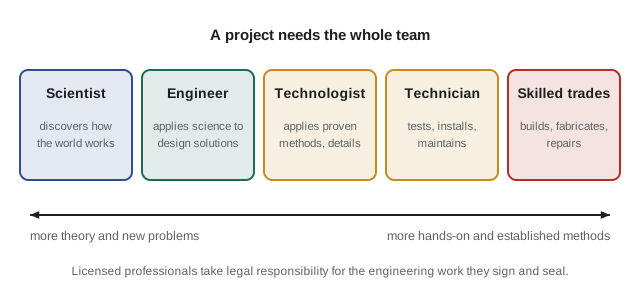
Engineering technologists and technicians apply established methods: drafting, testing, surveying, inspection and much detailed design. Skilled tradespeople build and maintain what is designed. A good engineer respects that expertise. The welder who says a joint cannot be made as drawn, or the operator who says a valve is always awkward to reach, is giving you design information you should not ignore.
The engineering disciplines
Engineering is divided into disciplines, each with its own body of knowledge, though real projects always cross the lines.
- Civil engineering: structures, bridges, foundations, roads, water supply, wastewater and dams. The oldest discipline outside the military.
- Mechanical engineering: machines, engines, heating and cooling, manufacturing and anything that moves or converts energy.
- Electrical engineering: power generation and distribution, electronics, control systems and communications.
- Chemical engineering: processes that change materials, from refineries and upgraders to pharmaceuticals, pulp and paper, and food.
- Computer and software engineering: digital hardware, embedded systems, networks and software where failures can affect safety, such as medical devices, vehicles and industrial controls.
- Petroleum engineering: drilling, reservoirs and production of oil and gas, increasingly also geothermal energy and carbon storage.
- Others include mining, materials, environmental, geological, biomedical, aerospace, agricultural and engineering physics.
In Canada the engineering profession had 330,639 members across the 12 provincial and territorial regulators at the end of 2024, according to Engineers Canada. That year 10,246 people became newly licensed engineers.
The design process
Design is the heart of engineering. No two textbooks draw the process the same way, but they share the same logic: understand the problem, generate options, evaluate them, develop the best one in detail, test it, and learn from the results.
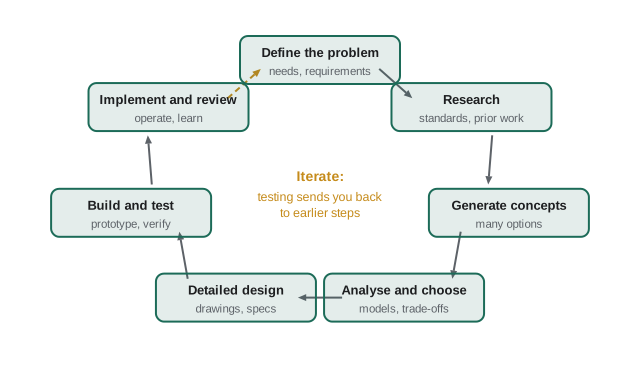
The single most common reason designs fail is a poorly defined problem. Before sketching anything, an engineer writes down what the design must do and the limits it must respect:
- Functional requirements: what it must do, stated measurably ("carry a 5 kPa pedestrian load", "deliver 40 L/s at 300 kPa").
- Constraints: hard limits that cannot be violated (budget, a site boundary, a building code, a deadline, an environmental permit).
- Criteria: qualities to maximize or minimize when comparing acceptable designs (cost, weight, efficiency, appearance, ease of maintenance).
Worked problem
Sorting out a design brief
A town wants a pedestrian bridge over a creek. Classify each item: (a) must span 24 m; (b) total cost under $1.2 million; (c) should look attractive; (d) must meet the Canadian Highway Bridge Design Code; (e) minimize maintenance; (f) must be accessible to wheelchairs.
Show solution
- Functional requirements: (a) the span and (f) accessibility describe what the bridge must do.
- Constraints: (b) the budget and (d) the code are hard limits that any acceptable design must meet.
- Criteria: (c) appearance and (e) maintenance are used to rank designs that already meet the requirements and constraints.
Answer: Requirements (a), (f); constraints (b), (d); criteria (c), (e). Writing the brief this way makes it clear which demands are negotiable and which are not
Choosing between alternatives
Good designers generate several concepts before committing to one, because the first idea is rarely the best. To compare them fairly, engineers often use a weighted decision matrix: score each option against each criterion, multiply by the criterion's weight, and add.
Worked problem
A weighted decision matrix
Three deck options for the bridge are scored from 1 to 10. Weights: cost 0.4, durability 0.3, ease of construction 0.2, environmental impact 0.1. Steel scores 6, 8, 7, 5; precast concrete 8, 7, 6, 6; mass timber 7, 5, 8, 9. Which ranks highest?
Show solution
- Steel: \(0.4(6) + 0.3(8) + 0.2(7) + 0.1(5) = 2.4 + 2.4 + 1.4 + 0.5 = 6.7\).
- Concrete: \(3.2 + 2.1 + 1.2 + 0.6 = 7.1\).
- Timber: \(2.8 + 1.5 + 1.6 + 0.9 = 6.8\).
- Sensitivity check: swap the weights of cost and durability (0.3 and 0.4). Steel 6.9, concrete 7.0, timber 6.6. Concrete still leads, but narrowly.
Answer: Precast concrete ranks first, but the margin is small. A decision matrix structures a discussion; it does not replace judgement, and its result is only as good as the weights and scores
Engineering judgement
Engineering calculations rest on models: simplified descriptions of reality. A beam is treated as a line, air as an ideal gas, soil as a uniform material. Judgement is knowing when a model is good enough, checking results against experience, and building in margins for what you do not know.
Estimation
Experienced engineers estimate before they calculate. A quick order-of-magnitude estimate catches errors in the detailed calculation and shows which factors matter. If your spreadsheet says a small pump needs 2 MW, a 30-second estimate should tell you something is wrong.
Worked problem
A quick estimate
Estimate the daily water demand of a community of 1 million people, assuming about 250 L per person per day for homes, businesses and leakage combined.
Show solution
- \(10^6 \times 250\) L \(= 2.5 \times 10^8\) L/day, or 250 ML/day (250 000 m³/day).
- That is about 2.9 m³ every second, around the clock.
Answer: Roughly 250 ML/day. The real figure for a given city could differ by a factor of two, but an estimate like this tells a designer at once whether a pipe or treatment plant size is plausible
Units and checking
Many engineering failures are not failures of theory but of arithmetic, units or communication. Checking is a professional duty, not an optional extra: independent review of calculations and drawings is standard practice and, for authenticated work, often required.
Worked problem
The Gimli Glider
In 1983, Air Canada Flight 143, a new Boeing 767 that measured fuel in kilograms, needed 22 300 kg of fuel. The tanks held 7682 L, and the crew used a density of 1.77 to convert litres to mass, a value in pounds per litre, believing it was kilograms per litre. They therefore added 4917 L. The correct density of jet fuel is about 0.803 kg/L. How much fuel was really on board?
Show solution
- Total volume: \(7682 + 4917 = 12\,599\) L.
- Mass: \(12\,599 \times 0.803 = 10\,100\) kg.
- Fraction of the required fuel: \(10\,100/22\,300 = 45\%\).
Answer: Less than half the fuel needed. Both engines stopped over Manitoba, and the crew glided the aircraft to a safe landing at a former air base at Gimli. Unit errors are among the most common and most dangerous mistakes in engineering
Factors of safety
Loads are uncertain, materials vary, and models are approximate. Engineers allow for this by designing for more than the expected load. The simplest measure is the factor of safety:
Worked problem
Factor of safety for a lifting cable
A wire rope with a minimum breaking strength of 50 kN lifts a 10 kN load. Find the factor of safety. What is it if a sudden jerk increases the effective load by 50%?
Show solution
- Static: \(\text{FS} = 50/10 = 5.0\).
- With the jerk, the load is \(1.5 \times 10 = 15\) kN, so \(\text{FS} = 50/15 = 3.3\).
Answer: 5.0 statically, falling to 3.3 under the dynamic load. This is why rigging standards specify generous design factors for wire rope and why smooth lifting matters
Modern codes such as the National Building Code of Canada use limit states design instead of a single factor: loads are multiplied by load factors greater than 1, and resistances by resistance factors less than 1, each chosen to reflect the uncertainty in that particular quantity. The idea is the same: plan for the worst plausible combination, not the average.
Communication and teamwork
An engineer's work is only as good as the documents that carry it: drawings, specifications, calculations, reports and emails. Contractors build what is drawn, not what the engineer intended. Clear, accurate, well-organized communication is therefore a core technical skill, and most engineers spend more time writing, meeting and explaining than calculating.
Projects are also team efforts across disciplines and organizations: owners, consultants, contractors, suppliers, regulators and the public. Working well with people who have different expertise and priorities, and being honest about uncertainty and mistakes, are part of competent practice. ENGG-160 develops these skills in detail.
Common mistakes
MistakeJumping straight to a solution before defining the problem.
InsteadWrite down requirements, constraints and criteria first; most design failures start with a vague brief.
MistakeTreating the output of a decision matrix or computer model as the answer.
InsteadTools structure thinking. Check sensitivity, question the inputs and apply judgement.
MistakeSkipping the estimate and trusting a detailed calculation.
InsteadEstimate first; a large disagreement means an error somewhere.
MistakeMixing units or leaving them off.
InsteadCarry units through every step and convert at the start. Have someone else check.
MistakeDesigning exactly to the expected load.
InsteadAllow for uncertainty with factors of safety or limit states design, as the codes require.
Summary and key terms
- Engineering applies science, mathematics and experience to design useful, safe things under real constraints.
- It is a regulated profession in Canada because engineering decisions affect public safety.
- Engineers work alongside scientists, technologists, technicians and tradespeople, each with distinct roles.
- The main disciplines include civil, mechanical, electrical, chemical, computer and petroleum engineering, among many others.
- Design is iterative: define the problem, research, generate concepts, analyse, detail, test, implement and review.
- Briefs separate functional requirements, constraints and criteria; decision matrices help compare options.
- Judgement means estimating, checking units, verifying models and allowing margins such as factors of safety.
- Communication and teamwork are core engineering skills.
- Engineering
- Applying science and mathematics to design and operate systems for human use.
- Practice of engineering
- The activities a provincial law reserves for licensed engineers.
- Functional requirement
- A measurable statement of what a design must do.
- Constraint
- A hard limit a design must not violate.
- Criterion
- A quality used to compare acceptable designs.
- Decision matrix
- A table scoring options against weighted criteria.
- Factor of safety
- Capacity divided by expected demand.
- Limit states design
- Design using factored loads and factored resistances.
Practice problems
Work each problem on paper first, then reveal the answer to check.
Give one example each of a functional requirement, a constraint and a criterion for a home furnace.
Show answer
Requirement: deliver 20 kW of heat. Constraint: meet the gas code and fit through a standard door. Criterion: highest efficiency or lowest noise.
Why do designers generate several concepts before choosing one?
Show answer
The first idea is rarely the best; comparing alternatives reveals better solutions and trade-offs, and shows the client the reasoning behind the choice.
In the decision matrix example, what score would timber need on cost to tie with concrete?
Show answer
Timber totals 6.8 with a cost score of 7. It needs 0.3 more points, so 0.4 × cost must rise by 0.3: cost score 7.75.
Estimate the electrical energy used by 500 000 homes in a day if each averages 1.0 kW.
Show answer
500 000 × 1.0 kW × 24 h = 12 000 000 kWh = 12 GWh per day.
A shelf bracket can carry 1.2 kN before failing. What is the largest load allowed for a factor of safety of 3?
Show answer
1.2/3 = 0.40 kN.
A designer misreads a pressure of 600 kPa as 600 psi. By roughly what factor is the design pressure overstated?
Show answer
600 psi ≈ 4137 kPa, about 6.9 times too high. (The opposite mistake would be dangerously low.)
List three people outside engineering whose input could improve the design of a water treatment plant.
Show answer
Examples: plant operators, maintenance technicians, the regulator, the community, health officials, the contractor.
What is the difference between a scientist and an engineer studying corrosion?
Show answer
The scientist seeks to understand the mechanism; the engineer uses that knowledge to choose materials, coatings or cathodic protection so a structure lasts its design life.
Why do building codes use load factors greater than 1?
Show answer
Real loads can exceed expected values; the factors cover that uncertainty so the structure remains safe under rare but plausible loads.
Give two reasons to keep an engineering notebook.
Show answer
It records assumptions and decisions for later review or defence, and documents your experience for licensure.
Lesson quiz · 5 questions
Score 60% or more to complete this lesson.
Create a free account to save your progress, take quizzes and earn a certificate.