
ENGG-100 · Lesson 2 of 5 · 30 min
Regulation and licensing in Canada
Anyone can call themselves a writer or a designer. Not just anyone can call themselves a professional engineer, sign off on a bridge design, or offer engineering services to the public. In Canada those rights are reserved by law for people and companies licensed by an engineering regulator, and the reason is simple: the public cannot judge whether a structure, machine or process is safe, so the law makes sure the people designing them are qualified and accountable.
This chapter explains how engineering is regulated in Canada: who the regulators are and what powers they hold, what the protected titles and practice are, how an engineering graduate becomes a licensed professional engineer, and what obligations come with the licence, from stamping drawings to continuing professional development and discipline. The details follow APEGA in Alberta, with notes on how other provinces differ.
Why engineering is regulated
A profession is an occupation that requires specialized knowledge, serves the public, and is trusted to govern itself. In exchange for that trust, it must put the public interest ahead of the interests of its members. Canadian provinces have delegated the regulation of engineering to bodies made up mostly of engineers themselves, a system called self-regulation, on the condition that they protect the public.
Under the Constitution, regulating professions is a provincial and territorial responsibility. There is therefore no single national licence: there are 12 engineering regulators, one for each province and territory except that the Northwest Territories and Nunavut share one:
- Alberta: APEGA (Association of Professional Engineers and Geoscientists of Alberta)
- British Columbia: Engineers and Geoscientists BC
- Saskatchewan: APEGS
- Manitoba: Engineers Geoscientists Manitoba
- Ontario: Professional Engineers Ontario (PEO)
- Quebec: Ordre des ingénieurs du Québec (OIQ)
- New Brunswick: Engineers and Geoscientists New Brunswick
- Nova Scotia: Engineers Nova Scotia
- Prince Edward Island: Engineers PEI
- Newfoundland and Labrador: PEGNL
- Northwest Territories and Nunavut: NAPEG
- Yukon: Engineers Yukon
Each regulator operates under its own provincial act. In Alberta that is the Engineering and Geoscience Professions Act and its General Regulation. The act gives APEGA the power to set entry requirements, license members, set practice standards, investigate complaints and discipline members.
Engineers Canada and accreditation
Engineers Canada is the national organization of the 12 regulators. It is not a regulator and does not license anyone. Its most important job is accreditation: through the Canadian Engineering Accreditation Board (CEAB), it reviews university engineering programs against national standards. At the time of writing, Engineers Canada lists 308 accredited programs at 47 institutions. A degree from an accredited program is accepted by every regulator as meeting the academic requirement for licensure, and Canada's accreditation is recognized internationally under the Washington Accord.
Accreditation applies to programs, not to individual courses or people, and it does not rank programs. It also does not apply to HSM University: courses on this site follow the structure of an accredited curriculum but do not lead to licensure.
Protected titles and practice
Provincial acts protect engineering in two ways.
- Title protection: only licensed people may use titles such as "Professional Engineer", the designation "P.Eng.", or (in most provinces) the word "engineer" in a way that implies they are licensed.
- Practice protection: only licensed people may carry out the practice of engineering as the act defines it, and companies that offer engineering services to the public must also hold authorization (in Alberta, a Permit to Practice).
Practice protection matters more for public safety: it is what prevents an unqualified person from designing a pressure vessel or a building's structure, whatever they call themselves.
The "software engineer" exception in Alberta
Titles are a live issue in the technology sector, where "software engineer" is a common job title for people who are not licensed engineers. Alberta amended its act in 2023 so that, from December 7, 2023, anyone may use the title "software engineer" without a licence, and the Minister may add similar titles by regulation. The "Professional Engineer" title and the "P.Eng." designation remain reserved. APEGA opposed the change, and notes that people who actually practise engineering in the technology industry must still be licensed, and that companies providing engineering services still need a Permit to Practice. Other provinces have taken different positions, so the rules depend on where you work.
Worked problem
Can she use the title?
Priya graduated from an accredited mechanical engineering program in May and joined a pipeline company in Calgary. Her manager suggests she sign her emails "Priya Shah, Pipeline Engineer". Can she?
Show solution
- She is not yet licensed, so she may not use "P.Eng." or present herself as an engineer in a way that implies she is licensed.
- Once she registers with APEGA as an Engineer-in-Training, she can use "Engineer-in-Training" or "EIT".
- Titles like "Engineering Graduate" or "Pipeline EIT" are accurate and safe.
Answer: No. She should use "EIT" once registered (or a title such as "engineering graduate") until she earns her P.Eng. Her employer can also be in breach if it holds her out as an engineer
Becoming a professional engineer
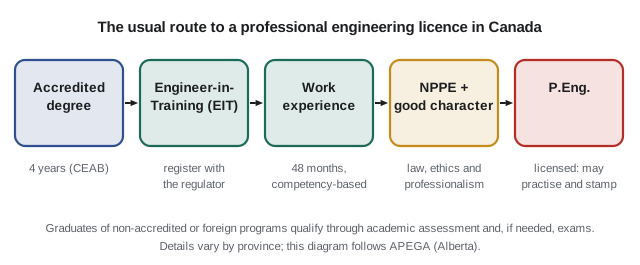
The usual path to a P.Eng. licence has four parts.
1. Academic qualifications
A bachelor's degree from a CEAB-accredited program meets the academic requirement directly. Graduates of other programs, including international graduates, have their academic background assessed by the regulator and may be assigned confirmatory or technical exams to show equivalence.
2. Engineer-in-Training
After graduating, you can register as an Engineer-in-Training (EIT). It costs little, lets you use the EIT title, and starts a record of your experience with the regulator. You can work under the supervision of licensed engineers but cannot take professional responsibility for engineering work yourself.
3. Work experience
APEGA requires at least 48 months of professional-level engineering experience. It is assessed through a competency-based assessment: applicants describe examples from their work that demonstrate 22 competencies, such as technical competence, communication, project management, professional accountability and social and environmental awareness. Each is scored from 0 to 5 by validators, at least three people who know the applicant's work, normally including licensed engineers. As of July 18, 2026, all APEGA engineering applicants use a revised process in which eight of the 22 competencies cover practice in the Canadian work environment, such as Canadian codes and standards and occupational health and safety. Other regulators use similar competency-based systems, and some credit part of a graduate degree or pre-graduation experience toward the 48 months.
4. Professional practice exam and good character
Applicants must pass the National Professional Practice Exam (NPPE), which tests knowledge of professionalism, law and ethics, and show good character (declaring, for example, any criminal convictions or past discipline). Quebec's OIQ uses its own professional exam.
When all four parts are complete, the regulator issues a licence, and you may use the title Professional Engineer and the designation P.Eng.
Other designations
Alberta also licenses Professional Licensees (P.L.(Eng.)), who may practise independently within a defined, limited scope, often technologists with long experience in one field. Engineering technologists and technicians are certified separately (in Alberta, by ASET, the Association of Science and Engineering Technology Professionals of Alberta). Geoscientists (P.Geo.) are licensed by APEGA too.
The Iron Ring
Many Canadian engineering graduates take part in the Ritual of the Calling of an Engineer and receive an iron ring, worn on the little finger of the working hand. The ceremony, written by Rudyard Kipling and first held in Montreal in 1925, reminds new engineers of their obligation to the public. It is a tradition, not a licence: wearing the ring does not make anyone a professional engineer.
Obligations of a licence
A licence brings responsibilities that continue for your whole career.
Authentication
Licensed engineers authenticate their work, traditionally with a stamp or seal and signature, now often digitally. Authentication tells everyone who relies on a document that a named, licensed professional has prepared or thoroughly reviewed it and takes responsibility for it. APEGA's practice standard on authenticating professional work products sets out when and how this must be done.
Worked problem
Stamping someone else's work
A contractor's drafter, who is not licensed, has prepared drawings for a steel platform. The contractor asks Daniel, a P.Eng., to stamp them that afternoon so they can be issued for construction. Daniel has not seen them before. What should he do?
Show solution
- Authentication means Daniel takes professional responsibility for the design, as if he had prepared it.
- He may only stamp work he prepared or that was done under his direct supervision and control, or work he has reviewed thoroughly enough to accept full responsibility for it.
- A quick look on the day is not enough. He must check the design basis, loads, calculations and connections, or decline.
Answer: He should refuse to stamp the drawings until he has reviewed (and if necessary redone) the design to the same standard as his own work. "Plan stamping" without review is a serious breach that regulators discipline
Permits and practice management
In Alberta, a company or organization that practises engineering needs a Permit to Practice. It must name a responsible member, a licensed professional who is accountable for the company's engineering practice, and maintain a professional practice management plan describing how it ensures that engineering work is properly supervised, checked and authenticated.
Continuing competence
Licensed engineers must keep their knowledge current. APEGA, like other regulators, requires members to complete and report a set amount of continuing professional development over each reporting cycle, through courses, conferences, technical work, teaching, volunteering and self-study. Regulators also carry out practice reviews of members and permit holders.
Complaints and discipline
Anyone can complain to the regulator about an engineer. Complaints are investigated and, where warranted, go to a discipline hearing. Findings fall under two broad headings: unskilled practice (falling short of the expected standard of knowledge, skill or judgement) and unprofessional conduct (breaches of the code of ethics or the act). Penalties range from reprimands and fines to required courses, suspension and cancellation of the licence. Decisions are published, because transparency is part of protecting the public.
Worked problem
Working in another province
Amir, a P.Eng. registered with APEGA in Edmonton, is asked to design a water treatment upgrade for a town in Saskatchewan. Can he do it on his Alberta licence?
Show solution
- Licences are provincial. To practise in Saskatchewan he must be licensed by APEGS, and his firm may also need authorization there.
- Under the Canadian Free Trade Agreement and provincial labour mobility laws, a licensed engineer in good standing in one province can usually obtain a licence in another without re-qualifying.
Answer: He must register with APEGS before practising there, which is usually a straightforward mobility application. Engineers who work across Canada often hold several provincial licences
Common mistakes
MistakeThinking Engineers Canada issues licences.
InsteadLicences come from the 12 provincial and territorial regulators. Engineers Canada coordinates them and runs accreditation.
MistakeBelieving an engineering degree, or an iron ring, makes you an engineer.
InsteadYou need a licence: degree, experience, exam and good character, granted by a regulator.
MistakeAssuming a licence from one province lets you practise anywhere in Canada.
InsteadRegister in each province where you practise; mobility agreements make this straightforward.
MistakeStamping drawings you have not checked because a colleague or client vouches for them.
InsteadAuthenticate only work you prepared, supervised or have thoroughly reviewed and accept responsibility for.
MistakeAssuming the Alberta "software engineer" exemption means software work never needs a licence.
InsteadIt frees the title only. Work that meets the legal definition of engineering practice still requires licensure.
Summary and key terms
- Engineering is a self-regulated profession; the regulator's duty is to protect the public.
- Regulation is provincial: 12 regulators, including APEGA in Alberta and PEO in Ontario. Engineers Canada coordinates them and accredits programs through the CEAB.
- Provincial acts protect titles (Professional Engineer, P.Eng.) and the practice of engineering; companies need authorization such as a Permit to Practice.
- Since December 7, 2023, Alberta allows the title "software engineer" without a licence, but practice protection still applies.
- The path to P.Eng.: accredited degree (or assessment), EIT registration, 48 months of competency-assessed experience, the NPPE and good character.
- Licensed engineers authenticate their work, maintain competence through professional development, and are subject to discipline.
- Self-regulation
- A profession governing its own members under authority delegated by law.
- APEGA
- The engineering and geoscience regulator in Alberta.
- Engineers Canada
- The national organization of the 12 engineering regulators; not itself a regulator.
- CEAB
- The Canadian Engineering Accreditation Board, which accredits engineering programs.
- EIT
- Engineer-in-Training: a graduate gaining experience toward licensure.
- P.Eng.
- Professional Engineer: the protected designation of a licensed engineer.
- NPPE
- National Professional Practice Exam on law, ethics and professionalism.
- Permit to Practice
- Authorization for a company to practise engineering in Alberta.
- Authentication
- Stamping and signing a document to take professional responsibility for it.
Practice problems
Work each problem on paper first, then reveal the answer to check.
Why is engineering regulated provincially rather than federally?
Show answer
The Constitution assigns regulation of professions (property and civil rights) to the provinces and territories.
What is the difference between title protection and practice protection?
Show answer
Title protection restricts who may use names like P.Eng.; practice protection restricts who may actually perform engineering work as defined in the act.
A graduate of a non-accredited foreign program wants to become a P.Eng. in Alberta. What extra step is likely?
Show answer
An academic assessment, possibly with confirmatory or technical exams to show equivalence to an accredited degree.
Name four of the regulators and their provinces.
Show answer
Any four of: APEGA (AB), EGBC (BC), APEGS (SK), Engineers Geoscientists Manitoba, PEO (ON), OIQ (QC), and the Atlantic and northern regulators.
What does the CEAB accredit, and what does accreditation not do?
Show answer
It accredits university engineering programs. It does not license people, accredit individual courses, or rank programs.
How long is the minimum work experience for a P.Eng. in Alberta, and how is it assessed?
Show answer
48 months, assessed through a competency-based assessment of 22 competencies scored by validators.
What does an engineer's stamp on a drawing mean?
Show answer
That a named licensed professional prepared or thoroughly reviewed it and takes professional responsibility for it.
What is the role of the responsible member under an Alberta Permit to Practice?
Show answer
A licensed professional accountable for the company's engineering practice, including its practice management plan.
Give an example of unskilled practice and an example of unprofessional conduct.
Show answer
Unskilled practice: a design error from failing to apply the relevant code. Unprofessional conduct: stamping drawings without review, or concealing a conflict of interest.
Does a developer in Alberta titled "software engineer" need a licence?
Show answer
Not for the title since December 2023. If the work they do meets the legal definition of practising engineering, they must be licensed and their company needs a Permit to Practice.
Lesson quiz · 5 questions
Score 60% or more to complete this lesson.
Create a free account to save your progress, take quizzes and earn a certificate.