
ENGG-100 · Lesson 2 of 5 · 32 min
Regulation and licensing in the United States
Anyone can call themselves a writer or a designer. Not just anyone can sign and seal a bridge design or offer engineering services to the public. In the United States those rights are reserved by state law for licensed Professional Engineers (PEs) and for firms authorized to practice, and the reason is simple: the public cannot judge whether a structure, machine or process is safe, so the law makes sure the people taking responsibility for them are qualified and accountable.
This chapter explains how engineering is regulated in the United States: who the licensing boards are and what powers they hold, what the protected titles and practice are, how an engineering graduate becomes a PE, and what obligations come with the license, from sealing drawings to continuing education and discipline. Rules differ from state to state, so examples name the state they come from.
Why engineering is regulated
A profession is an occupation that requires specialized knowledge, serves the public, and is trusted to set its own standards. In exchange for that trust, it must put the public interest ahead of the interests of its members. In the United States the power to license professions belongs to the states, under their authority to protect public health, safety and welfare.
Licensure began with a crisis. In 1907 Wyoming passed the first engineering licensing law, after its state engineer, Clarence Johnston, saw water-rights filings and irrigation plans prepared by people with no qualifications. Other states followed over the next forty years, and a disaster accelerated the process: in March 1937, a natural gas explosion at the New London School in Texas killed about 300 students and teachers. Odorless gas had leaked from an improperly connected line into the building. Within weeks Texas passed its Engineering Practice Act, and the disaster also led Texas to require that a strong odorant be added to natural gas, a practice that became standard across the country. By 1947 every state had an engineering licensing law.
State boards and NCEES
Each state, the District of Columbia and the US territories has a licensing board created by its own engineering practice act, for example the Texas Board of Professional Engineers and Land Surveyors or the California Board for Professional Engineers, Land Surveyors, and Geologists. The board sets entry requirements, issues licenses, investigates complaints and disciplines licensees. There is no national license.
The boards cooperate through NCEES, the National Council of Examiners for Engineering and Surveying. NCEES has 69 member boards across the 55 US jurisdictions (some states have separate boards for engineering and surveying). NCEES is not a regulator and does not license anyone. It writes and administers the national exams, publishes a Model Law that states may adopt, and keeps the NCEES Record, a verified file of a person's education, exams, experience and references that can be sent to any board. In its 2024–25 fiscal year, NCEES counted about 1.02 million engineering licenses held across its member boards; because many engineers hold licenses in several states, the number of individual PEs is smaller.
ABET and accreditation
ABET accredits college programs in engineering, computing, applied science and engineering technology. Its Engineering Accreditation Commission reviews engineering programs against criteria for student outcomes, curriculum, faculty and continuous improvement. ABET reports more than 4,800 accredited programs at about 950 institutions in 42 countries. A bachelor's degree from an ABET-accredited engineering program is the standard educational route to licensure in every state, and ABET is a signatory of the Washington Accord, which recognizes equivalent accreditation in other countries, including Canada.
Accreditation applies to programs, not to individual courses or people, and it does not rank programs. It also does not apply to HSM University: courses on this site follow the structure of an accredited curriculum but do not lead to licensure.
Protected titles and practice
State laws protect engineering in two ways.
- Title protection: only licensees may use the titles "Professional Engineer" or "Registered Engineer" and the designation "PE". Some states go further and restrict any use of the word "engineer" that implies the person offers engineering services to the public.
- Practice protection: only licensees may practice engineering as the state act defines it, and firms that offer engineering services to the public generally need a certificate of authorization (or firm registration) and a PE in responsible charge.
Practice protection matters more for public safety: it is what prevents an unqualified person from designing a building's structure, a public water system or an electrical system for a hospital, whatever they call themselves.
The industrial exemption
A large difference from Canada: most states have an industrial exemption, which allows engineers employed by manufacturers, utilities and other companies to do engineering work on the company's own products and facilities without a license. As a result, most American engineers are not licensed. Licensure is essential for engineers who offer services to the public, design public works, or must sign and seal plans submitted to building officials, and it is usually required for consulting engineers, many government engineering positions and expert witnesses.
Titles are also contested. In 2017 Oregon's board fined Mats Järlström, a Swedish-trained electronics engineer, for writing to officials about traffic-light timing while calling himself an engineer. In 2018 a federal court ruled that applying the title law to his speech violated the First Amendment. Title rules for job titles such as "software engineer" are generally not enforced in industry, but practice protection still applies to work that meets the legal definition of engineering.
Worked problem
Can she use the title?
Priya graduated in May from an ABET-accredited mechanical engineering program, passed the FE exam and joined a consulting firm in Houston. Her manager suggests she sign her emails "Priya Shah, P.E. (pending)". Can she?
Show solution
- She is not licensed, so she may not use "PE" in any form, including "pending".
- Having passed the FE, she can apply to the Texas board for certification as an Engineer in Training and use "EIT".
- A job title such as "Engineer I" or "Design Engineer (EIT)" inside the firm is normal, but documents to clients must make clear that a licensed PE is in responsible charge.
Answer: No. She should use "EIT" (or "Engineer Intern" in states that use that term) until she is licensed. Using "PE" before licensure is a violation that boards discipline
Becoming a Professional Engineer
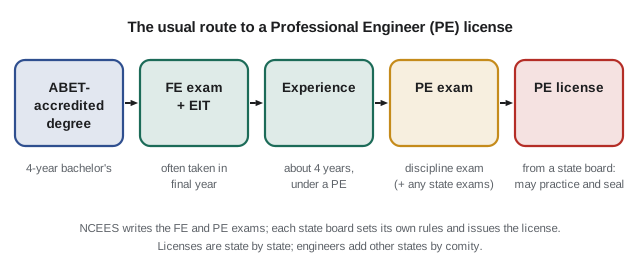
The usual path to a PE license has four parts.
1. Education
A bachelor's degree from an ABET-accredited engineering program meets the education requirement in every state. Graduates of other programs, including international graduates, usually need a credentials evaluation (NCEES offers one) and may need more years of experience. A few states allow licensure with long experience in place of a degree.
2. The FE exam and Engineer in Training
The Fundamentals of Engineering (FE) exam is a computer-based exam offered year-round at Pearson VUE test centers. It has 110 questions in a six-hour appointment (about 5 hours 20 minutes of exam time) and comes in seven disciplines: chemical, civil, electrical and computer, environmental, industrial and systems, mechanical, and other disciplines. Many students take it in their final year, while the material is fresh. In NCEES's 2024–25 year, almost 58,000 people took the FE, and first-time pass rates ranged from about 61% (civil) to 69% (mechanical).
After passing the FE, you can apply to a state board for certification as an Engineer in Training (EIT) or Engineer Intern (EI). You can then work under the supervision of PEs but cannot take professional responsibility for engineering work yourself.
3. Experience
Most states require four years of progressive engineering experience after the degree, usually under the supervision of a PE. "Progressive" means the work grows in responsibility and judgment, not four years of repeating the same task. Some states credit a master's or doctoral degree toward part of it. References, normally from PEs who know your work, confirm the experience.
4. The PE exam
The Principles and Practice of Engineering (PE) exam tests competence in a discipline, such as civil (with depth areas in construction, geotechnical, structural, transportation, and water resources and environmental), mechanical, electrical and computer, or chemical. Most PE exams are now computer-based, with about 80 to 85 questions in a nine-hour appointment; the Structural exam takes 16 hours over two days. Pass rates vary widely by discipline. Some states add their own exams: California, for example, requires civil applicants to pass state seismic principles and engineering surveying exams, and Texas requires an exam on its law and ethics.
When all parts are complete, the board issues a license, and you may use the title Professional Engineer and the designation PE.
Practicing in more than one state
A license is valid only in the state that issued it. Engineers who work across state lines apply for licensure by comity (also called endorsement) in each additional state. An NCEES Record makes this quicker, and engineers who meet the Model Law Engineer standard (accredited degree, FE, PE and four years of experience) can have their applications accepted readily by most boards.
The Order of the Engineer
Many American graduates join the Order of the Engineer, founded in 1970 and inspired by Canada's iron ring ceremony. Members take an Obligation to serve with integrity and receive a stainless steel ring worn on the little finger of the working hand. Like the Canadian ring, it is a commitment, not a license.
Obligations of a license
A license brings responsibilities that continue for your whole career.
Sealing documents
PEs seal their work with a stamp or digital seal and signature. A seal tells everyone who relies on a document, from building officials to contractors, that a named, licensed professional in responsible charge prepared it or directly supervised it and takes legal responsibility for it. Each board's rules define what must be sealed and how.
Worked problem
Sealing someone else's work
A contractor's drafter, who is not licensed, has prepared drawings for a steel platform. The contractor asks Daniel, a PE, to seal them that afternoon so they can be submitted for a permit. Daniel has not seen them before. What should he do?
Show solution
- Sealing means Daniel takes professional responsibility for the design, as if he had prepared it.
- State rules allow a PE to seal only work prepared under their responsible charge, meaning their direct control and personal supervision.
- A quick look on the day is not enough. He would have to take responsible charge: check the design basis, loads, calculations and connections, or redo the design.
Answer: He should refuse to seal the drawings unless the work is brought under his responsible charge and reviewed to the same standard as his own. "Plan stamping" without supervision is a serious violation that boards discipline, often with license suspension
Firms
Most states require a firm that offers engineering services to the public to register with the board, often called a certificate of authorization, and to designate one or more PEs in responsible charge of the firm's engineering work in that state.
Continuing education
Most states require PEs to earn professional development hours (PDH) to renew their licenses, commonly 15 PDH per year or 30 per two-year renewal, often including some on ethics or state law, through courses, conferences, technical papers, teaching and committee work. Boards audit a share of licensees.
Complaints and discipline
Anyone can file a complaint with a state board. Boards investigate and may hold hearings. Typical grounds are negligence or incompetence, misconduct such as sealing work not done under responsible charge, fraud, practicing outside one's competence, and violating the board's rules of professional conduct. Penalties range from reprimands and fines to probation, suspension and revocation. Actions are public, and boards report them to NCEES so that other states can see them.
Worked problem
Working in another state
Amir, a PE licensed in Colorado, is asked to design a water treatment upgrade for a town in Utah. Can he do it on his Colorado license?
Show solution
- Licenses are issued by states. To practice in Utah he must be licensed by Utah, and his firm may also need Utah authorization.
- Utah, like other states, grants licensure by comity to PEs in good standing whose qualifications meet its standards; an NCEES Record speeds this up.
Answer: He must obtain a Utah license (and, if required, firm registration) before practicing there, usually a straightforward comity application. Engineers who work nationally often hold many state licenses
Common mistakes
MistakeThinking NCEES or ABET issues licenses.
InsteadLicenses come from state boards. NCEES writes the exams and keeps records; ABET accredits programs.
MistakeBelieving an engineering degree, the FE exam or an Order of the Engineer ring makes you a PE.
InsteadYou need a license from a state board: education, the FE, experience and the PE exam.
MistakeAssuming a license from one state lets you practice anywhere.
InsteadObtain a license in each state where you practice, usually by comity.
MistakeSealing drawings you did not prepare or supervise because a colleague or client vouches for them.
InsteadSeal only work prepared under your responsible charge.
MistakeAssuming the industrial exemption means a license never matters in industry.
InsteadIt covers in-house work on a company's own products; offering services to the public, public works and sealed submissions still require a PE.
Summary and key terms
- Engineering licensure exists to protect the public; each state licenses engineers under its own practice act.
- NCEES coordinates the 69 member boards, writes the FE and PE exams and keeps the NCEES Record; ABET accredits programs.
- State laws protect titles (Professional Engineer, PE) and the practice of engineering; firms usually need authorization. Most states have an industrial exemption, so many engineers in industry are not licensed.
- The path to a PE: ABET-accredited degree, the FE exam and EIT status, about four years of progressive experience, and the PE exam (plus any state-specific exams).
- Licenses are state by state; comity makes additional licenses straightforward.
- PEs seal work prepared under their responsible charge, earn continuing education hours, and are subject to board discipline.
- State licensing board
- The state agency that licenses and disciplines engineers under the state's practice act.
- NCEES
- The National Council of Examiners for Engineering and Surveying, which writes the FE and PE exams.
- ABET
- The organization that accredits engineering, computing and technology programs.
- FE exam
- Fundamentals of Engineering exam, usually the first exam toward licensure.
- EIT
- Engineer in Training (or Engineer Intern): someone who has passed the FE and is gaining experience.
- PE
- Professional Engineer: the protected designation of a licensed engineer.
- PE exam
- Principles and Practice of Engineering exam in a discipline.
- Industrial exemption
- A provision letting engineers work on their employer's own products without a license.
- Responsible charge
- Direct control and personal supervision of engineering work, required before a PE may seal it.
- Comity
- Licensure in another state based on a license already held.
Practice problems
Work each problem on paper first, then reveal the answer to check.
Why is engineering licensed by the states rather than the federal government?
Show answer
Licensing professions falls under the states' power to protect public health, safety and welfare; the Constitution gives the federal government no general power over professional licensing.
What is the difference between title protection and practice protection?
Show answer
Title protection restricts who may use names like PE; practice protection restricts who may actually perform engineering work as defined in the act.
What role did the 1937 New London School explosion play in engineering regulation?
Show answer
It led Texas to pass its Engineering Practice Act within weeks and to require odorants in natural gas.
An engineer designs gearboxes for the manufacturer that employs her and is not licensed. Is she breaking the law in most states? Why?
Show answer
Usually not: the industrial exemption covers in-house work on the employer's own products.
What does ABET accredit, and what does accreditation not do?
Show answer
It accredits college programs. It does not license people, accredit individual courses or rank programs.
List the usual four parts of the path to a PE license.
Show answer
ABET-accredited degree; FE exam and EIT status; about four years of progressive experience under a PE; the PE exam.
What does a PE's seal on a drawing mean?
Show answer
That a named licensed professional in responsible charge prepared or directly supervised it and takes legal responsibility for it.
What is comity?
Show answer
Granting a license in another state to an engineer already licensed elsewhere whose qualifications meet that state's standards.
Give an example of negligence and an example of misconduct that a board might discipline.
Show answer
Negligence: a design error from failing to apply the governing code. Misconduct: sealing plans not prepared under responsible charge, or concealing a conflict of interest.
What did the 2018 Järlström decision say about Oregon's title law?
Show answer
Applying it to penalize his speech, in which he described himself as an engineer while commenting on traffic signals, violated the First Amendment.
Lesson quiz · 5 questions
Score 60% or more to complete this lesson.
Create a free account to save your progress, take quizzes and earn a certificate.