
ENGG-100 · Lesson 4 of 5 · 37 min
Safety and risk
Safety is the first rule of the code of ethics, and it is where engineers make the biggest difference. The choices made on a drawing board, in a specification or in a control system decide whether workers can do their jobs without being hurt and whether the public can trust what has been built. A guardrail designed in costs a few hundred dollars; a fall from a platform without one can cost a life.
This chapter introduces the language and tools of safety engineering: the difference between hazard and risk, risk assessment with a risk matrix, the hierarchy of controls, workers' rights and employers' duties under occupational health and safety law, factors of safety and design codes, reliability and redundancy, and systematic methods such as FMEA and HAZOP.
Hazard and risk
Two words are often confused:
- A hazard is anything with the potential to cause harm: a moving machine part, a pressurized vessel, a toxic gas, a work height, electricity, fatigue.
- Risk combines how likely harm is and how bad it would be. A hazard that people are never exposed to carries little risk; a modest hazard encountered every day can carry a lot.
A simple model is
Engineers cannot remove all hazards. High-voltage lines, pressure vessels and moving vehicles are inherently hazardous. The job is to reduce the risk they pose to a level that is acceptable, and to keep it there over the whole life of the system.
Worked problem
Hazard or risk?
Classify each as a hazard or a statement of risk: (a) a 25 kV distribution line; (b) "there is a moderate chance a worker will contact the line while operating a crane nearby, which would likely be fatal"; (c) hydrogen sulfide in a sour gas well; (d) "the chance of a leak at this flange causing a harmful H₂S exposure is about once in 100 years".
Show solution
- (a) and (c) are hazards: sources of potential harm.
- (b) and (d) are risk statements: they combine likelihood and consequence for a particular exposure.
Answer: Hazards: (a), (c). Risks: (b), (d). Good safety thinking always moves from naming the hazard to estimating the risk
Risk assessment
A risk matrix is the most common tool for quick risk assessment. Likelihood and consequence are each rated on a scale, typically 1 to 5, and their product places the risk in a band that tells you how urgently it must be reduced.
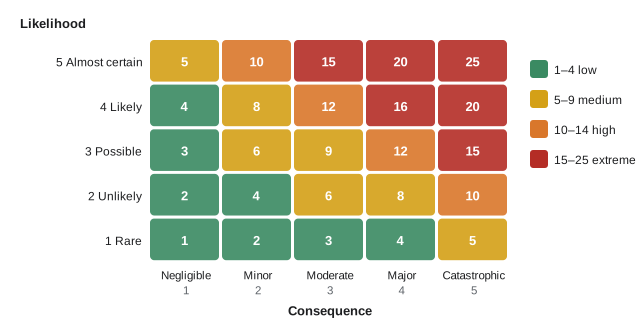
Typical actions: extreme risks must be reduced before work proceeds; high risks need prompt action and senior approval; medium risks need specific controls and monitoring; low risks are managed through routine procedures.
Worked problem
Scoring a fall hazard
Maintenance staff climb onto a 3 m high equipment platform every month. It has no guardrails, and the surface can be icy. Score the risk, then score it again after permanent guardrails and a non-slip surface are installed.
Show solution
- Before: a fall is possible (likelihood 3) and could cause serious injury (consequence 4). Risk \(= 3 \times 4 = 12\): high.
- Guardrails and a non-slip surface make a fall rare (likelihood 1). The consequence if it happened is unchanged (4). Risk \(= 1 \times 4 = 4\): low.
Answer: From 12 (high) to 4 (low). Notice that the controls reduced the likelihood, not the consequence; reducing consequence would mean lowering the platform or eliminating the need to climb
Risk matrices are simple and quick but coarse: they depend on judgment, and two people can score the same hazard differently. For major hazards, engineers use quantitative risk assessment, estimating actual frequencies (events per year) and consequences (for example, expected fatalities or costs) from data and models.
Worked problem
Is the safeguard worth it?
A failure that would cause $20 million in damage and lost production is estimated to occur with a probability of 1 in 1000 per year. A safeguard would reduce that to 1 in 10 000 per year and costs $12 000 per year to maintain. Is it justified on cost alone?
Show solution
- Expected annual loss without the safeguard: \(10^{-3} \times 20\,000\,000 = \$20\,000\).
- With the safeguard: \(10^{-4} \times 20\,000\,000 = \$2000\).
- Reduction: \$18 000 per year, against a cost of \$12 000 per year.
Answer: Yes, it saves more than it costs. But cost is not the only test: where people could be hurt, regulators and codes expect risks to be reduced "as low as reasonably practicable" (ALARP), which can justify safeguards that do not pay for themselves
The hierarchy of controls
Once a risk is identified, the question is how to control it. Not all controls are equally effective. The hierarchy of controls ranks them:
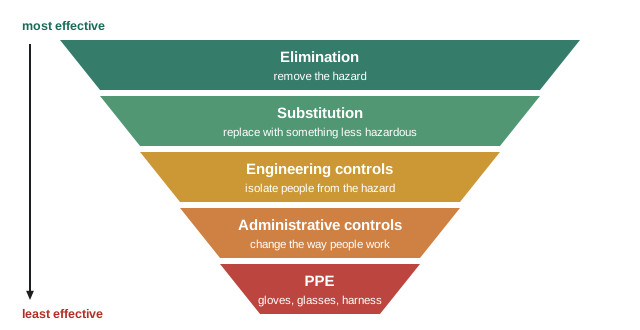
- Elimination: remove the hazard entirely (design out the need to work at height; locate equipment at ground level).
- Substitution: replace it with something less hazardous (a water-based solvent instead of a flammable one).
- Engineering controls: physically separate people from the hazard (guards, interlocks, ventilation, enclosures, relief valves, guardrails).
- Administrative controls: change how people work (procedures, training, permits, signs, job rotation).
- Personal protective equipment (PPE): hard hats, gloves, safety glasses, hearing protection, harnesses.
Engineers have most influence at the top of the hierarchy, especially during design, when changes are cheap. This idea is called prevention through design. PPE is the last line of defense, not the first, because it only works if it is worn correctly every time and it does nothing to the hazard itself.
Worked problem
Controlling noise
An air compressor produces 95 dBA at the operator's position, well above the 85 dBA level at which hearing protection is generally required. Suggest a control at each level of the hierarchy.
Show solution
- Elimination: relocate the compressor to a separate room so operators no longer work beside it.
- Substitution: replace it with a quieter compressor model.
- Engineering: fit an acoustic enclosure and vibration isolators.
- Administrative: limit time spent near it and post a hearing-protection zone.
- PPE: earplugs or earmuffs for anyone entering the area.
Answer: Choose from the top: relocating or enclosing the compressor protects everyone automatically. Earplugs alone rely on every person wearing them properly
Occupational health and safety law
In the United States, workplace safety is governed by the Occupational Safety and Health Act of 1970, enforced by OSHA (the Occupational Safety and Health Administration). About half the states run their own OSHA-approved state plans, which must be at least as effective as the federal program; California's Cal/OSHA is the largest. Mines are covered separately by the Mine Safety and Health Administration.
Workers have core rights under the OSH Act:
- The right to know about hazards, including chemical hazards through the Hazard Communication standard and safety data sheets, and to receive training in a language they understand.
- The right to report hazards and file a confidential complaint with OSHA, and to be protected from retaliation for doing so (Section 11(c)).
- A limited right to refuse work that presents an imminent danger of death or serious injury, when they have asked the employer to fix it, a reasonable person would agree the danger is real, and there is no time to get an OSHA inspection.
Employers have the main duty: the General Duty Clause requires them to keep the workplace free of recognized hazards likely to cause death or serious physical harm, and specific OSHA standards set rules for hazards such as falls, trenching, confined spaces, machine guarding and lockout. Employers must identify and control hazards, train and supervise workers, provide protective equipment and record serious injuries. Workers must follow safety rules and use required equipment. Engineers who design equipment, structures or processes must make sure their designs can be built, operated and maintained safely, since OSHA standards apply to the people who will do that work.
Remember also Lesson 3: willful violations of OSHA standards that cause a worker's death can be prosecuted as crimes, and executives and engineers who direct work share responsibility for safety.
Designing for safety
Codes, standards and factors of safety
Much safety knowledge is captured in codes and standards: the International Building Code (adopted, often with amendments, by states and cities), ASCE 7 for structural loads, the National Electrical Code (NFPA 70), the ASME Boiler and Pressure Vessel Code, pipeline safety rules from PHMSA, and many others. Codes encode lessons learned, often from failures, and set minimum requirements. Following them is a legal obligation, but codes cannot anticipate every situation, and meeting the code does not relieve an engineer of judgment.
Lesson 1 introduced factors of safety and limit states design. Their purpose is to cover uncertainty in loads, materials, workmanship and models. The right margin depends on how well the loads and materials are known and how severe a failure would be: lifting equipment and pressure systems use larger margins than, say, a garden shed.
Reliability and redundancy
The reliability of a component is the probability that it works as intended over a stated period. Systems are built from many components, and how they are connected matters.
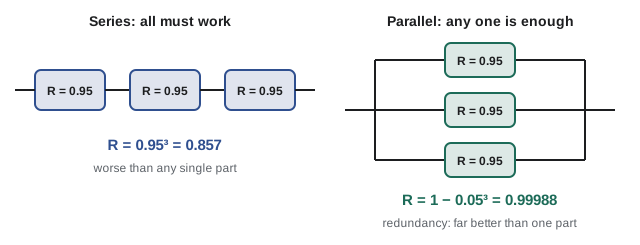
In series, every component must work: the reliabilities multiply. In parallel (redundancy), the system works if any one component works: the system fails only if all fail.
Worked problem
How reliable is a chain of components?
A control loop has 10 components in series, each 99% reliable over a year. What is the system reliability? What if a critical pump is duplicated, two 99% pumps in parallel?
Show solution
- Series: \(0.99^{10} = 0.904\). The system fails nearly one year in ten, though each part fails only one year in a hundred.
- Two pumps in parallel: \(1 - (0.01)(0.01) = 0.9999\).
Answer: 0.904 for the chain; 0.9999 for the duplicated pump. This is why critical systems use redundancy, and why every added series component reduces reliability
Redundancy only helps if failures are independent. Two pumps fed by the same power supply, or two sensors that can be fooled by the same blockage, can fail together. Engineers look for these common-cause failures and use diversity (different types of equipment) where it matters.
Systematic hazard analysis
For complex systems, engineers use structured methods to find hazards that intuition misses:
- Failure modes and effects analysis (FMEA) lists every way each component can fail, the effect on the system, and how it would be detected. Each failure mode is rated for severity (S), occurrence (O) and detection (D), often on 1 to 10 scales, and their product, the risk priority number RPN \(= S \times O \times D\), ranks where to act.
- Hazard and operability study (HAZOP) is used in process plants. A team goes through the piping and instrumentation diagrams line by line, applying guide words such as "no flow", "more pressure" or "reverse flow" to find deviations, their causes and consequences.
- Fault tree analysis works backward from an undesired event to the combinations of failures that could cause it.
Worked problem
An FMEA entry
A relief valve on a pressure vessel could stick closed. Severity is rated 9 (vessel rupture), occurrence 3, and detection 4 (only found at annual testing). Find the RPN. After adding a second, independent relief valve and testing every six months, occurrence of an unprotected overpressure is rated 1 and detection 2. Find the new RPN.
Show solution
- Before: \(\text{RPN} = 9 \times 3 \times 4 = 108\).
- After: \(\text{RPN} = 9 \times 1 \times 2 = 18\).
Answer: From 108 to 18. Severity stays at 9 because the consequence of a rupture has not changed; the controls make it far less likely and more quickly detected
Accidents are rarely one failure
Investigations nearly always find that a major accident needed several things to go wrong at once: a design weakness, a maintenance lapse, an alarm that was ignored, a procedure that was not followed, schedule pressure. James Reason's "Swiss cheese" model pictures each safeguard as a slice with holes; an accident happens when the holes line up. Good safety engineering adds independent layers of protection and keeps the holes small and few, and good safety culture means reporting near misses so the holes are found before they line up. Management of change, the formal review of every modification to equipment, procedures or organization, prevents new holes from being introduced, as the Hyatt Regency walkway change did.
Common mistakes
MistakeUsing "hazard" and "risk" interchangeably.
InsteadA hazard is a source of harm; risk combines its likelihood and consequence.
MistakeReaching for PPE or training as the first solution.
InsteadStart at the top of the hierarchy: eliminate, substitute or engineer the hazard out first.
MistakeAssuming that meeting the code means a design is safe.
InsteadCodes set minimums. Judgment is still needed for situations they do not cover.
MistakeAssuming redundancy always multiplies reliability.
InsteadOnly for independent failures. Watch for common causes such as shared power or the same blockage.
MistakeTreating a risk matrix score as precise.
InsteadMatrices are coarse and subjective; use them to prioritize, and quantify major hazards.
Summary and key terms
- A hazard is a source of harm; risk combines likelihood and consequence.
- Risk matrices rank risks quickly; quantitative methods and ALARP guide decisions on major hazards.
- The hierarchy of controls: elimination, substitution, engineering controls, administrative controls, PPE. Engineers act best at the top, during design.
- The OSH Act and OSHA standards give workers the right to know about hazards, to report them without retaliation and, in limited cases, to refuse imminently dangerous work; the General Duty Clause puts the main duty on employers, and designers have duties too.
- Codes and factors of safety cover uncertainty but do not replace judgment.
- Series reliabilities multiply; parallel redundancy greatly increases reliability if failures are independent.
- FMEA (RPN = S × O × D), HAZOP and fault trees find hazards systematically. Accidents usually need several safeguards to fail at once.
- Hazard
- Anything with the potential to cause harm.
- Risk
- The combination of the likelihood and consequence of harm.
- Risk matrix
- A grid scoring likelihood against consequence to rank risks.
- ALARP
- As low as reasonably practicable: the target for reducing risk to people.
- Hierarchy of controls
- Elimination, substitution, engineering, administrative, PPE, from most to least effective.
- Prevention through design
- Eliminating or reducing hazards at the design stage.
- Reliability
- The probability that a component or system performs as intended for a stated period.
- Redundancy
- Duplicate components so the system still works if one fails.
- FMEA
- Failure modes and effects analysis, ranking failures by risk priority number.
- HAZOP
- A structured team review of process deviations using guide words.
Practice problems
Work each problem on paper first, then reveal the answer to check.
Give an example of a high hazard but low risk, and a low hazard but high risk.
Show answer
High hazard, low risk: a high-voltage substation behind a locked fence that only qualified staff enter. Low hazard, high risk: a slippery office stairway used by hundreds of people daily.
A task is rated likely (4) with moderate consequence (3). Find the risk score and band on the 5 × 5 matrix.
Show answer
12: high.
Rank these controls for a chemical splash hazard: face shield, closed transfer system, written procedure, using a less corrosive chemical.
Show answer
Less corrosive chemical (substitution), closed transfer system (engineering), written procedure (administrative), face shield (PPE).
Name three rights of workers under the OSH Act.
Show answer
The right to know about hazards and be trained, the right to report hazards to OSHA without retaliation, and a limited right to refuse imminently dangerous work.
Four components, each 0.98 reliable, are connected in series. What is the system reliability?
Show answer
0.98⁴ = 0.922.
Two independent detectors, each 0.90 reliable, are installed in parallel. What is the reliability of detection?
Show answer
1 − (0.10)(0.10) = 0.99.
Why might two "redundant" pumps both fail at once?
Show answer
A common cause, such as a shared power supply, a common suction line that blocks, the same maintenance error on both, or a fire in the shared room.
An FMEA entry has S = 7, O = 5, D = 6. Find the RPN. Which factor could an inspection program reduce?
Show answer
RPN = 210. Inspection improves detection, lowering D.
A safeguard costs $5000 per year and reduces the annual probability of a $2 million loss from 1/200 to 1/2000. Is it cost-justified?
Show answer
Expected loss falls from $10 000 to $1000, a saving of $9000 per year, more than its $5000 cost. Yes.
What is management of change, and which case in Lesson 3 shows why it matters?
Show answer
Formal review and approval of any change to design, equipment or procedures before it is made. The Hyatt Regency walkway connection change.
Lesson quiz · 5 questions
Score 60% or more to complete this lesson.
Create a free account to save your progress, take quizzes and earn a certificate.