
ENGG-100 · Lesson 3 of 5 · 38 min
The code of ethics
Technical skill alone does not make a good engineer. Engineers regularly face situations where doing the right thing costs money, time or goodwill: a schedule that does not allow proper checking, a client who wants a report softened, a supplier offering favors, a manager who says the risk is acceptable when you are not convinced. Most engineering disasters have an ethical failure somewhere in the chain of events, often one that an individual could have stopped.
This chapter covers the codes of ethics that guide American engineers, from the NSPE Code to the rules of professional conduct that state boards enforce, the ideas behind them, and the common ethical problems of practice: competence, conflicts of interest, confidentiality, honesty and when to blow the whistle. It then studies American cases that shaped the profession, and gives a practical method for working through an ethical problem.
Why engineers need a code
Ethics is the study of right and wrong conduct. Professional ethics applies it to the special situation of a profession: engineers hold knowledge the public cannot check, make decisions that affect people who have no say in them, and work for employers and clients whose interests may not match the public's. A code of ethics sets out the duties that follow from that position, and for licensed engineers it is not optional: state boards adopt rules of professional conduct, and breaching them is misconduct, subject to discipline.
Three broad ways of thinking about ethics help when a code does not give a clear answer:
- Duty-based (deontological) ethics asks which obligations apply: honesty, keeping promises, respecting people's rights. Some actions are wrong regardless of the outcome, such as falsifying test results.
- Consequence-based (utilitarian) ethics asks which choice produces the best overall outcome for everyone affected. It underlies cost–benefit and risk analysis, but can overlook the rights of minorities.
- Virtue ethics asks what a person of good character, such as a respected senior engineer, would do. It is useful when rules conflict.
Engineering codes blend all three: they list duties, rank the public good first, and describe the character expected of professionals.
The NSPE Code of Ethics and state rules
The National Society of Professional Engineers (NSPE) Code of Ethics is the best-known American code. Its six Fundamental Canons say that engineers, in fulfilling their professional duties, shall:
- 1. Hold paramount the safety, health, and welfare of the public.
- 2. Perform services only in areas of their competence.
- 3. Issue public statements only in an objective and truthful manner.
- 4. Act for each employer or client as faithful agents or trustees.
- 5. Avoid deceptive acts.
- 6. Conduct themselves honorably, responsibly, ethically, and lawfully so as to enhance the honor, reputation, and usefulness of the profession.
The NSPE Code binds NSPE members, and the discipline societies (ASCE, ASME, IEEE, AIChE and others) have similar codes for their members. What gives ethics the force of law for licensees is each state board's rules of professional conduct, many based on the NCEES Model Rules. They likewise put the public first, limit practice to areas of competence, require honesty and disclosure of conflicts, and prohibit sealing work not done under responsible charge.
The order matters: when duties conflict, the public comes before the employer, the client or the engineer's own interest. NSPE's Board of Ethical Review publishes opinions on real cases that show how the canons apply in practice.
Common ethical issues
Competence
Canon 2 means knowing the limits of your expertise. An engineer qualified in structural design is not automatically competent to design an electrical system, and a recent graduate is not ready to take sole responsibility for a complex pressure vessel. Competence can be built through study, mentoring and supervised work, but you must not take on work beyond it in the meantime.
Worked problem
Outside your field
Maya is a civil engineer at a small firm. A long-time client asks the firm to add a 600 V electrical service to a building it is renovating, and her manager asks her to "just handle it" because the firm has no electrical engineer. What should she do?
Show solution
- Canon 2: she is not competent in electrical design by training or experience.
- Canon 1: an incorrect electrical design creates fire and shock hazards for the public.
- Options: decline that part of the work; recommend the client hire an electrical consultant; or the firm subcontracts a qualified electrical engineer who seals that work.
Answer: She should not do the electrical design herself. Explaining the risk and proposing a qualified subconsultant protects the public, the client and the firm
Conflicts of interest
A conflict of interest exists when a personal interest could influence, or could appear to influence, professional judgment. Not every conflict is wrong, but every conflict must be disclosed, and some must be avoided entirely.
Worked problem
Evaluating bids
Tom is evaluating five bids for a municipal contract. He realizes one bidder is owned by his brother-in-law. Tom is sure he can be fair. What should he do?
Show solution
- Even if he is fair, others cannot know that; the appearance of bias damages trust, and hiding it would be deceptive (canons 4 and 5).
- He should immediately tell his supervisor in writing and step away from evaluating that contract.
Answer: Disclose and recuse himself. Hiding the conflict would be unprofessional conduct even if the right bidder won
Gifts and hospitality raise the same question. A coffee from a supplier is usually harmless; playoff tickets from a vendor whose product you are about to specify are not. Follow your employer's policy, and when in doubt, disclose or decline.
Honesty and objectivity
Engineers must report facts truthfully, state the limits of their data and assumptions, and never let a client's preferences change their technical conclusions. That includes not overstating your qualifications, not taking credit for others' work, and giving opinions only within your competence. With AI tools now common in design and writing, the same rule applies: you remain responsible for checking anything a tool produces, and confidential client information must not be pasted into public tools.
Confidentiality
Clients and employers are entitled to confidentiality about their business. But confidentiality is not absolute: it does not extend to hiding a danger to the public. If you learn of a hazard, the public interest comes first.
Raising concerns and whistleblowing
When an engineer believes work is unsafe or illegal, the usual path is to raise it internally first: with the responsible engineer, then supervisors, then senior management, putting concerns in writing. If that fails and the danger is real, the engineer has a duty to go further, to the regulator, the owner or the authority responsible. The NSPE Code says that if engineers' judgment is overruled where the safety, health, property or welfare of the public are endangered, they shall notify their employer or client and such other authority as may be appropriate. Going outside your organization is a serious step and should be based on facts, not suspicion, but staying silent about a real danger is itself a breach of the code.
Worked problem
Pressure to sign
Leila inspects a pressure vessel and finds wall thinning from corrosion below the minimum required thickness. Her manager asks her to sign the inspection report as acceptable, because a shutdown now would delay a major production deadline. He promises the vessel will be repaired at the next turnaround in eight months. What should she do?
Show solution
- Recognize: signing would be a deceptive act (canon 5) and could endanger workers and the public (canon 1).
- Facts: confirm the measurements and the calculated remaining strength; check whether the code allows a reduced operating pressure.
- Options: refuse to sign; propose a fitness-for-service assessment, a lower operating pressure, or an earlier repair; escalate in writing.
- If the company insists on operating an unsafe vessel, report to the state's boiler and pressure vessel authority (the chief inspector) and, if workers are at risk, OSHA.
Answer: She must not sign an inaccurate report. She should document her findings, offer safe alternatives and escalate. Her duty to the public overrides the schedule
Lessons from history
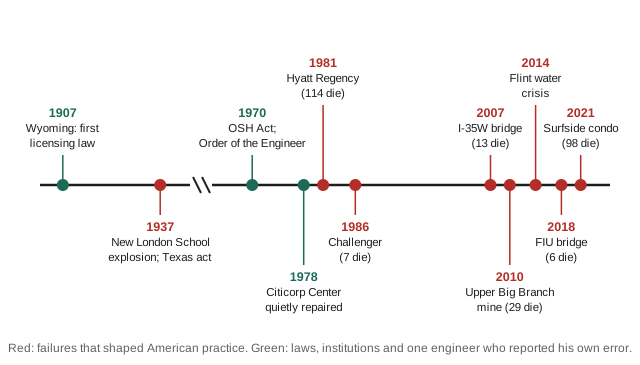
The codes of ethics were written in the aftermath of disasters. Studying them shows how ordinary decisions, made under ordinary pressures, add up to catastrophe.
Worked problem
Citicorp Center, 1978
In 1978 the structural engineer of New York's 59-story Citicorp Center, William LeMessurier, learned that the welded joints in the tower's unusual wind-bracing had been changed to bolted joints during construction, and his own review then showed that winds striking the building diagonally (quartering winds) raised the forces in some braces far above the original calculations. A storm severe enough to topple it was estimated to occur about once in 16 years. What did he do, and why is it a model?
Show solution
- He confirmed the problem with independent analysis and wind-tunnel data rather than dismissing it.
- He told the building's owner and the city, although it put his reputation and insurance at risk.
- Steel plates were welded over the bolted joints at night during hurricane season, with an evacuation plan ready, until the repairs were complete.
Answer: He reported his own error and fixed it before anyone was hurt. Honesty about mistakes, even at personal cost, is what the first canon demands
Worked problem
The Hyatt Regency walkways, 1981
In Kansas City, two suspended walkways in a hotel atrium collapsed during a dance, killing 114 people. The original design hung both walkways from continuous rods. During fabrication the detail was changed so the upper walkway hung from the roof and the lower walkway hung from the upper one. What went wrong?
Show solution
- The change doubled the load on the connections at the upper walkway: they now carried both walkways.
- The change was proposed by the steel fabricator and approved without the engineer of record re-analyzing it.
- Even the original connection design was weaker than the building code required.
Answer: The engineers of record lost their Missouri licenses. Responsibility for a design includes every change made to it, and a seal must never be applied without real review
Worked problem
The Challenger launch, 1986
The night before the Space Shuttle Challenger launch, engineers at the contractor that built the solid rocket boosters recommended against launching in near-freezing temperatures, because rubber O-ring seals in the booster joints lost resilience in the cold. Under pressure from NASA, managers reversed the recommendation; one engineer-manager was famously told to "take off his engineering hat and put on his management hat". The shuttle broke apart 73 seconds after launch, killing all seven crew. What is the lesson?
Show solution
- The engineers had the right technical concern, but the burden of proof was reversed: they were asked to prove it was unsafe rather than managers proving it was safe.
- Schedule pressure and organizational culture overrode technical judgment.
Answer: When safety is in doubt, the default must be not to proceed. Engineers in management roles keep their professional obligations
Upper Big Branch and the law
On April 5, 2010, an explosion at the Upper Big Branch coal mine in West Virginia killed 29 miners. Investigations found that the company had repeatedly violated ventilation and dust-control rules and had concealed hazards from inspectors. In 2015 the company's former chief executive was convicted of conspiring to willfully violate federal mine safety standards and sentenced to a year in prison. Mine safety is governed by the federal Mine Safety and Health Administration; most other workplaces fall under the Occupational Safety and Health Act of 1970, whose General Duty Clause requires every employer to keep the workplace free of recognized hazards likely to cause death or serious physical harm. Engineers who direct work share responsibility for meeting that duty.
More recent cases
On August 1, 2007, the I-35W bridge over the Mississippi River in Minneapolis collapsed at rush hour, killing 13 people; the National Transportation Safety Board found that gusset plates in the original 1960s design were too thin, a weakness made critical by added weight from earlier modifications and construction materials stored on the deck. In 2014, Flint, Michigan switched its water source without requiring corrosion control, and lead leached from old pipes into drinking water; officials' failures to act on warnings led to criminal charges and a national reckoning with lead service lines. On March 15, 2018, a newly installed pedestrian bridge at Florida International University collapsed onto traffic, killing six; the NTSB found design errors in a critical connection and that cracks seen in the days before were not recognized as a sign of imminent failure. On June 24, 2021, the Champlain Towers South condominium in Surfside, Florida partially collapsed, killing 98 people; an engineer's 2018 report had described major structural damage in the pool deck and garage. Florida then required milestone structural inspections of older condominium buildings. Each case led to changes in regulation and practice.
Common mistakes
MistakeTreating loyalty to your employer as your highest duty.
InsteadThe public interest is paramount. Loyalty to employers and clients operates within that limit.
MistakeAssuming a conflict of interest is acceptable if you are confident you can be fair.
InsteadDisclose every conflict; appearance matters, and some conflicts require stepping aside.
MistakeBelieving confidentiality requires silence about a danger to the public.
InsteadConfidentiality never extends to concealing a hazard. Escalate, and report if necessary.
MistakeGoing straight to the media with a concern.
InsteadRaise concerns internally and in writing first, then escalate to the owner, authority or regulator if the danger remains.
MistakeThinking engineers in management can set aside engineering judgment.
InsteadProfessional obligations apply in every role.
Summary and key terms
- A code of ethics sets out the duties that follow from engineers' specialized knowledge and impact on the public. For licensees, state rules of professional conduct make these duties enforceable.
- The NSPE's six canons: public safety, health and welfare first; competence; objective and truthful statements; faithful agency; no deception; honorable and lawful conduct.
- Common issues: working within competence, disclosing conflicts, honesty, confidentiality and its limits, and escalating safety concerns.
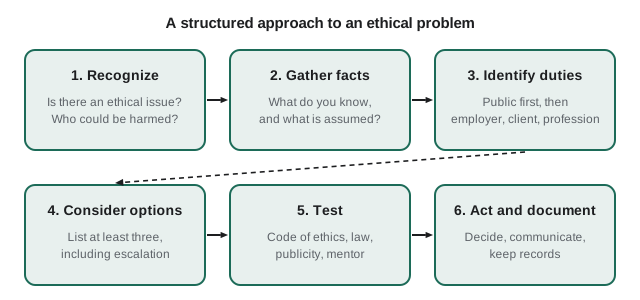
- A structured method helps: recognize, gather facts, identify duties, consider options, test them, then act and document.
- Hyatt Regency, Challenger, I-35W, FIU and Surfside show how design changes, ignored warnings and pressure lead to tragedy; Citicorp Center shows the value of reporting your own error.
- The OSH Act's General Duty Clause requires employers to protect workers from recognized serious hazards; willful violations can bring criminal penalties.
- Professional ethics
- Standards of conduct arising from a profession's duties to the public.
- Paramount
- Above all other considerations; the status of public safety in engineering codes.
- Competence
- Having the training and experience to do a task properly.
- Conflict of interest
- A personal interest that could influence, or appear to influence, professional judgment.
- Whistleblowing
- Reporting wrongdoing or danger to an authority when internal channels fail.
- General Duty Clause
- Section 5(a)(1) of the OSH Act: employers must keep workplaces free of recognized hazards likely to cause death or serious harm.
- Responsible charge
- Direct control and personal supervision of engineering work, required before a PE may seal it.
Practice problems
Work each problem on paper first, then reveal the answer to check.
Which NSPE canon is paramount, and what does that mean in practice?
Show answer
Canon 1: the safety, health and welfare of the public. When duties conflict, protecting the public comes before employer, client or personal interests.
A supplier offers you a free week at their lodge just as you are writing a specification that could favor their product. What should you do?
Show answer
Decline, and disclose the offer to your employer. Accepting creates a clear conflict of interest.
You find an error in calculations you sealed last year for a building now in use. What should you do?
Show answer
Assess its significance immediately, notify your employer and the client, and take steps to correct it. If public safety is at risk, act urgently and inform the authorities.
Explain the difference between a utilitarian and a duty-based view of falsifying a minor test result to save a project.
Show answer
A utilitarian might weigh consequences (perhaps no harm results); a duty-based view says falsifying data is wrong in itself. Engineering codes prohibit it absolutely.
What was the main technical change that caused the Hyatt Regency collapse?
Show answer
Changing from continuous rods to two offset rods, which doubled the load on the upper walkway connections.
What did William LeMessurier do when he found the Citicorp Center weakness, and why is it held up as an example?
Show answer
He verified the problem, told the owner and the city, and had the joints reinforced before a severe storm could strike, reporting his own error at personal risk.
Your client asks you to remove a paragraph from your report describing a possible slope stability risk to neighboring homes. How do you respond?
Show answer
Refuse to remove a material safety finding; you may clarify wording but not change the conclusion. If the client tries to suppress it, escalate.
Is it acceptable to use an AI tool to draft a design calculation?
Show answer
It can be a tool, but you remain fully responsible: verify every step independently, follow your employer's rules, and do not enter confidential data into public tools.
What warning signs preceded the FIU bridge collapse, and what should they have triggered?
Show answer
Cracks in a critical node in the days before; they should have led to closing the road beneath and shoring the span until the engineer of record proved it safe.
In the Challenger case, how was the burden of proof reversed?
Show answer
Engineers were asked to prove the launch was unsafe, rather than managers demonstrating it was safe, so uncertainty led to launching instead of waiting.
Lesson quiz · 5 questions
Score 60% or more to complete this lesson.
Create a free account to save your progress, take quizzes and earn a certificate.