
ENGG-130 · Lesson 9 of 12 · 31 min
Cables
Cables are among the most efficient structural elements ever devised. Because a cable can carry only tension, every bit of its material works at the same stress along its length, with no material wasted resisting bending. That is why the longest bridge spans in the world are suspension bridges, why power and telecommunication lines are strung on cables between towers, and why cables appear in guyed towers, cable-stayed roofs, ski lifts, cranes, elevators, mooring lines and zip lines. The price of that efficiency is that a cable changes its shape to suit its load: it sags into whatever shape lets it carry the load in pure tension. This lesson shows how to analyze cables carrying concentrated loads, cables carrying loads uniformly distributed along the horizontal (which hang as parabolas), and cables hanging under their own weight (catenaries), and how sag, tension and length are linked, with consequences for power lines on hot days and for the design of arches.
Assumptions
In statics, a cable is treated as perfectly flexible, so it can transmit only a tension force along its own length; it cannot carry bending or compression. It is also usually treated as inextensible: its stretch under load is small enough to ignore when finding its shape, although the power-line example later in this lesson shows that small changes in length can still matter a great deal for sag. Because the cable is a flexible, pin-ended member, the tension force at every point is tangent to the cable.
Cables with concentrated loads
When a light cable carries point loads, it forms straight segments between the loads, with a kink at each one. Each segment is a two-force member (Lesson 4) in tension. The supports provide both horizontal and vertical reactions, and if no horizontal loads act, the horizontal component of tension H is the same in every segment, since each joint is in horizontal equilibrium.
The problem has one more unknown than equilibrium can supply, because the shape is not yet known. Some piece of geometry must be given, usually the sag at one point. Then the method is: find the vertical reactions by taking moments for the whole cable (exactly as for a simply supported beam carrying the same loads); cut the cable at the point of known sag and take moments for one side to find H; then use moments at the other load points to find their sags.
Worked problem
A cable with two loads
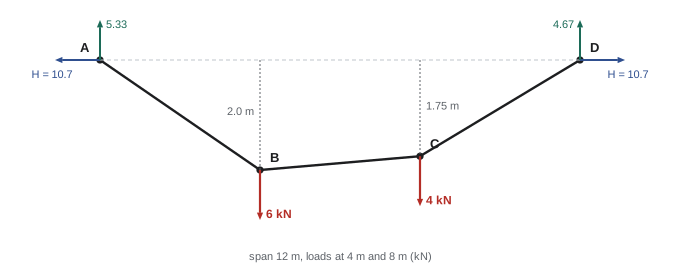
A cable spans 12 m between level supports A and D. It carries 6 kN at B, 4 m from A, and 4 kN at C, 8 m from A. The sag at B is 2.0 m. Find the sag at C, the horizontal tension and the maximum tension.
Show solution
- Vertical reactions, from moments about D for the whole cable: \(12A_y = 6(8) + 4(4)\), so \(A_y = 5.33\) kN; then \(D_y = 10 - 5.33 = 4.67\) kN.
- Cut just right of B and take moments about B for the left part. The cable force there passes through B, so: \(A_y(4) - H(2.0) = 0\), giving \(H = 10.67\) kN.
- Cut just left of C and take moments about C for the right part: \(D_y(4) - H\,y_C = 0\), so \(y_C = 18.67/10.67 = 1.75\) m.
- Maximum tension is in segment AB, where the vertical component is largest: \(T = \sqrt{10.67^2 + 5.33^2} = 11.9\) kN.
Answer: The sag at C is 1.75 m, the horizontal tension is 10.7 kN throughout, and the maximum tension is 11.9 kN in segment AB. Notice that the sags (2.0 and 1.75 m) are proportional to the bending moments a simply supported beam would have under the same loads (21.3 and 18.7 kN·m): the cable's shape is the moment diagram divided by H.
That last observation is general and important. The shape a cable takes under a set of loads, called the funicular shape, is the bending moment diagram of a simply supported beam with the same loads, scaled by 1/H. A deeper sag means a smaller H; a tight cable with little sag needs an enormous horizontal tension, the same lesson as the taut line in Lesson 2.
Funicular shapes and arches
Turn a hanging cable upside down and its tension becomes compression: an arch built to the inverted funicular shape of its loads carries them in pure compression, with no bending. The English scientist Robert Hooke stated this in 1675 ("as hangs the flexible line, so but inverted will stand the rigid arch"). Masonry, which is strong in compression but weak in tension, depends on it: Roman aqueducts, Gothic cathedrals and stone bridges stand because their arches follow, closely enough, the inverted funicular of their loads. The Catalan architect Antoni Gaudí designed the Sagrada Família using hanging models of strings and weights, photographed and turned upside down. Modern concrete shells and arch bridges are shaped the same way. If the load pattern changes, for example a heavy truck on one half of an arch bridge, the funicular shape changes too, and the arch must resist the difference in bending.
Cables with a load uniform along the horizontal: the parabola
The main cables of a suspension bridge carry the deck, which is hung from them by closely spaced vertical hangers. The deck weighs much more than the cable, and its weight is uniform along the horizontal span. A cable carrying a load w per unit horizontal length takes the shape of a parabola. Taking the origin at the lowest point, with horizontal tension \(T_0\) there:
For level supports a span L apart with sag h at midspan, setting y = h at x = L/2 gives the horizontal tension, which is the same everywhere. The tension is largest at the supports, where the cable is steepest and its vertical component equals half the total load:
The first result is the beam formula wL²/8 divided by the sag, exactly as the funicular idea predicts. The length of a shallow parabolic cable is close to \(S \approx L\left[1 + \tfrac{8}{3}(h/L)^2\right]\).
Worked problem
A suspension bridge cable
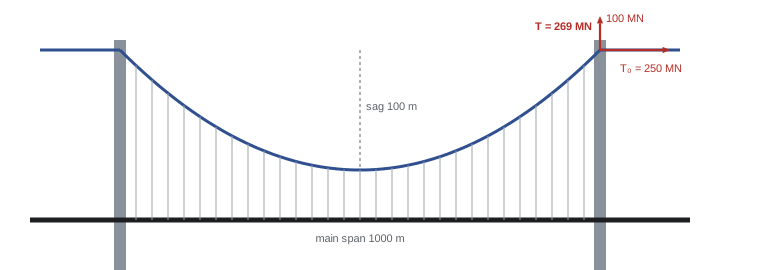
A suspension bridge has a main span of 1,000 m and a cable sag of 100 m (a sag ratio of 1:10, typical of large suspension bridges). Each of its two cables carries 200 kN/m of deck, hanger and cable weight plus traffic. Find the horizontal and maximum cable tensions and the cable length in the main span.
Show solution
- \(T_0 = 200 \times 1000^2/(8 \times 100) = 250\,000\) kN.
- Vertical component at each tower: \(200 \times 1000/2 = 100\,000\) kN.
- \(T_{\max} = \sqrt{250\,000^2 + 100\,000^2} = 269\,000\) kN, at the towers.
- Length: \(S \approx 1000[1 + \tfrac{8}{3}(0.1)^2] = 1026.7\) m.
Answer: About 250 MN horizontal tension and 269 MN at the towers, per cable: forces so large that each main cable is made of tens of thousands of parallel high-strength steel wires, spun in place, and anchored into massive concrete anchorages that resist the horizontal pull. Halving the sag would double T₀, which is why bridge designers accept tall towers: they buy a deeper sag and lower cable forces.
Cables under their own weight: the catenary
A cable carrying only its own weight, such as a power line between towers or a chain hanging between two posts, has a load that is uniform along its curved length rather than along the horizontal. Its shape is a catenary (from the Latin for chain):
where w is the weight per unit length of cable, and the tension at any height y above the lowest point is T₀ + wy, so it is greatest at the higher support. Given the span and sag, T₀ must be found by trial or numerically, because it appears inside the hyperbolic cosine. For shallow cables, with sag less than about one-tenth of the span, the catenary and parabola are almost identical, and the simpler parabolic formulas are used. For deep sags, such as a long chain between closely spaced posts or a mooring line, the difference matters.
import math

w, L, h = 16.0, 300.0, 6.0          # conductor weight N/m, span m, sag m (supports level)

# Parabolic approximation (load uniform along the horizontal)
T0_par = w * L ** 2 / (8 * h)
Tmax_par = math.hypot(T0_par, w * L / 2)

# Exact catenary: find T0 so that (T0/w)(cosh(wL/(2 T0)) - 1) equals the sag
def sag(T0):
    return T0 / w * (math.cosh(w * L / (2 * T0)) - 1)
lo, hi = 100.0, 1e7
for _ in range(100):                # sag falls as T0 rises
    mid = (lo + hi) / 2
    if sag(mid) > h:
        lo = mid
    else:
        hi = mid
T0 = (lo + hi) / 2
Tmax = T0 + w * h                   # catenary: T = T0 + w y at height y
S = 2 * T0 / w * math.sinh(w * L / (2 * T0))
print(f"Parabola: T0 = {T0_par / 1000:.3f} kN, Tmax = {Tmax_par / 1000:.3f} kN")
print(f"Catenary: T0 = {T0 / 1000:.3f} kN, Tmax = {Tmax / 1000:.3f} kN, length {S:.3f} m")

# Hot day: conductor lengthens by alpha * S * dT (elastic stretch relief ignored)
alpha, dT = 19e-6, 50.0
S_hot = S + alpha * S * dT
h_hot = math.sqrt(3 * L * (S_hot - L) / 8)   # parabolic length-sag relation
print(f"Extra slack {S - L:.3f} m -> {S_hot - L:.3f} m after a {dT:.0f} C rise")
print(f"Sag grows from {h:.2f} m to {h_hot:.2f} m; tension falls to {w * L ** 2 / (8 * h_hot) / 1000:.1f} kN")Parabola: T0 = 30.000 kN, Tmax = 30.096 kN Catenary: T0 = 30.016 kN, Tmax = 30.112 kN, length 300.320 m Extra slack 0.320 m -> 0.605 m after a 50 C rise Sag grows from 6.00 m to 8.25 m; tension falls to 21.8 kN
For this conductor, with a sag of only 2 % of the span, the parabola and catenary differ by less than 0.1 %. The second part of the output is more striking. The conductor is only 0.32 m longer than the span. A temperature rise of 50 °C, from a cool morning to a hot afternoon with heavy current flowing (PHYS-131), adds only 0.29 m of length, less than 0.1 %, yet nearly doubles the slack and increases the sag from 6.0 m to 8.3 m. Because sag depends on the square root of the slack, small changes in length produce large changes in sag. (In a real line, the lower tension also lets the conductor contract elastically a little, so the increase is somewhat less; utilities use detailed sag-tension software that includes it.)
This matters for safety. Electrical codes require minimum clearances between conductors and the ground, roads, buildings and trees at the conductor's maximum design temperature and under ice loading, the conditions of greatest sag. Lines that sag into trees on hot days have started wildfires and triggered major blackouts, including the August 2003 blackout that left about 50 million people in Ontario and the northeastern United States without power, which began when overloaded, sagging lines in Ohio contacted trees that had not been trimmed.
Sag, tension and design choices
Every cable design trades sag against tension. A tight cable with little sag has large tensions, needing a stronger cable and heavier anchorages and towers; a slack cable has lower tension but needs taller towers or more clearance. Several further points arise in practice:
- Supports at different heights. The lowest point of the cable shifts toward the lower support, and may lie beyond it, in which case the cable rises all the way from the lower support. The same equations apply, measured from the lowest point.
- Ice and wind. Ice accretion adds weight, and wind adds horizontal load per unit length; codes specify combinations of radial ice thickness and wind pressure for each region, and the resulting tension often governs the design of towers and anchors.
- Vibration. Wind can make cables oscillate, through vortex shedding on slender conductors (fatigue at the clamps, controlled by dampers) or galloping of ice-coated lines. Cable-stayed bridge stays are fitted with dampers for the same reason.
- Guy wires. Guyed masts and towers are held by pretensioned cables whose sag reduces their effective stiffness; designers pretension guys so that they stay taut under the design wind.
Worked problem
A guy cable
A guy cable runs from the top of a 30 m mast to an anchor 20 m from its base. It is pretensioned to 15 kN. Treating it as straight, find the horizontal pull on the mast and the uplift on the anchor.
Show solution
- Cable length: \(\sqrt{30^2 + 20^2} = 36.1\) m.
- Horizontal component: \(15 \times 20/36.1 = 8.32\) kN.
- Vertical component (uplift on the anchor, compression added to the mast): \(15 \times 30/36.1 = 12.5\) kN.
Answer: The mast receives 8.3 kN horizontally and 12.5 kN additional compression from each guy; the anchor must resist 12.5 kN of uplift and 8.3 kN of horizontal pull, with a safety factor. With three or four guys at equal angles, the horizontal pulls balance under no wind, and wind shifts the balance so the windward guys tighten and the leeward ones slacken.
Common mistakes
MistakeTreating a cable as able to carry compression or bending.
InsteadA cable carries only tension along its length.
MistakeTrying to solve a cable with point loads without a geometric condition.
InsteadA sag or cable length must be given to find H.
MistakeAssuming tension is constant along a cable.
InsteadOnly the horizontal component is constant; total tension is largest where the cable is steepest.
MistakeUsing the parabola for deep-sag cables under self-weight.
InsteadUse the catenary when sag exceeds about a tenth of the span.
MistakeIgnoring temperature and ice when checking clearance.
InsteadCheck sag at maximum temperature and under ice loads.
Summary and key terms
- Cables carry only tension, tangent to the cable; they are highly efficient but change shape with load.
- Under point loads, cables form straight segments; one geometric condition is needed to find H.
- A cable's shape is the simple-beam moment diagram divided by H; inverted, it gives a compression-only arch.
- Under load uniform along the horizontal, a cable is a parabola: T₀ = wL²/(8h).
- Under self-weight, a cable is a catenary; for shallow sag it is almost a parabola.
- Maximum tension occurs at the steepest point, usually the higher support.
- Small length changes cause large sag changes; check clearances at high temperature and under ice.
- Cable
- A flexible member that carries only tension along its length.
- Sag
- The vertical distance from the supports' chord to the cable.
- Horizontal tension
- The constant horizontal component of cable tension, H or T₀.
- Funicular shape
- The shape a cable takes under a given set of loads.
- Parabolic cable
- A cable under load uniform along the horizontal.
- Catenary
- The shape of a uniform cable hanging under its own weight.
- Sag ratio
- Sag divided by span.
- Anchorage
- The foundation that resists a cable's pull at its end.
- Guy cable
- A pretensioned cable that stabilizes a mast or tower.
- Galloping
- Large, wind-driven oscillation of iced or irregular cables.
Practice problems
Work each problem on paper first, then reveal the answer to check.
In the two-load example, what is the tension in segment CD?
Show answer
√(10.67² + 4.67²) = 11.6 kN.
A cable spans 10 m with a single 8 kN load at midspan and a sag of 1 m. Find H.
Show answer
A_y = 4 kN; H = 4 × 5/1 = 20 kN.
If the sag in the previous question were 0.25 m, what would H be?
Show answer
80 kN.
A parabolic cable spans 60 m with 4 m sag and carries 2 kN/m. Find T₀ and T_max.
Show answer
T₀ = 2 × 3600/32 = 225 kN; T_max = √(225² + 60²) = 233 kN.
Estimate the length of that cable.
Show answer
60[1 + (8/3)(4/60)²] = 60.71 m.
When is the parabolic approximation adequate for a self-weight cable?
Show answer
When the sag is less than about one-tenth of the span.
For a catenary, how does tension vary with height?
Show answer
T = T₀ + wy; it increases with height above the lowest point.
From the code output, how much does the sag grow for a 50 °C rise?
Show answer
From 6.0 m to about 8.3 m.
What shape should an unreinforced masonry arch follow, and why?
Show answer
The inverted funicular of its loads, so it carries them in pure compression.
A guy at 60° to the ground carries 20 kN. Find its horizontal and vertical components.
Show answer
10 kN horizontal; 17.3 kN vertical.
Lesson quiz · 5 questions
Score 60% or more to complete this lesson.
Create a free account to save your progress, take quizzes and earn a certificate.