
ENGG-401 · Lesson 10 of 12 · 26 min
Inflation, price changes and real versus nominal analysis
Prices change over time. Construction materials, wages, energy and equipment generally become more expensive, while some technologies, such as solar panels, batteries and computing, have become cheaper. Engineering projects with lives of 20 years or more are strongly affected by these changes. Inflation also affects interest rates, the real value of tax deductions and the purchasing power of future revenues. This lesson explains how inflation is measured, the difference between real and nominal (actual) dollars, the relationship between real and nominal interest rates, how to perform consistent analyses in either real or nominal terms, differential price changes for specific items such as energy, the effect of inflation on after-tax analysis, and exchange rates for international projects.
Measuring inflation
Inflation is a general increase in the price level, which reduces the purchasing power of money. It is measured by price indices that track the cost of a representative basket of goods and services over time. The general inflation rate \(f\) between two years is the percentage change in the index; over several years, the average annual rate is the geometric mean:
In Canada, Statistics Canada publishes the Consumer Price Index (CPI) monthly, along with industrial product and raw materials price indices and building construction price indices for major cities. The Bank of Canada targets CPI inflation of 2 %, the midpoint of a 1 % to 3 % control range, under an agreement with the federal government that is renewed every five years.
Engineering cost estimates often use specialized indices rather than general consumer indices: construction cost indices, such as those published by statistical agencies and industry publications like Engineering News-Record; chemical plant cost indices for process industries; and equipment-specific producer price indices. These capture the price changes of the specific items in a project, which may differ markedly from general inflation.
Real and nominal dollars
Cash flows can be expressed in two ways. Nominal (actual, then-current) dollars are the amounts of money actually paid or received at the time, including the effect of inflation. Real (constant, today's) dollars express amounts in terms of the purchasing power of a base year. The two are related by the general inflation rate:
For example, $100,000 received in 10 years, with 2.5 % general inflation, has the purchasing power of about $78,120 today. Contracts, loans, tax rules and most financial data are expressed in nominal dollars; engineering estimates of future costs are often made more naturally in real dollars, for example "the plant will need 500,000 kWh a year at today's prices". Both are valid, but they must not be mixed.
Real and nominal interest rates
Market interest rates are nominal: they compensate lenders for both the real time value of money and expected inflation. The real interest rate \(i_r\) excludes inflation. The exact relationship, the Fisher equation, is:
For small rates, \(i_n \approx i_r + f\). With a real rate of 7 % and inflation of 2.5 %, the nominal rate is \(1.07 \times 1.025 - 1 = 9.675\,\%\). Firms often state their MARR in nominal terms because their financing costs are nominal; public agencies often specify real discount rates for benefit-cost analysis (Lesson 8). Real and nominal MARRs must be converted with the Fisher equation, not by subtraction alone, when precision matters.
Consistent analysis
The golden rule of inflation in engineering economics is consistency: either discount real cash flows at a real interest rate, or discount nominal cash flows at a nominal interest rate. Both approaches give the same present worth when done correctly, because each nominal cash flow is the real amount inflated at \(f\), and the nominal discount factor includes the same inflation.
Worked problem
Real and nominal give the same answer
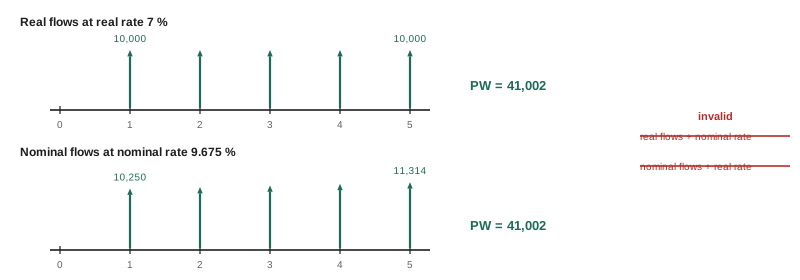
An energy-saving project saves $10,000 a year in today's dollars for 5 years. General inflation is 2.5 % and the real MARR is 7 %. Find the present worth of the savings by both methods.
Show solution
- Real analysis: \(PW = 10{,}000\,(P/A, 7\,\%, 5) = 10{,}000 \times 4.1002 = 41{,}002\).
- Nominal rate: \(i_n = 1.07 \times 1.025 - 1 = 9.675\,\%\).
- Nominal savings in year \(t\): \(10{,}000 \times 1.025^t\), i.e. 10,250; 10,506; 10,769; 11,038; 11,314.
- Nominal analysis: discount each at 9.675 %; the sum is also $41,002.
Answer: Both give a present worth of about $41,002; mixing methods would not.
Common errors are discounting real cash flows at a nominal rate, which undervalues future benefits and biases decisions against long-lived investments, and discounting nominal cash flows at a real rate, which overvalues them. Spreadsheets should label every column and rate as real or nominal.
Differential price changes
Not all prices change at the general inflation rate. Energy, labour, materials and technologies have their own price trajectories, and the difference matters for engineering decisions. If electricity prices are expected to rise 2 % a year faster than general inflation, an efficiency investment's real savings grow at about 2 % a year, which can be modelled as a geometric gradient in real terms (Lesson 3). Conversely, if a technology's cost is falling, delaying a purchase may be worth considering. The real escalation rate \(e_r\) of a specific item relates to its nominal escalation \(e_n\) and general inflation \(f\) by \(1 + e_n = (1 + e_r)(1 + f)\). Energy price forecasts from government agencies and utilities, and long-term construction cost trends, are common sources for differential escalation rates, and because they are uncertain, sensitivity analysis is essential.
| Item | Typical treatment |
|---|---|
| General O&M costs | Escalate at general inflation (constant in real terms) |
| Wages | Often escalate faster than inflation by productivity growth |
| Electricity and fuel | Use agency or utility forecasts; high uncertainty |
| Construction costs | Use construction cost indices |
| Solar panels, batteries, computing | Often decline in real terms |
| Fixed contracts, loan payments, tax depreciation | Fixed in nominal terms; decline in real terms |
Inflation and taxes
Inflation interacts with taxes because tax depreciation is based on historical (nominal) cost and is not indexed to inflation. As inflation rises, the real value of depreciation deductions falls, while revenues and costs rise with prices, so taxable income and taxes rise in real terms. The result is that inflation reduces the after-tax real return on capital investments. After-tax analysis with inflation must therefore use nominal cash flows (or carefully deflated ones), with depreciation fixed in nominal dollars.
Worked problem
Inflation erodes the depreciation tax shield
An investment of $100,000 earns before-tax savings of $30,000 a year in real terms for 5 years and is depreciated straight-line at $20,000 a year for tax purposes. The tax rate is 25 % and the real after-tax MARR is 6 %. Compare the present worth with no inflation and with 3 % general inflation.
Show solution
- No inflation: \(ATCF = 30{,}000 \times 0.75 + 0.25 \times 20{,}000 = 27{,}500\) each year; \(PW = -100{,}000 + 27{,}500\,(P/A, 6\,\%, 5) = 15{,}840\).
- With 3 % inflation: nominal savings \(30{,}000 \times 1.03^t\); depreciation stays $20,000 nominal; nominal MARR \(1.06 \times 1.03 - 1 = 9.18\,\%\).
- Discounting nominal ATCFs at 9.18 % gives \(PW \approx 14{,}136\).
- Inflation reduces present worth by about $1,700, because the fixed nominal tax shield is worth less in real terms.
Answer: PW falls from about $15,840 to about $14,140 with 3 % inflation.
Similar effects apply to fixed-rate loans, which become cheaper in real terms during inflation (benefiting borrowers), and to contracts with fixed prices, which shift risk between parties. Escalation clauses in long-term contracts adjust prices by agreed indices to share inflation risk.
Inflation and project financing
Inflation affects the cost of financing and the cash flows of long-term contracts. Infrastructure projects funded by long-term fixed-rate bonds benefit from inflation in real terms, while revenues from user fees may be indexed to inflation under concession agreements. Engineers working on public-private partnerships and long-term operating contracts should understand how revenues, costs and payments are indexed, because mismatches between indexed revenues and unindexed costs, or the reverse, can transform a project's economics.
Exchange rates
International projects add another source of price change: exchange rates. Equipment bought from abroad, revenues earned in another currency and loans in foreign currencies expose projects to exchange rate risk. Analysts can work in one currency, converting forecast foreign cash flows at expected exchange rates, or analyse in each currency and convert present worths. Purchasing power parity suggests that, over the long run, exchange rates move to offset inflation differences between countries, but in the short and medium term exchange rates are volatile. Hedging with forward contracts, matching currencies of costs and revenues, and sensitivity analysis manage the risk. For projects between Canada and the United States, the Canadian–US dollar exchange rate can change project economics significantly, especially for imported equipment.
Here \(X_t\) is the expected exchange rate in units of home currency per unit of foreign currency in year \(t\).
Inflation in construction contracts and estimates
Long construction projects face inflation between estimate and completion. Estimators escalate costs to the midpoint of construction using forecasts of construction cost indices, and owners include escalation allowances in budgets. Contracts allocate inflation risk: lump-sum fixed-price contracts place it on the contractor, who prices it into the bid; contracts with price adjustment clauses tied to indices for steel, fuel, asphalt or labour share it; and cost-reimbursable contracts leave it with the owner. In periods of rapid inflation, as in 2021 to 2023 when construction material prices rose sharply in both countries, contracts without adjustment mechanisms led to disputes and losses, prompting many public owners to add index-based price adjustment clauses for volatile materials.
Inflation forecasts and sensitivity
Long-term inflation forecasts are uncertain. Central bank targets of about 2 % provide a reasonable base case for general inflation in both countries, but actual inflation has deviated substantially, as the period from 2021 to 2023 showed. Analyses of long-lived projects should test sensitivity to higher and lower inflation, particularly for after-tax analyses, for projects with fixed-price revenue contracts, and for projects financed with fixed-rate debt, where inflation shifts value between parties. Real analysis is often preferred for long-term public projects precisely because it avoids the need to forecast general inflation, focusing instead on relative price changes such as energy prices compared with general prices.
Indexing and real wages
Labour is a major cost in many projects, and wages often rise faster than general inflation as productivity grows. In real analysis, labour costs may therefore be escalated at a real rate of perhaps 0.5 % to 1.5 % a year, increasing the attractiveness of automation and labour-saving investments over time. Collective agreements with scheduled wage increases provide specific nominal escalation for unionized workforces.
Deflating historical cash flows
Post-audits and benchmarking compare past project costs, which were recorded in nominal dollars of different years. To compare them fairly, convert each to constant dollars of a common base year by dividing by the ratio of the price index in its year to the index in the base year. Using a construction-specific index rather than the CPI gives better comparisons for construction costs, because construction prices can diverge from general consumer prices for long periods.
Whichever approach is chosen, the report should state clearly whether figures are in real or nominal dollars, the base year for real dollars, and the inflation and escalation rates assumed for each category of cost and revenue.
Common mistakes
MistakeDiscounting real cash flows at a nominal MARR.
InsteadMatch real flows with real rates and nominal with nominal.
MistakeSubtracting inflation from the nominal rate for precise work.
InsteadUse the Fisher equation.
MistakeEscalating every item at general inflation.
InsteadUse item-specific escalation where it differs.
MistakeInflating tax depreciation.
InsteadKeep depreciation fixed in nominal dollars.
MistakeIgnoring exchange rate risk on imported equipment.
InsteadConvert at expected rates and test sensitivity.
Summary and key terms
- Inflation is measured by price indices; average rates use geometric means.
- Nominal dollars include inflation; real dollars hold purchasing power constant.
- The Fisher equation links real and nominal rates: 1 + i_n = (1 + i_r)(1 + f).
- Discount real flows at real rates or nominal flows at nominal rates.
- Specific items such as energy and technology change at their own rates.
- Inflation erodes the real value of unindexed tax depreciation and fixed contracts.
- Exchange rates add price risk to international projects.
- Inflation
- General increase in prices.
- Price index
- Measure of price changes of a basket over time.
- Nominal dollars
- Amounts actually paid at the time.
- Real dollars
- Amounts in constant purchasing power.
- Real interest rate
- Interest rate excluding inflation.
- Nominal interest rate
- Interest rate including inflation.
- Fisher equation
- Relationship between real and nominal rates.
- Differential escalation
- Price change of an item relative to inflation.
- Escalation clause
- Contract term adjusting prices by an index.
- Purchasing power parity
- Exchange rates offsetting inflation differences over time.
Practice problems
Work each problem on paper first, then reveal the answer to check.
Average inflation if an index rose from 100 to 128 in 10 years?
Show answer
About 2.5 % per year.
Real value today of $50,000 in 8 years at 2 % inflation?
Show answer
About $42,675.
Nominal rate for 5 % real and 3 % inflation?
Show answer
8.15 %.
Real rate for 10 % nominal and 4 % inflation?
Show answer
About 5.77 %.
What is the golden rule of inflation analysis?
Show answer
Use real with real or nominal with nominal.
Why are tax depreciation deductions eroded by inflation?
Show answer
They are fixed in nominal terms.
Real escalation if energy rises 5 % nominal with 2 % inflation?
Show answer
About 2.94 % real.
Who benefits from inflation on a fixed-rate loan?
Show answer
The borrower.
What does an escalation clause do?
Show answer
Adjusts contract prices by an index.
Name a way to manage exchange rate risk.
Show answer
Forward contracts, currency matching, sensitivity analysis.
Lesson quiz · 5 questions
Score 60% or more to complete this lesson.
Create a free account to save your progress, take quizzes and earn a certificate.