
FILM-120 · Lesson 10 of 12 · 26 min
World cinema from the 1980s to the 2000s
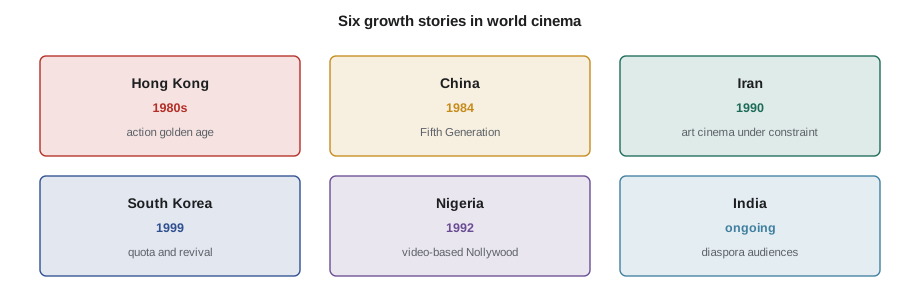
From the 1980s onward, the map of world cinema changed dramatically. Hong Kong action cinema influenced filmmakers everywhere; a Fifth Generation of Chinese directors won festival prizes; Iranian filmmakers created a celebrated art cinema under strict censorship; South Korea built one of the world's most dynamic film industries; and Nigeria's video-based Nollywood became one of the most productive film industries on Earth. Indian cinema expanded globally, and filmmakers from Africa, Latin America and Indigenous communities reached new audiences. This lesson surveys these developments and the forces behind them: policy, technology, festivals, diasporas and globalization.
Forces shaping world cinema
Several forces shaped world cinema from the 1980s to the 2000s:
- Globalization of Hollywood: American films expanded their share of many national markets as multiplexes spread and trade agreements reduced barriers.
- National policy: some countries protected and funded local film through quotas, subsidies and film schools, while others opened markets.
- Festivals: international festivals and their markets introduced filmmakers from new regions to critics, buyers and audiences.
- Technology: video and later digital cameras lowered costs and made new production models possible.
- Diasporas: emigrant communities created international audiences for Indian, Chinese, Nigerian and other films.
Each national story mixes these forces differently, and comparing them shows that the strength of a national cinema depends on policy and economics as well as talent.
Hong Kong cinema
Hong Kong, a British colony until its return to China in 1997, had a busy commercial film industry producing comedies, martial arts films and melodramas in Cantonese. Bruce Lee's kung fu films of the early 1970s made Hong Kong action internationally famous. In the 1980s and early 1990s, the "Hong Kong New Wave" and commercial filmmakers created a golden age: John Woo's stylized gangster films with balletic gunfights, Tsui Hark's martial arts fantasies, Jackie Chan's comic stunt-driven action, and later Wong Kar-wai's moody, fragmented romances such as In the Mood for Love (2000).
Hong Kong action techniques, including wire work, rapid editing of fights and fight choreography led by specialized directors, were adopted by Hollywood from the late 1990s, and several Hong Kong directors and stars worked in the United States. After 1997 and especially in the 2000s and 2010s, Hong Kong's industry increasingly co-produced with mainland China, a market subject to Chinese censorship.
The Fifth Generation and Chinese cinema
After the Cultural Revolution (1966–1976) closed the Beijing Film Academy, it reopened in 1978. Its first graduating class, in 1982, became known as the Fifth Generation. Chen Kaige's Yellow Earth (1984), shot by Zhang Yimou, used striking compositions of landscape and long silences to tell a story of rural life, breaking with socialist realist conventions. Zhang Yimou's Red Sorghum (1987) won the Golden Bear at Berlin, and Chen's Farewell My Concubine (1993) won the Palme d'Or at Cannes. Their films' rich colours and rural and historical settings brought Chinese cinema to international audiences, though some were banned or restricted at home.
In the 1990s, a "Sixth Generation" of urban filmmakers made lower-budget, often unauthorized films about contemporary city life. From the 2000s, China's commercial industry grew explosively, with rapid cinema construction; by the late 2010s China had more cinema screens than any other country, and its box office rivalled North America's.
Iranian cinema
After the 1979 revolution, Iran's film industry operated under Islamic rules on content and dress, including requirements for women to wear headscarves on screen. Within these limits, filmmakers developed an internationally celebrated art cinema. Abbas Kiarostami's films, such as Close-Up (1990), which blends documentary and re-enactment around a real case of a man impersonating a filmmaker, and Taste of Cherry (1997), which shared the Palme d'Or, used long takes, non-professional actors and reflexive structures. Mohsen Makhmalbaf, Jafar Panahi and Majid Majidi gained international recognition, often through films centred on children, partly because stories about children could avoid some restrictions. Asghar Farhadi's A Separation (2011) later won the Academy Award for foreign language film.
Iranian filmmakers have faced censorship, bans and imprisonment. Jafar Panahi was banned from filmmaking in 2010 and continued to make films secretly, smuggled out to festivals. Iranian cinema shows how artistic innovation can grow under constraint while reminding us of the human costs of censorship.
The Korean wave
South Korea's film industry was weak in the early 1990s, with Hollywood films dominating its screens. A combination of democratization after 1987, the end of strict censorship, investment by large conglomerates, a screen quota system requiring cinemas to show Korean films on a set number of days each year, and a generation of film school graduates produced a dramatic revival. Shiri (1999), an action thriller, outgrossed Hollywood imports in Korea. Directors such as Park Chan-wook, Bong Joon-ho, Lee Chang-dong and Kim Jee-woon made genre-bending films that won festival prizes and international audiences. Bong's Parasite (2019) won the Palme d'Or and became the first non-English-language film to win the Academy Award for Best Picture, in 2020.
Worked problem
Screen quota days
South Korea's screen quota required cinemas to show Korean films on 146 days a year until 2006, when it was reduced to 73 days. What share of a 365-day year did each represent, and by how many percentage points did the requirement fall?
Show solution
- Before 2006: \( 146 \div 365 = 0.40 \), or 40 %.
- After 2006: \( 73 \div 365 = 0.20 \), or 20 %.
- Reduction: \( 40 - 20 = 20 \) percentage points.
Answer: The quota fell from 40 % of the year to 20 %. Korean films nevertheless kept a strong share of their home market in the following years, which suggests that a quota helped build an industry that later stood on its own, though historians debate how much credit the quota deserves.
Nollywood and African cinemas
In Nigeria, an industry nicknamed Nollywood grew from the early 1990s using inexpensive video cameras and selling films directly to audiences on videocassettes and later discs. Living in Bondage (1992), a thriller about wealth and the occult, is often cited as an early hit. Films were made quickly and cheaply, in English and in Yoruba, Igbo, Hausa and other languages, and distributed through markets in Lagos and across Africa and the diaspora. By the 2000s Nigeria was producing well over a thousand titles a year, by some counts more than any country except India, though such comparisons depend on how films are counted. Nollywood later moved toward cinema releases and streaming.
Elsewhere in Africa, filmmakers such as Ousmane Sembène of Senegal, often called the father of African cinema, made films from the 1960s on colonialism, tradition and modern life. The FESPACO festival in Ouagadougou, Burkina Faso, founded in 1969, became the major pan-African film festival. Many African filmmakers depended on European co-production funding, which raised questions about whose interests shaped their films.
India, Latin America and global flows
Indian popular cinema, especially Hindi-language Bollywood, expanded its global reach through diaspora audiences in Britain, North America, the Gulf and Africa, and through satellite television and home video. Large-budget productions in Telugu and Tamil also reached international audiences in later decades. In Latin America, a revival around 2000 brought international attention to Mexican filmmakers such as Alfonso Cuarón, Guillermo del Toro and Alejandro González Iñárritu, to Argentina's new cinema and to Brazil's City of God (2002); all three Mexican directors later won Academy Awards for directing.
Canada's own place in world cinema in this period combined Quebec's strong auteur tradition, English-Canadian festival successes, Indigenous filmmaking and diasporic filmmakers such as Deepa Mehta, whose Elements trilogy, Fire (1996), Earth (1998) and Water (2005), dealt with Indian history and society, and Atom Egoyan, whose Armenian heritage shaped films such as Ararat (2002). TIFF became one of the world's main showcases for international films seeking North American distribution.
| Cinema | Key factors | Representative film (described) |
|---|---|---|
| Hong Kong | Commercial genre industry, stunt and action innovation | John Woo's gangster films, In the Mood for Love |
| China (Fifth Generation) | Reopened film academy, festival recognition, censorship | Yellow Earth (1984), Red Sorghum (1987) |
| Iran | Art cinema under content rules, non-professional actors | Close-Up (1990), Taste of Cherry (1997) |
| South Korea | Democratization, screen quota, conglomerate investment | Shiri (1999), Parasite (2019) |
| Nigeria (Nollywood) | Direct-to-video production, multiple languages, diaspora | Living in Bondage (1992) |
| India | Huge output in many languages, diaspora markets | Hindi and South Indian blockbusters |
Worked problem
Comparing market shares
In an illustrative year, local films earned 52 % of the box office in South Korea, 40 % in France, 10 % in the United Kingdom and 3 % in English Canada. If English Canada's box office is 700 million dollars, how much would local films earn at the Korean share versus the actual 3 %?
Show solution
- At 3 %: \( 700 \times 0.03 = 21 \) million dollars.
- At 52 %: \( 700 \times 0.52 = 364 \) million dollars.
- Difference: \( 364 - 21 = 343 \) million dollars.
Answer: The gap is about 343 million dollars in this illustrative comparison. Such numbers help explain why Canadian policymakers have studied Korean and French support systems, though market size, language and proximity to Hollywood make direct comparisons difficult.
Indigenous cinema
From the 1990s and 2000s, Indigenous filmmakers in Canada, Australia, New Zealand, the United States and elsewhere gained greater control over their own stories. In Canada, Alanis Obomsawin's documentaries at the NFB, including Kanehsatake: 270 Years of Resistance (1993) about the 1990 Oka Crisis, and the Inuit production company Isuma, founded by Zacharias Kunuk and colleagues, created films from Indigenous perspectives. In New Zealand, Lee Tamahori's Once Were Warriors (1994) and Taika Waititi's later films reached large audiences. Indigenous film festivals, such as the imagineNATIVE Film + Media Arts Festival in Toronto, founded in the late 1990s, became important platforms. Indigenous cinema challenges the long history of outsiders representing Indigenous peoples, discussed in lesson 6, and raises questions of protocol, consent and ownership of stories.
Festivals, distribution and the global market
For filmmakers outside Hollywood, the path to international audiences in this period usually ran through festivals and their markets. A premiere at Cannes, Venice, Berlin or Toronto could attract critics, sales agents and distributors who bought rights for particular territories. Sales agents became key intermediaries, representing films to buyers around the world. Co-productions between countries pooled funding and opened access to several national support systems, though they sometimes pushed films toward stories that would appeal to European funders. Home video, satellite television and later streaming allowed films to reach diaspora communities and new audiences without traditional cinema releases. When you study a film from this period, trace its route: where it premiered, who sold it, which countries released it, and how audiences at home and abroad first saw it. The answers often reveal as much about world cinema as the film itself.
- Useful sources for tracing a film's route include festival catalogues, trade paper reports from the major markets and the distribution credits listed in national film databases.
Common mistakes
MistakeTreating world cinema as a single category
InsteadDistinguish national cinemas shaped by different policies, technologies and audiences
MistakeAssuming festival success means popularity at home
InsteadNote that some festival winners were banned or little seen domestically
MistakeAttributing Korea's revival to one factor
InsteadCombine democratization, quotas, investment and talent
MistakeDismissing Nollywood because of low budgets
InsteadRecognize its huge output, audiences and innovative distribution
MistakeIgnoring censorship's human costs
InsteadRemember filmmakers such as Panahi who faced bans and imprisonment
Summary and key terms
- From the 1980s, globalization, national policy, festivals, technology and diasporas reshaped world cinema.
- Hong Kong's action golden age influenced filmmaking worldwide.
- China's Fifth Generation won major festival prizes, and China's commercial industry later grew explosively.
- Iranian filmmakers created a celebrated art cinema under censorship, often at personal cost.
- South Korea's revival combined democratization, a screen quota and investment, culminating in Parasite's Best Picture win in 2020.
- Nigeria's Nollywood built a huge video-based industry serving Africa and the diaspora.
- Indigenous filmmakers increasingly told their own stories, supported by new companies and festivals.
- Fifth Generation
- Chinese filmmakers from the Beijing Film Academy's 1982 graduating class
- Hong Kong New Wave
- Hong Kong filmmakers of the late 1970s and 1980s who renewed local cinema
- Screen quota
- A rule requiring cinemas to show local films for a set number of days
- Korean wave
- The international popularity of South Korean films, television and music
- Nollywood
- Nigeria's large, video-based film industry
- FESPACO
- The pan-African film festival in Ouagadougou, founded in 1969
- Diaspora audience
- Viewers from emigrant communities who watch films from their countries of origin
- Co-production
- A film made jointly by producers from two or more countries
- Isuma
- An Inuit-owned production company founded by Zacharias Kunuk and colleagues
- imagineNATIVE
- An Indigenous film and media arts festival in Toronto, founded in the late 1990s
Practice problems
Work each problem on paper first, then reveal the answer to check.
Name two Hong Kong filmmakers of the 1980s and 1990s.
Show answer
Any two of: John Woo, Tsui Hark, Jackie Chan, Wong Kar-wai.
Who were the Fifth Generation?
Show answer
Chinese filmmakers who graduated from the reopened Beijing Film Academy in 1982.
Name two features of Kiarostami's films.
Show answer
Any two of: long takes, non-professional actors, blending documentary and fiction, reflexive structures.
What made Parasite historic in 2020?
Show answer
It was the first non-English-language film to win the Academy Award for Best Picture.
What share of a year is a 73-day quota?
Show answer
\( 73 \div 365 = 20 \% \).
How did Nollywood distribute its early films?
Show answer
Directly to audiences on videocassettes and discs.
Who is often called the father of African cinema?
Show answer
Ousmane Sembène.
Name a film by Alanis Obomsawin.
Show answer
Kanehsatake: 270 Years of Resistance (1993).
If local films earn 5 % of a 600-million-dollar market, how much is that?
Show answer
\( 600 \times 0.05 = 30 \) million dollars.
Why are comparisons of film output between countries tricky?
Show answer
Countries count films differently, for example including or excluding direct-to-video titles.
Lesson quiz · 5 questions
Score 60% or more to complete this lesson.
Create a free account to save your progress, take quizzes and earn a certificate.