
FILM-120 · Lesson 7 of 12 · 27 min
Postwar cinema: neorealism, golden ages and widescreen
The years after the Second World War reshaped cinema around the world. In Italy, filmmakers working amid ruins created Neorealism, a style of location shooting, non-professional actors and everyday stories that influenced filmmakers everywhere. Japanese and Indian cinemas entered celebrated periods and gained international recognition through new film festivals. In the United States, the Supreme Court's Paramount decision broke up the studios' control of cinemas, and television drew audiences away, pushing Hollywood toward widescreen, colour and spectacle. This lesson connects these developments.
Italian Neorealism
Italian Neorealism emerged as fascism collapsed and the war ended. Studios were damaged or occupied by refugees, equipment and film stock were scarce, and filmmakers wanted to show the reality of a country that had endured dictatorship, war and poverty. Roberto Rossellini's Rome, Open City (1945), partly shot while Rome was still recovering from occupation, tells of resistance fighters and a priest under German occupation. Vittorio De Sica's Bicycle Thieves (1948), written with Cesare Zavattini, follows a poor worker and his son searching the city for his stolen bicycle, without which he will lose his job.
Typical features of Neorealist films include:
- Shooting on real locations, especially streets, apartments and rural landscapes, rather than studio sets.
- Casting non-professional actors alongside professionals.
- Stories of ordinary people, poverty, unemployment and the aftermath of war.
- Loose, episodic plots without neat resolutions.
- Available light and a documentary-like look, though many films still used scripts, dubbing and careful staging.
Neorealism's core period was short, roughly 1945 to the early 1950s, as Italy's economy recovered and governments discouraged films that showed the country in a poor light. Its influence, however, was enormous. Filmmakers in India, Latin America, Iran, Africa and the French New Wave cited it as a model for making serious films cheaply, on location, about real lives.
Worked problem
Location shooting on a tight budget
A described postwar production had a budget equivalent to 100 units. Building studio sets for 40 scenes would cost 1.2 units per scene. Shooting the same scenes on location would cost 0.4 units per scene in permits, transport and lighting, but add 8 units of extra scheduling cost. What share of the budget would each approach consume?
Show solution
- Studio sets: \( 40 \times 1.2 = 48 \) units, or 48 % of the budget.
- Location: \( 40 \times 0.4 + 8 = 16 + 8 = 24 \) units, or 24 %.
- Saving: \( 48 - 24 = 24 \) units.
Answer: In this illustrative case, location shooting halves the cost of these scenes, freeing a quarter of the budget. Neorealism's aesthetic choices were also economic necessities, which helps explain why it inspired filmmakers working with few resources.
Film festivals and the rise of art cinema
After the war, international film festivals became showcases for national cinemas and new directors. Venice, first held in 1932, resumed after the war; Cannes was launched in 1946; Berlin in 1951. Festivals created prestige, press attention and markets for films that might never be shown widely, helping build an international audience for "art cinema": films by recognized directors, often with ambiguous narratives, personal styles and serious themes. Specialized art-house cinemas, film societies and university film clubs grew in Europe and North America to show them.
In Canada, the Stratford Film Festival in Ontario began in 1956, the Montreal International Film Festival ran in the early 1960s, and the Vancouver International Film Festival dates from 1958. The festival that became the Toronto International Film Festival (TIFF) was founded in 1976 as the Festival of Festivals and is now one of the most important festivals in the world, especially for launching films into awards season.
Japanese cinema's golden age
Japanese cinema of the 1950s is often described as a golden age. Akira Kurosawa's Rashomon (1950), which tells the story of a crime through the conflicting accounts of several witnesses, won the Golden Lion at Venice in 1951 and introduced many Western audiences to Japanese film. Kurosawa went on to make samurai epics and modern dramas, including Seven Samurai (1954), whose story of hired warriors defending a village was later remade as an American western and imitated in countless action films.
Yasujirō Ozu made quiet family dramas such as Tokyo Story (1953), with low camera positions, mostly static framing, and transitional shots of empty spaces and objects between scenes. Kenji Mizoguchi made historical films with long takes and fluid camera movement, often focused on the suffering of women. The Japanese studios, such as Toho, Shochiku and Daiei, operated in many ways like Hollywood studios, with contract staff and genre production, and Japan also produced popular monster and science-fiction films from 1954 onward.
Indian cinema
India had a large film industry from the silent era, and by the late twentieth century it produced more films than any other country. Production was centred in several cities and languages: Hindi-language films from Bombay (now Mumbai), later nicknamed "Bollywood", and major industries in Tamil, Telugu, Bengali, Malayalam, Kannada and other languages. Popular Indian films developed a distinctive form combining melodrama, comedy, action, romance and musical numbers, with songs often released before the film and becoming hits in their own right.
In Bengal, Satyajit Ray's Pather Panchali (1955), the first part of his Apu Trilogy, followed a poor rural family with a quiet, observational style influenced by Neorealism, which Ray had seen while visiting London. It won a prize at Cannes in 1956, and Ray became one of the most respected filmmakers in the world. His work founded what became known as Indian "parallel cinema", an art cinema distinct from the commercial mainstream.
| Cinema | Key years | Defining features | Example described |
|---|---|---|---|
| Italian Neorealism | about 1945–1952 | Locations, non-professional actors, everyday hardship | Bicycle Thieves (1948) |
| Japanese golden age | 1950s | Major directors, studio system, festival recognition | Rashomon (1950), Tokyo Story (1953) |
| Indian popular cinema | 1950s onward | Song and dance, melodrama, multiple language industries | Hindi-language studio films |
| Indian parallel cinema | from 1955 | Realist, personal art cinema | Pather Panchali (1955) |
The Paramount decision and the end of the studio system
In the United States, the federal government had sued the major studios in 1938, arguing that vertical integration and block booking violated antitrust law. In 1948 the Supreme Court ruled in United States v. Paramount Pictures that these practices restrained trade. The resulting consent decrees required the majors to sell their theatre chains and ended block booking. Without guaranteed screens, studios cut production, dropped long-term contracts and began financing independent producers and star-driven packages rather than making everything in-house.
The Paramount decrees shaped the American industry for decades. In 2020, a federal court agreed to the Department of Justice's request to terminate them, concluding that the industry had changed fundamentally, though studios' influence over exhibition remains a subject of debate.
The decrees did not apply in Canada, where the large theatre chain Famous Players, controlled by Paramount, continued to operate alongside the Odeon chain. A 1948 deal known as the Canadian Cooperation Project, negotiated between Hollywood and the Canadian government, promised to mention Canada and shoot more scenes in Canada in American films instead of Canada imposing quotas on American films; critics saw it as a missed chance to build a Canadian feature industry.
Television and Hollywood's response
Television spread quickly in the late 1940s and 1950s. Weekly cinema attendance in the United States, which peaked in the mid-1940s, fell steeply over the following decade as families stayed home to watch TV and moved to suburbs far from downtown cinemas. Hollywood responded in several ways:
- Widescreen formats and larger images that television could not match.
- More colour films, as single-strip colour negative made colour cheaper.
- Spectacle: epics, musicals and location shooting in exotic places.
- Gimmicks such as 3D, which had a brief boom in 1953 and 1954.
- Selling or licensing old films to television, and producing television series, as studios realized television was also a market.
Drive-in theatres also boomed in the postwar years, serving suburban families and teenagers.
The widescreen revolution
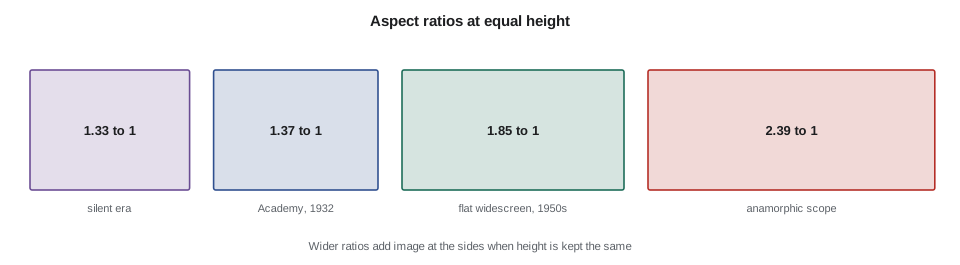
For two decades after 1932, almost all films used the Academy ratio of about 1.37 to 1. In 1952, Cinerama used three synchronized projectors to fill a vast curved screen, creating a sensation but proving impractical for most cinemas. In 1953, Twentieth Century-Fox introduced CinemaScope with The Robe. CinemaScope used an anamorphic lens to squeeze a wide image horizontally onto standard 35 mm film; a matching lens on the projector unsqueezed it to a ratio of about 2.55 to 1, later reduced to about 2.35 to 1 to make room for an optical soundtrack, and standardized in the 1970s at about 2.39 to 1.
Other studios adopted or competed with their own systems. Paramount's VistaVision ran 35 mm film horizontally through the camera to create a larger, sharper negative. Large formats using 65 mm camera negative and 70 mm prints, such as Todd-AO, gave the highest image quality for roadshow epics. Meanwhile, most studios began cropping standard films to "flat" widescreen ratios by masking the projector: 1.85 to 1 became the North American standard, while 1.66 to 1 was common in Europe.
Worked problem
Comparing image areas at equal height
A screen is 6 metres high. How wide would the image be at 1.37, 1.85 and 2.39 to 1, and how much wider is the scope image than the Academy image?
Show solution
- Academy width: \( 6 \times 1.37 = 8.22 \) metres.
- Flat widescreen width: \( 6 \times 1.85 = 11.1 \) metres.
- Scope width: \( 6 \times 2.39 = 14.34 \) metres.
- Ratio of scope to Academy: \( 14.34 \div 8.22 \approx 1.74 \).
Answer: At the same height, the scope image is about 74 % wider than the Academy image. This is why widescreen felt like a dramatic upgrade in the 1950s, and why showing scope films on old square televisions required cropping or letterboxing.
Widescreen changed composition. Filmmakers learned to stage action across the width of the frame, use longer takes because the wide image held more information, and place characters at the edges for tension. Early CinemaScope lenses distorted close-ups, so some directors avoided them at first. When films were later shown on 4:3 televisions, the practice of "pan and scan" cropped wide images to fit, a compromise that many directors disliked.
Why widescreen still matters for analysis
Aspect ratio is not a neutral container. When you analyze a film from the 1950s or later, note its original ratio and check that the copy you are watching preserves it. Many films circulated for decades on television and home video in cropped versions, and some older films have been reissued with altered framing. A scope composition that places two characters at opposite edges of the frame, separated by empty space, loses its meaning if one character is cropped out. Ask, too, what a filmmaker gained or gave up by choosing a ratio: wide frames favour landscapes, groups and lateral movement, while narrower frames concentrate attention on faces and vertical space. Some recent filmmakers deliberately return to the Academy ratio to evoke earlier cinema or to create a sense of confinement, showing that historical formats remain living choices.
Common mistakes
MistakeThinking Neorealism used no scripts or professional techniques
InsteadNote that many films used scripts, dubbing and careful staging along with locations and non-professionals
MistakeTreating festivals as minor events
InsteadExplain how festivals built international reputations and markets for art cinema
MistakeCalling all Indian cinema Bollywood
InsteadDistinguish Hindi-language Bombay cinema from industries in other languages and from parallel cinema
MistakeAssuming widescreen began in the digital era
InsteadTrace it to Cinerama (1952) and CinemaScope (1953)
MistakeForgetting that the Paramount decrees did not apply in Canada
InsteadNote the continuing role of Famous Players and the Canadian Cooperation Project
Summary and key terms
- Italian Neorealism (about 1945 to the early 1950s) used locations, non-professional actors and everyday stories, and influenced filmmakers worldwide.
- Postwar festivals such as Venice, Cannes and Berlin built international audiences for art cinema.
- Japanese cinema's 1950s golden age included Rashomon's Venice victory in 1951 and the work of Kurosawa, Ozu and Mizoguchi.
- Indian cinema developed popular song-and-dance forms in several languages and an art cinema led by Satyajit Ray.
- The 1948 Paramount decision forced the American majors to sell their cinemas; the decrees were terminated in 2020.
- Television drew audiences away, and Hollywood responded with colour, spectacle, 3D and widescreen.
- CinemaScope (1953) used anamorphic lenses; 1.85 to 1 became the North American flat widescreen standard.
- Neorealism
- A postwar Italian movement of location shooting, non-professional actors and everyday hardship
- Non-professional actor
- A performer without acting training, often cast for authenticity
- Art cinema
- Films marked by personal style, ambiguity and serious themes, shown at festivals and art houses
- Parallel cinema
- Indian art cinema distinct from the commercial mainstream
- Paramount decision
- The 1948 Supreme Court ruling that forced studios to sell their theatre chains
- Canadian Cooperation Project
- A 1948 arrangement in which Hollywood promised to promote Canada instead of Canada imposing quotas
- CinemaScope
- A widescreen system introduced in 1953 using anamorphic lenses
- Anamorphic lens
- A lens that squeezes a wide image horizontally onto film and unsqueezes it in projection
- Aspect ratio
- The ratio of an image's width to its height
- Pan and scan
- Cropping a widescreen film to fit a narrower television screen
Practice problems
Work each problem on paper first, then reveal the answer to check.
Name three features of Neorealism.
Show answer
Any three of: locations, non-professional actors, everyday hardship, episodic plots, documentary look.
Which film won the Golden Lion at Venice in 1951?
Show answer
Rashomon.
What was Satyajit Ray's first feature?
Show answer
Pather Panchali (1955).
What did the 1948 Paramount decision require?
Show answer
The majors had to sell their theatre chains and stop block booking.
When were the Paramount decrees terminated?
Show answer
In 2020.
Name two ways Hollywood responded to television.
Show answer
Any two of: widescreen, colour, spectacle, 3D, licensing films to TV.
How did CinemaScope create a wide image?
Show answer
An anamorphic lens squeezed the image onto film and another lens unsqueezed it in projection.
A screen is 5 metres high. How wide is a 1.85 image?
Show answer
\( 5 \times 1.85 = 9.25 \) metres.
What was the Canadian Cooperation Project?
Show answer
A 1948 deal in which Hollywood promised to mention and film Canada instead of Canada imposing quotas.
Why did pan and scan frustrate directors?
Show answer
It cropped their widescreen compositions to fit narrower television screens.
Lesson quiz · 5 questions
Score 60% or more to complete this lesson.
Create a free account to save your progress, take quizzes and earn a certificate.