
FILM-210 · Lesson 2 of 12 · 29 min
Idea, premise, logline and theme
Every script starts with an idea, but an idea is not yet a story. "A lighthouse keeper" is an image. "A lighthouse keeper who must decide whether to report a shipwreck that would make her a hero but expose her brother's smuggling" is the start of a story, because it contains a person, a choice and something at stake. This lesson shows how writers turn raw ideas into a premise, compress that premise into a logline, and discover the theme that gives a story meaning. These tools are not just for selling scripts. They are how writers test whether an idea can carry a film before spending months writing it.
Where ideas come from
Ideas come from everywhere: personal experience, news stories, family history, a place, an image, a "what if" question, a genre you love, or an injustice that makes you angry. Professional writers keep idea files and add to them constantly. Most ideas will never become scripts, and that is fine. The habit of collecting them trains you to notice dramatic situations in everyday life.
- Personal experience: write what you know emotionally, even if the setting is invented. A story about a first job in a kitchen can draw on any experience of being new and overwhelmed.
- "What if" questions: what if a town's only doctor lost her nerve? What if a grandfather's voice notes kept arriving after his funeral?
- Places and worlds: a remote research station, a night shift at a hospital laundry, a hockey rink at 5 a.m.
- Adaptation: short stories, plays, podcasts, articles and true events, which require rights, as lesson 12 explains.
- Genre: a fresh twist on a familiar form, such as a heist film set in a library.
For short films, the best ideas are often small and specific. A short cannot sustain a sprawling plot, but it can deliver one strong situation, one turn and one emotional change. Ask whether your idea can be told with two or three characters in one or two locations. If not, it may be a feature or series idea instead.
From idea to premise
A premise is the dramatic situation at the heart of a story: who wants what, and what stands in the way. Writers often test a premise with a set of questions. Who is the protagonist? What do they want, and why now? What stops them? What happens if they fail? Why is this story worth telling? If you cannot answer these, the idea needs more work.
| Question | Weak answer | Stronger answer |
|---|---|---|
| Who is the protagonist? | A teenager | Nadia, 16, the only fluent English speaker in her family |
| What do they want? | To be happy | To win a regional debate final her parents cannot attend |
| Why now? | No reason | The final is the same day as her father's citizenship interview, where she must translate |
| What stands in the way? | Life is hard | She can be in only one place, and each choice disappoints someone |
| What is at stake? | Unclear | Her scholarship chance versus her father's future in the country |
The stronger answers are specific, visual and full of conflict. Note that conflict does not need villains. Nadia faces a dilemma between two good things, which is often more interesting than a fight between good and evil.
The logline
A logline compresses a story into one or two sentences. Producers, agents and funders ask for loglines because they reveal quickly whether a story has a clear protagonist, goal and conflict. A good logline usually contains a specific protagonist described with an adjective or role, an inciting situation, a goal and an obstacle or stakes, and it hints at genre and tone.
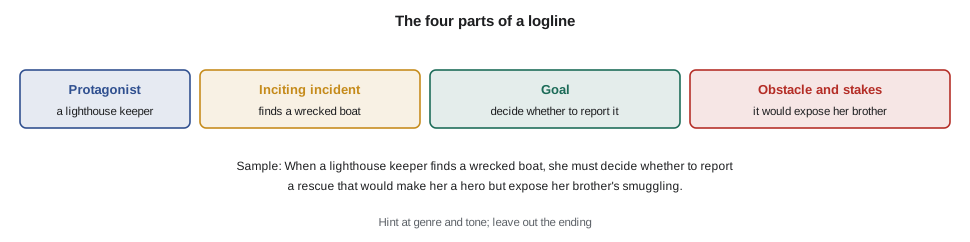
Here is an original example: "When a timid night-shift nurse discovers that a dying patient is the man who wrongly convicted her father, she must decide before dawn whether to tell him who she is." It has a protagonist (a timid night-shift nurse), an inciting incident (discovering who the patient is), a goal or dilemma (whether to tell him) and a ticking clock (before dawn). It also suggests a quiet drama rather than a thriller.
- Use active verbs: discovers, must decide, fights, escapes.
- Make the protagonist specific but not named; "a retired ferry captain" tells us more than "Bill".
- Show the conflict; a logline without an obstacle describes a situation, not a story.
- Keep it under about 35 words.
- Avoid the ending; a logline sells the question, not the answer.
Worked problem
Repairing a weak logline
A student writes: "This is a film about grief and family and how people deal with loss in different ways." Rewrite it as a logline and explain what changed.
Show solution
- The original names a theme, not a story: there is no protagonist, goal or conflict.
- Choose a specific protagonist: "a widowed beekeeper".
- Add an inciting incident and a goal: "must harvest her late wife's last hives before the first frost".
- Add an obstacle: "with the help of the stepson who blames her for the death".
- Combine: "A widowed beekeeper must harvest her late wife's last hives before the first frost, with the help of the stepson who blames her for the death."
Answer: The new logline has a protagonist, a goal, a deadline and a relationship in conflict. The theme of grief is still there, but now it lives inside a story an audience can follow.
Testing loglines with numbers
Writers sometimes score loglines against a simple checklist to compare versions. The scores are not science, but they make weaknesses visible.
Worked problem
Scoring two loglines
Score each logline 1 point for each element present: specific protagonist, inciting incident, goal, obstacle, stakes or deadline, and genre or tone. Logline A: "A boy goes on an adventure." Logline B: "When his grandmother's memory starts to fail, a ten-year-old sneaks her out of the care home to find the lake where she grew up before his parents notice."
Show solution
- Logline A: protagonist is vague (0), no inciting incident (0), "adventure" is a vague goal (0), no obstacle (0), no stakes (0), tone is vague (0). Score 0 of 6.
- Logline B: specific protagonist (1), inciting incident of memory failing (1), goal of finding the lake (1), obstacle of being caught (1), deadline of before his parents notice (1), tone of a gentle road movie (1). Score 6 of 6.
Answer: Logline B scores 6 and A scores 0. The exercise shows that specificity, not length, makes a logline work.
Theme: what the story is about underneath
If the premise is what happens, the theme is what the story means. Theme is the idea or question the story explores, such as whether loyalty to family can excuse dishonesty, or what we owe the people who raised us. Strong themes usually come out of the character's choices rather than being stated in dialogue. If a character announces the moral, audiences feel lectured. If the character makes a hard choice that embodies the theme, audiences feel it.
Many writers find their theme during drafting rather than before. A useful exercise is to state the theme as a question rather than an answer: "Is it ever right to break a promise?" A question keeps the story open and lets different characters embody different answers. A supporting character might argue that promises are sacred; another might break them casually; the protagonist must find a position by the end.
- Express theme as a question, not a slogan.
- Give different characters different answers to the question.
- Test every scene: does it connect, however indirectly, to the theme?
- Let the climax force the protagonist to answer the question through action.
Genre, tone and audience
Genre sets audience expectations: a horror film promises fear, a romantic comedy promises a relationship and laughter, a thriller promises suspense. Tone is the emotional colour of the telling: dark, warm, satirical, melancholy. Knowing your genre and tone early shapes every decision, from the opening image to the dialogue. Mixing genres can be powerful, but a mix that is not controlled feels confused. Audience matters too. A short for children's festivals, a horror short for genre festivals and an art-house drama for a cinémathèque need different approaches.
| Genre | Core promise | Typical engine |
|---|---|---|
| Horror | Fear and dread | A threat that escalates |
| Thriller | Suspense | A ticking clock and danger |
| Comedy | Laughter | Characters' flaws colliding |
| Drama | Emotional truth | A hard choice or loss |
| Romance | Connection | Two people overcoming obstacles to be together |
| Mystery | Curiosity | Clues and a hidden truth |
Originality and ethics
Every writer borrows, but there is a line between influence and copying. Ideas themselves are not protected by copyright, but specific expression, such as dialogue, detailed scenes and characters, is. Lesson 12 covers this in detail. Ethically, be careful when writing about real people and communities you do not belong to. Research, consult and ask whose story it is to tell. Authenticity is not just a moral question; audiences and funders notice when a story's world rings false.
Canadian funders and broadcasters increasingly ask how projects about Indigenous communities involve Indigenous creators, following protocols such as the On-Screen Protocols and Pathways guide developed by the Indigenous Screen Office.
Pitching your idea
A pitch is a spoken presentation of a story, usually short. In a two-minute pitch you might give the title, logline, genre and tone, introduce the protagonist, describe the beginning, the main conflict and how it escalates, and suggest why it matters to you and to an audience. Practise until it sounds natural. A pitch is also a test: if listeners lean in, the idea has energy; if they look puzzled, the story may not be clear yet.
Worked problem
Timing a pitch
You have 2 minutes to pitch. You speak at about 140 words per minute. How many words can your pitch contain, and how might you divide them?
Show solution
- Total words: \( 2 \times 140 = 280 \) words.
- Title and logline: about 40 words.
- Protagonist and world: about 60 words.
- Story beginning, conflict and escalation: about 140 words.
- Why this story and why you: about 40 words.
Answer: About 280 words. Writing the pitch out and timing it keeps you within the limit and makes sure the conflict, not the backstory, takes most of the time.
Working title and first impressions
A working title is part of a script's first impression. A strong title suggests genre, tone and the central idea in a few words, and it makes a logline easier to remember. Avoid titles that are generic, such as "The Journey," or that give away the twist. Many writers keep a list of possible titles and test them on friends alongside the logline. A title can change many times before release, but a good working title helps readers picture the film from the first page.
Common mistakes
MistakeConfusing a theme or setting with a story
InsteadBuild a premise with a specific protagonist, goal, obstacle and stakes
MistakeWriting loglines that list events or name characters
InsteadUse a role and adjective, an inciting incident, a goal and an obstacle in one sentence
MistakeStating the moral in dialogue
InsteadLet the theme emerge from the protagonist's choices under pressure
MistakeChoosing a feature-sized idea for a short
InsteadPick one situation, one turn and a small cast and location count
MistakeGiving away the ending in the logline
InsteadSell the dramatic question and keep the answer for the script
Summary and key terms
- Ideas come from experience, questions, places, adaptation and genre; writers collect them constantly.
- A premise states who wants what and what stands in the way, and why it matters now.
- A logline compresses the story into one or two sentences with a specific protagonist, inciting incident, goal and obstacle.
- Theme is the question or idea underneath the story, best expressed through choices rather than speeches.
- Genre sets audience expectations and tone sets the emotional colour of the telling.
- Ideas are free to use but expression is protected; writing about other communities calls for research and consultation.
- A short, timed pitch tests whether an idea is clear and compelling before drafting.
- Premise
- The core dramatic situation of a story: who wants what and what opposes them
- Logline
- A one- or two-sentence summary of a story's protagonist, goal and conflict
- Inciting incident
- The event that disrupts the protagonist's world and starts the story
- Stakes
- What the protagonist stands to gain or lose
- Ticking clock
- A deadline that adds urgency to the protagonist's goal
- Theme
- The underlying idea or question a story explores
- Genre
- A category of story with recognizable conventions and audience expectations
- Tone
- The emotional quality or attitude of the storytelling
- Pitch
- A short spoken presentation of a story to potential buyers or collaborators
- Dilemma
- A choice between two options that both carry a cost
Practice problems
Work each problem on paper first, then reveal the answer to check.
What four elements should a logline contain?
Show answer
A specific protagonist, an inciting incident, a goal and an obstacle or stakes.
Why describe the protagonist by role rather than name in a logline?
Show answer
A role and adjective tell the reader who they are; a name alone tells nothing.
Turn "a film about loneliness" into a premise.
Show answer
For example: a retired lighthouse keeper must befriend a stranded teenager before a storm cuts the island off.
Why express a theme as a question?
Show answer
It keeps the story open and lets characters embody different answers.
How many words fit in a 90-second pitch at 140 words per minute?
Show answer
About 210 words.
Why are small, specific ideas often best for shorts?
Show answer
A short can sustain only one situation, one turn and few locations.
What does genre promise an audience?
Show answer
A particular experience, such as fear in horror or laughter in comedy.
Is an idea protected by copyright?
Show answer
No; specific expression such as scenes, dialogue and characters can be.
What is a ticking clock?
Show answer
A deadline that raises urgency.
Why does conflict not require a villain?
Show answer
A dilemma between two good things or inner flaws can create strong conflict.
Lesson quiz · 5 questions
Score 60% or more to complete this lesson.
Create a free account to save your progress, take quizzes and earn a certificate.