
FILM-210 · Lesson 5 of 12 · 31 min
Structure II: short films and series
Feature-film structure is only one shape a screen story can take. Short films and television series each have their own demands. A short must tell a complete story in minutes, with no room for subplots or slow setup. A series must hook an audience in a pilot, sustain story over many episodes and seasons, and fit the rhythms of broadcast schedules or streaming releases. This lesson looks at how structure changes in short films, half-hour and one-hour episodes and limited series, and at how writers' rooms break stories together.
The short film
A short film is not a compressed feature. Trying to cram a feature's worth of plot into ten minutes produces a rushed, confusing film. Successful shorts usually focus on one character, one situation and one turn or revelation. Many festivals define a short as about 40 minutes or less, but most festival shorts are much shorter, often 5 to 15 minutes, because programmers can fit more of them into a program and audiences respond to economy.
- Start late: open as close to the turning point as possible. Skip the morning routine and arrive at the moment the situation changes.
- Keep it small: two or three main characters and one to three locations.
- One turn or revelation: many shorts build to a single twist, reversal or emotional shift.
- End early: leave the audience with an image or question rather than tying every thread.
- Make every second count: in a 7-minute film, a 30-second establishing sequence is more than 7 % of the running time.
Worked problem
Budgeting screen time in a short
A 9-minute short has a 45-second opening title sequence and a 60-second end credit roll. What share of the running time is left for story, and what share does the opening take?
Show solution
- Total running time: \( 9 \times 60 = 540 \) seconds.
- Titles and credits: \( 45 + 60 = 105 \) seconds.
- Story time: \( 540 - 105 = 435 \) seconds, about 7.25 minutes.
- Opening share: \( 45 \div 540 \approx 8.3 \% \).
Answer: About 7 minutes 15 seconds of story, with the opening titles alone using about 8 % of the film. Many short-film makers put a brief title card at the end and keep credits short so the story starts immediately.
Shapes that work in shorts
Several structural shapes appear again and again in successful shorts.
| Shape | How it works | Example premise (original) |
|---|---|---|
| Single situation | One problem in real time | A courier must deliver a cake across a frozen city in 20 minutes |
| Revelation | Information reframes everything before it | A man's daily visits to a café turn out to be visits to his late wife's favourite table |
| Reversal | The protagonist's position flips | A bully discovers he is the one being filmed and mocked |
| Portrait | A day or moment that reveals a character | An elderly beekeeper's last harvest before selling her land |
| Poem or mood piece | Images and sound evoke a feeling or idea | Winter dawn on a reserve as a grandmother teaches a song |
The revelation and reversal shapes depend on careful setup. Plant clues that seem ordinary on first viewing but make sense afterward. If the twist is unearned or obvious, it feels like a trick.
Television series: the basics
Series writing differs from feature writing in several ways. A feature resolves its story; a series must keep going. Writers build a story engine, a situation that can generate many episodes: a workplace, a family, a recurring case, a mission. Characters change more slowly, because audiences return to watch familiar people. Episodes balance story lines that resolve within the episode with arcs that run across a season.
- Procedural or episodic series: each episode has a self-contained story, such as a case of the week, with lighter serialized threads.
- Serialized series: stories run across many episodes, and each episode moves the larger plot forward.
- Limited series or miniseries: a single story told across a set number of episodes, with a clear ending.
- Anthology series: each season, or each episode, tells a different story with new characters.
Episode structure: teasers, acts and act-outs
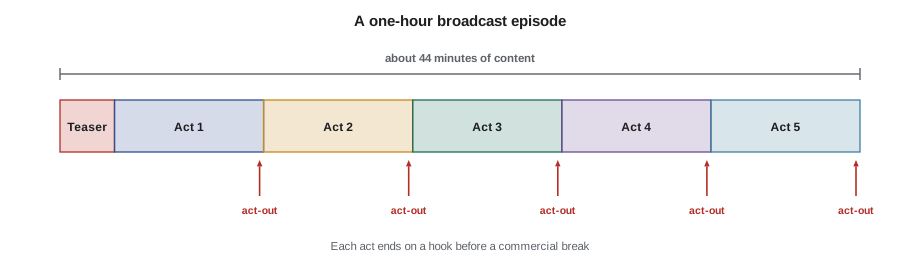
Broadcast television built its structure around advertising breaks. A one-hour drama traditionally runs about 42 to 44 minutes of content in a 60-minute slot, divided into a teaser or cold open and four to six acts. A half-hour comedy runs about 21 to 22 minutes, often with a cold open, two or three acts and a short tag. Each act ends with an act-out: a hook, cliffhanger or reversal designed to keep viewers watching through the commercials.
Streaming series do not need commercial breaks, and episode lengths vary more. Many writers still write act-outs, because the structure keeps episodes moving and helps viewers decide to keep watching. Streaming episodes often end with a stronger cliffhanger, because the platform will play the next episode automatically.
Worked problem
Timing a one-hour episode
A broadcast drama has 44 minutes of content: a 3-minute teaser and five acts of equal length. How long is each act, and roughly how many script pages is that?
Show solution
- Act time: \( 44 - 3 = 41 \) minutes for five acts.
- Each act: \( 41 \div 5 = 8.2 \) minutes.
- At about a page a minute, each act is about 8 pages.
- Whole script: \( 44 \) minutes, about 50 to 55 pages, because TV scripts often run slightly more than a minute a page.
Answer: Each act is about 8 minutes, roughly 8 pages. The full script would run about 50 to 55 pages, depending on the show's style and pace.
A, B and C stories
Most episodes interweave several story lines. The A story is the main plot, usually involving the lead and taking the most screen time. The B story is a secondary plot, often lighter or more personal. A C story or runner is a small recurring thread, sometimes comic, that appears in a few short scenes. Good episodes connect their stories thematically: the A, B and C stories explore the same question from different angles, and they may collide at the climax.
Worked problem
Balancing story lines
A 30-page half-hour script has 18 scenes. The writer wants an approximate split of 55 % A story, 30 % B story and 15 % C story by scenes. How many scenes should each get?
Show solution
- A story: \( 0.55 \times 18 \approx 10 \) scenes.
- B story: \( 0.30 \times 18 \approx 5 \) scenes.
- C story: \( 0.15 \times 18 \approx 3 \) scenes.
- Check: \( 10 + 5 + 3 = 18 \).
Answer: About 10, 5 and 3 scenes. In practice the C story scenes are often short, so its share of pages may be even smaller than its share of scenes.
The pilot
A pilot is the first episode of a series and a sales document. It must introduce the world and characters, establish the story engine and tone, tell a satisfying story of its own and make viewers want more. Some pilots are premise pilots, showing how the situation begins; others drop viewers into a world already in motion. Pilots are hard to write because they must do so much setup without feeling like setup. A common tip is to make the pilot a typical episode of the show, so buyers can see what week five will look like, while still telling a strong origin moment.
- Introduce the protagonist through action that shows their essence and dilemma.
- Establish the world's rules and the story engine.
- Tell a complete story that resolves within the episode.
- End with a hook that points to the season's larger story.
- Write a series bible or pitch document with season arcs and future episodes.
Writers' rooms
Most series are written by teams in a writers' room led by the showrunner. The room breaks stories together, building each episode's beats on a whiteboard before one writer goes off to write an outline and then a draft. The showrunner and senior writers then revise. Room sizes and schedules vary widely, from large rooms on long network seasons to small "mini-rooms" on streaming series that meet for a few weeks before production.
| Role | Main responsibility |
|---|---|
| Showrunner | Overall creative control, final rewrites, production decisions |
| Executive story editor or co-executive producer | Senior writers who run the room in the showrunner's absence |
| Story editor | Writes episodes and helps break stories |
| Staff writer | Entry-level writer who pitches and may write an episode |
| Writers' assistant or script coordinator | Takes room notes, manages drafts and revision pages |
In Canada, the Writers Guild of Canada's agreement with the Canadian Media Producers Association sets minimum fees for episode scripts and, under the 2024 agreement, requires larger-budget series to keep story editors employed during much of principal photography.
Limited series and the season arc
A limited series tells one story across a fixed number of episodes, often six to ten. Structurally it is closer to a long feature divided into chapters. Writers plan a season arc with its own act structure: the first episode or two set up, the middle episodes escalate, and the final episodes resolve. Each episode still needs its own shape and an ending that pulls viewers forward. A common approach is to give each episode a different focus character or point of view while advancing the main story.
From short to feature or series
Many filmmakers use a short as a proof of concept for a longer project. A short can demonstrate a world, a tone or a central character that a feature or series would develop. Funders and producers sometimes ask to see a short before investing in a first feature by the same team. If you plan to expand a short, make sure it still works as a complete story on its own; festival audiences and programmers judge a short as a film, not as a pitch. At the same time, keep notes on the larger story: the characters, conflicts and settings that would carry 90 minutes or a season.
Worked problem
Expanding a short into a series pitch
A 10-minute short follows a night-shift nurse in a small northern hospital. You want to pitch an 8-episode series of one-hour episodes. Roughly how many minutes of story must the series contain, and how many times longer is that than the short?
Show solution
- Series running time: about \( 8 \times 44 = 352 \) minutes of content in broadcast terms.
- Ratio to the short: \( 352 \div 10 \approx 35 \) times longer.
- Story engine: the hospital, its staff and patients can supply new cases each week, while the nurse's personal story runs across the season.
Answer: About 352 minutes, roughly 35 times the short. The short proves the world and the lead character, but the series pitch must show an engine that can generate dozens of hours of story.
Common mistakes
MistakeTreating a short as a compressed feature
InsteadFocus on one character, one situation and one turn
MistakeLong openings in short films
InsteadStart as close as possible to the turning point
MistakeAct-outs that are not real turns
InsteadEnd each act with a genuine reversal, question or cliffhanger
MistakeDisconnected A, B and C stories
InsteadLink story lines thematically and let them interact at the climax
MistakeA pilot that is all setup and no story
InsteadTell a complete episode story while establishing the series engine
Summary and key terms
- Shorts work best with one character, one situation and one turn or revelation, starting late and ending early.
- Common short shapes include the single situation, revelation, reversal, portrait and mood piece.
- Series need a story engine that generates episodes; formats include procedural, serialized, limited and anthology.
- Broadcast episodes use teasers and acts with act-outs at commercial breaks; streaming keeps many of these habits.
- Episodes interweave A, B and C stories, ideally linked by theme.
- A pilot must introduce the world, establish the engine, tell a complete story and hook viewers.
- Writers' rooms break stories collectively under a showrunner, with roles from staff writer to executive producer.
- Story engine
- A situation that can generate many episodes of a series
- Teaser
- A short opening scene before the main titles that hooks the audience; also called a cold open
- Act-out
- The ending of an act, designed as a hook before a break
- A story
- The main plot line of an episode
- Runner
- A small recurring thread, often comic, across several short scenes
- Pilot
- The first episode of a series, written to sell and establish it
- Writers' room
- A team of writers who break and write a series' episodes together
- Limited series
- A series telling one complete story over a fixed number of episodes
- Procedural
- A series built on self-contained episode stories, such as a case of the week
- Serialized
- A series whose stories continue across many episodes
Practice problems
Work each problem on paper first, then reveal the answer to check.
What fraction of a 6-minute short is a 30-second opening?
Show answer
\( 30 \div 360 \approx 8.3 \% \).
Name three common short film shapes.
Show answer
For example, single situation, revelation and reversal.
What is an act-out?
Show answer
The hook or turn that ends an act before a break.
How long is each act in 40 minutes of content with a 4-minute teaser and four equal acts?
Show answer
\( 36 \div 4 = 9 \) minutes.
What is a story engine?
Show answer
A situation that can generate many episodes.
What is the difference between serialized and procedural series?
Show answer
Serialized stories continue across episodes; procedurals resolve a main story each episode.
Who leads a writers' room?
Show answer
The showrunner.
Why should A, B and C stories connect?
Show answer
Linked stories explore the theme from different angles and make the episode feel unified.
Why do streaming episodes often end on strong cliffhangers?
Show answer
The platform plays the next episode, so a strong hook encourages viewers to continue.
What does a revelation short depend on?
Show answer
Careful setup with clues that make sense afterward.
Lesson quiz · 5 questions
Score 60% or more to complete this lesson.
Create a free account to save your progress, take quizzes and earn a certificate.