
HSE-390 · Lesson 10 of 12 · 21 min
Laboratory and pharmacy hazards
▶ Video coming soon A video version of this lesson is on the way.
The laboratory and the pharmacy are two of the most controlled places in a hospital. Both have strict procedures, specially designed rooms and equipment, and staff with long technical training. They also concentrate some of the hospital's most serious hazards in a small space: infectious specimens, toxic and flammable chemicals, hazardous drugs, sharps, glass, cryogenic liquids and compressed gases. This lesson looks at those hazards from the point of view of the people who work there, and of the porters, housekeepers and maintenance staff who go in and out. HSE-392 covers bloodborne pathogens and HSE-394 covers hazardous drugs and radiation in more depth.
The core laboratory at Northbridge
Northbridge's laboratory runs around the clock with about 48 staff. Daniel works in the core lab, which handles chemistry, hematology and transfusion testing. Next to it are microbiology, which grows and identifies bacteria and other organisms from patient specimens, and a small pathology section where tissue from surgery is examined and preserved. A team of lab assistants collects blood on the units each morning. Specimens arrive all day from the units, the emergency department, Maple Court, Northbridge Home Care and outside clinics, by pneumatic tube, by hand and by courier.
Biological hazards in the lab
Every specimen that reaches the lab could contain an infectious agent, and most of the time nobody knows which ones do. That is why labs treat all specimens as potentially infectious and work at a containment level matched to the organisms they handle.
In Canada, the Human Pathogens and Toxins Act and the Canadian Biosafety Standard, administered by the Public Health Agency of Canada, set the rules for laboratories that handle human pathogens. A hospital clinical lab normally works at containment level 2 (CL2), which requires a biological safety cabinet for work that could create aerosols, restricted access, a biosafety officer, a written plan and training. Some organisms, such as Mycobacterium tuberculosis when it is grown in culture, need higher containment, and labs that find them send them on to a reference lab.
The main ways lab staff are exposed are:
- Aerosols: tiny droplets created by opening tubes, pipetting, vortexing, centrifuging and spills. They can be breathed in or land on the eyes and face.
- Splashes onto the eyes, nose, mouth or broken skin.
- Sharps: needles, broken glass, scalpels and slides.
- Contaminated surfaces and gloves that then touch the face, a phone or a keyboard.
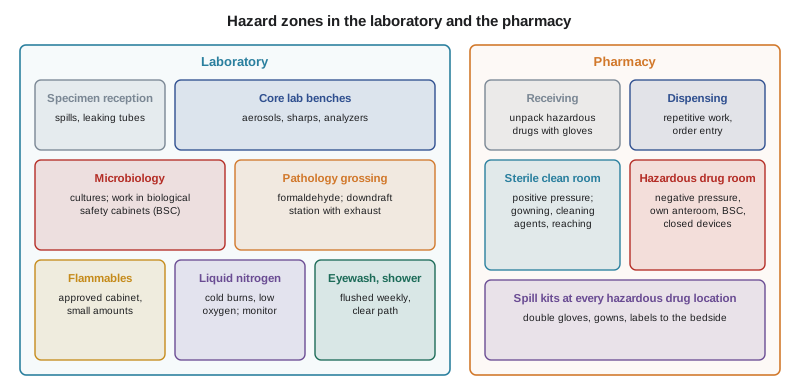
The controls follow the hierarchy. Plastic tubes have replaced most glass. Sealed centrifuge rotors or safety cups keep aerosols in if a tube breaks. A Class II biological safety cabinet draws air in through the front and filters it, protecting the worker, the specimen and the room. Work surfaces are disinfected at the start and end of each shift and after any spill. Lab coats, gloves and eye protection are worn at the bench, and lab coats stay in the lab. Eating, drinking, applying makeup and handling contact lenses are not allowed in the lab, and phones are kept out of the work area or cleaned often.
Chemical hazards in the lab
The lab uses many chemicals: acids and bases, solvents such as xylene and alcohols, stains, reagents, and formalin to preserve tissue. The hazards are those in Lesson 6, made sharper by the variety of chemicals and the small, enclosed rooms. WHMIS applies to all of them. Chemical fume hoods, which are different from biological safety cabinets, draw fumes away from the worker and exhaust them outside. Flammable liquids are kept in approved flammable storage cabinets, in the smallest quantities that work requires, and acids are stored separately from bases and from flammables.
Formaldehyde, the active ingredient in formalin, deserves special mention. It is a known human carcinogen, a strong irritant to the eyes and airways and a sensitizer. Pathology staff are exposed when they open specimen containers, cut tissue at the grossing station and dispose of used formalin, and operating room staff can be exposed when specimens are placed in containers. Prefilled specimen containers, downdraft grossing stations with local exhaust, closed disposal systems and regular air monitoring are the main controls.
# Formaldehyde air sampling at the grossing station, one day shift.
# Each sample: (minutes, concentration in ppm)
samples = [(120, 0.06), (15, 0.28), (105, 0.08), (30, 0.04), (90, 0.11), (15, 0.35), (105, 0.05)]

minutes = sum(m for m, c in samples)
twa8 = sum(m * c for m, c in samples) / 480   # unsampled time counted as zero
peak = max(c for m, c in samples if m == 15)

targets = {"internal 8-hour target": 0.1, "internal 15-minute target": 0.3}
print(f"sampled {minutes} minutes")
print(f"8-hour time-weighted average: {twa8:.3f} ppm (target {targets['internal 8-hour target']})")
print(f"highest 15-minute sample:     {peak:.2f} ppm (target {targets['internal 15-minute target']})")
print("8-hour average within target:", twa8 <= targets["internal 8-hour target"])
print("15-minute peak within target:", peak <= targets["internal 15-minute target"])sampled 480 minutes 8-hour time-weighted average: 0.086 ppm (target 0.1) highest 15-minute sample: 0.35 ppm (target 0.3) 8-hour average within target: True 15-minute peak within target: False
The 8-hour average is within the hospital's target, but one 15-minute sample, taken while a large specimen was being cut, is above it. Northbridge uses internal targets based on the American Conference of Governmental Industrial Hygienists (ACGIH) threshold limit values for formaldehyde, 0.1 ppm averaged over 8 hours and 0.3 ppm over 15 minutes, because they are more protective than some legal limits; the legal limits in Ontario are set in Regulation 833. The investigation finds that the downdraft station's airflow was reduced by a clogged filter. Once it is replaced, the peak readings fall below the target.
Other lab hazards
- Liquid nitrogen and dry ice: liquid nitrogen at about -196 °C (-321 °F) causes severe cold burns, and as it boils it can displace the oxygen in a small room. Face shields, cryogenic gloves, good ventilation and oxygen monitors where large amounts are stored are the controls. Dry ice in a sealed container can build up enough pressure to burst it.
- Compressed gas cylinders: secured upright with chains or straps, capped when moved, and moved on a cylinder cart.
- Centrifuges: the lid must stay closed until the rotor has stopped, loads must be balanced, and a tube that breaks inside a running centrifuge is treated as a spill that may have created aerosols.
- Electrical equipment, analyzers with moving parts and the heat from incubators and ovens.
- Ergonomics, covered in Lesson 8: pipetting, microscopy, standing at benches and repetitive specimen handling.
- Working alone at night: one or two staff may run the whole lab overnight.
Phlebotomy on the units adds hazards the lab cannot control: needles used on patients who may move suddenly, collection in cramped rooms, and confused or frightened patients. Lab assistants use safety-engineered needles, keep a sharps container within reach on their tray, and ask a nurse for help with patients who may not stay still.
The pharmacy
Northbridge's pharmacy has about 30 staff. Priya works mostly in the sterile compounding area, where IV medications, nutrition solutions and chemotherapy are prepared. The hazards there are different from those in a retail pharmacy.
Hazardous drugs are the most serious. Some medications, including most anti-cancer drugs and some hormones, antivirals and immunosuppressants, can cause cancer, birth defects, reproductive harm or organ damage in the people who handle them, even in very small amounts over long periods. NIOSH maintains a list of hazardous drugs that hospitals in Canada as well as the United States use. In Ontario, the pharmacy follows the National Association of Pharmacy Regulatory Authorities (NAPRA) model standards for compounding hazardous sterile preparations, as adopted by the Ontario College of Pharmacists, and Regulation 67/93 has its own requirements for antineoplastic drugs, including training of the workers who handle them.
Exposure can happen at every step, not just compounding: when boxes are unpacked in receiving, since the outside of vials can be contaminated; when drugs are compounded; when they are transported; when nurses give them; when patients' body fluids are handled for some days afterwards; when spills are cleaned; and when waste is collected. The main controls are:
- A separate negative pressure room with its own anteroom for compounding hazardous drugs, and a biological safety cabinet or compounding isolator inside it.
- Closed system drug-transfer devices, which stop drug from escaping when it is moved from vial to syringe to bag.
- Two pairs of chemotherapy-tested gloves and a gown that resists permeation.
- Spill kits at every place hazardous drugs are stored, prepared or given, and trained staff to use them.
- Labels that mark hazardous drugs all the way to the bedside, so that porters, nurses and housekeepers know what they are handling.
The clean rooms themselves have hazards: staff gown up in full protective clothing, work for long periods with their arms extended into a cabinet, and clean surfaces with sporicidal disinfectants. Ergonomics and chemical exposure to cleaning agents need the same attention as the drugs. Outside the clean rooms, pharmacy staff face the repetitive work of picking, labelling and order entry described in Lesson 8, and in hospitals with an outpatient pharmacy, the risk of robbery and aggression from members of the public.
For supervisors: people who visit
The most vulnerable people in a lab or pharmacy are often not the staff, who are trained, but the people who come in for a few minutes: a porter picking up a bag of chemotherapy, a housekeeper emptying bins, an electrician fixing a light over a cabinet, a contractor servicing a fume hood. Make sure each of them knows the rules for your area before they start: where they can go, what not to touch, what the signs and labels mean, and what to do in a spill. Work on biological safety cabinets, fume hoods and ventilation needs a permit and decontamination first, because the inside of a filter can be heavily contaminated.
Worked problem
A broken tube in the centrifuge
At 0315, Daniel opens a centrifuge after a run and sees that one blood tube has broken, spraying blood around the inside of the bowl. He is alone in the core lab, and the specimen is from a patient in the emergency department whose infection status is unknown. What should he do?
Show solution
- Close the lid again right away and leave it closed for about 30 minutes, so that any aerosol can settle. Warn anyone else nearby and post a sign on the centrifuge.
- Remove his gloves, wash his hands and check himself for splashes. If any blood reached his eyes, face or broken skin, he flushes the area and reports it as an exposure immediately, as in Lesson 5.
- After the waiting time, he puts on a gown, gloves, eye protection and a mask, opens the lid, and removes broken glass or plastic with forceps, never his hands, into a sharps container. Sealed buckets or the rotor are taken to a biological safety cabinet to be opened and disinfected.
- He disinfects the bowl, rotor and buckets with the lab's approved disinfectant for the contact time on the label, then records the spill, informs the charge technologist and requests a new specimen.
- The lab reviews why the tube broke and whether sealed safety cups were in use. They were not on that rotor, and the lab changes its procedure so they are used for all blood tubes.
Answer: Close the lid and wait about 30 minutes, check for exposure, clean up with PPE and forceps, disinfect, report, and use sealed safety cups in future.
Common mistakes
MistakeTreating specimens with no infection label as safe.
InsteadTreat every specimen as potentially infectious.
MistakeUsing a chemical fume hood for infectious work, or a biological safety cabinet for volatile chemicals.
InsteadThey do different jobs; use the right one for the hazard.
MistakeOpening a centrifuge lid while the rotor is still spinning.
InsteadWait for it to stop, and after a breakage, wait about 30 minutes more.
MistakeThinking hazardous drug exposure happens only in the compounding room.
InsteadIt can happen in receiving, transport, administration, spills and waste handling too.
MistakeLetting contractors work on cabinets or hoods without a permit.
InsteadDecontaminate first and control the work with a permit.
Summary and key terms
- Labs and pharmacies concentrate infectious, chemical, drug, sharps, cold and pressure hazards in small spaces.
- Clinical labs in Canada work at containment level 2 under the Canadian Biosafety Standard.
- Aerosols, splashes, sharps and contaminated surfaces are the main routes of lab infection.
- Biological safety cabinets protect against biological hazards; chemical fume hoods protect against chemical fumes.
- Formaldehyde is a carcinogen and sensitizer; exhaust at the grossing station and air monitoring are key controls.
- Hazardous drugs can harm staff at every step from receiving to waste; negative pressure rooms, closed system devices, double gloves and spill kits are key.
- Visitors, contractors and support staff need briefing and permits before working in labs and pharmacies.
- Biological safety cabinet
- A ventilated cabinet with filters that protects the worker, the work and the room from infectious aerosols.
- Chemical fume hood
- A ventilated enclosure that draws chemical fumes away from the worker and exhausts them outside.
- Aerosol
- Tiny droplets or particles suspended in the air.
- Hazardous drug
- A drug that can cause cancer, birth defects, reproductive harm or organ damage in people who handle it.
- Closed system drug-transfer device
- A device that prevents drug or vapour from escaping when a drug is transferred between containers.
- Time-weighted average
- The average concentration of a substance in air over a work shift, usually 8 hours.
Practice problems
Work each problem on paper first, then reveal the answer to check.
Name three ways lab workers can be exposed to infection.
Show answer
Any three of: aerosols, splashes, sharps, contaminated surfaces and gloves.
What is the difference between a biological safety cabinet and a chemical fume hood?
Show answer
A biological safety cabinet filters air to protect against infectious aerosols; a fume hood draws chemical fumes away and exhausts them outside.
What two hazards does liquid nitrogen create?
Show answer
Severe cold burns, and displacement of oxygen in a small room as it boils.
What did the formaldehyde sampling find, and what was the cause?
Show answer
The 8-hour average was within target but one 15-minute peak was above it, because a clogged filter had reduced the airflow at the grossing station.
Give four places where hazardous drug exposure can happen.
Show answer
Any four of: receiving, compounding, transport, administration, handling patients' body fluids, spills, waste.
What should be done before a contractor works on a biological safety cabinet?
Show answer
Decontaminate it and control the work with a permit.
Lesson quiz · 5 questions
Score 60% or more to complete this lesson.
Create a free account to save your progress, take quizzes and earn a certificate.