
LES-112 · Lesson 8 of 12 · 19 min
Warrantless searches: consent, plain view and exigent circumstances
▶ Video coming soon A video version of this lesson is on the way.
Desjardins starts with a short role play. He plays an officer at a traffic stop, and Priya Sandhu plays the driver. 'Mind if I take a quick look in the car?' he asks. Priya shrugs and says, 'I guess.' He asks the class whether that was consent. Opinions split. Some say yes, she agreed. Others say she did not really feel she had a choice. Desjardins then asks a second question: if he had told her first that she was free to say no, and that anything found could be used against her, would her answer mean more? Everyone agrees it would. 'Consent,' he says, 'is the easiest search to get and the easiest to lose in court.'
This lesson covers three exceptions to the warrant requirement that officers use often: consent, plain view and exigent circumstances. Each allows a search or seizure without a warrant, but only when its own conditions are met. The officer who relies on one must be able to show, with facts, that every condition was satisfied.
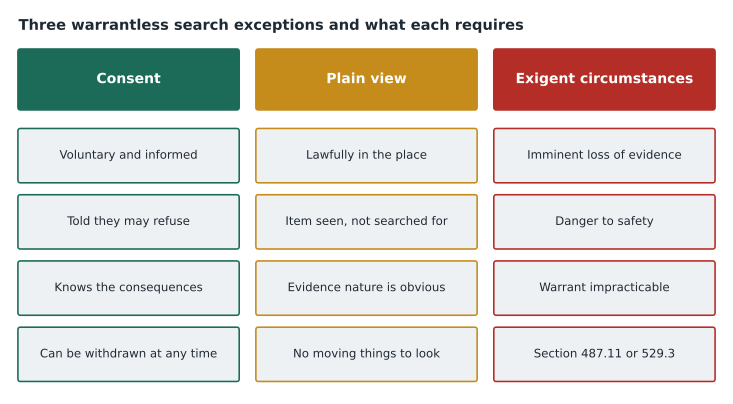
Consent
In R. v. Wills (1992), the Ontario Court of Appeal set out the test that Canadian courts still apply. For consent to be valid, there must be consent, express or implied; the person giving it must have authority to do so; it must be voluntary, not the product of police oppression, coercion or other external conduct that negates the freedom to choose; the person must be aware of the nature of the police conduct they are being asked to consent to; the person must be aware of their right to refuse; and the person must be aware of the potential consequences of giving consent. The Crown must prove valid consent on a balance of probabilities. In practice this means officers should tell the person what they want to search and why, that they may refuse, and that anything found may be used as evidence. In R. v. Borden (1994), the Supreme Court held that consent to give a blood sample for one investigation did not extend to its use in another the man had not been told about, because he was not aware of the consequences of consenting.
Consent also has limits of scope and authority. A person can consent only to a search of things they have authority over, and only to the extent they agree. In R. v. Reeves (2018), the Supreme Court held that a man's common-law spouse could not validly consent to police taking a computer they shared, because the man retained a reasonable expectation of privacy in it, though she could allow police into the shared home. Consent can be withdrawn at any time, and when it is, the search must stop unless another power applies.
Port Ardent's consent search policy, revised in 2022, requires officers to read a short script, record the response on camera, and note the outcome. Haddad tracks consent requests by outcome because they reveal two things: how often people agree once they are told they can refuse, and how often consent searches actually find anything.
# Port Ardent consent search requests at vehicle and pedestrian stops, one year
requests = 240
refused = 61
granted = requests - refused
withdrawn_during = 7
evidence_found = 23
completed = granted - withdrawn_during
print("requests:", requests)
print("refused:", refused, f"({refused / requests:.2f})")
print("granted:", granted, "withdrawn during the search:", withdrawn_during)
print("completed searches:", completed)
print("evidence found:", evidence_found, f"(hit rate {evidence_found / completed:.3f})")requests: 240 refused: 61 (0.25) granted: 179 withdrawn during the search: 7 completed searches: 172 evidence found: 23 (hit rate 0.134)
About a quarter of people refused once told they could, and seven withdrew consent part way through, after which the officers stopped. Of 172 completed searches, 23 found evidence, a hit rate of about 0.134. Haddad compares that with searches based on reasonable grounds, which find evidence far more often, and tells officers that a low hit rate is a signal that consent requests are being made without much reason to expect anything. Requests that rest on a hunch, she says, cost the public's trust for little return.
Plain view
Plain view is not really a search at all, because seeing what is openly visible from a place the officer is lawfully entitled to be does not intrude on any reasonable expectation of privacy. The plain view doctrine allows the officer to seize what they see if they are lawfully in the place, the evidence is in plain view rather than found by searching, and its nature as evidence is immediately apparent: the officer must have reasonable grounds to believe the item is evidence of an offence. Section 489(2) of the Criminal Code codifies a version of this, allowing an officer lawfully present in the execution of their duties to seize anything they believe on reasonable grounds has been obtained by or used in an offence or will afford evidence of one. Some older cases required that the discovery be inadvertent; more recent appellate decisions in Ontario have doubted that requirement, but officers should never use a plain view seizure as a cover for a search they could not otherwise do.
The key in plain view cases is that the officer must already be lawfully where they are. An officer who climbs a fence to look into a backyard is not in a lawful position, and nothing they see is in plain view in the legal sense. An officer standing on the sidewalk, or invited into a living room, or executing a warrant for stolen tools in a garage, is lawfully present, and what they see without searching can be seized if its nature as evidence is obvious. When Ali's team found a box of tools from a different store in Brandt's garage, they could seize it under plain view during the warrant search only because the store's labels and price stickers made its connection to another theft apparent at a glance.
Exigent circumstances
Exigent circumstances allow police to search or enter without a warrant when the conditions for obtaining one exist but urgency makes getting one impracticable. Section 487.11 of the Criminal Code allows a search without a warrant for evidence where the conditions for a warrant exist but by reason of exigent circumstances it would be impracticable to obtain one, and section 11(7) of the Controlled Drugs and Substances Act is similar. In R. v. Paterson (2017), the Supreme Court explained that exigent circumstances denote urgency, arising from circumstances calling for immediate police action to preserve evidence, officer safety or public safety, and that impracticable means impossible in practice, not merely inconvenient; the availability of telewarrants matters. In Paterson, officers who entered an apartment without a warrant to seize drugs after the occupant admitted having them were found to have no real urgency, and the evidence was excluded. Section 529.3 creates a parallel rule for entering a dwelling to arrest, and Godoy recognized entry to protect life in response to a 911 call.
Desjardins tells the class that exigency is the exception most often claimed and most often rejected. The most common reason for rejection is that the urgency was not real, or that police had time to get a warrant and chose not to. Modern telewarrant systems can produce a warrant in under an hour at any time of day, and courts know it. An officer who claims exigency should be able to explain what would have happened in the time it took to get a warrant: who would have been hurt, or what evidence would have been destroyed, and why.
There is also a difference between entering to deal with the emergency and searching for evidence once inside. Officers who enter a home because they hear screaming may do what is needed to find and protect the person, check for others in danger and secure weapons, but they may not search drawers for evidence once the emergency is over. Anything they see in plain view while dealing with the emergency can be seized, and anything else needs a warrant.
Recording consent properly
Because consent is so easy to dispute later, the way it is recorded matters as much as the words used to get it. Port Ardent's policy requires three things. First, the officer reads a short script that says what the officer wants to search and why, that the person may refuse, that the person may stop the search at any time, and that anything found may be used as evidence. Second, the request and the answer are recorded on the body-worn camera, so the court can see the tone, the setting and the person's response. Third, the officer notes the time consent was given, the scope agreed, any limits the person set, and the time the search ended.
The script is short enough to say in thirty seconds, and Desjardins has the class practise it in pairs until they can say it naturally. He warns against two common mistakes. The first is asking in a way that sounds like an order: 'You don't mind if I look, right?' is a question that expects a yes. The second is bargaining: 'If you let me look, we can get this over with quickly' suggests that refusing will cost the person something, which undermines voluntariness. A plain question, asked once, with the right information, is what courts look for.
He also tells the class what to do when a person refuses. Thank them, explain what will happen next, and move on. A refusal is the exercise of a right, not a sign of guilt, and it cannot be used as grounds for a search or an arrest. If the officer already has grounds for another power, such as reasonable grounds to believe under a statute or the automobile exception, they can use that power, but they should say so clearly rather than asking for consent they do not need. Asking for consent when another power already applies, and then relying on the consent, only creates confusion later.
Finally, consent from young people and people in vulnerable situations deserves extra care. A teenager stopped late at night, a person who does not speak the language well, or a person in crisis may agree to anything an officer asks. Officers should consider whether the person really understands, use an interpreter where needed, and remember that a court will look at the person's characteristics when deciding whether consent was voluntary.
Worked problem
Was the warrantless entry justified?
At 23:30, officers respond to a report of a fight in an apartment. When they arrive, it is quiet. A woman opens the door a crack, says everything is fine, and tries to close it. Officers see a smear of blood on the door frame and hear a man coughing inside. They push the door open and enter. Inside they find a man with a cut lip and, on the coffee table, a bag of white powder. Was the entry lawful, and can the bag be seized?
Show solution
- Ask whether there was real urgency: a reported fight, blood on the door frame, and the woman's attempt to close the door gave reasonable grounds to suspect someone might be injured, the kind of situation Godoy recognized.
- Ask whether a warrant was practicable: a person who may be injured cannot wait an hour.
- Limit the entry to its purpose: find and check the injured man, check for others in danger, secure any weapons.
- Apply plain view to the bag: the officers were lawfully present, saw it without searching, and its nature as a likely controlled substance was immediately apparent, so it can be seized.
- Do not search further for evidence once the emergency is resolved; get a warrant for anything more.
Answer: The entry was justified by the emergency, and the bag on the table could be seized in plain view; a search of other rooms or containers for drugs would need a warrant.
Common mistakes
MistakeIf the person says yes, consent is valid.
InsteadConsent must meet the Wills test, including awareness of the right to refuse and the consequences.
MistakeAnyone at the house can consent to a search of everything in it.
InsteadA person can consent only to what they have authority over; Reeves limited consent over a shared computer.
MistakePlain view allows officers to move things to get a better look.
InsteadThe nature of the item must be apparent without searching.
MistakeExigency exists whenever getting a warrant would take time.
InsteadPaterson requires real urgency and impracticability, not inconvenience.
Summary and key terms
- Consent must meet the Wills test: authority, voluntariness and awareness of the conduct, the right to refuse and the consequences.
- Consent is limited by authority and scope and can be withdrawn (Reeves).
- Recording consent and telling people they may refuse protects both sides.
- Plain view requires lawful presence, discovery without searching, and evidence that is immediately apparent; section 489(2) codifies it for officers on duty.
- Exigent circumstances require urgency and impracticability of a warrant (section 487.11, Paterson).
- Entry for an emergency allows only what the emergency requires.
- Consent search
- A search authorized by the informed, voluntary agreement of a person with authority.
- Wills test
- The Ontario Court of Appeal test for valid consent to a search.
- Plain view
- Seizing evidence openly visible from a lawful position without searching.
- Exigent circumstances
- Urgency requiring immediate action to preserve evidence or safety where a warrant is impracticable.
- Impracticable
- Impossible in practice, not merely inconvenient (Paterson).
- Withdrawal of consent
- Ending consent part way through a search, which then must stop.
Practice problems
Work each problem on paper first, then reveal the answer to check.
List the elements of the Wills test.
Show answer
Consent given; authority; voluntariness; awareness of the nature of the conduct; awareness of the right to refuse; awareness of the consequences.
In the code example, what was the hit rate of completed consent searches?
Show answer
23 of 172, about 0.134.
What three conditions does plain view require?
Show answer
Lawful presence, discovery without searching, and evidence whose nature is immediately apparent.
What did Paterson say impracticable means?
Show answer
Impossible in practice, not merely inconvenient.
Lesson quiz · 5 questions
Score 60% or more to complete this lesson.
Create a free account to save your progress, take quizzes and earn a certificate.