
MELC-209 · Lesson 5 of 12 · 19 min
The Canadian Electrical Code as adopted in Prince Edward Island
▶ Video coming soon A video version of this lesson is on the way.
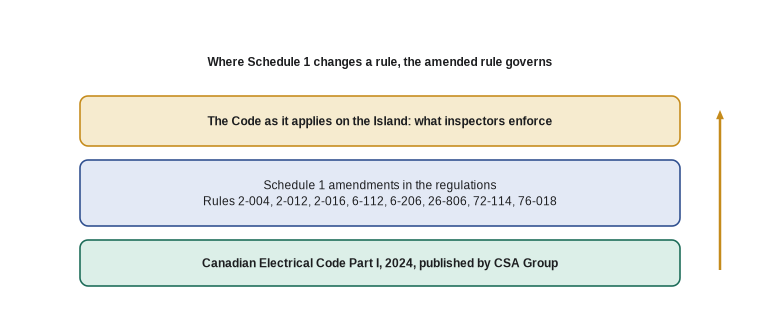
The Canadian Electrical Code Part I is a national standard published by CSA Group. It has no legal force anywhere until a province adopts it. Each province decides which edition to adopt, when, and with what changes. On the Island, the Electrical Inspection and Code Regulations do the adopting. The office consolidation current to October 2024 adopts the 2024 Canadian Electrical Code, Part I, Twenty-sixth Edition, subject to the amendments in Schedule 1. This lesson explains what that means for an Island contractor, which rules the Island changes, and how to keep a Code book that matches the law.
As in the rest of this program, the lesson cites rule numbers and describes their effect in its own words. It never reproduces the text of the Code or of the regulations. Keep your own copy of both and read the actual wording.
How adoption works
The regulations define the Code as the 2024 edition and then say that electrical installations must comply with it, as amended by Schedule 1. Three consequences follow.
- Edition matters. An installation is judged against the edition in force under the regulations, not the newest edition CSA has published and not the edition you trained on. When the Island moves to a new edition, the regulations will be amended, and the change will apply to work from the date the amendment says.
- Island amendments override the national text. Where Schedule 1 amends or revokes a rule, the national wording no longer applies on the Island in that respect. A rule you know from another province may read differently here.
- The regulations also require the contractor to have a copy. Section 2 makes having a copy of the Code a qualification for an electrical contractor licence. An inspector who asks to see the Code on site is asking about a licence requirement.
The consolidation is labelled current to October 5, 2024, and like every office consolidation it is unofficial: the version published in the Royal Gazette governs. Before relying on any detail, check whether the regulations have been amended since.
The rules Schedule 1 changes
Schedule 1 is short, but it touches some of the rules an Island contractor uses most. The consolidation shows amendments or revocations affecting, among others, the following rules.
| Rule | Subject in the national Code | Why it matters on the Island |
|---|---|---|
| 2-004 | Permits | The Island rewrites who applies for a permit, when, and on what conditions; Lesson 6 covers it |
| 2-012 | Notification of work ready for inspection | Sets the notice, covering and certificate of compliance steps |
| 2-016 | Current permits and connection | Governs when an installation may be connected and energized |
| 2-022 | Work on existing installations | Contractors must discuss required upgrades with an inspector before starting |
| 2-024 | Use of approved equipment | Equipment must be certified by an accepted testing laboratory |
| 2-036 | Refusal of permits and defects | Permits may be refused to contractors who fail to correct defects |
| 6-112 | Service attachment and support | Island practice for how service conductors attach to buildings |
| 6-206 | Service equipment location and service rooms | Island requirements for where service equipment goes |
| 26-806 | Disconnects for heating equipment | Relevant to the heat pumps and electric heat common on the Island |
| 72-114 | Mobile home and recreational vehicle parks | Island provisions for parks and campgrounds |
| 76-018 | Temporary installations | Island rules for temporary pole services on construction sites |
Several of these are administrative rules from Section 2, the part of the Code that covers permits, inspections and approvals. That is typical. Provinces adopt the technical sections of the Code almost unchanged and rewrite Section 2 to fit their own permit and inspection systems. The Island does the same.
The technical amendments are few, and each reflects local conditions. Service attachment and service equipment location reflect the utilities' practices and the Island's housing stock. Heating disconnects matter on an island where heat pumps and electric baseboard heat are common. Mobile home parks, campgrounds and temporary construction services are a large part of seasonal and rural work.
Marking up a Code book
Wayne shows Natalie the copy of the Code he kept on the dash of his truck for most of his career. Every rule the Island amended has a tab and a handwritten note: amended in PEI, see Schedule 1. He replaced the book with each new edition and redid the tabs each time. It took an evening, and it saved him from applying the national rule where the Island rule was different.
Natalie does the same with her 2024 book. She lists the amended rules from Schedule 1, tabs each one, and writes the regulation reference beside it. She also tabs the Island's permit fee schedule in her copy of the regulations, because customers ask what the permit will cost.
| Code section | Rules to tab |
|---|---|
| Section 2 | 2-004, 2-012, 2-016, 2-022, 2-024, 2-036 |
| Section 6 | 6-112, 6-206 |
| Section 26 | 26-806 |
| Section 72 | 72-114 |
| Section 76 | 76-018 |
Grouping the amended rules by section shows where the Island's changes concentrate. Six of the eleven are in Section 2, the general rules on permits, inspection and administration, which is where provinces most often adapt the national code to their own systems.
The list also makes Wayne's point visible: most of the tabs are in Section 2. That is where an Island contractor is most likely to be caught out by applying the national wording.
When the edition changes
CSA publishes a new edition of the Code every three years. Each province then decides when to adopt it. Some adopt quickly; others wait. On the Island the change happens when the regulations are amended, and the amendment sets the date from which new work must follow the new edition.
For a contractor, an edition change raises three practical questions. Which edition applies to a job whose permit was taken out before the change? What has changed that affects the work the company does most? And has the Island kept, dropped or changed any of its amendments? The first is answered by the amending regulation and by Inspection Services; ask before assuming. The second is covered in MELC-101 and in the change summaries CSA publishes. The third needs a fresh read of Schedule 1.
Natalie adds a reminder to her calendar to check the Royal Gazette for amendments to the Electrical Inspection and Code Regulations every quarter. Wayne says he used to hear about changes from inspectors first, which worked when there were fewer contractors and fewer changes. A quarterly check is more reliable.
Working on existing installations
The Island's amendment to Rule 2-022 matters for the renovation and service upgrade work that makes up much of a small contractor's business. As summarized in the consolidation, contractors must discuss required upgrades with an inspector before starting work on an existing installation.
The reason is practical. Older Island houses often have wiring that met the rules when it was installed but would not meet them now. When a contractor alters or extends that wiring, questions arise about how much of the existing installation must be brought up to current rules. The national Code leaves much of this to the inspection authority. The Island rule makes the conversation happen before the work, not after.
Worked problem
A heat pump in an older farmhouse
Gallant Electric is hired to install a ducted heat pump in a 1960s farmhouse near Kinkora. The house has a 100 ampere service and a mix of original and updated wiring. The heat pump and air handler will add a large load. What should Natalie do before starting?
Show solution
- Do a load calculation for the dwelling with the new equipment, as covered in MELC-102, to see whether the existing service can carry it.
- Because this is work on an existing installation, discuss with an inspector what upgrades will be required, as the Island amendment to Rule 2-022 requires.
- Apply for the permit for the work agreed, including any service upgrade.
- Plan the job, including any coordination with Maritime Electric if the service changes.
Answer: On older installations, talk to the inspector first. The answer shapes the quote, the permit and the schedule.
Approved equipment
Rule 2-024, as it applies on the Island, requires electrical equipment to be certified by an approved testing laboratory. This matters more every year as contractors are asked to install equipment customers buy online. A heat pump, EV charger or light fixture ordered from an overseas marketplace may have no recognized Canadian certification mark. Installing it puts the contractor, not the customer, in the position of having installed uncertified equipment.
Natalie writes a sentence into her quote template: customer-supplied equipment must carry a recognized Canadian certification mark, and Gallant Electric will not install equipment that does not. Wayne says that one sentence will save her more arguments than anything else she writes.
Reading an amendment
Island amendments in Schedule 1 take one of a few forms. Some revoke a national rule and substitute a new one. Some amend part of a rule, replacing a subrule or adding a new one. Some revoke a rule without replacing it. When you read an amendment, first find out which form it takes, then read the national rule and the amendment side by side to see exactly what changed.
Natalie practises on Rule 2-004. The national rule sets out general requirements for permits and leaves the details to the inspection authority. The Island's version fills in those details for PEI: who may apply, that each building needs its own application, that the electrical permit follows any building or development permit, and how annual permits work. Reading the two together makes it clear why a contractor from another province, relying on memory, could easily get Island permits wrong.
Bulletins and interpretations
Some provinces publish formal interpretations of the Code or regular technical bulletins. Saskatchewan's interpretations, for example, are adopted as requirements. On the Island, the main written sources are the regulations and Schedule 1, and day-to-day questions are usually answered by the inspectors and the Chief Electrical Inspector. When an inspector gives you an interpretation that affects how you do a type of work, write it down with the date and the inspector's name, and apply it consistently. If you are unsure whether an interpretation applies more widely, ask.
Wayne kept a folder of letters and emails from inspectors over the years. Several of them, he says, saved him from arguing the same point twice.
Why provinces amend the Code
New contractors sometimes ask why provinces do not simply adopt the national Code as published. The answer is that the Code is written to be adopted. CSA expects each jurisdiction to fit Section 2 to its own permit and inspection system, and some technical rules depend on local conditions such as utility practices, climate and building stock. Amendments are how a province makes a national standard work locally.
For the Island, that local fit shows in the subjects Schedule 1 touches: how services attach to buildings and where service equipment goes, which depend on the utilities' practices; heating disconnects, which matter in a province where electric heat and heat pumps are everywhere; mobile home and recreational vehicle parks, which are part of the Island's seasonal economy; and temporary construction services. A contractor who understands why a rule was amended is less likely to apply the wrong version of it.
Natalie adds one more habit: whenever an inspector mentions a rule she does not recognize, she checks first whether it is an Island amendment. More often than not, it is.
Common mistakes
MistakeApplying the national Code wording where the Island has amended the rule.
InsteadCheck Schedule 1. Section 2 rules on permits and inspection are the ones most often changed.
MistakeAssuming the newest CSA edition is the one in force.
InsteadThe edition in force is the one the regulations adopt, from the date the amending regulation sets.
MistakeStarting a renovation on an old installation without talking to the inspector.
InsteadThe Island amendment to Rule 2-022 requires the conversation about upgrades first.
MistakeInstalling customer-supplied equipment with no recognized certification mark.
InsteadRule 2-024 requires certified equipment. Refuse uncertified equipment in writing.
Summary and key terms
- The Electrical Inspection and Code Regulations adopt the 2024 Canadian Electrical Code, Part I, Twenty-sixth Edition, subject to Schedule 1.
- Schedule 1 amends or revokes rules including 2-004, 2-012, 2-016, 6-112, 6-206, 26-806, 72-114 and 76-018.
- Most Island amendments are in Section 2, which provinces rewrite to fit their permit and inspection systems.
- On existing installations, contractors must discuss required upgrades with an inspector before starting.
- Equipment must be certified by an approved testing laboratory, which matters for customer-supplied equipment.
- Adoption
- The act of a province giving legal force to an edition of the Canadian Electrical Code by regulation.
- Schedule 1
- The schedule of the PEI regulations that amends or revokes rules of the adopted Code.
- Office consolidation
- An unofficial combined version of a regulation and its amendments, for reference only.
- Royal Gazette
- The official publication in which PEI regulations and amendments are published.
- Certification mark
- A mark showing equipment has been certified by an accepted testing laboratory.
Practice problems
Work each problem on paper first, then reveal the answer to check.
Which edition of the Canadian Electrical Code does the October 2024 consolidation adopt?
Show answer
The 2024 Canadian Electrical Code, Part I, Twenty-sixth Edition.
Why are most Island amendments in Section 2 of the Code?
Show answer
Section 2 covers permits, inspections and approvals, which each province adapts to its own system.
A customer hands Natalie an EV charger with no Canadian certification mark. What should she do?
Show answer
Decline to install it, because Rule 2-024 requires certified equipment.
What should a contractor do before altering an existing installation on the Island?
Show answer
Discuss required upgrades with an inspector, as the Island amendment to Rule 2-022 requires.
Lesson quiz · 5 questions
Score 60% or more to complete this lesson.
Create a free account to save your progress, take quizzes and earn a certificate.