
MELC-213 · Lesson 3 of 12 · 19 min
Registering as a qualified electrical worker
▶ Video coming soon A video version of this lesson is on the way.
Lesson 2 showed who counts as a qualified electrical worker. Being qualified is not enough to take out a permit. The Electrical Protection Regulations require a qualified electrical worker to register before an installation permit is issued in their name. This lesson walks through registration: why it exists, what it costs, how long it lasts, what to send, and how Kilabuk Electric keeps its registrations current.
Registration is a small piece of paperwork, but it is the link between a person and every permit they hold. If it lapses, the person cannot get a new installation permit until it is renewed. For a contractor with one or two qualified people, a lapsed registration can stop work on a job site in a community where no one else can step in.
What the regulations require
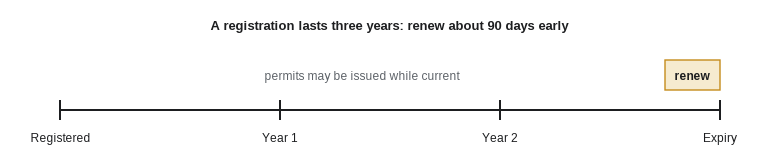
The regulations made under the Act set out a simple rule: a qualified electrical worker who wants an installation permit must be registered with the chief inspector. Registration carries a fee of 30 dollars, and a registration is valid for three years. Those numbers are set in the regulations and have not changed in a long time, so confirm them against the current consolidation before you rely on them.
The regulations do not describe a long application. In practice, Safety Services asks for proof of qualification, which for most people is a copy of their certificate of qualification, along with contact details and the fee. People approved by the chief inspector under section 4 of the Act already have a decision on file, which is their proof.
Why registration exists
Registration gives the chief inspector a list of the people who may hold installation permits. That list does three jobs. It confirms that each permit holder is qualified, it gives inspectors a contact for every permit, and it lets the chief inspector act if a person's work repeatedly falls short. Because the Act puts responsibility for an installation on the permit holder, the territory needs to know exactly who those permit holders are.
In a territory of about 40,000 people spread across 25 communities, many reachable only by air or, in summer, by sea, inspectors cannot know every electrician personally. A registration list with addresses, phone numbers and certificate details is how Safety Services connects a permit in Kugluktuk or Grise Fiord to a person who can answer questions about it.
What to send
Safety Services publishes its own application forms and contact information. Requirements can change, so always use the current form from the Government of Nunavut. A typical registration package for a certified electrician contains:
- the completed registration application;
- a copy of the electrician's certificate of qualification, front and back, including any Red Seal endorsement;
- contact details, including a mailing address and a phone number that works when the person is on a job in another community;
- the registration fee.
For a person approved by the chief inspector rather than certified, the approval letter replaces the certificate. Keep a copy of everything sent and a record of when it went, because mail and courier times between communities and Iqaluit can stretch from days to weeks.
Safety Services has offices in Iqaluit, Kinngait, Rankin Inlet and Cambridge Bay. Iqaluit is the main contact for most of the Qikiqtaaluk region, Rankin Inlet for the Kivalliq, and Cambridge Bay for the Kitikmeot. A toll-free line connects callers from any community. Check the Government of Nunavut's Safety Services page for current addresses and numbers.
Registration costs in context
At 30 dollars for three years, registration is one of the smallest costs in an electrical business. The bigger costs come from delays: a crew flown in to a community who cannot start because the permit holder's registration has lapsed. A worked example shows why a simple tracking system pays for itself.
Worked problem
The cost of a lapsed registration
Jeela sends Moses and Kyle to Pangnirtung for a two-week job. Moses is to hold the permit. On arrival, they learn his registration expired the week before, and Safety Services needs several working days to process a renewal. Flights for two are 1,600 dollars each way per person, accommodation is 250 dollars per person per night, and each worker earns 52 dollars an hour for eight hours a day. What does a three-day delay cost if they wait in Pangnirtung?
Show solution
- Accommodation: 2 people times 3 nights times 250 dollars, which is 1,500 dollars.
- Wages: 2 people times 3 days times 8 hours times 52 dollars, which is 2,496 dollars.
- Flights are already spent, so they are not part of the delay cost, unless the job must be rebooked.
- Total: about 3,996 dollars, plus the cost of rescheduling other work.
Answer: About 4,000 dollars, all to avoid a 30-dollar renewal sent on time.
The numbers are invented, but the shape is real. In the North, the cost of a mistake is mostly travel and idle time, not the fee.
Tracking registrations
Kilabuk Electric keeps registrations in the same spreadsheet as certificates. Peter Ootoova, the bookkeeper, adds a column for registration dates and a rule that flags anything due within 90 days. The table below shows the same check.
| Person | Registered | Expires (three-year term) | Days left on September 1, 2026 | Flag |
|---|---|---|---|---|
| Jeela Kilabuk | April 1, 2025 | April 1, 2028 | 578 | Current |
| Moses Akavak | November 15, 2023 | November 15, 2026 | 75 | Renew now |
| Kyle Brennan | June 20, 2026 | June 20, 2029 | 1,023 | Current |
Moses's 75 days are counted as 29 left in September, 31 in October and 15 in November. Anything under 90 days is flagged, and anything already past its expiry date would be flagged as expired, with no new permit taken out until the renewal is through.
Moses's registration in the example expires in November, inside the 90-day window, so Peter sends the renewal in September. That margin covers mail time and any questions from Safety Services.
What changes when you move or change employers
A registration belongs to the person, not the company. If Moses leaves Kilabuk Electric to work for another contractor, his registration goes with him. The company should update its own records, and Moses should tell Safety Services about any change of address or phone number so inspectors can reach him about permits he still holds.
A permit, on the other hand, cannot be transferred. The regulations say so directly. If the permit holder leaves a job before it is finished, the work under that permit needs to be dealt with: completed, inspected, or closed out, and a new permit taken out by the person who carries on. Lesson 4 covers the rules on cancelling and expiring permits.
Registration and the transition to new legislation
In November 2024, the Legislative Assembly passed amendments to the Technical Standards and Safety Act that will bring electrical safety under that broader statute and repeal the Electrical Protection Act when they take effect. The new framework may change how qualified workers are recognized, how long registrations or licences last, and what they cost. We could not confirm when those provisions come into force, so this course describes the system in the consolidated Electrical Protection Act and its regulations.
If you are registering now, use whatever process Safety Services currently runs. If you hear that a new licence or authorization has replaced registration, ask how existing registrations carry over. Transitional rules usually protect people already registered, but the details matter, and they come from the regulations and the department, not from this course.
Registration for approved workers
A person approved under section 4 may have conditions on their permits. Those conditions follow the person, not a particular job. When Doug MacLeod trained in Rankin Inlet decades ago, an older electrician he worked with held an approval limited to residential work in his community. Every permit issued to that man carried the same limit. When he renewed his registration, the approval and its conditions stayed on file.
If you hold an approval with conditions and want them changed, the route is to ask the chief inspector, with evidence such as completed training, a certificate earned since, or a record of inspected work. A newly earned certificate replaces the approval, because the person then qualifies on the first branch of the definition.
A registration checklist for a small company
Jeela's checklist, kept at the front of the company's permit binder, reads as follows. Each item is simple; the point is to do them every time.
- Before hiring: confirm the certificate and check whether the person is already registered in Nunavut.
- On hiring: send a registration application if needed, and copy the receipt to the job file.
- Every quarter: run the renewal check and send renewals 90 days early.
- On any change: update the person's address and phone number with Safety Services.
- On leaving: close out or reassign open work, because permits do not transfer.
Registration in practice: Peter's month
Peter does the company's books two days a week, and in September he spends one morning on registrations. He pulls the crew list, runs the renewal check, prints the forms for Moses's renewal and attaches a copy of Moses's certificate. He calls Safety Services in Iqaluit to confirm the current fee and how it can be paid, because the office has changed its payment options before. Then he notes in the permit binder the date the package was sent.
Three weeks later, a confirmation arrives. Peter files it and updates the spreadsheet. It is not interesting work, but it means that when Jeela needs Moses to take out a permit for a job in Kimmirut in December, the registration will not be the reason the job slips.
Peter also keeps a short list of questions for Safety Services whenever he calls, because getting answers by phone saves days of letters. In September his list includes how long renewals are taking, whether an emailed scan of a certificate is acceptable, and whether there is any news on the new legislation.
Registration and the people on the job
Elisapee asks Jeela why she has to wait years to register when Kyle registered in a week. Jeela's answer is that registration is not a test. It records a qualification a person already has. Elisapee's route runs through her apprenticeship: logged hours, technical training blocks in the South or in Nunavut, and the certification exam at the end. Once she holds her certificate, registration is a form and a fee.
Until then, Elisapee's records live with the apprenticeship office, not with Safety Services. Jeela keeps both sets of records in the permit binder, so the company can show an inspector at any time who on site is registered, who is an apprentice, and who supervises whom.
Doug adds one more practice from his years in Rankin Inlet. When a crew travels to a community, someone at the home office should be able to answer a call from an inspector about any open permit, even if the permit holder is on the land or out of cell range. A shared permit list with registration numbers makes that possible.
When the registration list matters to a client
Housing organizations and the territorial government often ask contractors to show that their electricians are qualified before a contract is signed. A clean registration list, with certificate numbers, registration dates and expiry dates, answers that question in one page. Jeela attaches hers to every bid for public housing work, alongside the company's insurance certificate and WSCC clearance, which Lesson 8 covers.
Clients also care about continuity. On a long retrofit program, the housing authority may want to know that if one permit holder is unavailable, another registered person can take over new permits without a gap. Showing two or three registered workers, with dates well clear of expiry, is a simple way to give that assurance.
Keeping that list current is part of running a reliable business. It costs almost nothing, and it prevents the kind of delay that damages a contractor's reputation in a small market where every client knows every other client.
Common mistakes
MistakeAssuming a provincial certificate lets a person take out a Nunavut permit straight away.
InsteadThe person is qualified, but must register before an installation permit is issued in their name.
MistakeSending a renewal the week it expires.
InsteadMail and processing time between communities can take weeks; send renewals about 90 days early.
MistakeTreating a registration as the company's.
InsteadRegistration belongs to the person and goes with them when they change employers.
MistakeLeaving open permits behind when a permit holder leaves.
InsteadPermits cannot be transferred; close out the work or have the new permit holder take out a new permit.
Summary and key terms
- A qualified electrical worker must register before an installation permit is issued in their name.
- The regulations set a 30-dollar fee and a three-year term.
- Registration belongs to the person and follows them between employers; permits do not transfer.
- Approved workers keep their approval and any conditions on file through renewal.
- Pending amendments to the Technical Standards and Safety Act may change the system, so check current rules.
- Registration
- Entry on the chief inspector's list of qualified electrical workers who may hold installation permits.
- Term
- The three-year period a registration is valid for.
- Renewal window
- The margin, such as 90 days, a company uses to renew before expiry.
- Proof of qualification
- A certificate of qualification or the chief inspector's approval letter.
- Safety Services
- The Government of Nunavut office that administers electrical registration, permits and inspection.
Practice problems
Work each problem on paper first, then reveal the answer to check.
Can an unregistered qualified electrical worker work under another person's permit?
Show answer
Yes, as an employee working under a registered permit holder, but they cannot hold an installation permit themselves.
Where are Safety Services offices located?
Show answer
Iqaluit, Kinngait, Rankin Inlet and Cambridge Bay, with a toll-free line.
What replaces the certificate in an approved worker's registration package?
Show answer
The chief inspector's approval letter.
Why send renewals early in Nunavut?
Show answer
Mail, courier and processing times between communities can be long, and a lapse stops new permits.
Lesson quiz · 5 questions
Score 60% or more to complete this lesson.
Create a free account to save your progress, take quizzes and earn a certificate.