
PHOT-302 · Lesson 1 of 12 · 25 min
The fashion and editorial industry
Fashion and editorial photography make some of the most visible images in the world: magazine covers and stories, advertising campaigns on billboards and buses, lookbooks that sell a designer's collection to buyers, and the endless stream of product images that fill online shops. Unlike portraiture, where the photograph serves a single sitter, fashion and editorial work serves several masters at once: a publication or brand, its audience, the clothes and the people who made them, and the creative vision of a team. This course follows that work from idea to published story. This first lesson maps the industry: how fashion images are commissioned and paid for, who the clients are, how editorial and commercial work relate, how the industry has changed with digital publishing and social media, and what it takes to build a career in it. The lighting foundations come from PHOT-210 and PHOT-211, and the work with people from PHOT-220; this course builds on both.
What fashion and editorial photography are
Fashion photography is photography whose primary purpose is to show, sell or interpret clothing, accessories, beauty products and the ideas around them. Editorial photography is photography made to accompany or tell a story in a publication, whether a magazine, newspaper, website or book. The two overlap constantly: a fashion editorial is a story in a magazine built around clothes, while a fashion campaign is advertising commissioned by a brand. The distinction that matters most in practice is who commissions the image and why. In editorial work, the publication commissions images for its readers, and the clothes are credited but not paid for; the photographer usually has more creative freedom and less money. In commercial work, a brand or agency commissions images to sell products, pays much more, and controls the result closely. Many photographers do both: editorial work builds reputation and portfolio, and commercial work pays the bills.
A short history
Fashion photography began in the early twentieth century as halftone printing made it possible to reproduce photographs in magazines. Baron Adolph de Meyer became Vogue's first staff photographer in 1913, creating soft, pictorialist images of society women. Edward Steichen's 1911 photographs of Paul Poiret gowns are often called the first modern fashion photographs, and his work for Condé Nast in the 1920s and 1930s brought modernist clarity. In the 1930s, Martin Munkácsi photographed models running on beaches, bringing movement and outdoor life into fashion; Toni Frissell and Louise Dahl-Wolfe made fashion feel active and modern. After the Second World War, Richard Avedon and Irving Penn defined the next decades: Avedon with energy, movement and personality, Penn with austere studio precision. Helmut Newton, Guy Bourdin and Deborah Turbeville in the 1970s pushed fashion toward narrative, provocation and atmosphere. Peter Lindbergh and Herb Ritts in the 1980s and 1990s brought black-and-white naturalism and the era of the supermodel; Corinne Day and Juergen Teller brought a rawer, documentary approach. In recent decades, photographers such as Nick Knight, Tim Walker, Tyler Mitchell, Viviane Sassen and many others have expanded the range of what fashion images can be, while digital capture, retouching and social media have transformed how they are made and seen.
| Period | Notable approaches | Examples of photographers |
|---|---|---|
| 1910s–1930s | Pictorialism, then modernist clarity | De Meyer, Steichen, Hoyningen-Huene, Horst |
| 1930s–1950s | Movement and outdoor life | Munkácsi, Frissell, Dahl-Wolfe |
| 1950s–1960s | Personality and studio precision | Avedon, Penn, Bailey |
| 1970s | Narrative, provocation and atmosphere | Newton, Bourdin, Turbeville |
| 1980s–1990s | Naturalism, supermodels, raw realism | Lindbergh, Ritts, Day, Teller |
| 2000s–today | Digital, conceptual, diverse voices | Knight, Walker, Sassen, Mitchell |
Who commissions fashion images
Understanding the clients helps you understand what each image must do:
- Magazines and publications: print and digital fashion magazines, newspaper style sections, independent magazines and online publications commission editorials, covers and portraits. Budgets range from almost nothing at independent titles to substantial sums for major covers, but editorial fees are generally low.
- Fashion brands and designers: from global luxury houses to small independent labels, they commission campaigns, lookbooks, e-commerce images and social content.
- Retailers: department stores and online retailers commission large volumes of e-commerce and campaign imagery.
- Beauty and cosmetics companies: commission campaigns, product and beauty images with strict standards for skin and product accuracy.
- Advertising and creative agencies: act for brands, hiring photographers for campaigns and managing the creative process.
- Public relations agencies and showrooms: commission lookbooks and press images.
- Models, actors and musicians: commission tests and promotional images.
Each client has different priorities: editorial clients care about story and reputation, brands care about the product and the brand image, and retailers care about volume, consistency and sales.
How the industry fits together
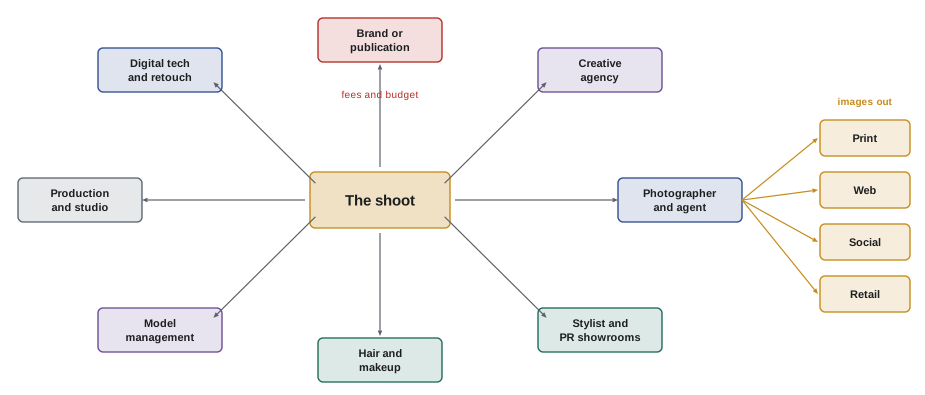
A fashion image usually involves many businesses. Designers and brands create the clothes; public relations agencies and showrooms lend samples to stylists for editorials; model management companies represent models; artist agencies represent photographers, stylists and hair and makeup artists; production companies handle logistics on larger shoots; rental studios, equipment houses and location agencies supply spaces and tools; retouching studios and digital technicians handle the files; and publications, advertisers and platforms carry the images to audiences. Understanding this ecosystem helps a photographer know whom to contact, whom to credit, who pays for what and how work flows.
Editorial and commercial economics
The economics of fashion photography are unusual. Editorial work at prestigious publications can pay modest day rates or flat fees that barely cover costs, and photographers sometimes spend their own money on production for the chance to be published, because editorial credits build the reputation that attracts commercial clients. Commercial work pays much more, through a creative fee or day rate plus a usage fee that reflects how widely and for how long the images will be used (Lesson 12). A global campaign may pay many times more than an editorial. E-commerce work pays steady day rates for high volumes of consistent images. Many photographers balance these: a few editorials a year for creative growth and visibility, regular commercial or e-commerce clients for income. Be cautious about working for exposure alone: it can be valuable when the publication genuinely reaches the clients you want, but it rarely pays the rent, and it can undermine fair rates for everyone.
The digital and social transformation
Since the 2000s, the fashion image industry has changed profoundly. Print magazine circulation and advertising revenue have declined, and many titles have closed or moved online, while digital publications, brand-owned media and social platforms have grown. Brands now produce enormous volumes of content for websites, social media, marketplaces and email, often shot in-house or by content studios, and image lifespans have shortened from a season to days. Influencers and creators have become both talent and publishers, and campaigns may combine traditional photography with short-form video. Digital capture and tethering have changed how shoots run (Lesson 10), and retouching and generative tools have changed what images can show (Lesson 11). At the same time, the craft of a well-made fashion image, with a clear idea, beautiful light, strong styling and authentic emotion, remains valued and recognizable.
Diversity, sustainability and responsibility
The fashion industry has been widely criticized for narrow beauty standards, lack of diversity in models and creative teams, exploitative treatment of young models, and environmental harm. These criticisms have produced real change: more diverse casting in size, age, ethnicity, gender identity and disability; health and welfare standards for models; laws protecting models in some jurisdictions; and greater attention to sustainability in production. Photographers have influence here: through whom they cast and hire, how they treat people on set, how they retouch, and what stories they choose to tell. Lessons 5 and 11 discuss these responsibilities in detail.
Careers in fashion and editorial photography
Most fashion photographers start as assistants, interns, digital technicians or retouchers, learning by working on other photographers' shoots, and build a portfolio through test shoots with new models, emerging stylists and hair and makeup artists. Others come from adjacent fields such as street style, music or portraiture, or build audiences on social platforms. Fashion centres such as Paris, Milan, London and New York remain important, and in Canada, Toronto and Montreal have active fashion, retail and advertising industries, with Vancouver strong in commercial and lifestyle work; in the United States, New York and Los Angeles dominate, with other cities supporting regional retail and e-commerce work. Career paths include editorial photographer, commercial and campaign photographer, e-commerce photographer, in-house brand photographer, content studio photographer, beauty photographer and fashion filmmaker. Agents represent established photographers, negotiating fees and finding work. Success depends on a distinctive vision, technical reliability, collaboration skills, professionalism and persistence.
Worked problem
Balancing a year of work
An emerging fashion photographer wants to build a reputation and earn a living. Over a year, they can realistically shoot 8 editorials that pay $300 each but cost about $400 each in production, 25 e-commerce days at $1,200, and 2 small commercial campaigns paying $6,000 each including usage. What is their net income from these, and what does each type of work contribute?
Show solution
- Editorials: 8 × ($300 − $400) = −$800 net, but they build portfolio and visibility.
- E-commerce: 25 × $1,200 = $30,000 of steady income.
- Campaigns: 2 × $6,000 = $12,000, with growth potential if editorial work attracts more.
- Total before other business costs: −$800 + $30,000 + $12,000 = $41,200.
Answer: About $41,200 before other costs; editorials lose money directly but support the reputation that wins better-paid work, while e-commerce provides a base income.
How this course works
The course moves through the life of a fashion shoot. Lesson 2 describes the main genres; Lesson 3, concepts and mood boards; Lesson 4, the creative team; Lesson 5, casting and model welfare; Lesson 6, pre-production; Lessons 7 and 8, studio and location fashion; Lesson 9, directing models; Lesson 10, digital capture and on-set workflow; Lesson 11, editing and sequencing a story and retouching standards; and Lesson 12, rights, pitching, business and the capstone editorial.
The fashion calendar
Fashion photography follows the rhythm of the fashion calendar. Designers show collections twice a year, usually spring and summer collections in the autumn and autumn and winter collections in late winter, at fashion weeks in New York, London, Milan and Paris, with growing weeks in Toronto, Montreal, Los Angeles and many other cities. Magazines plan their issues months ahead, so a September issue story may be shot in June or July with samples borrowed straight from the runway. Brands shoot campaigns and lookbooks before a collection reaches stores, and e-commerce teams shoot continuously as new products arrive. Resort, pre-fall and capsule collections, along with frequent product drops, add further shooting periods. Knowing the calendar helps photographers pitch at the right time, anticipate busy and quiet seasons, and understand why samples are often available only for a few days.
Fashion media today
The places where fashion images appear have multiplied. Printed magazines still carry prestige, especially for covers and major stories, but most fashion images are now seen on phones: on magazine websites, brand sites, social media feeds and short videos. Brands publish their own content, sometimes with in-house studios and creative teams, and creators and influencers produce images that compete with professional work. Many commissions now ask for stills and motion from the same shoot, vertical as well as horizontal versions, and behind-the-scenes content. For photographers, this means more outlets and more volume, but also pressure on budgets and timelines. The skills that distinguish professional fashion photographers, a clear point of view, excellent light, collaboration with a team and the ability to deliver reliably, matter more than ever in a crowded field.
Common mistakes
MistakeTreating editorial and commercial work as the same.
InsteadUnderstand who commissions the image and why.
MistakeIgnoring fashion photography history.
InsteadStudy the photographers who shaped the genre.
MistakeWorking for exposure without a plan.
InsteadChoose unpaid or low-paid work strategically.
MistakeSeeing fashion only as clothes.
InsteadUnderstand the ideas, people and businesses around them.
MistakeIgnoring the industry's responsibilities.
InsteadConsider diversity, welfare and sustainability in every choice.
Summary and key terms
- Fashion photography shows, sells or interprets clothing and beauty; editorial photography tells stories in publications.
- Editorial work offers freedom and reputation; commercial work pays more and is controlled closely.
- The genre evolved from pictorialism to modernism, movement, narrative and digital diversity.
- Clients include magazines, brands, retailers, beauty companies, agencies and talent.
- Many businesses contribute to every fashion image.
- Digital publishing and social media have multiplied content and shortened image lifespans.
- Careers grow through assisting, testing, collaboration and a distinctive vision.
- Fashion photography
- Photography that shows, sells or interprets clothing and beauty.
- Editorial
- Images made to accompany or tell a story in a publication.
- Campaign
- Advertising imagery commissioned by a brand.
- Lookbook
- Images presenting a collection to buyers and press.
- Showroom
- Business that lends designer samples to stylists.
- Model management company
- Agency that represents models.
- Artist agency
- Agency representing photographers and creatives.
- Usage fee
- Payment reflecting how images will be used.
- Test shoot
- Unpaid collaborative shoot to build portfolios.
- Content studio
- Business producing high volumes of brand imagery.
Practice problems
Work each problem on paper first, then reveal the answer to check.
What distinguishes editorial from commercial work?
Show answer
Who commissions it and why; publications vs brands.
Who was Vogue's first staff photographer?
Show answer
Baron Adolph de Meyer, from 1913.
What did Martin Munkácsi bring to fashion?
Show answer
Movement and outdoor life.
Name two photographers associated with the 1970s.
Show answer
Helmut Newton, Guy Bourdin, Deborah Turbeville.
Name four types of fashion clients.
Show answer
Magazines, brands, retailers, beauty companies, agencies, talent.
Who lends samples to stylists?
Show answer
PR agencies and showrooms.
Why do photographers accept low editorial fees?
Show answer
For reputation and portfolio that attract commercial work.
How has social media changed fashion images?
Show answer
More content, shorter lifespans, creators as talent and publishers.
Name two Canadian fashion centres.
Show answer
Toronto and Montreal.
How do most fashion photographers start?
Show answer
Assisting, digital tech or retouching, and test shoots.
Lesson quiz · 5 questions
Score 60% or more to complete this lesson.
Create a free account to save your progress, take quizzes and earn a certificate.