
PHYS-130 · Lesson 11 of 12 · 30 min
Oscillations, waves and sound
Anything with mass and a restoring force can vibrate: a car on its springs, a building swaying in the wind, a pendulum, a guitar string, the air in a pipe, the quartz crystal in a watch. Vibrations matter to engineers for two opposite reasons. They are useful, in clocks, sensors, loudspeakers, ultrasound and communication; and they can be destructive, shaking machines apart, fatiguing structures and annoying or harming people. When vibrations travel, they become waves, which carry energy without carrying matter, as sound, seismic waves and the ripples on a vibrating string. This lesson develops simple harmonic motion, its energy, damping and resonance, then the properties of mechanical waves, standing waves and harmonics, sound levels in decibels and the Doppler effect. MATH-201 treats the differential equations of vibration in more depth.
Simple harmonic motion
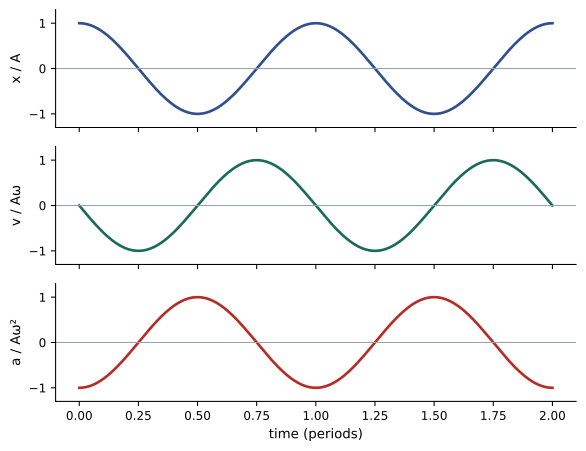
A mass m on a spring of stiffness k, displaced and released, experiences a restoring force −kx (Lesson 4). Newton's second law gives \(m\ddot{x} = -kx\), whose solution is a sinusoidal oscillation:
The amplitude A and phase φ depend on how the motion starts; the angular frequency ω depends only on the system. This is simple harmonic motion (SHM). The velocity \(-A\omega\sin(\omega t + \phi)\) is greatest as the mass passes through equilibrium, and the acceleration \(-\omega^2x\) is greatest at the extremes. Stiffer systems vibrate faster, heavier ones slower.
Worked problem
A car bouncing on its suspension
The car of Lesson 4 (1400 kg on four springs of 30 kN/m) is bounced at one corner. Treating one quarter of the car (350 kg) on one spring, find the natural frequency.
Show solution
- \(\omega = \sqrt{30\,000/350} = 9.26\) rad/s.
- \(f = 9.26/2\pi = 1.47\) Hz, a period of 0.68 s.
Answer: About 1.5 Hz. Car suspensions are tuned to roughly 1 to 1.5 Hz because people find vertical motion near that frequency comfortable, close to the rhythm of walking; much higher frequencies feel harsh.
Other systems behave the same way for small motions. A simple pendulum of length L has \(\omega = \sqrt{g/L}\), independent of the mass and, for small swings, of the amplitude, which is why pendulums kept time for three centuries. (For larger swings the period grows, as MATH-201 shows.) A pendulum with a 1 s swing each way (period 2 s) needs \(L = g/\pi^2 = 0.994\) m, the length of a grandfather clock's pendulum. Torsional pendulums, floating ships rolling in waves, and the air in a bottle when you blow across it are further examples.
Energy in SHM
With no friction, mechanical energy is conserved, and it moves back and forth between kinetic and elastic potential energy (Lesson 6):
At the extremes, all the energy is potential; at the centre, all kinetic, so the maximum speed is \(v_{max} = A\omega\). The energy is proportional to the square of the amplitude, a result that carries over to waves.
Damping and resonance
Real oscillations die away because friction, air resistance and internal losses remove energy: they are damped. With light damping, the system oscillates at nearly its natural frequency while the amplitude decays; with heavy damping, it returns slowly without oscillating; critical damping, the boundary between them, returns to rest fastest without overshoot, which is what door closers, vehicle shock absorbers (approximately) and measuring instruments aim for.
When a system is pushed by a periodic force, it eventually vibrates at the forcing frequency. If that frequency is close to the natural frequency, the response can be very large: resonance. With light damping, the amplitude at resonance can be tens of times the static deflection the same force would cause. Resonance is useful in radio tuning, musical instruments and ultrasonic cleaners, and dangerous in structures and machines. Rotating machinery is balanced and mounted so that its running speed is far from the natural frequencies of its supports; tall buildings and slender bridges are checked for wind and footfall excitation.
London's Millennium Bridge is a well-known example: on its opening day in 2000, crowds made it sway sideways, because the bridge's lateral natural frequency, about 1 Hz, matched the sideways sway of walking, and as the bridge moved, people unconsciously fell into step with it, adding to the force. The bridge was closed and fitted with dampers. The famous collapse of the Tacoma Narrows Bridge in 1940, by contrast, was not simple resonance but an aerodynamic instability (flutter) in which the wind fed energy into the twisting motion, a self-excited oscillation of the kind described in MATH-201.
Mechanical waves
A wave is a travelling disturbance that carries energy through a medium without carrying the medium along. In a transverse wave, such as a wave on a string, the medium moves perpendicular to the direction of travel; in a longitudinal wave, such as sound, it moves back and forth along it. Seismic waves include both: the faster P waves are longitudinal and the slower S waves transverse, and the delay between their arrivals tells seismologists how far away an earthquake was.
A sinusoidal wave has a wavelength λ (the distance between crests), a frequency f (crests passing per second) and a speed
The speed is set by the medium, not by the source. On a string with tension T and mass per unit length μ, \(v = \sqrt{T/\mu}\). In a fluid, the speed of sound is \(v = \sqrt{B/\rho}\), with B the bulk modulus (Lesson 9): about 343 m/s in air at 20 °C, 1480 m/s in water. In a solid bar it is \(\sqrt{E/\rho}\), about 5000 m/s in steel, which is why ultrasonic testing can locate a flaw from the timing of its echo.
Worked problem
Ultrasonic thickness testing
An ultrasonic gauge on a corroded steel pipe wall (sound speed 5900 m/s for this wave type) receives the echo from the far wall 3.2 µs after the pulse. Find the wall thickness.
Show solution
- The pulse travels to the far wall and back: distance \(= vt = 5900 \times 3.2 \times 10^{-6} = 0.0189\) m.
- Thickness = half of that: 9.4 mm.
Answer: 9.4 mm. If the original wall was 12.7 mm, about 3.3 mm has been lost to corrosion. Inspectors map wall thickness this way across pipelines, tanks and pressure vessels without cutting them open.
Superposition and standing waves
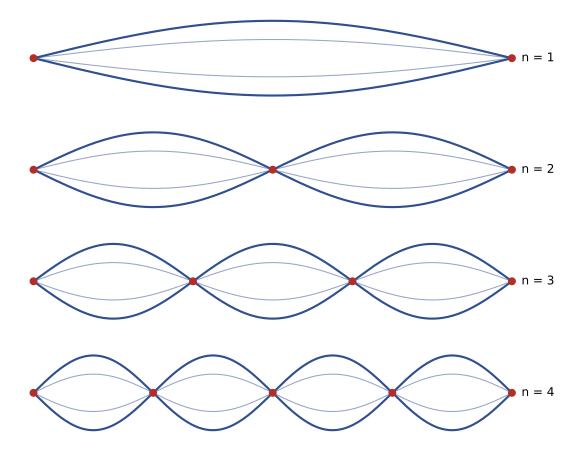
When two waves meet, the displacements add (the principle of superposition). Waves in step reinforce each other (constructive interference); waves half a wavelength out of step cancel (destructive interference), the principle behind noise-cancelling headphones. A wave reflected from a fixed end of a string travels back and combines with the incoming wave. At certain frequencies the combination is a standing wave: a pattern that oscillates in place, with nodes that never move and antinodes of maximum motion between them.
On a string of length L fixed at both ends, standing waves fit only when a whole number of half-wavelengths fits the length, \(L = n\lambda/2\). The allowed frequencies are the harmonics:
These are exactly the natural frequencies and mode shapes found for a taut cable in MATH-201. A pipe open at both ends has the same harmonic series for sound; a pipe closed at one end has only the odd harmonics, \(f_n = nv/(4L)\) with n odd. Every structure has a set of natural frequencies and mode shapes in the same way, which is why engineers compute them before checking for resonance.
Worked problem
Tuning a cable
A steel guy cable 20 m long, with a mass of 1.2 kg/m, is meant to carry a tension of 30 kN. An engineer plucks it and measures a fundamental frequency of 3.4 Hz. Is the tension correct?
Show solution
- From \(f_1 = \dfrac{1}{2L}\sqrt{T/\mu}\): \(T = \mu(2Lf_1)^2 = 1.2 \times (2 \times 20 \times 3.4)^2 = 22\,200\) N.
- The design tension of 30 kN would give \(f_1 = \dfrac{1}{40}\sqrt{30\,000/1.2} = 3.95\) Hz.
Answer: The cable carries only about 22 kN, three-quarters of its design tension, so it needs tightening. Measuring natural frequencies is a quick, non-destructive way to check tension in guy cables, bridge stays and post-tensioning tendons.
Sound intensity and decibels
The intensity of a wave is the power it carries per unit area, in W/m². Human hearing spans an enormous range, from about 10⁻¹² W/m² (the threshold of hearing) to 1 W/m² (painful), so sound is measured on a logarithmic scale, the sound level in decibels:
Every 10 dB is a tenfold increase in intensity, and 3 dB a doubling. Two equal sources together are therefore only 3 dB louder than one. For a small source radiating equally in all directions, intensity falls as \(1/r^2\), so the level drops by 6 dB for each doubling of distance. Occupational exposure limits are typically 85 dB(A) averaged over an 8-hour day in most Canadian jurisdictions and US guidance, with permitted time halving for each 3 dB increase (some US regulations use 90 dB(A) and 5 dB); HSE-241 covers hearing conservation.
Worked problem
Two machines
One machine produces 88 dB at a work position. A second identical machine is installed beside it. Find the new level, and the level if the worker moves to twice the distance from both.
Show solution
- Two equal sources double the intensity: 88 + 3 = 91 dB.
- Doubling the distance quarters the intensity: 91 − 6 = 85 dB.
Answer: 91 dB with both machines running, falling to 85 dB at twice the distance. Under an 85 dB, 3 dB exchange rule, the permitted daily exposure at 91 dB is only 2 hours; distance, enclosures and quieter machines are better controls than relying on hearing protection.
The Doppler effect
When a source of sound moves toward a listener, successive wave crests are emitted closer together, so the listener hears a higher frequency; when it moves away, a lower one. For a source moving at speed \(v_s\) directly toward or away from a stationary listener, with sound speed v:
using the minus sign for approach. For an ambulance siren at 700 Hz approaching at 25 m/s, \(f' = 700 \times 343/318 = 755\) Hz, falling to \(700 \times 343/368 = 652\) Hz as it passes. Doppler shifts of reflected waves measure speed: radar speed guns, Doppler ultrasound of blood flow, and the acoustic Doppler current profilers that measure river and ocean currents for hydrometric surveys.
Common mistakes
MistakeConfusing angular frequency ω (rad/s) with frequency f (Hz).
Insteadf = ω/2π and T = 1/f.
MistakeAssuming the period of a mass on a spring depends on amplitude.
InsteadFor SHM, T = 2π√(m/k) is independent of amplitude.
MistakeThinking the wave speed depends on the source frequency.
InsteadThe medium sets v; frequency and wavelength adjust so v = fλ.
MistakeAdding decibel values directly.
InsteadAdd intensities; two equal sources add only 3 dB.
MistakeIgnoring resonance when a forcing frequency is near a natural frequency.
InsteadCheck natural frequencies and keep forcing frequencies well away or add damping.
Summary and key terms
- SHM: x = A cos(ωt + φ) with ω = √(k/m); a pendulum has ω = √(g/L).
- Energy ½kA² is shared between kinetic and potential; v_max = Aω.
- Damping removes energy; critical damping returns fastest without overshoot.
- Resonance occurs when forcing frequency approaches a natural frequency.
- Waves: v = fλ; on a string v = √(T/μ); sound travels at about 343 m/s in air.
- Standing waves on a string have harmonics fₙ = nv/(2L).
- Sound level β = 10 log(I/I₀); +3 dB doubles intensity; the Doppler effect shifts frequency for moving sources.
- Simple harmonic motion
- Sinusoidal oscillation produced by a restoring force proportional to displacement.
- Natural frequency
- The frequency at which a system vibrates freely.
- Amplitude
- The maximum displacement from equilibrium.
- Damping
- Loss of vibrational energy to friction or other effects.
- Resonance
- A large response when forcing frequency is near a natural frequency.
- Transverse wave
- A wave in which the medium moves perpendicular to the direction of travel.
- Longitudinal wave
- A wave in which the medium moves along the direction of travel.
- Standing wave
- A wave pattern that oscillates in place, with fixed nodes.
- Harmonic
- A natural frequency that is a whole-number multiple of the fundamental.
- Decibel
- A logarithmic unit of sound level, 10 log₁₀(I/I₀).
- Doppler effect
- The change in observed frequency due to relative motion of source and observer.
Practice problems
Work each problem on paper first, then reveal the answer to check.
Find the frequency of a 2 kg mass on a spring with k = 800 N/m.
Show answer
ω = 20 rad/s; f = 3.18 Hz.
If the mass is quadrupled, what happens to the frequency?
Show answer
It halves.
Find the period of a 2.5 m pendulum.
Show answer
2π√(2.5/9.81) = 3.17 s.
A 0.5 kg mass oscillates with amplitude 0.1 m on a 200 N/m spring. Find the energy and maximum speed.
Show answer
E = 1.0 J; v_max = 2.0 m/s.
A wave of frequency 50 Hz has wavelength 0.8 m. Find its speed.
Show answer
40 m/s.
Find the wavelength of 1 kHz sound in air.
Show answer
0.343 m.
A string 0.65 m long has a fundamental of 196 Hz. Find the wave speed and the third harmonic.
Show answer
v = 2Lf = 255 m/s; f₃ = 588 Hz.
What sound level corresponds to I = 10⁻³ W/m²?
Show answer
90 dB.
A source gives 80 dB at 2 m. Find the level at 8 m.
Show answer
80 − 12 = 68 dB.
A train horn at 400 Hz recedes at 30 m/s. What frequency is heard?
Show answer
400 × 343/373 = 368 Hz.
Lesson quiz · 5 questions
Score 60% or more to complete this lesson.
Create a free account to save your progress, take quizzes and earn a certificate.