
PHYS-130 · Lesson 6 of 12 · 30 min
Potential energy, stability and energy in engineered systems
Lesson 5 introduced work, kinetic energy, gravitational potential energy and the conservation of mechanical energy, and showed how friction converts mechanical energy to heat. This lesson takes the energy method further. It explains which forces have a potential energy and why, shows how a potential energy curve reveals the force on a body, its equilibrium positions and whether they are stable, and develops the elastic potential energy of springs, which governs impact loads, bumpers and energy absorbers. It then widens the view to energy accounting in engineered systems: storage in pumped hydro and flywheels, the chain of efficiencies from electricity to useful work, and regenerative braking. Energy is often the quickest route to an answer, and it is always a powerful check.
Conservative and non-conservative forces
A force is conservative if the work it does on a body moving between two points depends only on the endpoints, not on the path. Equivalently, the work around any closed path is zero. Gravity and ideal spring forces are conservative: lifting a box up a ramp or straight up a ladder to the same height takes the same work against gravity, and that work is fully recovered when the box comes back down. Friction and drag are non-conservative: the longer the path, the more work they do, and that energy leaves the mechanical system as heat.
Only conservative forces have a potential energy U, defined so that the work done by the force from A to B is \(W = U_A - U_B\). Mechanical energy K + U is then conserved when only conservative forces do work, and in general
where \(W_{nc}\) is the work of the non-conservative forces (negative for friction, positive for an engine or a person pushing).
Force from potential energy
Since a conservative force does work equal to the decrease in potential energy, \(F\,dx = -dU\) in one dimension, so the force is minus the slope of the potential energy:
In three dimensions this becomes \(\mathbf{F} = -\nabla U\), the gradient of MATH-209. Checking: for gravity near the Earth, U = mgy gives F = −mg, downward; for a spring, \(U = \tfrac{1}{2}kx^2\) gives F = −kx, Hooke's law (Lesson 4). The force always points downhill on the potential energy curve, toward lower U.
Potential energy curves, equilibrium and stability
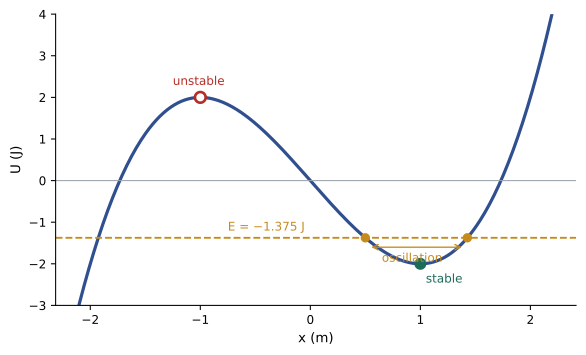
A graph of U(x) tells the whole story of one-dimensional motion under conservative forces. Where the slope is zero, the force is zero: these are equilibrium positions. At a minimum of U, a small displacement produces a force pushing the body back, so the equilibrium is stable; at a maximum, a small displacement produces a force pushing it farther away, so it is unstable; where the curve is flat over a range, the equilibrium is neutral. With total energy E, the body can move only where \(U(x) \le E\), since kinetic energy cannot be negative; the points where U = E are turning points, where the body momentarily stops and reverses.
Worked problem
Reading a potential energy curve
A body moves along x with \(U(x) = x^3 - 3x\) (in joules, x in metres). Find the equilibria and their stability, and describe the motion if it starts at rest at x = 0.5 m.
Show solution
- \(F = -dU/dx = -(3x^2 - 3)\), which is zero at x = ±1 m.
- \(d^2U/dx^2 = 6x\): positive at x = 1 (a minimum, stable) and negative at x = −1 (a maximum, unstable).
- Starting at rest at x = 0.5: E = U(0.5) = 0.125 − 1.5 = −1.375 J. The body oscillates about x = 1 between the two points where U = −1.375 J: x = 0.5 m and, solving \(x^3 - 3x + 1.375 = 0\), x ≈ 1.43 m.
Answer: A stable equilibrium at x = 1 m, an unstable one at x = −1 m, and an oscillation between 0.5 m and 1.43 m. If the body had energy above U(−1) = 2 J it could pass over the hump and escape toward negative x. The same reasoning describes molecules, buckling structures and the stability of a ship.
Engineers use this reasoning for stability questions everywhere. A ship is stable when tilting it raises its centre of gravity relative to the centre of buoyancy, so its potential energy has a minimum in the upright position. A ball in a bowl is stable; a pencil balanced on its point is not. A slender column under load (MATH-201) loses stability when its potential energy changes from a minimum to a maximum as the load increases, which is buckling.
Elastic potential energy and impact
Stretching or compressing a spring by x stores elastic potential energy \(U = \tfrac{1}{2}kx^2\), the area under the force-extension line. This energy can be released as motion (a spring launcher, a bow) or must be absorbed when a moving mass is brought to rest (a bumper, a cable stopping a falling load, a car's crumple zone).
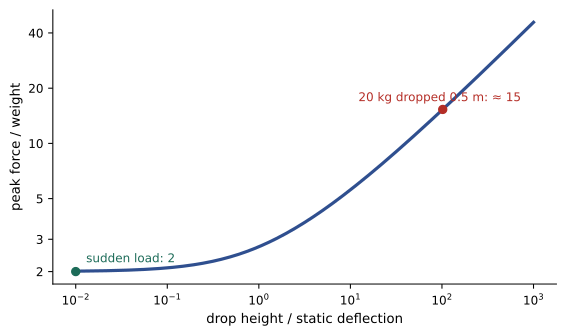
Energy gives a quick, important result for impact. A mass dropped onto a spring compresses it far more than the same mass resting on it, and the peak force is correspondingly larger.
Worked problem
A dropped load
A 20 kg weight falls from rest through 0.50 m onto a spring with k = 40 kN/m. Find the maximum compression and the peak force, and compare with the weight resting on the spring.
Show solution
- Static compression: \(\delta_{st} = mg/k = 196.2/40\,000 = 4.9\) mm.
- Energy from release to maximum compression δ: the weight falls h + δ, so \(mg(h + \delta) = \tfrac{1}{2}k\delta^2\).
- \(20\,000\delta^2 - 196.2\delta - 98.1 = 0\), so \(\delta = 0.0751\) m (75 mm).
- Peak force: \(k\delta = 40\,000 \times 0.0751 = 3000\) N, about 15 times the weight.
Answer: A maximum compression of 75 mm and a peak force of about 3000 N, fifteen times the static value. Even a weight placed suddenly on the spring (h = 0) gives twice the static force. Dynamic loads like this are why lifting slings, guardrails and fall-arrest systems are designed for impact, and why fall-arrest lanyards include energy absorbers that lengthen the stopping distance.
Energy storage
Large-scale energy storage is one of the central challenges of electricity systems with high shares of wind and solar power. Mechanical storage stores energy as potential or kinetic energy. Pumped hydro storage, by far the largest form of grid storage worldwide, pumps water uphill when electricity is cheap and plentiful and releases it through turbines when it is needed; the stored energy is \(E = \rho Vgh\).
Worked problem
A pumped storage reservoir
An upper reservoir holds 1.0 × 10⁶ m³ of usable water, 300 m above the lower reservoir. How much electrical energy can it deliver, with an 88% generating efficiency?
Show solution
- Stored potential energy: \(1000 \times 1.0 \times 10^6 \times 9.81 \times 300 = 2.94 \times 10^{12}\) J.
- In kilowatt-hours: \(2.94 \times 10^{12}/3.6 \times 10^6 = 818\,000\) kWh, or 818 MWh.
- Delivered: 0.88 × 818 = 720 MWh.
Answer: About 720 MWh, enough to supply 240 MW for three hours. Large heads matter: the same energy at 30 m would need ten times the water. Including pumping losses, pumped hydro typically returns 70 to 80% of the electricity used to fill it.
Flywheels store kinetic energy of rotation (Lesson 8) and can deliver it very quickly, which suits short-term frequency regulation and uninterruptible power supplies; springs and compressed air are used on smaller scales. Comparing the energy stored per kilogram shows why chemical storage dominates portable uses: a lithium-ion battery stores roughly 0.5 to 0.9 MJ/kg, gasoline about 46 MJ/kg of chemical energy, while lifting a kilogram of water 300 m stores only about 3 kJ.
Efficiency chains
In a system of several stages, each with its own efficiency, the overall efficiency is the product of the stage efficiencies. Every stage loses some energy as heat, so systems with many conversions waste a surprising share of their input.
Worked problem
A pumping station
A pump station has a motor drive (efficiency 0.95), an electric motor (0.93), a coupling and gearbox (0.97) and a pump (0.78). It must lift 0.20 m³/s of water through a total head of 40 m. Find the electrical input power.
Show solution
- Useful hydraulic power: \(\rho gQh = 1000 \times 9.81 \times 0.20 \times 40 = 78.5\) kW.
- Overall efficiency: \(0.95 \times 0.93 \times 0.97 \times 0.78 = 0.668\).
- Input: 78.5/0.668 = 117 kW.
Answer: About 117 kW of electricity for 78.5 kW of useful work: a third is lost as heat, most of it in the pump. Since pumps use a large share of the electricity in water and industrial systems, choosing the right pump and running it near its best-efficiency point is one of the most effective energy savings available.
The same accounting applies to time-varying loads. A pump that must deliver a large flow only for a few hours a day can be sized for that peak, or a smaller pump can fill a storage tank continuously and let the tank meet the peak: the energy delivered is the same, but the power rating, and with it the cost of the motor and electrical supply, is lower. Choosing between power and energy in this way is one of the commonest decisions in engineering design, from water systems to battery packs.
Regenerative braking
A conventional vehicle turns its kinetic energy into heat in the brakes every time it stops. Electric and hybrid vehicles can run their motors as generators to recover part of it. For a 1600 kg car stopping from 60 km/h (16.7 m/s), the kinetic energy is \(\tfrac{1}{2} \times 1600 \times 16.7^2 = 222\) kJ. If 60% is recovered, after losses in the motor, inverter and battery, about 133 kJ returns to the battery, enough to reaccelerate a good part of the way. In stop-and-go city driving, where braking is frequent, regeneration can extend range noticeably; on the highway, where drag (Lesson 4) dominates and braking is rare, it matters little. Energy accounting shows at once which improvements pay off in which situations.
Common mistakes
MistakeDefining a potential energy for friction.
InsteadOnly conservative forces have potential energy; friction appears as W_nc.
MistakeForgetting the minus sign in F = −dU/dx.
InsteadThe force points toward lower potential energy.
MistakeIgnoring the extra fall distance δ in an impact problem.
InsteadThe weight descends h + δ while compressing the spring.
MistakeDesigning for static load when a load can be dropped or applied suddenly.
InsteadEven a suddenly applied load doubles the force; dropped loads can multiply it many times.
MistakeAdding stage efficiencies or losses.
InsteadMultiply the efficiencies of the stages.
Summary and key terms
- Conservative forces do path-independent work and have a potential energy; non-conservative forces do not.
- K₁ + U₁ + W_nc = K₂ + U₂ accounts for all forces.
- F = −dU/dx: the force points downhill on the potential energy curve.
- Minima of U are stable equilibria, maxima unstable; motion is confined to U ≤ E between turning points.
- Elastic energy ½kx² governs impacts; a dropped load can produce many times its weight in force.
- Pumped hydro stores ρVgh; flywheels store rotational kinetic energy.
- Overall efficiency is the product of stage efficiencies; regenerative braking recovers part of a vehicle's kinetic energy.
- Conservative force
- A force whose work is independent of path.
- Non-conservative force
- A force, such as friction, whose work depends on path and removes mechanical energy.
- Potential energy curve
- A graph of potential energy against position.
- Stable equilibrium
- An equilibrium at a minimum of potential energy.
- Unstable equilibrium
- An equilibrium at a maximum of potential energy.
- Turning point
- A position where kinetic energy is zero and the motion reverses.
- Elastic potential energy
- Energy ½kx² stored in a deformed spring.
- Impact factor
- The ratio of peak dynamic force to static weight.
- Pumped hydro storage
- Storing energy by pumping water to a higher reservoir.
- Regenerative braking
- Recovering kinetic energy by running a motor as a generator.
Practice problems
Work each problem on paper first, then reveal the answer to check.
Find F(x) for U = 4x² − 2x (J, m).
Show answer
F = −8x + 2 N.
Where is that force zero, and is the equilibrium stable?
Show answer
x = 0.25 m; stable (U″ = 8 > 0).
A spring with k = 500 N/m is compressed 0.10 m. How much energy does it store?
Show answer
2.5 J.
That spring launches a 0.05 kg ball horizontally. Find the launch speed.
Show answer
√(2 × 2.5/0.05) = 10 m/s.
What peak force results when a load is applied suddenly (h = 0) to a spring?
Show answer
Twice the weight (δ = 2δ_st).
A 10 kg mass falls 0.2 m onto a spring with k = 10 kN/m. Find the maximum compression.
Show answer
5000δ² − 98.1δ − 19.6 = 0: δ = 0.073 m.
How much energy is stored by 5000 m³ of water raised 100 m, in kWh?
Show answer
4.9 × 10⁹ J = 1360 kWh.
Stages have efficiencies 0.9, 0.8 and 0.95. Find the overall efficiency.
Show answer
0.684.
A 12 t bus brakes from 50 km/h. How much kinetic energy is available for regeneration?
Show answer
½ × 12 000 × 13.9² = 1.16 MJ.
Why does regenerative braking help more in the city than on the highway?
Show answer
City driving involves frequent braking; highway energy goes mainly to drag, which cannot be recovered.
Lesson quiz · 5 questions
Score 60% or more to complete this lesson.
Create a free account to save your progress, take quizzes and earn a certificate.