
PHYS-131 · Lesson 10 of 12 · 28 min
Electromagnetic waves and light
Lessons 1 to 9 treated electric and magnetic fields separately or linked through induction. Their full connection has an astonishing consequence: a changing electric field creates a magnetic field and a changing magnetic field creates an electric field, so together they can sustain each other and travel through empty space as an electromagnetic wave. Radio, Wi-Fi, mobile phones, radar, microwave ovens, infrared thermometers, visible light, X-rays and fibre-optic communication are all the same phenomenon at different frequencies. This lesson describes how electromagnetic waves arise, the electromagnetic spectrum and its engineering uses, the energy and intensity the waves carry, polarization, reflection and refraction, the total internal reflection that guides light along optical fibres, and the photon picture of light that explains solar cells and LEDs (Lesson 11).
From fields to waves
Faraday's law (Lesson 7) says a changing magnetic field induces an electric field. Maxwell added the complementary statement: a changing electric field produces a magnetic field, just as a current does. Combining the two laws gives a wave equation for both fields (MATH-209), with a speed that depends only on the electric and magnetic constants:
This is the measured speed of light, and in 1865 the agreement told Maxwell that light is an electromagnetic wave. In such a wave the electric and magnetic fields are perpendicular to each other and to the direction of travel (a transverse wave), oscillate in phase, and have magnitudes related by E = cB. Any accelerating charge radiates: the oscillating currents in an antenna launch radio waves; the vibrating charges in hot objects emit infrared and visible light; electrons decelerating in a target produce X-rays. Like all waves (PHYS-130), electromagnetic waves obey \(c = f\lambda\) in vacuum.
The electromagnetic spectrum
| Region | Wavelength | Frequency | Engineering uses |
|---|---|---|---|
| Radio | over 1 m | below 300 MHz | AM/FM broadcasting, two-way radio, power-line carrier |
| Microwave | 1 mm to 1 m | 300 MHz to 300 GHz | mobile phones, Wi-Fi, radar, satellite links, microwave ovens |
| Infrared | 700 nm to 1 mm | 300 GHz to 430 THz | thermal imaging, remote controls, fibre optics (1310 and 1550 nm) |
| Visible | 400 to 700 nm | 430 to 750 THz | lighting, displays, cameras, machine vision |
| Ultraviolet | 10 to 400 nm | 750 THz to 30 PHz | water disinfection, curing adhesives, photolithography |
| X-rays and gamma rays | below 10 nm | above 30 PHz | medical imaging, weld inspection, sterilization |
Different parts of the spectrum interact with matter in very different ways, which decides how each is used. Long radio waves bend around hills and reflect from the ionosphere; microwaves pass through clouds but are absorbed by water, which is how a microwave oven heats food; infrared is emitted by everything warm, so thermal cameras can find overheating electrical connections and heat leaks in buildings; and X-rays pass through soft tissue and thin metal but are stopped by denser material, revealing bones and hidden weld defects.
Worked problem
Wavelengths of wireless signals
Find the wavelengths of Wi-Fi at 2.4 GHz, a 5G millimetre-wave band at 28 GHz, and an FM radio station at 100 MHz.
Show solution
- 2.4 GHz: \(\lambda = 3.00 \times 10^8/2.4 \times 10^9 = 0.125\) m.
- 28 GHz: \(\lambda = 0.0107\) m, about 11 mm.
- 100 MHz: \(\lambda = 3.0\) m.
Answer: 12.5 cm, 11 mm and 3 m. Antennas are typically a half or quarter wavelength long, which is why an FM antenna is about 75 cm and a phone's antennas fit inside its case. Millimetre waves carry huge bandwidth but are blocked by walls, foliage and even rain, so 5G millimetre-wave cells must be small and closely spaced.
Energy and intensity
Electromagnetic waves carry energy, shared equally between the electric and magnetic fields. The power per unit area carried by a wave, its intensity, is the average of the Poynting vector (MATH-209):
where \(E_0\) is the amplitude of the electric field, and 377 Ω is the impedance of free space, \(\sqrt{\mu_0/\varepsilon_0}\). From a small source radiating power P equally in all directions, the intensity falls with the inverse square of distance, \(I = P/(4\pi r^2)\), as for sound (PHYS-130).
Worked problem
Sunlight and a radio transmitter
Find the electric field amplitude in sunlight of intensity 1000 W/m², and the intensity and RMS field 100 m from an antenna radiating 1.0 kW equally in all directions.
Show solution
- Sunlight: \(E_0 = \sqrt{2I/(c\varepsilon_0)} = \sqrt{2000/(3.00 \times 10^8 \times 8.854 \times 10^{-12})} = 870\) V/m.
- Transmitter: \(I = 1000/(4\pi \times 100^2) = 7.96 \times 10^{-3}\) W/m², so \(E_{rms} = \sqrt{377 \times 0.00796} = 1.7\) V/m.
Answer: Sunlight has a field amplitude of about 870 V/m; the transmitter produces about 1.7 V/m at 100 m. Exposure limits for radio-frequency fields for the general public (Health Canada's Safety Code 6 and FCC rules in the United States) are set in these terms and are typically tens of volts per metre at broadcast frequencies, so safety assessments focus on the region close to antennas.
Electromagnetic waves also carry momentum and exert radiation pressure, I/c on an absorbing surface: only about 3 µPa for full sunlight, but enough to steer solar sails and to require correction in the orbits of satellites with large solar panels.
Polarization
The direction of a wave's electric field defines its polarization. Antennas emit polarized waves, and a receiving antenna must be aligned with them: a vertical antenna picks up little from a horizontally polarized signal. Light from the Sun or a lamp is unpolarized, a random mixture of directions, but a polarizing filter transmits only one component. Ideal polarizers transmit half of unpolarized light, and polarized light passing through a polarizer at angle θ to its polarization direction follows Malus's law:
Light reflected from water, roads and glass is partly polarized horizontally, which is why polarized sunglasses, with vertical transmission axes, cut glare. Liquid crystal displays work by using an electric field to rotate the polarization of light between crossed polarizers, switching each pixel between bright and dark. Engineers also use polarized light to reveal stress patterns in transparent models and in glass (photoelasticity).
Reflection and refraction
Light slows down in transparent materials, travelling at v = c/n, where n is the refractive index: about 1.33 for water, 1.5 for glass and 1.46 to 1.48 for the silica in optical fibres. At a boundary between materials, some light reflects, with angle of reflection equal to the angle of incidence, and the rest refracts, changing direction according to Snell's law:
with angles measured from the normal. Light entering a denser medium bends toward the normal. Because n varies slightly with wavelength (dispersion), a prism separates white light into colours, and pulses of light in a fibre spread out over long distances, limiting data rates.
Total internal reflection and optical fibres
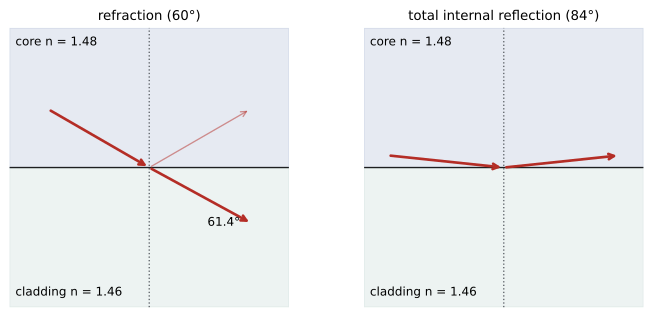
When light travels from a denser medium toward a less dense one (\(n_1 > n_2\)), it bends away from the normal. At the critical angle \(\theta_c\), with \(\sin\theta_c = n_2/n_1\), the refracted ray skims along the boundary; beyond it, no light escapes and all of it is reflected. This total internal reflection is lossless, which is what makes optical fibres possible. A fibre has a core of slightly higher refractive index than the surrounding cladding, so light entering within a certain cone is trapped and guided along the core for kilometres, around gentle bends.
Worked problem
An optical fibre
A fibre has a core index of 1.48 and a cladding index of 1.46. Find the critical angle at the core-cladding boundary, the numerical aperture \(NA = \sqrt{n_1^2 - n_2^2}\) and the acceptance half-angle in air, and the time light takes to travel 1 km.
Show solution
- \(\theta_c = \sin^{-1}(1.46/1.48) = 80.6°\) from the normal.
- \(NA = \sqrt{1.48^2 - 1.46^2} = 0.242\); acceptance half-angle \(\sin^{-1}0.242 = 14.0°\).
- Speed in the core: \(3.00 \times 10^8/1.48 = 2.03 \times 10^8\) m/s, so 1 km takes 4.9 µs.
Answer: Light must strike the boundary at more than 80.6° from the normal, which corresponds to entering the fibre within 14° of its axis. Signals take about 4.9 µs per kilometre, a delay that matters for financial trading networks and for synchronizing data centres (DCE courses). Modern single-mode fibres, with tiny cores, carry terabits per second over thousands of kilometres with optical amplifiers, and losses as low as 0.2 dB/km at 1550 nm.
Antennas and links
An antenna converts guided currents into radiated waves and back again. The simplest efficient design, the half-wave dipole, is two conductors each a quarter wavelength long, fed at the centre; a monopole of a quarter wavelength over a ground plane, such as a car's whip antenna, works the same way. Antennas radiate more strongly in some directions than others, described by their gain: a dish antenna concentrates its power into a narrow beam, which is why satellite dishes must be aimed accurately. Antennas also work identically in transmission and reception (reciprocity), so the same gain helps in both directions.
For a radio link in free space, the received power falls with the square of distance and, for antennas of fixed gain, with the square of frequency. The Friis transmission equation summarizes this: \(P_r = P_tG_tG_r\left(\lambda/4\pi d\right)^2\). A 0.1 W Wi-Fi transmitter at 2.4 GHz with simple antennas (gains near 1) delivers about \(0.1 \times (0.125/(4\pi \times 30))^2 = 1.1 \times 10^{-8}\) W, about −50 dBm, to a receiver 30 m away in open space, still comfortably above the sensitivity of a typical receiver. Walls, floors and people absorb and reflect the signal, which is why indoor coverage falls off much faster, and why engineers plan wireless networks with surveys and models rather than the free-space formula alone.
Light as photons
Some properties of light cannot be explained by waves. In the photoelectric effect, light ejects electrons from a metal only if its frequency exceeds a threshold, however intense the light. Einstein explained this in 1905: light energy comes in packets, photons, each with energy
A convenient form is \(E\ (\text{eV}) = 1240/\lambda\ (\text{nm})\). A red photon at 650 nm carries 1.9 eV, a blue one at 450 nm 2.8 eV, and an ultraviolet photon at 254 nm, used for disinfection, 4.9 eV, enough to break chemical bonds in DNA. Whether a material absorbs or emits light, and at what colour, depends on how photon energies compare with the energy levels of its electrons, the principle behind LEDs, lasers, solar cells and digital camera sensors, developed in Lesson 11.
Common mistakes
MistakeThinking radio waves and light are different phenomena.
InsteadAll are electromagnetic waves; only the frequency differs.
MistakeUsing the vacuum speed of light inside glass or fibre.
InsteadLight travels at c/n in a material.
MistakeMeasuring angles in Snell's law from the surface.
InsteadAngles are measured from the normal to the surface.
MistakeExpecting total internal reflection when light goes into a denser medium.
InsteadIt occurs only from a higher to a lower refractive index, beyond the critical angle.
MistakeAssuming brighter light gives each photon more energy.
InsteadPhoton energy depends on frequency; intensity sets the number of photons.
Summary and key terms
- Changing E and B fields sustain each other as waves travelling at c = 1/√(μ₀ε₀) = 3.00 × 10⁸ m/s.
- E and B are perpendicular to each other and to the direction of travel, with E = cB; c = fλ.
- The spectrum runs from radio through microwaves, infrared, visible and ultraviolet to X-rays and gamma rays.
- Intensity I = ½cε₀E₀² = E_rms²/377 Ω, falling as 1/r² from a small source.
- Polarizers obey Malus's law I = I₀ cos²θ.
- Snell's law n₁ sin θ₁ = n₂ sin θ₂; total internal reflection beyond θ_c = sin⁻¹(n₂/n₁) guides light in fibres.
- Photons carry energy E = hf; E (eV) = 1240/λ (nm).
- Electromagnetic wave
- Coupled oscillating electric and magnetic fields travelling at the speed of light.
- Electromagnetic spectrum
- The range of electromagnetic waves ordered by frequency or wavelength.
- Intensity
- Power per unit area carried by a wave.
- Impedance of free space
- √(μ₀/ε₀) ≈ 377 Ω, relating E and H in a plane wave.
- Polarization
- The direction of oscillation of a wave's electric field.
- Refractive index
- n = c/v, the factor by which light slows in a material.
- Snell's law
- n₁ sin θ₁ = n₂ sin θ₂ for refraction at a boundary.
- Critical angle
- The angle of incidence beyond which total internal reflection occurs.
- Numerical aperture
- A measure of the light-gathering cone of a fibre, √(n₁² − n₂²).
- Photon
- A quantum of electromagnetic energy, E = hf.
Practice problems
Work each problem on paper first, then reveal the answer to check.
Find the frequency of light with a wavelength of 1550 nm.
Show answer
1.94 × 10¹⁴ Hz (194 THz).
A wave has E₀ = 300 V/m. Find B₀.
Show answer
1.0 µT.
Find the intensity of a wave with E_rms = 10 V/m.
Show answer
100/377 = 0.27 W/m².
A source radiates 100 W equally. Find the intensity at 10 m.
Show answer
100/(4π × 100) = 0.080 W/m².
Polarized light of 50 W/m² meets a polarizer at 60°. Find the transmitted intensity.
Show answer
50 cos² 60° = 12.5 W/m².
Light enters water (n = 1.33) from air at 45°. Find the refraction angle.
Show answer
sin θ₂ = 0.707/1.33: θ₂ = 32.1°.
Find the critical angle for glass (1.50) to air.
Show answer
41.8°.
Find the NA of a fibre with n₁ = 1.47 and n₂ = 1.45.
Show answer
√(2.1609 − 2.1025) = 0.242.
How long does light take to cross 100 km of fibre (n = 1.47)?
Show answer
0.49 ms.
Find the photon energy of green light at 530 nm.
Show answer
1240/530 = 2.34 eV.
Lesson quiz · 5 questions
Score 60% or more to complete this lesson.
Create a free account to save your progress, take quizzes and earn a certificate.