
PHYS-131 · Lesson 3 of 12 · 28 min
Gauss's law and conductors
Lesson 2 found electric fields by adding up the contributions of point charges, and stated a few results from Gauss's law in brief. Adding contributions works for any arrangement, but for charge spread over a sphere, along a wire or across a plate it means integrating, often laboriously. Gauss's law offers a shortcut whenever the charge distribution is symmetric, and it is also one of the four fundamental laws of electromagnetism (MATH-209). This lesson defines electric flux, states Gauss's law and uses it to find the fields of charged spheres, wires, coaxial cables and plates. It then explains how conductors behave in electrostatic equilibrium: why the field inside them vanishes, why charge gathers on their outer surfaces and at sharp points, and how these facts are used in lightning protection, electrostatic shielding and the design of high-voltage equipment.
Electric flux
Picture the electric field as lines flowing out of positive charges. The electric flux through a surface measures how much field passes through it. For a uniform field E crossing a flat area A whose normal makes an angle θ with the field,
where \(\mathbf{A}\) is a vector of magnitude A pointing along the outward normal (Lesson 2 of PHYS-130 introduced the dot product). Flux is greatest when the field crosses the surface squarely and zero when the field runs along it. For a curved surface or a varying field, the surface is divided into small patches and the contributions are added: \(\Phi_E = \oint \mathbf{E} \cdot d\mathbf{A}\) over a closed surface. Flux leaving a closed surface counts as positive and flux entering it as negative.
Gauss's law
Gauss's law states that the total electric flux out of any closed surface equals the charge enclosed divided by the permittivity of free space:
Charges outside the surface contribute field lines that enter and leave, adding nothing to the net flux. The law holds for any closed surface, but it is useful for finding fields only when symmetry lets you choose a Gaussian surface on which the field has the same magnitude everywhere and is either perpendicular or parallel to the surface. Then the integral becomes simply E times an area. Three symmetries cover most engineering cases.
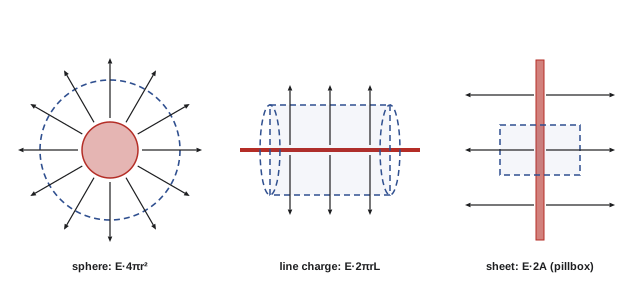
Spherical symmetry
For a total charge Q spread uniformly over or through a sphere of radius R, choose a concentric spherical Gaussian surface of radius r > R. By symmetry the field is radial and the same everywhere on it, so \(E \cdot 4\pi r^2 = Q/\varepsilon_0\) and
exactly the field of a point charge at the centre, the result quoted in Lesson 2. Inside a hollow charged shell, the Gaussian surface encloses no charge, so the field is zero.
Worked problem
The limit of a Van de Graaff generator
A Van de Graaff generator has a spherical dome of radius 0.20 m. Air breaks down at about 3 MV/m. Find the maximum charge and voltage the dome can hold.
Show solution
- At the surface, \(E = Q/(4\pi\varepsilon_0R^2) \le 3 \times 10^6\) V/m.
- \(Q_{max} = 4\pi\varepsilon_0R^2E = 4\pi \times 8.854 \times 10^{-12} \times 0.04 \times 3 \times 10^6 = 1.3 \times 10^{-5}\) C.
- Potential of the sphere: \(V = Q/(4\pi\varepsilon_0R) = ER = 3 \times 10^6 \times 0.20 = 600\) kV.
Answer: About 13 µC and 600 kV. Since V = ER at the breakdown field, a larger dome holds a higher voltage, which is why high-voltage laboratory equipment uses large, smoothly rounded electrodes.
Cylindrical symmetry
For a long straight wire, or any long cylinder, with charge λ per unit length, choose a coaxial cylindrical Gaussian surface of radius r and length L. The field is radial, so no flux passes through the flat end caps, and through the curved side \(E \cdot 2\pi rL = \lambda L/\varepsilon_0\):
The field falls off as 1/r, more slowly than from a point charge. Inside a coaxial cable, the field between the conductors has this form, and it is strongest at the surface of the inner conductor, which governs the cable's voltage rating (MATH-209).
Worked problem
Corona on a transmission line
A single 15 mm radius conductor of a high-voltage line is 15 m above the ground and at 200 kV relative to it. A standard result for a wire above a conducting plane gives the surface field as \(E = V/[r\ln(2h/r)]\). Find E and compare with the onset of corona discharge, roughly 2 to 3 MV/m for a smooth conductor in fair weather.
Show solution
- \(\ln(2h/r) = \ln(30/0.015) = \ln 2000 = 7.60\).
- \(E = 200\,000/(0.015 \times 7.60) = 1.75 \times 10^6\) V/m.
Answer: About 1.75 MV/m, uncomfortably close to corona onset, especially in rain, fog or with surface scratches and insects that raise the local field. Corona wastes power, causes audible crackling and radio interference, so higher-voltage lines use bundles of two to four conductors per phase, which act like one large conductor and lower the surface field.
Planar symmetry
For a large flat sheet with charge σ per unit area, choose a short "pillbox" cylinder straddling the sheet, with faces of area A on each side. Field lines cross both faces perpendicularly and none cross the curved side, so \(2EA = \sigma A/\varepsilon_0\) and \(E = \sigma/(2\varepsilon_0)\), independent of distance. Two parallel plates with opposite charges ±σ have fields that add between them, \(E = \sigma/\varepsilon_0\), and cancel outside: the uniform field of the parallel-plate capacitor (Lesson 4).
Worked problem
The Earth's surface charge
In fair weather, a downward electric field of about 130 V/m exists just above flat ground. Treating the ground as a conductor with all its excess charge on the surface, find the surface charge density.
Show solution
- Just outside a conductor, \(E = \sigma/\varepsilon_0\) (see below), so \(\sigma = \varepsilon_0E = 8.854 \times 10^{-12} \times 130 = 1.15 \times 10^{-9}\) C/m².
- The field points down, toward the ground, so the ground carries negative charge.
Answer: About −1.2 nC/m². Over the whole Earth this amounts to roughly half a million coulombs, maintained by thunderstorms around the globe. Under a thundercloud the field near the ground can rise to several kilovolts per metre and reverse direction, which field mills at airports and launch sites measure to warn of lightning.
Conductors in electrostatic equilibrium
In a conductor, charges move freely. If an electric field existed inside, it would push charges until they rearranged to cancel it, which happens in a tiny fraction of a second. So in electrostatic equilibrium:
- The electric field inside the conducting material is zero.
- Any excess charge lies on the surface. (A Gaussian surface just inside the conductor has zero field on it, so it encloses no net charge.)
- Just outside the surface, the field is perpendicular to it, with magnitude \(E = \sigma/\varepsilon_0\). A component along the surface would move charges along it.
- The whole conductor is at one potential, since no work is done moving a charge through a region with zero field. Its surface is an equipotential (Lesson 2).
These facts explain electrostatic shielding: inside an empty cavity in a conductor, the field is zero whatever charges are outside, the Faraday cage. Shielded cables, the metal cases of instruments and the screened rooms used for sensitive measurements all rely on it, as does your safety in a car or aircraft struck by lightning.
Charges inside cavities
Gauss's law also tells what happens when a charge sits inside a hollow conductor. Place a charge +q in a cavity without touching the walls. A Gaussian surface inside the metal, surrounding the cavity, has zero field everywhere on it, so it must enclose zero net charge: a charge −q is induced on the cavity's inner surface. If the conductor was neutral, +q then appears on its outer surface. Faraday demonstrated this with a metal ice pail and an electroscope: lowering a charged ball into the pail deflected the electroscope by the same amount wherever the ball was inside, and touching the ball to the inside wall changed nothing outside, because the ball's charge and the induced inner charge simply cancelled.
Two practical consequences follow. First, if the outer surface is connected to ground, its charge flows away, and the outside world sees no field at all from the charge inside: a grounded enclosure shields the outside from what is inside, as well as the inside from what is outside, which is how equipment with high internal voltages is made safe to stand beside and how screened cables keep their signals from radiating. Second, charge delivered to the inside of a conductor ends up entirely on its outer surface, which is how a Van de Graaff generator keeps adding charge to its dome however much is already there: the belt carries charge inside the dome, where the field from the dome's own charge is zero.
Sharp points and lightning protection
On an irregular conductor, charge is not spread evenly: it crowds onto regions of small radius of curvature, where the field just outside is therefore strongest. Two connected spheres at the same potential show why: since V = Q/(4πε₀R), the charge on each is proportional to its radius, and the surface field E = V/R is inversely proportional to it, so the small sphere has the stronger field. At a sharp point the field can exceed the breakdown strength of air while the rest of the conductor is far below it, producing corona discharge.
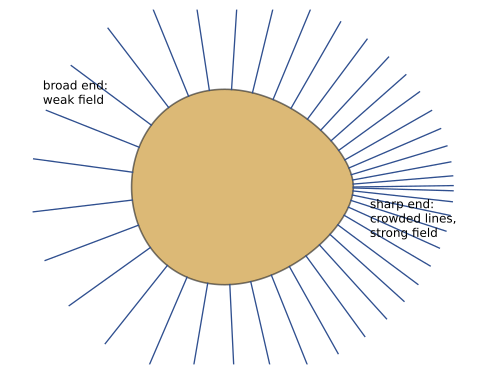
Engineers use this both ways. Lightning protection systems place air terminals (lightning rods) at the highest points of a building, bonded to down conductors and a low-resistance earth electrode, so that a stroke attaches to them and its current passes safely to ground instead of through the structure; the terminals work by intercepting the stroke, not by preventing it. Conversely, high-voltage equipment avoids sharp edges, using smooth, large-radius electrodes and corona rings on insulators and bushings to keep surface fields below breakdown, and electrostatic discharge (ESD) protection in electronics manufacturing controls charge build-up because a spark from a person's finger, at thousands of volts, can destroy a microchip.
Common mistakes
MistakeThinking Gauss's law fails when there is no symmetry.
InsteadIt always holds; symmetry is needed only to use it for finding E easily.
MistakeIncluding charges outside the Gaussian surface in Q_enc.
InsteadOnly enclosed charge counts; outside charges add zero net flux.
MistakeUsing the point-charge 1/r² law for a long wire.
InsteadA line charge gives E = λ/(2πε₀r), falling as 1/r.
MistakeAssuming excess charge spreads through the volume of a conductor.
InsteadIn equilibrium it lies entirely on the surface.
MistakeAssuming the field is the same everywhere on a conductor's surface.
InsteadIt is strongest where the surface curves most sharply.
Summary and key terms
- Electric flux Φ_E = ∮E · dA measures field passing through a surface.
- Gauss's law: the flux out of any closed surface equals Q_enc/ε₀.
- Spherical symmetry gives the point-charge field outside the charge; zero inside a hollow shell.
- A line charge gives E = λ/(2πε₀r); a sheet gives σ/(2ε₀); parallel plates σ/ε₀ between them.
- In a conductor in equilibrium, E = 0 inside, charge lies on the surface and E = σ/ε₀ just outside.
- A closed conductor shields its interior from external fields.
- Charge and field concentrate at sharp points, causing corona; lightning terminals and smooth HV electrodes exploit this.
- Electric flux
- The amount of electric field passing through a surface, ∫E · dA.
- Gauss's law
- The net electric flux out of a closed surface equals the enclosed charge over ε₀.
- Gaussian surface
- An imaginary closed surface chosen to apply Gauss's law.
- Line charge density
- Charge per unit length, λ.
- Surface charge density
- Charge per unit area, σ.
- Electrostatic equilibrium
- A state in which no charges are moving in a conductor.
- Electrostatic shielding
- The exclusion of external electric fields from a conducting enclosure.
- Corona discharge
- Partial breakdown of air near a sharply curved, highly charged conductor.
- Air terminal
- A lightning rod: the strike receptor of a lightning protection system.
- Electrostatic discharge
- A sudden flow of charge, such as a spark, that can damage electronics.
Practice problems
Work each problem on paper first, then reveal the answer to check.
A 0.5 m² flat surface sits in a uniform 2000 N/C field at 60° to its normal. Find the flux.
Show answer
2000 × 0.5 × cos 60° = 500 N·m²/C.
A closed surface encloses +3 µC and −1 µC. Find the net flux.
Show answer
2 × 10⁻⁶/8.854 × 10⁻¹² = 2.26 × 10⁵ N·m²/C.
Find the field 0.5 m from the centre of a sphere carrying 2 µC.
Show answer
8.99 × 10⁹ × 2 × 10⁻⁶/0.25 = 7.2 × 10⁴ N/C.
What is the field inside a uniformly charged hollow metal sphere?
Show answer
Zero.
A long wire carries 5 nC/m. Find the field 0.1 m away.
Show answer
5 × 10⁻⁹/(2π × 8.854 × 10⁻¹² × 0.1) = 900 N/C.
How does the field of a line charge change when the distance triples?
Show answer
It falls to one third.
Find the field between plates with σ = 2 µC/m².
Show answer
σ/ε₀ = 2.26 × 10⁵ V/m.
A dome of radius 0.5 m: what is its maximum voltage in air (3 MV/m)?
Show answer
1.5 MV.
Two connected spheres have radii 1 cm and 10 cm. Which has the stronger surface field, and by what factor?
Show answer
The small one, 10 times stronger.
Why are you safe inside a car struck by lightning?
Show answer
The metal body acts as a conducting shell carrying the current around the outside, shielding the interior.
Lesson quiz · 5 questions
Score 60% or more to complete this lesson.
Create a free account to save your progress, take quizzes and earn a certificate.