
PHYS-460 · Lesson 8 of 12 · 25 min
Pulsed lasers: Q-switching, mode-locking and ultrafast optics
▶ Video coming soon A video version of this lesson is on the way.
Many of the most important uses of lasers depend not on their average power but on concentrating energy in time. A pulse of 1 mJ lasting 10 ns has a peak power of 100 kW; the same energy in 100 fs has a peak power of 10 GW. Short pulses drill and machine materials without melting them, freeze the motion of molecules and electrons, measure distances by timing, and reach intensities at which matter behaves in entirely new ways. This lesson describes the two basic techniques for making short pulses, Q-switching and mode-locking, the time–bandwidth limit that relates pulse duration to spectral width, and the chirped pulse amplification and high-harmonic generation that earned Nobel Prizes in 2018 and 2023.
Q-switching
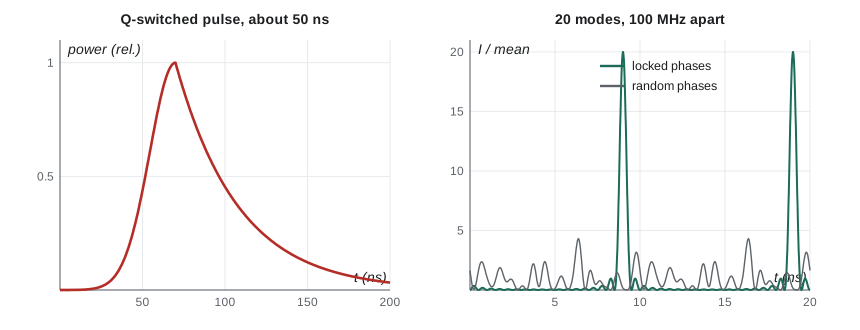
In lesson 5 the inversion was clamped at threshold whenever the laser oscillated. Q-switching defeats that clamp. A fast shutter inside the cavity, the Q-switch, holds the cavity loss very high while the pump builds the inversion far above the normal threshold. Because the cavity cannot oscillate, the energy simply accumulates in the long-lived upper level. When the Q-switch suddenly opens, the gain is many times the loss; the photon density grows exponentially in a few round trips and sweeps out most of the stored inversion in a single giant pulse.
The name comes from the quality factor Q of lesson 4: the switch changes the cavity from low Q to high Q. Q-switches can be active, an electro-optic Pockels cell or an acousto-optic modulator driven by an external signal, or passive, a saturable absorber that is opaque at low intensity and becomes transparent once the light becomes strong. Q-switching needs a gain medium that can store energy, with an upper-level lifetime longer than the pumping time, which is why Nd:YAG, with its 230 µs lifetime, is the classic Q-switched laser.
If the initial inversion is \(r\) times the threshold value, the rate equations give the fraction \(\eta\) of the stored inversion extracted by the pulse as the solution of
and a pulse width of roughly
a few photon lifetimes. Short cavities and high gain give short pulses. Typical Q-switched solid-state lasers produce pulses of 5 to 50 ns with energies from millijoules to joules and peak powers from kilowatts to hundreds of megawatts. They are used for marking, range-finding, tattoo removal, pumping other lasers and generating harmonics.
Mode-locking
To make much shorter pulses, we use the many longitudinal modes of the cavity. A laser oscillating on \(N\) modes spaced by \(\Delta\nu = c/2L\) emits a field that is the sum of \(N\) waves at frequencies \(\nu_0 + k\Delta\nu\). If the modes have random phases, the intensity fluctuates randomly about its mean. If their phases are locked together, so that the phase difference between adjacent modes is constant, the waves add constructively once every round trip and cancel almost everywhere else. The output becomes a train of short pulses, separated by the round-trip time \(T = 2L/c\), with each pulse lasting about
the reciprocal of the total oscillating bandwidth. The peak intensity is \(N\) times the average, because the energy of the whole round trip is squeezed into a fraction \(1/N\) of it. In the time domain, the picture is equally simple: a single pulse circulates in the cavity and a fraction escapes through the output mirror each time it arrives.
Mode-locking can be active, with a modulator inside the cavity driven at exactly the round-trip frequency, or passive, using a saturable absorber or an intensity-dependent effect that favours a short intense pulse over a long weak one. The most widely used passive technique in Ti:sapphire lasers is Kerr-lens mode-locking, discovered in 1991: the intensity-dependent refractive index of the crystal (lesson 10) focuses an intense pulse more strongly than weak light, and an aperture or the gain region then lets the pulse pass with less loss. Semiconductor saturable absorber mirrors (SESAMs) perform the same role in many compact lasers. Mode-locked lasers typically produce pulses at repetition rates of tens of megahertz to gigahertz.
The time–bandwidth limit
A pulse of duration \(\Delta t\) cannot have a bandwidth narrower than about \(1/\Delta t\). This is a property of the Fourier transform, the same mathematics as the uncertainty principle. For a pulse whose intensity has a Gaussian shape, the product of the full widths at half maximum in time and frequency is at least
with equality for a pulse without chirp, one whose frequency does not change during the pulse. Such a pulse is called transform-limited. The constant depends on the pulse shape: 0.315 for a hyperbolic secant squared, the natural shape of many mode-locked lasers. The bandwidth of the gain medium therefore sets the shortest possible pulse. Nd:YAG, with a gain width of about 0.12 THz, cannot produce pulses much shorter than a few picoseconds. Ti:sapphire, with gain over hundreds of nanometres, supports pulses of a few femtoseconds, only a few optical cycles long. Ytterbium in glass, with a few terahertz of bandwidth, produces pulses of 100 to 300 fs and dominates industrial femtosecond machining.
Pulses in a dispersive medium acquire chirp because different frequencies travel at different speeds (lesson 9 treats this in fibres). A transform-limited pulse that passes through a few centimetres of glass is stretched; to keep pulses short, ultrafast lasers include elements with the opposite dispersion, such as prism pairs, grating pairs or specially designed chirped mirrors.
Chirped pulse amplification
Amplifying short pulses to high energy creates a problem. At intensities of a few gigawatts per square centimetre, the intensity-dependent refractive index of the amplifier crystal starts to focus the beam on itself and distort it, damaging the crystal. For years this capped the peak power of short-pulse lasers. In 1985, at the University of Rochester, Donna Strickland and Gérard Mourou solved the problem with chirped pulse amplification (CPA). A short pulse is first stretched in time by a large factor, typically \(10^3\) to \(10^5\), using a dispersive element that delays one end of its spectrum relative to the other. The long, low-intensity pulse is amplified safely. A second dispersive element, a compressor matched to the stretcher, then squeezes it back to nearly its original duration.
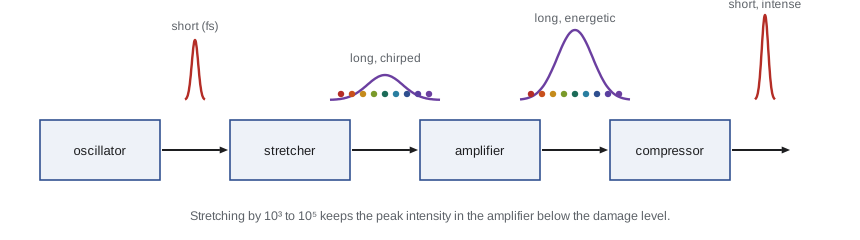
CPA made terawatt and then petawatt lasers possible in university laboratories. It is also used in the femtosecond lasers that cut flaps in the cornea for refractive eye surgery and in precision micromachining. Strickland and Mourou shared the 2018 Nobel Prize in Physics with Arthur Ashkin, who invented optical tweezers.
Attosecond pulses
An optical cycle of 800 nm light lasts 2.7 fs, so a laser pulse cannot be much shorter than a few femtoseconds. To go further requires higher frequencies. In high-harmonic generation, an intense femtosecond pulse is focused into a gas. Near the peak of each half-cycle, the field partly ionizes an atom; the freed electron is accelerated away, turned around when the field reverses, and driven back into its parent ion. If it recombines, it emits its kinetic energy as an extreme-ultraviolet photon. Because this happens twice per optical cycle, the emission consists of odd harmonics of the laser frequency, extending to a cutoff energy
where \(I_p\) is the ionization energy of the atom and \(U_p\) the mean quiver energy of a free electron in the field. Paul Corkum at the National Research Council in Ottawa explained this mechanism with his three-step model in 1993. Each recollision lasts a fraction of an optical cycle, so the harmonics emerge as a train of bursts lasting a few hundred attoseconds, and isolated attosecond pulses can be selected. Pierre Agostini measured trains of attosecond pulses in 2001, and Ferenc Krausz isolated single pulses the same year; Anne L'Huillier had discovered and explained the plateau of high harmonics from 1987 onward. The three shared the 2023 Nobel Prize in Physics. Attosecond pulses can follow the motion of electrons within atoms and molecules.
Computing pulses
The program estimates the energy, duration and peak power of a Q-switched Nd:YAG pulse, sums 5, 20 and 80 modes with locked and random phases to show mode-locking, computes transform-limited pulse durations for three gain media, follows the intensity through a chirped-pulse amplifier, and evaluates the high-harmonic cutoff in argon.
import math, cmath
h, c = 6.62607015e-34, 2.99792458e8
# Q-switching: energy stored in the inversion is released in a few cavity round trips
V = math.pi * (3.2e-3) ** 2 * 0.075       # pumped volume of a 6.4 mm diameter, 7.5 cm rod (m^3)
N_i = 4 * 1.08e22                          # inversion stored at 4 times threshold (per m^3)
E_photon = h * c / 1064e-9
E_stored = N_i * V * E_photon
tau_p = 20e-9; r = 4
# extraction fraction eta solves  r * eta = -ln(1 - eta)  (bisection)
lo, hi = 1e-9, 1 - 1e-12
for _ in range(200):
    mid = (lo + hi) / 2
    if r * mid + math.log(1 - mid) > 0: lo = mid
    else: hi = mid
eta = (lo + hi) / 2
print(f"initial inversion = {r} times threshold: extraction efficiency = {eta:.3f}")
dt = tau_p * r * eta / (r - 1 - math.log(r))   # standard pulse-width estimate
E = eta * E_stored                         # if nearly all cavity loss is the output mirror
print(f"stored energy = {E_stored*1e3:.0f} mJ, pulse energy about {E*1e3:.0f} mJ")
print(f"pulse width about {dt*1e9:.0f} ns, peak power about {E/dt/1e6:.1f} MW")
# mode-locking: N equally spaced modes with locked phases
def intensity(t, N, df, phases):
    s = sum(cmath.exp(2j * math.pi * (k * df * t) + 1j * phases[k]) for k in range(N))
    return abs(s) ** 2
df = 100e6; T = 1 / df
import random
rng = random.Random(460)
print()
for N in (5, 20, 80):
    locked = [0.0] * N
    rand = [rng.uniform(0, 2 * math.pi) for _ in range(N)]
    ts = [T * i / 4000 for i in range(4000)]
    I_l = [intensity(t, N, df, locked) for t in ts]
    I_r = [intensity(t, N, df, rand) for t in ts]
    pk = max(I_l); above = sum(1 for x in I_l if x > pk / 2) * T / 4000
    print(f"N = {N:3d}: locked peak/mean = {pk/(sum(I_l)/len(I_l)):6.1f}, width {above*1e9:.3f} ns "
          f"(1/(N df) = {1/(N*df)*1e9:.3f} ns); random phases peak/mean = {max(I_r)/(sum(I_r)/len(I_r)):5.1f}")
# transform limit for Gaussian pulses: dnu * dt = 0.441
print()
for name, lam, dlam in [('Ti:sapphire', 800e-9, 47e-9), ('Yb glass-guide', 1030e-9, 10e-9), ('Nd:YAG', 1064e-9, 0.45e-9)]:
    dnu = c * dlam / lam ** 2
    print(f"{name:15s} bandwidth {dnu/1e12:7.3f} THz -> shortest Gaussian pulse {0.441/dnu*1e15:8.1f} fs")
# chirped pulse amplification: stretch, amplify, compress
E_out, t_short, stretch = 1.0, 30e-15, 1e4
t_long = t_short * stretch
area = math.pi * (5e-3) ** 2
print()
print(f"1 J in 30 fs: peak power {E_out/t_short/1e12:.0f} TW")
print(f"in the amplifier (stretched {stretch:.0e} times): {E_out/t_long/1e9:.1f} GW, intensity {E_out/t_long/area/1e4/1e9:.2f} GW/cm^2 on a 1 cm beam")
print(f"focused to 5 um radius: {E_out/t_short/(math.pi*(5e-6)**2)/1e4:.1e} W/cm^2")
# high-harmonic generation cutoff: E_max = Ip + 3.17 Up, Up (eV) = 9.33e-14 I(W/cm^2) lam(um)^2
Ip = 15.76   # argon
for I in (1e14, 3e14):
    Up = 9.33e-14 * I * 0.8 ** 2
    Emax = Ip + 3.17 * Up
print(f"argon, 800 nm, {I:.0e} W/cm^2: Up = {Up:.1f} eV, cutoff {Emax:.0f} eV, highest odd harmonic {2*int((Emax/1.55-1)//2)+1}")initial inversion = 4 times threshold: extraction efficiency = 0.980 stored energy = 19 mJ, pulse energy about 19 mJ pulse width about 49 ns, peak power about 0.4 MW N = 5: locked peak/mean = 5.0, width 1.803 ns (1/(N df) = 2.000 ns); random phases peak/mean = 2.7 N = 20: locked peak/mean = 20.0, width 0.443 ns (1/(N df) = 0.500 ns); random phases peak/mean = 5.2 N = 80: locked peak/mean = 80.0, width 0.113 ns (1/(N df) = 0.125 ns); random phases peak/mean = 6.7 Ti:sapphire bandwidth 22.016 THz -> shortest Gaussian pulse 20.0 fs Yb glass-guide bandwidth 2.826 THz -> shortest Gaussian pulse 156.1 fs Nd:YAG bandwidth 0.119 THz -> shortest Gaussian pulse 3700.7 fs 1 J in 30 fs: peak power 33 TW in the amplifier (stretched 1e+04 times): 3.3 GW, intensity 4.24 GW/cm^2 on a 1 cm beam focused to 5 um radius: 4.2e+19 W/cm^2 argon, 800 nm, 1e+14 W/cm^2: Up = 6.0 eV, cutoff 35 eV, highest odd harmonic 21 argon, 800 nm, 3e+14 W/cm^2: Up = 17.9 eV, cutoff 73 eV, highest odd harmonic 45
With the inversion stored at four times threshold, the pulse extracts 0.98 of the stored energy, about 19 mJ from a 6.4 mm by 7.5 cm rod, in a pulse about 50 ns long with a peak power of 0.4 MW. A shorter cavity would shorten the pulse proportionally, and practical lasers reach about 10 ns.
The mode sums show both rules of mode-locking: with locked phases the peak is exactly \(N\) times the mean, and the width is close to \(1/(N\Delta\nu)\), slightly less because the half-maximum width of the summed pulse is \(0.886/(N\Delta\nu)\). With random phases the peak-to-mean ratio stays small and grows only slowly with \(N\). The transform limits explain the choice of gain media: 20 fs for Ti:sapphire, 156 fs for ytterbium in glass, and 3.7 ps for Nd:YAG.
A 1 J, 30 fs pulse has a peak power of 33 TW, far beyond what any amplifier crystal could survive. Stretched \(10^4\) times, the same energy is only 3.3 GW, about 4 GW per square centimetre on a 1 cm beam, which a good amplifier tolerates. Recompressed and focused to 5 µm, the intensity reaches \(4 \times 10^{19}\ \mathrm{W/cm^2}\), where electrons oscillate at nearly the speed of light. In argon at \(3 \times 10^{14}\ \mathrm{W/cm^2}\) the harmonic cutoff is 73 eV, around the 45th harmonic of 800 nm light.
Worked problem
Pulse train of a mode-locked laser
A mode-locked Ti:sapphire laser has a 1.5 m cavity and produces 20 fs pulses with 1.0 W average power. Find the repetition rate, the pulse energy and the peak power.
Show solution
- Repetition rate: \(c/2L = 3.0 \times 10^8/3.0 = 100\) MHz.
- Pulse energy: \(1.0/10^8 = 10\) nJ.
- Peak power: about \(10 \times 10^{-9}/20 \times 10^{-15} = 5 \times 10^5\) W.
Answer: 100 MHz, 10 nJ and about 0.5 MW peak power from a laser whose average output is only 1 W.
Worked problem
Transform limit
What is the shortest Gaussian pulse that a bandwidth of 10 nm at 1550 nm can support?
Show solution
- \(\Delta\nu = c\Delta\lambda/\lambda^2 = 3.0 \times 10^8 \times 10^{-8}/(1.55 \times 10^{-6})^2 = 1.25 \times 10^{12}\) Hz.
- \(\Delta t = 0.441/1.25 \times 10^{12} = 3.5 \times 10^{-13}\) s.
Answer: About 350 fs.
Common mistakes
MistakeExpecting a Q-switch to raise the average power.
InsteadQ-switching concentrates energy into pulses; average power is set by the pump and is often slightly lower.
MistakeThinking mode-locking needs a single-mode laser.
InsteadIt needs many modes with locked phases; more locked bandwidth gives shorter pulses.
MistakeAssuming any short pulse is transform-limited.
InsteadChirp lengthens a pulse beyond \(0.441/\Delta\nu\); dispersion must be compensated.
MistakeThinking CPA amplifies a short pulse directly.
InsteadCPA stretches the pulse first so the amplifier sees low intensity, then recompresses it.
MistakeExpecting even harmonics in high-harmonic generation from a gas.
InsteadSymmetric emission twice per cycle gives only odd harmonics.
Summary and key terms
- Q-switching stores inversion far above threshold and releases it in a single pulse of a few photon lifetimes, typically nanoseconds.
- Mode-locking fixes the phases of \(N\) modes to give a pulse train at \(c/2L\) with pulses \(\approx 1/(N\Delta\nu)\) long and peak power \(N\) times the mean.
- The time–bandwidth product of a Gaussian pulse is at least 0.441; gain bandwidth limits pulse duration.
- Chirped pulse amplification stretches, amplifies and recompresses pulses, enabling terawatt and petawatt peak powers.
- High-harmonic generation produces attosecond extreme-ultraviolet pulses with cutoff \(I_p + 3.17U_p\).
- Q-switching
- Holding cavity loss high while inversion builds, then switching it low to release a giant pulse.
- Mode-locking
- Locking the phases of many longitudinal modes to produce a train of short pulses.
- Transform-limited pulse
- A pulse with the minimum duration allowed by its bandwidth, without chirp.
- Chirped pulse amplification
- Amplifying a pulse after stretching it in time, then compressing it.
- High-harmonic generation
- Emission of odd harmonics by electrons driven back into their parent ions by an intense field.
Practice problems
Work each problem on paper first, then reveal the answer to check.
A laser with a 75 cm cavity is mode-locked. What is its pulse repetition rate?
Show answer
\(c/2L = 3 \times 10^8/1.5 = 200\) MHz.
How many modes must be locked to make 1 ps pulses if the mode spacing is 100 MHz?
Show answer
\(N \approx 1/(\tau\Delta\nu) = 1/(10^{-12} \times 10^8) = 10^4\).
A Q-switched laser emits 100 mJ in 8 ns. Find the peak power.
Show answer
About \(0.1/8 \times 10^{-9} = 1.25 \times 10^7\) W, 12.5 MW.
Why is Ti:sapphire preferred for few-cycle pulses?
Show answer
Its gain bandwidth of hundreds of nanometres supports pulses of a few femtoseconds.
Estimate \(U_p\) for 800 nm light at \(10^{15}\ \mathrm{W/cm^2}\).
Show answer
\(U_p = 9.33 \times 10^{-14} \times 10^{15} \times 0.64 = 60\) eV.
Lesson quiz · 5 questions
Score 60% or more to complete this lesson.
Create a free account to save your progress, take quizzes and earn a certificate.