
PHYS-499 · Lesson 3 of 12 · 21 min
Reading physics: papers, the arXiv and review articles
▶ Video coming soon A video version of this lesson is on the way.
Coursework teaches physics from textbooks, which present settled knowledge in a logical order, with consistent notation and worked examples. Research is built from papers, which present new and sometimes unsettled results in compressed form, written for experts, with notation that changes from author to author and steps that the authors considered too obvious to include. Learning to read papers efficiently, critically and selectively is one of the main skills an honours project develops. This lesson describes the kinds of physics literature, explains how preprints and journals work, takes apart the anatomy of a typical paper, and sets out a method for reading that saves time on most papers and reserves it for the few that matter.
The kinds of physics literature
Physics writing comes in several forms, each suited to a different stage of a project. Textbooks and monographs give the foundations and are the right place to fill gaps in background, for example the eddy-current treatment in an electromagnetism text. Review articles, published in journals such as Reviews of Modern Physics, Reports on Progress in Physics and Physics Reports, survey a field, organize its results and point to the important papers; one good review can save weeks of searching. Research articles report new results and are the primary record. Letters, in journals such as Physical Review Letters, are short reports of results judged especially significant. Pedagogical articles, in the American Journal of Physics, the European Journal of Physics and The Physics Teacher, explain known physics clearly and often contain exactly the kind of model and experiment an honours project needs. Maya's starting point was a pedagogical literature of more than two dozen articles on magnets falling through pipes, which she would never have found by searching research journals alone.
Other sources matter too. Conference proceedings record work in progress. Theses, especially PhD theses, explain methods in much more detail than papers and are often the best guide to how an apparatus or analysis really works. Data sheets and manufacturers' specifications give properties of materials and instruments, with the caution that a specification is a promise, not a measurement. Technical reports from national laboratories and standards bodies give reference data; for the conductivity of copper alloys, for example, the standard reference is the International Annealed Copper Standard, defined in 1913, against which commercial copper is rated as a fraction of the standard conductivity.
Preprints and the arXiv
Most physics research now appears first as a preprint on the arXiv, a free repository started by Paul Ginsparg in August 1991 at Los Alamos as an email service for high-energy theorists and now run by Cornell University. By late 2026 it held more than 3.2 million papers across physics, mathematics, computer science, statistics and other fields. Physics remains its largest component: in 2025 the astrophysics categories alone received about 18,700 new papers. An arXiv identifier such as 2407.01234 encodes the year and month of submission (July 2024) and a sequence number; older identifiers have the form hep-th/9711200, with the archive name, the year and month, and a number. Versions are marked v1, v2 and so on, and later versions often correct errors, so always check that you are reading the latest one.
The arXiv is moderated, but not refereed. Moderators check that a submission is a plausible scientific paper in the right category; they do not check that it is correct. Many preprints are later published in refereed journals, sometimes with significant changes, and some are never published. Treat a preprint as the authors' claim, read it critically, and when a published version exists, cite that, with the arXiv identifier as well if your department's style allows it. Journals add peer review, copy-editing and a permanent record identified by a digital object identifier, or DOI. Many physics journals now allow or require open access, and funders in both countries increasingly require that publicly funded work be freely readable, a point lesson 9 returns to.
import re
NEW = re.compile(r"^(\d{2})(\d{2})\.(\d{4,5})(v\d+)?\Z")
OLD = re.compile(r"^([a-z\-]+)(\.[A-Z]{2})?/(\d{2})(\d{2})(\d{3})(v\d+)?\Z")
def describe(ident):
    m = NEW.match(ident)
    if m:
        yy, mm, num, ver = m.groups()
        return f"new style: {2000+int(yy)}-{mm}, number {num}, version {ver or 'latest'}"
    m = OLD.match(ident)
    if m:
        arch, sub, yy, mm, num, ver = m.groups()
        year = 1900 + int(yy) if int(yy) > 90 else 2000 + int(yy)
        return f"old style: archive {arch}{sub or ''}, {year}-{mm}, number {num}, version {ver or 'latest'}"
    return "not an arXiv identifier"
for i in ["2407.01234", "2511.09876v2", "hep-th/9711200", "physics/0601123v3", "cond-mat.mtrl-sci/0501001", "10.1119/1.1555345"]:
print(f"{i:28s} {describe(i)}")2407.01234 new style: 2024-07, number 01234, version latest 2511.09876v2 new style: 2025-11, number 09876, version v2 hep-th/9711200 old style: archive hep-th, 1997-11, number 200, version latest physics/0601123v3 old style: archive physics, 2006-01, number 123, version v3 cond-mat.mtrl-sci/0501001 not an arXiv identifier 10.1119/1.1555345 not an arXiv identifier
The anatomy of a physics paper
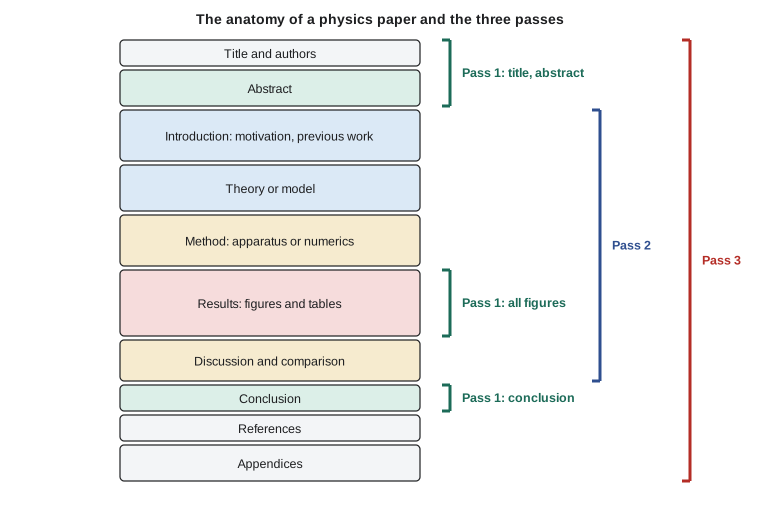
Most physics papers follow a recognizable structure, though the headings vary. The abstract states the question, the method and the main result, often with the key number. The introduction motivates the work and places it in the literature; its references are the quickest map of the field. A theory or model section sets up the equations. A methods section describes the apparatus or numerical procedure; in an experimental paper this is where the systematic errors are hidden, so it repays careful reading. The results section presents data, usually as figures with error bars. The discussion compares results with theory and previous work and should state limitations. The conclusion summarizes. Appendices contain derivations and technical details that the authors considered important but distracting, and for a student trying to reproduce the work they are often the most valuable part of the paper.
The figures deserve special attention. In physics, the figures usually carry the main result, and an experienced reader looks at them before reading much text. For each figure, ask what is on each axis and in what units, whether the axes are linear or logarithmic, what the error bars represent (one standard deviation, a 95 per 100 interval, or something else), which curves are data and which are models, and whether the models have been fitted or are predictions with no free parameters. That last distinction is easy to miss and fundamental. A model that matches the data after three parameters have been fitted tells you something different from one that matches with none.
Reading in three passes
Reading every paper from beginning to end is slow and usually unnecessary. A widely used method, described by the computer scientist Srinivasan Keshav in 2007, reads a paper in up to three passes. The first pass takes about ten minutes: read the title, abstract and introduction, look at every figure, read the conclusion and glance at the references. At the end you should be able to say what the paper claims, what kind of paper it is, whether it is relevant, and whether it is worth a second pass. Most papers stop here. The second pass takes an hour or two: read the whole paper carefully but skip the hardest derivations, note the key equations and assumptions, and write a short summary in your own words. The third pass, reserved for the handful of papers on which your project rests, means reconstructing the work: rederiving the equations, checking the numbers, and in Maya's case recomputing a published curve with her own code.
Maya's key paper was a pedagogical article that derived the drag on a point dipole in a thin-walled pipe. On her first pass she noted the result \(F = 45\mu_0^2 m^2 \sigma w v/(1024 a^4)\) and a comparison with measurements in a single pipe that agreed to about 10 per 100. On her second pass she wrote down the three assumptions behind the formula: a point dipole on the axis, a wall much thinner than the radius, and a speed low enough that the induced currents have no time to change the field they respond to. On her third pass she rederived the result, found the integral that produces the curious factor of 45/1024, and checked numerically that it was right. That third pass, described in lesson 7, became chapter 2 of her thesis.
Reading critically
Reading critically does not mean distrusting everything; it means checking what can be checked and noticing what cannot. Check units and dimensions in key equations. Check limiting cases: does the drag formula vanish when the conductivity does, and does it grow when the magnet gets closer to the wall, as physical intuition says it should? Check that error bars are present and defined. Look for the comparison the authors did not make: a paper that tests a model in one pipe has not tested how the drag depends on the radius. Note whether the data could be reproduced from the information given. And ask what would change your confidence in the result: a second independent measurement, a different method, a check of a key assumption.
It is also worth reading the papers that cite a key paper, not just the ones it cites. A later paper may have found an error, extended the result or measured something the original authors did not. For Maya, a forward search found two later articles that treated the finite size of the magnet, one by modelling the magnet as a pair of magnetic charges and one by a numerical integration similar to the one she eventually used. Neither had compared models across pipes of different radii and wall thicknesses, which confirmed that her question was open. Lesson 4 describes how to do these forward and backward searches systematically.
Keeping a reading log
A reading log, kept from the first week, is the single habit that most improves a literature review. For every paper you read past the first pass, record the full reference, the date you read it, the pass you reached, a summary in two or three sentences in your own words, the key equations or numbers, and your own questions or doubts. A spreadsheet, a reference manager with notes, or a plain text file all work; what matters is consistency. When you sit down to write the background chapter in February, the log turns the job from rereading thirty papers into organizing notes you already have. It also protects against accidental plagiarism, because your summaries are in your own words from the start.
log = [  # (key, year, pass reached, kind, relevant?)
    ("pointdipole-ajp",  2002, 3, "pedagogical", True),
    ("thickwall-ejp",    2006, 2, "pedagogical", True),
    ("chargemodel-ajp",  2011, 2, "pedagogical", True),
    ("numerical-ejp",    2017, 3, "pedagogical", True),
    ("eddybrake-review", 2015, 2, "review",      True),
    ("copper-iacs",      1913, 1, "standard",    True),
    ("maglev-ieee",      2009, 1, "research",    False),
    ("ndfeb-datasheet",  2020, 2, "data sheet",  True),
    ("induction-heat",   2019, 1, "research",    False),
]
from collections import Counter
print("papers logged:", len(log))
print("by deepest pass:", dict(sorted(Counter(p for _, _, p, _, _ in log).items())))
print("by kind:", dict(Counter(k for _, _, _, k, _ in log)))
core = [key for key, _, p, _, rel in log if p == 3]
print("third-pass papers (the project rests on these):", core)
print("ruled out after first pass:", [key for key, _, p, _, rel in log if p == 1 and not rel])papers logged: 9
by deepest pass: {1: 3, 2: 4, 3: 2}
by kind: {'pedagogical': 4, 'review': 1, 'standard': 1, 'research': 2, 'data sheet': 1}
third-pass papers (the project rests on these): ['pointdipole-ajp', 'numerical-ejp']
ruled out after first pass: ['maglev-ieee', 'induction-heat']Worked problem
A first pass on an unfamiliar paper
Jae-won finds a paper titled with the word matched filtering and the event name GW150914. After ten minutes, what should he be able to write down?
Show solution
- The claim: for example, that a matched-filter search of the public strain data recovers the event with a stated signal-to-noise ratio and chirp mass.
- The kind of paper: a methods or tutorial paper, a reanalysis, or a primary detection paper.
- The figures: what each shows, and whether the curves are fits or predictions.
- A decision: relevant and worth a second pass, relevant but not now, or not relevant; and two or three references from the introduction to check next.
Answer: A one-paragraph note covering the claim, the kind of paper, the main figures and a decision, entered in his reading log.
Common mistakes
MistakeReading every paper from start to finish.
InsteadUse a quick first pass to decide which papers deserve more; most do not.
MistakeTreating a preprint as established fact.
InsteadThe arXiv is moderated but not refereed; read critically and check for a published version.
MistakeIgnoring the error bars or not checking what they represent.
InsteadFind the definition of every uncertainty in a figure before comparing it with anything.
MistakeNot distinguishing fitted models from predictions.
InsteadA curve that matches after fitting free parameters is weaker evidence than one that matches with none.
MistakeKeeping no notes and relying on memory.
InsteadA reading log in your own words saves weeks when writing and protects against accidental plagiarism.
Summary and key terms
- Textbooks, reviews, research articles, letters, pedagogical articles, theses and data sheets each serve a different purpose in a project.
- The arXiv, started in 1991, carries most physics as preprints; it is moderated but not refereed, so check versions and published forms.
- Physics papers usually follow abstract, introduction, model, method, results, discussion and appendices; the figures often carry the main result.
- Read in up to three passes: survey, understand, rebuild; reserve the third for the few papers your project rests on.
- Read critically by checking units, limits, error bars and fitted versus predicted curves, and keep a reading log in your own words.
- Preprint
- A paper made public before or without journal peer review, usually on the arXiv.
- Peer review
- Evaluation of a submitted paper by independent experts before publication.
- DOI
- A digital object identifier: a permanent identifier for a published item.
- Review article
- A paper that surveys and organizes the results of a field.
- Three-pass method
- Reading a paper in increasing depth: survey, understand, rebuild.
Practice problems
Work each problem on paper first, then reveal the answer to check.
What does the arXiv identifier 2603.04512v2 tell you?
Show answer
Submitted in March 2026, sequence number 04512, second version.
Name two checks you can make on a key equation without rederiving it.
Show answer
Dimensional analysis, and limiting cases such as zero conductivity or a very distant wall.
Why can a PhD thesis be more useful than the paper based on it?
Show answer
It describes methods, apparatus and analysis in far more detail, including what did not work.
A figure shows data and a curve labelled model. What two things must you find out about the curve?
Show answer
Whether it was fitted or predicted with no free parameters, and what assumptions it uses.
What should a reading-log entry contain?
Show answer
Full reference, date, pass reached, a short summary in your own words, key equations or numbers, and your questions.
Lesson quiz · 5 questions
Score 60% or more to complete this lesson.
Create a free account to save your progress, take quizzes and earn a certificate.