
PRIN-110 · Lesson 3 of 12 · 27 min
Learn from experience
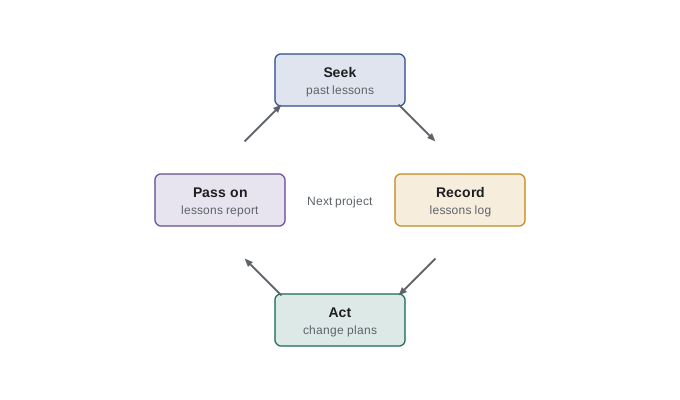
The second principle states that PRINCE2 project teams learn from experience: lessons are sought, recorded and acted upon throughout the life of the project. The three verbs matter. Seeking means looking actively for lessons at the start, rather than waiting for them to appear. Recording means writing them down so they survive the team. Acting means changing plans, approaches or behaviour as a result. A lessons log that is full of entries but never changes anything is not evidence that the principle is being applied.
Why projects forget
Projects are temporary. A team forms, works intensely for months and then disperses. People move to other projects, contractors leave, and the knowledge that made the difference walks out of the door. The next project in the same organization often makes the same mistakes because nobody told it what happened last time. Organizations that run many projects without learning pay repeatedly for the same lessons.
Projects are also unique. Each has something new about it: a new product, a new supplier, a new location or a new technology. Uniqueness makes it tempting to assume that previous experience does not apply. In practice most project problems are not unique at all. Optimistic estimates, unclear requirements, late supplier deliveries, poor handover to operations and weak stakeholder engagement recur across sectors and decades. Learning from experience is the principle that stops a project treating familiar risks as surprises.
When lessons are sought, recorded and passed on
The principle applies throughout the project, but the emphasis shifts.
| When | What happens | Typical sources |
|---|---|---|
| Starting up | Seek lessons that could affect the project approach and early decisions | Previous closure reports, lessons reports, corporate lessons libraries, experts, other organizations |
| Initiation | Apply lessons to plans, risk responses, quality and the tailoring of the method | The lessons log, peers in similar projects, suppliers |
| Each stage | Record new lessons as they arise; review them at stage boundaries | Team members, checkpoint reports, quality reviews, issues |
| Stage boundaries and exceptions | Produce lessons reports where useful; adjust the next stage plan | The lessons log, end stage reports |
| Closing | Pass on lessons for future projects in the end project report or lessons report | The lessons log, team retrospective, users and suppliers |
PRINCE2 provides two main management products for this principle. The lessons log is a project repository for lessons that apply to this project or future projects. A lessons report passes lessons on to others: to the corporate organization, to a programme, or to future projects. A lessons report may be produced at the end of a stage, after an exception, at closure, or whenever a lesson is significant enough to share immediately.
What makes a good lesson
Not every observation is a lesson. "Testing was hard" is a complaint. A useful lesson describes what happened, why it happened, what effect it had and what should be done differently, in enough detail that someone outside the project can act on it. Good lessons are specific, actionable and tied to a cause.
| Weak entry | Stronger lesson |
|---|---|
| The supplier was late. | The supplier's delivery slipped six weeks because the contract had no milestone for interface specifications. Future contracts should include a dated interface milestone with acceptance criteria. |
| Users did not like the new screens. | Clinic staff rejected the first screens because no frontline user attended design reviews. Include at least two frontline users in every design review and record their acceptance. |
| The budget ran out. | Data migration was estimated by analogy with a smaller project and took three times as long. Estimate migration from a sample of real records before baselining the cost. |
Lessons can be positive as well as negative. A technique that worked well, a supplier arrangement that prevented problems or a meeting format that sped up decisions are all worth recording. Projects that only record failures miss half of what they could pass on.
Prioritizing lessons
A busy project may record dozens of lessons. Not all of them deserve the same attention. A simple way to prioritize is to score each lesson for the likelihood that it recurs on similar projects and the impact if it does, then act first on the highest scores. The scoring is the same idea as risk assessment, because a lesson is in effect evidence about a risk.
Worked problem
Prioritizing a lessons log
A project manager scores four lessons from a previous project on likelihood of recurring (1 to 5) and impact (1 to 5). A: unclear acceptance criteria, likelihood 4, impact 4. B: delayed hardware shipping, likelihood 2, impact 5. C: meeting room double-booked, likelihood 5, impact 1. D: key user unavailable during testing, likelihood 3, impact 4. Rank them by score and say which should shape the initiation stage.
Show solution
- Score = likelihood × impact.
- A: 4 × 4 = 16.
- B: 2 × 5 = 10.
- C: 5 × 1 = 5.
- D: 3 × 4 = 12.
- Ranking: A (16), D (12), B (10), C (5).
Answer: A and D should shape initiation: write clear acceptance criteria into product descriptions and secure named user availability for testing in the stage plans. B becomes a risk with a response; C is minor.
Acting on lessons
The test of this principle is whether lessons change anything. Lessons can act on almost every part of the method:
- Plans: adding contingency or extra tasks where earlier projects struggled.
- Risk: lessons often become risks in the risk register, with responses based on what worked before.
- Quality: lessons about defects lead to stronger quality criteria and review methods.
- Organization: lessons about decision delays lead to clearer delegation or a different board composition.
- Tailoring: lessons about bureaucracy or gaps lead to changes in how the method is applied.
- Contracts: lessons about supplier performance lead to better terms in future procurements.
When a project manager documents the project approach during initiation, a short note on how key lessons have been applied is good evidence of the principle in action. Assurance reviewers look for exactly that link.
Organizational learning
A single project can only do so much. Lasting learning needs the organization to collect lessons across projects, analyse them for patterns and change its standards. A project management office, a centre of excellence or a programme office often maintains a lessons library. The most useful libraries are searchable, tagged by topic and project type, and curated so that outdated lessons are retired.
There is a well-known gap between identifying lessons and learning them. Many organizations produce lessons reports that nobody reads. Learning happens when lessons change processes, templates, training or contracts. A lesson about weak acceptance criteria is truly learned when the organization's product description template prompts for measurable criteria and reviewers reject descriptions without them.
Learning from public-sector projects
Public inquiries and audit reports are rich sources of lessons. In Canada, the Phoenix pay system, launched for the federal public service in 2016, produced widespread pay errors affecting a large share of employees. A 2018 independent lessons-learned review by Goss Gilroy and reports by the Auditor General found, among other things, that functions and testing were reduced to hold cost and schedule, that the system was launched without an adequate pilot, and that warnings were not escalated effectively. Those findings have been used in later federal guidance, and the Treasury Board Directive on the Management of Projects and Programmes stresses independent review and governance. The project to replace Phoenix has itself been the subject of further audits that draw on these lessons.
Whatever the sector, the most valuable lessons from such cases are rarely about technology. They are about decisions: who had authority, whether warnings were heard, whether testing was cut to meet a date, and whether the business case was honestly reviewed. Each of these connects to one or more PRINCE2 principles, which is why studying them is part of learning from experience.
Barriers to learning
Even well-intentioned teams struggle to learn. The common barriers are cultural rather than technical. People fear blame, so they hide mistakes. Teams are rushed at closure, so retrospectives are skipped. Lessons are written in vague language, so nobody can act on them. Lessons libraries are hard to search, so nobody looks. The project manager who wants to apply this principle needs to create a climate in which raising a lesson is normal and safe, and to schedule time for learning at the start, at stage boundaries and at closure.
Short, regular retrospectives help. Agile teams hold them at the end of every sprint, and a PRINCE2 project can use the same habit at checkpoints or stage ends. A good retrospective asks three questions: what went well, what did not, and what will we change? The third question turns observation into action.
Lessons from outside the organization
Lessons do not have to come from your own organization. Industry associations, professional bodies, published case studies, supplier experience and peers in other organizations are all valuable. A hospital planning a new records system can learn from hospitals that have already implemented one; a municipality planning a library renovation can call the project manager of a similar project in a neighbouring town. External lessons are particularly useful when the organization has never done this kind of project before, which is exactly when internal lessons are scarce.
Suppliers are an underused source. A supplier who has delivered similar products many times often knows the common failure points better than the customer does. Asking the supplier at initiation, "what usually goes wrong on projects like this?", costs nothing and frequently surfaces risks that would otherwise appear only in delivery. The answer belongs in the lessons log and, where relevant, in the risk register.
Learning during the project, not only between projects
Some lessons should change the current project immediately. If the first quality review of a set of product descriptions finds that criteria are vague, the project manager should not wait until closure to record that lesson; the remaining product descriptions should be improved now. If a supplier's first delivery reveals a misunderstanding about formats, the next work package should be clarified straight away. Learning within the project is often worth more than learning for the next one, because the people who benefit are still in the room.
Stage boundaries are a natural point to pause and review lessons from the stage just ending. The end stage report includes a review of lessons, and the next stage plan should show how the important ones have been applied. A board member who asks "what did we learn in this stage, and what are we doing differently in the next?" is applying this principle at the directing level.
Worked problem
Measuring whether lessons are acted on
At the end of stage 2, the lessons log contains 24 entries. Of these, 9 have a recorded action in a plan, risk response or product description, 4 have been passed to the project office, and the rest have no action. What percentage of lessons have been acted on within the project, and what would you recommend?
Show solution
- Acted on within the project: 9 of 24 = 37.5 %.
- Passed on to others: 4 of 24 ≈ 16.7 %.
- No action: 24 − 9 − 4 = 11, about 45.8 %.
- Recommendation: review the 11 lessons at the stage boundary, decide which should change the next stage plan, and close or pass on the rest.
Answer: About 38 % acted on within the project and 46 % with no action; the stage boundary is the right moment to deal with the backlog.
Common mistakes
MistakeCollecting lessons only at the end of the project.
InsteadSeek lessons at the start and record them throughout.
MistakeWriting vague lessons such as "testing was hard".
InsteadRecord the cause, effect and recommended action.
MistakeFilling a lessons log that never changes any plan.
InsteadShow how lessons have shaped plans, risks, quality and tailoring.
MistakeTreating learning from experience as the project manager's job alone.
InsteadExpect every team member and board member to raise lessons.
MistakeRecording only failures.
InsteadRecord positive lessons too, so good practice spreads.
Summary and key terms
- Lessons are sought, recorded and acted on throughout the project.
- Projects forget because they are temporary; they underestimate lessons because they think they are unique.
- The lessons log holds lessons; a lessons report passes them on.
- Good lessons name a cause, an effect and a recommended action.
- Scoring likelihood and impact helps prioritize which lessons to act on first.
- Lessons should visibly change plans, risk responses, quality criteria and tailoring.
- Organizational learning requires lessons to change standards, templates and training.
- Lesson
- Something learned that could improve this or future projects.
- Lessons log
- A project repository of lessons that apply to this or future projects.
- Lessons report
- A report that passes lessons on to the organization or future projects.
- Retrospective
- A team review of what went well, what did not and what will change.
- Lessons library
- An organization-wide collection of lessons from many projects.
- Closure report
- A report at the end of a project, such as the end project report.
- Root cause
- The underlying reason a problem occurred.
- Project approach
- The way the work will be delivered, chosen during starting up and initiation.
- Centre of excellence
- A group that sets project management standards across an organization.
- Blame culture
- A culture in which mistakes are punished, discouraging people from reporting them.
Practice problems
Work each problem on paper first, then reveal the answer to check.
Name the three verbs in the learn from experience principle.
Show answer
Seek, record and act.
Which product holds lessons during the project?
Show answer
The lessons log.
Which product passes lessons to others?
Show answer
The lessons report.
Likelihood 3, impact 5. Score?
Show answer
15.
When should lessons first be sought?
Show answer
In starting up the project.
Give one way a lesson can change the plan.
Show answer
Adding contingency or tasks where previous projects struggled.
Why might a lesson become a risk?
Show answer
Because it is evidence that something may go wrong again.
What are the three retrospective questions?
Show answer
What went well, what did not, and what will we change?
What turns an identified lesson into a learned lesson?
Show answer
A change in process, template, training or contract.
Can lessons be positive?
Show answer
Yes; good practice is worth recording too.
Lesson quiz · 5 questions
Score 60% or more to complete this lesson.
Create a free account to save your progress, take quizzes and earn a certificate.