
PRIN-110 · Lesson 6 of 12 · 28 min
Manage by exception
The fifth principle states that a PRINCE2 project has defined tolerances for each project objective, to establish limits of delegated authority. Each level of management is given an objective and a tolerance by the level above. As long as the objective is forecast to be met within tolerance, the lower level gets on with the work and the upper level stays informed but does not intervene. When a tolerance is forecast to be exceeded, the situation is an exception and must be escalated. Managing by exception lets senior people direct without micromanaging and lets people closer to the work act without constant permission.
Tolerances on seven performance targets
PRINCE2 7 defines seven performance targets for which tolerances can be set: time, cost, scope, quality, benefits, risk and sustainability. Sustainability was added in the 2023 edition to reflect the growing expectation that projects manage their environmental, social and governance effects.
| Target | Typical tolerance | Example |
|---|---|---|
| Time | Plus or minus an amount of time | Stage to finish within ±2 weeks of plan |
| Cost | Plus or minus an amount or percentage of budget | Stage cost within ±10 % |
| Scope | Permitted variation in what is delivered | Must-have features delivered; up to 20 % of could-have features may be dropped |
| Quality | Ranges on quality criteria | Page load time 2 to 3 seconds |
| Benefits | Permitted reduction in expected benefits | Annual savings no less than 90 % of the business case figure |
| Risk | Limits on aggregated or individual risk | No single risk with expected loss above 50,000 without board approval |
| Sustainability | Limits on environmental or social measures | Construction waste diverted from landfill at least 75 % |
Not every tolerance needs to be numerical, and not every target needs a tolerance on every project. Scope tolerance is often expressed through prioritization, such as the MoSCoW categories of must have, should have, could have and won't have this time. Quality tolerance sits in the quality criteria of product descriptions. What matters is that each level knows the limits of its authority.
Four levels, three sets of tolerance
Tolerances cascade down the management levels.
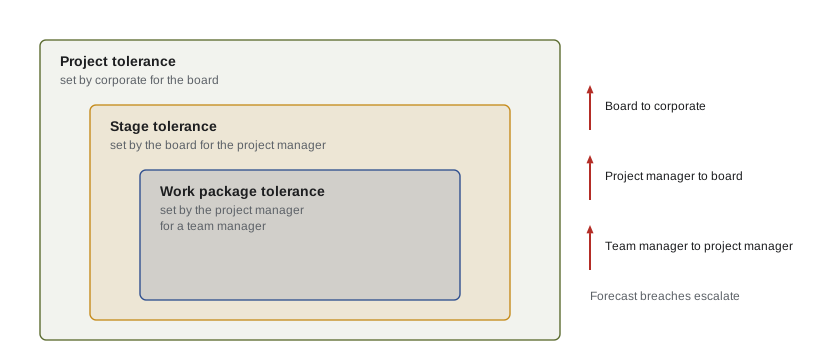
- Corporate, programme or business management sets project tolerances for the project board, usually in the project mandate or brief.
- The project board sets stage tolerances for the project manager when it authorizes each stage plan.
- The project manager sets work package tolerances for team managers when authorizing each work package.
If a team manager forecasts that a work package will exceed its tolerance, they raise an issue with the project manager. If the project manager forecasts that the stage will exceed its tolerance, they raise an exception report to the board. If the board forecasts that the project will exceed project tolerance, it escalates to corporate or business management. Each level handles what it can within its authority and escalates only what it cannot.
Forecast, not actual
An important detail is that escalation is triggered by a forecast breach, not an actual one. The project manager does not wait until the stage has overspent; they escalate as soon as the forecast shows that tolerance will be exceeded. Waiting until the breach has happened removes the board's chance to choose a different course. This is why PRINCE2 progress reporting asks for forecasts against tolerance, not just actuals to date.
Worked problem
Time tolerance from a forecast
A stage is planned to finish on week 20 with a time tolerance of ±2 weeks. At week 12, the project manager has completed work planned to finish by week 10. The remaining work was planned to take 10 weeks. If performance continues at the same rate, when will the stage finish, and is an exception needed?
Show solution
- Progress rate: 10 weeks of planned work done in 12 weeks, so the rate is 10 ÷ 12 ≈ 0.833.
- Remaining planned work: 10 weeks. At the same rate it will take 10 ÷ 0.833 = 12 weeks.
- Forecast finish: week 12 + 12 = week 24.
- Tolerance allows up to week 22. Week 24 exceeds it by 2 weeks.
Answer: The forecast finish of week 24 breaches the week 22 limit, so the project manager raises an exception report now rather than waiting.
Reporting by exception
Manage by exception reduces the need for the board to meet often. Between stage boundaries, the board receives highlight reports at an agreed frequency, perhaps fortnightly or monthly. These are short status summaries, not requests for decisions. Team managers send checkpoint reports to the project manager. The board only needs to act when something is outside tolerance or when the project manager asks for advice. A board that demands weekly detailed task reviews is undermining the principle, because it is pulling management decisions up a level.
| Report | From | To | Purpose |
|---|---|---|---|
| Checkpoint report | Team manager | Project manager | Progress on a work package |
| Highlight report | Project manager | Project board | Progress on the stage, forecasts and issues |
| Issue report | Project manager | Board or change authority | Details of an issue needing a decision |
| Exception report | Project manager | Project board | A forecast breach of stage or project tolerance and options |
| End stage report | Project manager | Project board | Performance of the stage and the request to proceed |
Exceptions handled step by step
When a stage is forecast to exceed its tolerance, PRINCE2 sets out a clear sequence.
1. The project manager raises an exception report describing the cause, consequences, options and a recommendation.
2. The board considers the report. It may increase tolerance, ask for an exception plan, or prematurely close the project.
3. If an exception plan is requested, the project manager produces it in managing a stage boundary, with an updated business case and project plan.
4. The board approves the exception plan, which replaces the current stage plan, and the stage continues under new tolerances.
Worked problem
Multi-target tolerance check
Stage 4 has these tolerances: cost ±6 % of 350,000, time +3 weeks / −1 week on a 16-week plan, at least 18 of 20 must-have requirements delivered, and at least 70 % of waste diverted from landfill. Current forecasts are: cost 368,000, finish in week 18, 19 must-haves delivered, and 66 % of waste diverted. Which targets are in exception?
Show solution
- Cost limit: 350,000 × 1.06 = 371,000. Forecast 368,000 is within.
- Time limit: week 16 + 3 = week 19. Forecast week 18 is within.
- Scope: 19 of 20 must-haves meets the minimum of 18. Within.
- Sustainability: 66 % is below the 70 % minimum. Outside tolerance.
Answer: Only sustainability is in exception. The project manager must still raise an exception report, because a forecast breach of any single tolerance is enough.
Setting tolerances well
Tolerances that are too tight cause a flood of exceptions and push routine decisions up to the board. Tolerances that are too loose remove the board's control. Good tolerances reflect the board's risk appetite, the uncertainty in the estimates and the consequences of deviation. Early stages with uncertain estimates may justify wider tolerances; later stages with firmer plans may justify narrower ones. Tolerances should be recorded in the stage plan or work package, so there is no argument later about what was agreed.
Tolerances can also be asymmetric. Many boards are relaxed about finishing early or under budget but strict about finishing late or over budget, so a time tolerance of +2 weeks / −4 weeks is common. On fixed-date projects, such as an event or a regulatory deadline, time tolerance may be zero, and scope tolerance becomes the main flexibility.
Issues within tolerance
Not every problem is an exception. A team manager who is a few days late on a work package, but still within work package tolerance, simply recovers the time or reports it in a checkpoint report. A project manager facing an issue that can be resolved within stage tolerance may take corrective action without involving the board, recording the issue in the issue register. Only forecast breaches go up a level. This is what keeps senior people's attention on the decisions that matter.
Failure modes
| Failure | Symptom | Remedy |
|---|---|---|
| No tolerances set | Everything or nothing is escalated, inconsistently | Agree tolerances in stage plans and work packages |
| Escalating actuals, not forecasts | The board hears about overruns after they happen | Forecast against tolerance in every highlight report |
| Micromanaging board | Weekly task reviews by senior people | Trust tolerances and highlight reports |
| Hidden exceptions | Project manager absorbs breaches to avoid bad news | Make escalation normal and expected |
| Tolerances only on cost and time | Quality, benefits or sustainability slip unnoticed | Consider all seven targets |
Tolerance on risk
Risk tolerance is often the least understood of the seven. It does not mean the project tolerates any risk; it sets limits on the risk exposure the project manager may accept without escalation. A risk tolerance might say that any individual risk with an expected monetary value above a set amount, or any risk that could affect safety, must be referred to the board. Expected monetary value is calculated as probability multiplied by impact.
Worked problem
Checking a risk against risk tolerance
The board has set a risk tolerance: any risk with an expected monetary value above 40,000 must be referred to the board. A new risk is identified: a 25 % chance that a key supplier will go out of business, with an estimated impact of 220,000. Must it be escalated?
Show solution
- Expected monetary value: 0.25 × 220,000 = 55,000.
- 55,000 is above the 40,000 limit.
Answer: Yes: the risk exceeds the board's risk tolerance, so the project manager refers it to the board with proposed responses.
Quality and benefits tolerance in practice
Quality tolerance is usually set inside product descriptions. A product description for a call-handling system might say that average call answer time must be 20 seconds, with a tolerance of 18 to 25 seconds. If testing shows 27 seconds, the product is outside quality tolerance; the team manager raises an issue, and if the problem cannot be fixed within work package tolerance it escalates. Benefits tolerance, as Lesson 2 showed, is set in the business case and protects the reason the project exists.
Sustainability tolerance is newer and still developing in many organizations. It might limit carbon emissions from construction, require a minimum share of recycled materials, or set targets for social value such as local employment. Its inclusion in PRINCE2 7 reflects the expectation that projects report on environmental and social effects as seriously as on cost and time.
Delegation as empowerment
Manage by exception is sometimes described only as a control mechanism, but it is equally about empowerment. Within tolerance, the project manager and team managers have authority to make decisions without asking permission. That authority motivates people, speeds decisions and puts choices in the hands of those who understand the detail. A board that sets sensible tolerances and then trusts the project manager to work within them gets better information, because the project manager has no reason to hide small problems. A board that intervenes in everything gets defensive reporting and slower progress.
Common mistakes
MistakeWaiting for an actual overspend before escalating.
InsteadEscalate as soon as the forecast shows a breach of tolerance.
MistakeSetting tolerances only for time and cost.
InsteadConsider all seven performance targets.
MistakeEscalating every issue to the board.
InsteadHandle issues within tolerance at the level that owns them.
MistakeHaving the board demand detailed weekly task reviews.
InsteadUse highlight reports and exceptions for board oversight.
MistakeLetting the project manager change their own stage tolerance.
InsteadOnly the board can change stage tolerance.
Summary and key terms
- Tolerances define limits of delegated authority at each management level.
- PRINCE2 7 has seven performance targets: time, cost, scope, quality, benefits, risk and sustainability.
- Corporate sets project tolerance, the board sets stage tolerance and the project manager sets work package tolerance.
- A forecast breach, not an actual one, triggers escalation.
- Highlight and checkpoint reports keep upper levels informed without involving them in detail.
- An exception report leads to a board decision and possibly an exception plan.
- Well-chosen tolerances reflect risk appetite and estimate uncertainty and may be asymmetric.
- Tolerance
- The permissible deviation from a plan before escalation is needed.
- Exception
- A situation where a tolerance is forecast to be exceeded.
- Performance targets
- Time, cost, scope, quality, benefits, risk and sustainability.
- Project tolerance
- Tolerance set by corporate or business management for the project.
- Stage tolerance
- Tolerance set by the project board for a management stage.
- Work package tolerance
- Tolerance set by the project manager for a work package.
- Highlight report
- A periodic progress report from the project manager to the board.
- Checkpoint report
- A periodic progress report from a team manager to the project manager.
- Exception report
- A report explaining a forecast breach of tolerance and options.
- MoSCoW
- A prioritization technique: must have, should have, could have, won't have this time.
Practice problems
Work each problem on paper first, then reveal the answer to check.
Who sets stage tolerance?
Show answer
The project board.
Who sets work package tolerance?
Show answer
The project manager.
Budget 120,000, tolerance ±5 %. Range?
Show answer
114,000 to 126,000.
Does an actual or forecast breach trigger escalation?
Show answer
A forecast breach.
Which target was added in PRINCE2 7?
Show answer
Sustainability.
Plan 10 weeks; 4 weeks of work done in 5 weeks. Forecast total?
Show answer
12.5 weeks.
Which report does a team manager send to the project manager?
Show answer
A checkpoint report.
What three options does the board have on an exception report?
Show answer
Increase tolerance, request an exception plan or close the project.
On a fixed-date event, which tolerance often provides flexibility?
Show answer
Scope.
Why might early stages have wider tolerances?
Show answer
Estimates are more uncertain early on.
Lesson quiz · 5 questions
Score 60% or more to complete this lesson.
Create a free account to save your progress, take quizzes and earn a certificate.