
PRIN-140 · Lesson 4 of 12 · 25 min
Starting up a project II: the outline business case, project approach and brief
The fourth and fifth activities of starting up produce the core content the project board will use to decide whether to authorize initiation. Preparing the outline business case answers why the project is worth investigating and what it might deliver. Selecting the project approach and assembling the project brief answer how the work might be done and pull everything together into one product. This lesson works through both activities with Ridgeline Water's starting up and builds the project brief that its board will review.
Prepare the outline business case
The executive is responsible for the outline business case, even though the project manager often drafts it. It is based on the reasons in the mandate, any corporate or program strategy, and whatever cost and benefit information can be gathered quickly. It is deliberately outline: its job is to show that the project is likely to be worthwhile and that the cost of initiation is justified, not to prove the full investment case. PRIN-130 showed how the business case develops from outline to detailed; here the focus is on what starting up needs.
This activity also produces the project product description: the description of the project's final product, including the customer's quality expectations and acceptance criteria. PRIN-131 studied it from the quality practice's side. The senior user leads on its content, with the project manager helping to make expectations measurable. Producing it now, before the approach is chosen, keeps the focus on what the customer needs rather than on how a particular solution would work.
| Outline business case section | What it should say at this point | Ridgeline Water |
|---|---|---|
| Executive summary | A few sentences for the board | Replace manual reading with smart meters to cut reading costs and non-revenue water |
| Reasons | Why the project is being considered, from the mandate | Rising reading costs, estimated bills, undetected leaks |
| Business options | Do nothing, do minimum, do something, at least | Do nothing; drive-by meters; smart meters |
| Expected benefits and dis-benefits | Main benefits and any significant dis-benefits, roughly sized | Reading, billing, leak and energy savings; job changes for meter readers |
| Timescale | Rough duration and key dates | About two years from authorization of initiation |
| Costs | Order-of-magnitude costs and the cost of initiation | About 9.6 million capital; about 160 thousand for initiation |
| Investment appraisal | A first indication of value | NPV about 2.3 million at 5 % for smart meters; sensitive to leak savings |
| Major risks | Risks that could undermine justification | Leak benefit depends on customer action; billing interface dependency |
A first look at the investment
Ridgeline Water's project manager reuses the cash flows from PRIN-130's appraisal to give the board a first indication of value. The code below calculates net present value, the discounted payback year and the simple payback for the smart-meter option, and repeats the NPV with the leak saving halved, because PRIN-130 found the case to be most sensitive to that benefit. At starting up this level of analysis is enough: it shows the case is promising, where the uncertainty lies, and therefore what initiation needs to examine.
rate = 0.05
capital = [5000, 4600]
benefit = 1240
def flows(net):
    return [-capital[0], -capital[1]] + [net] * 14
def npv(cf):
    return sum(c / (1 + rate) ** t for t, c in enumerate(cf))
def payback(cf, discount):
    cum = 0.0
    for t, c in enumerate(cf):
        cum += c / (1 + rate) ** t if discount else c
        if cum >= 0:
            return t
    return None
base = flows(benefit)
print(f"NPV at 5 %: {npv(base):,.0f} thousand")
print(f"Simple payback: year {payback(base, False)}; discounted payback: year {payback(base, True)}")
half_leak = flows(benefit - 640 / 2)
print(f"NPV with leak saving halved: {npv(half_leak):,.0f} thousand")NPV at 5 %: 2,309 thousand Simple payback: year 9; discounted payback: year 12 NPV with leak saving halved: -708 thousand
The smart-meter option has an NPV of about 2,309 thousand, pays back in simple terms in year 9 and in discounted terms in year 12, and turns negative if the leak saving is only half what is expected. That is exactly the kind of finding the outline business case should carry into the project brief: the project looks worthwhile, initiation is justified, and the detailed business case must test the leak assumption, which is why PRIN-130's plan included a pilot stage.
Select the project approach
The project approach describes how the work of the project will be done: the way the solution will be delivered and the way the project will be managed. It covers questions such as whether to build or buy, whether to deliver in one release or several, whether to use an agile or a linear delivery method, whether to use internal or external suppliers, and which standards and constraints the solution must follow. In PRINCE2 7 language this is often described in terms of the delivery approach and the overall project approach; check the manual's current wording.
Choosing the approach in starting up matters because it shapes everything that follows: the skills the team needs, the structure of the stages, the estimates for initiation and the risks. It should be informed by the lessons captured earlier, by the organization's standards and by the customer's quality expectations in the project product description. It should not be chosen simply because a supplier offered it or because the organization always does things that way.
| Approach question | Options considered | Ridgeline Water's choice and reason |
|---|---|---|
| Build or buy | Develop an in-house system; buy a proven metering system | Buy: mature market; internal capacity limited |
| Release strategy | Big bang across all districts; pilot then staged rollout | Pilot then staged rollout: tests the leak benefit before most money is spent (lesson L02) |
| Supplier model | One prime contractor; separate meter and network contracts | One prime contractor for meters and network; IT integrates billing internally |
| Delivery method | Linear for installation; iterative for the customer portal | Hybrid: linear installation stages, iterative portal and alerts work |
| Interfaces | Build against the current billing system; wait for the upgrade | Build against the upgraded billing system; agree the interface early (lesson L04) |
| Standards | Corporate procurement, accessibility, metering and privacy rules | All apply; written into acceptance criteria and the commercial approach |
For a Canadian public utility, the procurement route is often fixed by trade agreements and the municipality's own procurement bylaw: a contract of this size would normally need open competitive tendering under the Canadian Free Trade Agreement and possibly CETA thresholds. The project approach should state the route and its effect on the timeline, because tendering can take months.
Assemble the project brief
The project brief pulls together everything starting up has produced into one product that the board can review. It gives the board a firm basis for deciding whether to initiate the project, and it becomes a key input to initiation, which develops its contents into the project initiation documentation. Because it is assembled from the outputs of the earlier activities, a good project brief is short. Its value lies not in its length but in being complete enough for the decision.
| Project brief element (common usage) | Source in starting up |
|---|---|
| Project definition: background, objectives, desired outcomes, scope and exclusions, constraints and assumptions, tolerances, users and interested parties, interfaces | Mandate, executive, senior users |
| Outline business case | Activity 4 |
| Project product description | Activity 4, led by the senior user |
| Project approach | Activity 5 |
| Project management team structure and role descriptions | Activities 1 and 3 |
| References, such as relevant lessons and standards | Activity 2 and corporate standards |
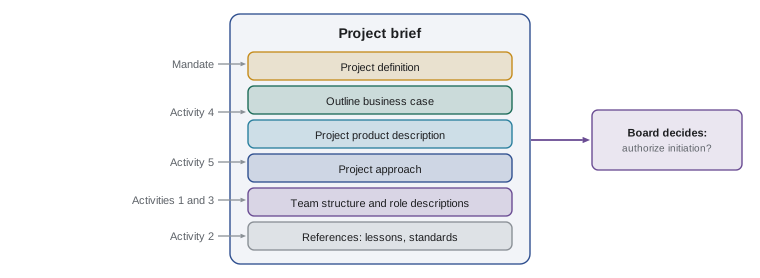
Project tolerances deserve a special mention. The business layer sets them, ideally in the mandate, and the project brief records them. If the mandate did not include them, the executive should obtain them from the business layer before the brief goes to the board, because the board cannot set stage tolerances for initiation and later stages without knowing the limits it is itself working within. Ridgeline Water's general manager sets project tolerances of +5 % on cost and +8 weeks on time, a benefits tolerance of −10 % on the annual net benefit, and requires scope changes affecting more than two districts to come back to the business layer.
Checking the project brief is complete
Before submitting the brief, the project manager and project assurance check that it contains what the board needs. The code below checks Ridgeline Water's draft against a list of required elements and against two quality rules: that the project tolerances come from the business layer, and that the project product description includes acceptance criteria.
required = ["background", "objectives", "scope", "exclusions", "constraints", "assumptions", "project tolerances",
            "interfaces", "outline business case", "project product description", "project approach", "team structure"]
brief = {
    "background": "Manual reading; estimated bills; leaks",
    "objectives": "Accurate bills; earlier leak detection",
    "scope": "All 20 districts, about 40,000 connections",
    "exclusions": "Commercial bulk meters; billing system upgrade itself",
    "constraints": "About 10 million capital; council approval",
    "assumptions": "",
    "project tolerances": {"cost": "+5 %", "time": "+8 weeks", "set_by": "general manager"},
    "interfaces": "Billing upgrade (IT); customer portal",
    "outline business case": "NPV about 2.3 million at 5 %",
    "project product description": {"acceptance_criteria": ["98 % daily reads", "under 1 in 1,000 bills corrected"]},
    "project approach": "Pilot then staged rollout; hybrid delivery",
}
missing = [k for k in required if not brief.get(k)]
print("Missing or empty:", ", ".join(missing) if missing else "none")
tol = brief["project tolerances"]
print("Tolerances set by business layer:", tol.get("set_by") in {"general manager", "council"})
print("Acceptance criteria present:", bool(brief["project product description"].get("acceptance_criteria")))Missing or empty: assumptions, team structure Tolerances set by business layer: True Acceptance criteria present: True
Two elements are missing: the assumptions are blank and the team structure has not been attached. Both matter. Unstated assumptions are invisible risks; for Ridgeline Water they include that the billing upgrade will be live before the pilot ends and that customers will accept leak alerts by text message. The team structure tells the board who it is and what each member is accountable for. The tolerances and acceptance criteria pass. The project manager completes the brief before moving to the last activity: planning the initiation stage.
Worked problem
Choosing an approach
A university wants a new student timetabling system. Starting up finds that two vendors offer mature products, that the registrar's previous in-house system took three years and was never finished, and that the system must be live for the start of term in September of next year, 14 months away. Suggest a project approach and the reasons to record in the project brief.
Show solution
- Build or buy: buy, because mature products exist and the lessons log records a failed in-house build.
- Release strategy: a pilot faculty in the spring term, then all faculties before September, so there is a fallback if the pilot reveals problems.
- Delivery method: configuration in short iterations with registrar staff, because timetabling rules are complex and best discovered by testing.
- Constraints: the September date is fixed; record it as a constraint with its reason, and plan time tolerance carefully.
- Record the approach and these reasons in the project brief so the board can challenge them before initiation.
Answer: Buy a product, pilot one faculty, configure iteratively with users, and treat September as a fixed constraint, with each reason recorded in the brief.
Common mistakes
MistakeWriting a detailed business case in starting up.
InsteadKeep it outline; the detailed business case is produced in initiation.
MistakeChoosing the approach because a supplier proposed it.
InsteadChoose it from the options, lessons, standards and customer needs, and record the reasons.
MistakeLeaving project tolerances out of the project brief.
InsteadObtain them from the business layer; the board needs them to set stage tolerances.
MistakeLeaving assumptions blank.
InsteadState assumptions explicitly; unstated assumptions are hidden risks.
MistakeLetting the supplier write the project product description.
InsteadThe senior user leads on expectations and acceptance criteria.
Summary and key terms
- The executive owns the outline business case; it shows the project is worth investigating.
- The project product description is produced alongside it, led by the senior user.
- A first appraisal is enough at this point if it shows value and identifies key uncertainties.
- The project approach describes how the solution will be delivered and managed, with reasons.
- The project brief assembles the project definition, outline business case, project product description, approach and team.
- Project tolerances come from the business layer and are recorded in the project brief.
- Assurance checks the brief is complete before it goes to the board.
- Project brief
- The product that assembles starting up's outputs to support the decision to initiate.
- Project approach
- How the work of the project will be delivered and managed.
- Project definition
- The part of the brief covering background, objectives, scope, constraints, tolerances and interfaces.
- Project tolerance
- The permissible deviation for the whole project, set by the business layer.
- Assumption
- Something taken as true for planning purposes that has not been confirmed.
- Net present value
- The sum of an option's cash flows, discounted to today's value.
- Discounted payback
- The point at which cumulative discounted cash flows become positive.
Practice problems
Work each problem on paper first, then reveal the answer to check.
Who is responsible for the outline business case?
Show answer
The executive.
Which product describing the final product is produced alongside the outline business case?
Show answer
The project product description.
Name three things the project approach should decide.
Show answer
Build or buy; release strategy; supplier model; delivery method; interfaces; standards.
What is the purpose of the project brief?
Show answer
To give the board a firm basis for deciding whether to initiate the project.
Who sets project tolerances?
Show answer
The business layer.
Ridgeline Water's NPV turns negative under which sensitivity?
Show answer
If the leak saving is only half what is forecast.
What were the two gaps in Ridgeline Water's draft brief?
Show answer
Blank assumptions and a missing team structure.
Name one assumption Ridgeline Water should record.
Show answer
That the billing upgrade is live before the pilot ends; or that customers accept text alerts.
Why choose the approach before planning initiation?
Show answer
It shapes the skills, stages, estimates and risks of initiation and beyond.
What happens to the project brief after the board authorizes initiation?
Show answer
It becomes an input to initiation and is developed into the PID.
Lesson quiz · 5 questions
Score 60% or more to complete this lesson.
Create a free account to save your progress, take quizzes and earn a certificate.